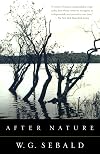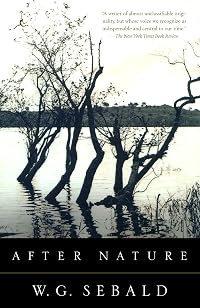
After Nature
by W. G. Sebald 
On This Page
Description
One of Sebald's earliest works, this haunting and shockingly original triptych of three biographical prose poems enlarges readers capacity to understand their place in the natural world.Tags
Recommendations













Member Reviews
Sebald's first book, published posthumously, is a short and beautiful three-part narrative about a German painter, an exploring who sailed with Bering, and a version of Sebald himself (very Sebald). The text is lineated like poetry but the prose reads like his later work. There is less density to After Nature than Sebald's later novels, but the text still provokes wonder through the arresting use of significant detail and distillation of language.
'Del natural', de W. G. Sebald, no es una novela propiamente dicha, sino que es un poema en prosa. En este librito (apenas 100 páginas), Sebald plasma su amor a la Naturaleza (con mayúsculas) utilizando el lenguaje y sus conocimientos como nadie.
Esta obra está dividida en tres partes: la primera dedicada al pintor Grünewald, prácticamente un desconocido, que retrataba sobre todo santos, crucifixiones, eclipses... En la segunda parte nos habla del botánico Steller, que acompañó a Behring en una expedición a Alaska, y en la que queda clara su gran cultura y capacidad de observación (es mi parte favorita). Y, por último, en la tercera parte nos habla del pasado, la otra gran obsesión de Sebald, de querer poner en conocimiento show more de los alemanes su pasado más oscuro, deliberadamente puesto en el olvido colectivo.
Es un libro insólito, extraño, ni de lejos lo mejor que ha escrito este gran autor alemán fallecido prematuramente en accidente de coche cuando estaba en su mejor momento de creatividad. Su último libro, 'Austerlitz', puede que sea el mejor libro de los últimos 25 años, así, sin más. show less
Esta obra está dividida en tres partes: la primera dedicada al pintor Grünewald, prácticamente un desconocido, que retrataba sobre todo santos, crucifixiones, eclipses... En la segunda parte nos habla del botánico Steller, que acompañó a Behring en una expedición a Alaska, y en la que queda clara su gran cultura y capacidad de observación (es mi parte favorita). Y, por último, en la tercera parte nos habla del pasado, la otra gran obsesión de Sebald, de querer poner en conocimiento show more de los alemanes su pasado más oscuro, deliberadamente puesto en el olvido colectivo.
Es un libro insólito, extraño, ni de lejos lo mejor que ha escrito este gran autor alemán fallecido prematuramente en accidente de coche cuando estaba en su mejor momento de creatividad. Su último libro, 'Austerlitz', puede que sea el mejor libro de los últimos 25 años, así, sin más. show less
If you enter the reading of this book as prose, and focus on not noticing the format, and just take in the words, it becomes obvious rather fast that this is a well-written piece of literature. I began by imagining all the words as verse collected instead into paragraphs, and by the last third it did not matter any longer that the text looked like poetry. I suppose this collection was called poetry because it was so lyrical and beautiful. Max Sebald, or another, shaping these words into "blank verse" also added to its claim of being poetry. Having the Poet Laureate of England write a blurb for the back of the dust jacket also acknowledges, and in some ways, confirms its claim of being poetry. But nonetheless and regardless, poetry it is show more or is not, but instead the beginnings of a too-short career in making historical artifacts that never cease to amaze. W.G. Sebald has a way of making any subject interesting just because he himself is so taken by it. He has a gift that engages even the most hateful and doubtful readers among us. And the more one reads and discovers of Sebald the better prepared to tackle these different types of formats as I had to learn the hard way. It is best not to stereotype in all of life but instead to look upon our journey as an unveiling. show less
The book consists of three long poems that are thematically related. The strongest is the first, an extended ekphrastic poem on a German artist named Matthew Grunewald. The third section takes up themes of wandering that are familiar from Sebald's novels. Though the poems have some striking images, you can tell that his real interests are in narrative and character. The novels of his that I have read are much stronger than this poetry collection.
This book is the english translation of the first literary work of Sebald, Nach der Natur. Ein Elementargedicht. It is an extended prose poem divided into three parts. The first is about the German Renaissance painter Matthias Grünewald, opening with his triptych on the alter of Lindenhardt parish church. The second part centers on the German naturalist Georg Wilhem Steller, a member of the Vitus Bering second Kamchatka expedition that landed in Alaska in the summer of 1741. The last part is centered on Sebald himself. The common theme that seems to run through the three parts of the book is that of human suffering, but also of the efforts of people in their quest for meaning, from which an order arises, in places beautiful and show more comforting, though more cruel, too, than the previous state of ignorance. A difficult book. Beautiful. show less
> Babelio : https://www.babelio.com/livres/Sebald-Dapres-nature--Poeme-elementaire/837777
> D'après nature révèlent l'originalité de cet auteur, et sans doute ne voit-on que rarement des débuts littéraires d'emblée si singuliers et si dignes d'intérêt...
—Danieljean (Babelio)
> D'après nature révèlent l'originalité de cet auteur, et sans doute ne voit-on que rarement des débuts littéraires d'emblée si singuliers et si dignes d'intérêt...
—Danieljean (Babelio)
Feb 20, 2021 (Edited)French
Ratings
Members
- Recently Added By
Published Reviews
ThingScore 100
After Nature, which came out in Germany in 1988 and now appears in an excellent translation by Michael Hamburger, is a work of considerable scope and ambition. Though its imagery is more challenging than anything in Sebald's prose works, the verse retains the Sebaldian virtues of rhetorical elegance and clarity, and sits well in English, as indeed does virtually every word he wrote.
added by jburlinson
Lists

German Literature
518 works; 56 members
Author Information

33+ Works 17,006 Members
He studied German language and literature in Freiburg, Switzerland and Manchester. He has taught at the University of East Anglia in Norwich, England since 1970. He became a professor of European literature in 1987. From 1989 to 1994 was the first director of the British Centre for Literary Translation. He was born in Wertach in Allgau, Germany in show more 1944. (Bowker Author Biography) show less
W. G. Sebald has a Legacy Library. Legacy libraries are the personal libraries of famous readers, entered by LibraryThing members from the Legacy Libraries group.
Some Editions
Awards and Honors
Distinctions
Series
Belongs to Publisher Series
Common Knowledge
- Canonical title
- After Nature
- Original title
- Nach der Natur: ein Elementargedicht.
- Original publication date
- 1988; 2002 (English) (English)
Classifications
Statistics
- Members
- 554
- Popularity
- 53,669
- Reviews
- 6
- Rating
- (3.86)
- Languages
- 12 — Danish, Dutch, English, Estonian, Finnish, French, German, Greek, Hungarian, Italian, Portuguese, Spanish
- Media
- Paper, Ebook
- ISBNs
- 25
- ASINs
- 2