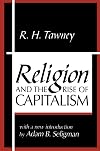
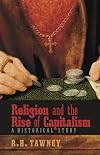
Religion and the Rise of Capitalism: A Historical Study
by R. H. Tawney
On This Page
Description
In one of the truly great classics of twentieth-century political economy, R. H. Tawney addresses the question of how religion has affected social and economic practices. He does this by a relentless tracking of the influence of religious thought on capitalist economy and ideology since the Middle Ages. In so doing he sheds light on why Christianity continues to exert a unique role in the marketplace. In so doing, the book offers an incisive analysis of the historical background of present show more morals and mores in Western culture.Religion and the Rise of Capitalism is even more pertinent now than when it first was published; for today it is clearer that the dividing line between spheres of religion and secular business is shifting, that economic interests and ethical considerations are no longer safely locked in separate compartments. By examining that period which saw the transition from medieval to modern theories of social organization, Tawney clarifies the most pressing problems of the end of the century. In tough, muscular, richly varied prose, he tells an absorbing and meaningful story. And in his new introduction, which may well be a classic in its own right, Adam Seligman details Tawney's entire background, the current status of social science thought on these large issues, and a comparative analysis of Tawney with Max Weber that will at once delight and inform readers of all kinds. show lessTags
Recommendations






























Member Reviews
Tawney, an economic historian, examines the influence of faith on the current (in his case the 1920s revised in the 1930s) economic world. Specifically, he focuses on the rise of individualistic capitalism.
He describes the transition from the era when usury was sin, and making money from money was contrary to the tenets of faith; to an era when Puritan development separated church and economy completely. Hard work and self-reliance became virtues while sloth and dependence became vices.
The book is beautifully written with exquisite prose that enlivens the history as it's presented. I am also happy to say it is a book that sent me to the dictionary on many occasion
He describes the transition from the era when usury was sin, and making money from money was contrary to the tenets of faith; to an era when Puritan development separated church and economy completely. Hard work and self-reliance became virtues while sloth and dependence became vices.
The book is beautifully written with exquisite prose that enlivens the history as it's presented. I am also happy to say it is a book that sent me to the dictionary on many occasion
Skipped around. Surprised by his descriptions of (1) the impact on vast wealth on Spain and (2) the power of the Low Countries through their international markets.
(1) influx of so much money into the country led to their decline. Prices increased beyond control. Before the era when currency was common and economic/spending policy tracked, so they never really understood where the country stood economically. Also, one failed shipment could lead to enormous economic shocks. - Need to compare to the Wallerstein.
(1) influx of so much money into the country led to their decline. Prices increased beyond control. Before the era when currency was common and economic/spending policy tracked, so they never really understood where the country stood economically. Also, one failed shipment could lead to enormous economic shocks. - Need to compare to the Wallerstein.
paperback
A classic of political economy that traces the influence of religious thought on capitalism
In one of the true classics of twentieth-century political economy, R. H. Tawney addresses the question of how religion has affected social and economic practices. He tracks the influence of religious thought on capitalist economy and ideology since the Middle Ages, shedding light on the question of why Christianity continues to exert a unique role in the marketplace. In so doing, the book offers an incisive analysis of the morals and mores of contemporary Western culture.
Religion and the Rise of Capitalism is more pertinent now than ever, as today the dividing line between the spheres of religion and secular business is shifting, blending ethical show more considerations with the motivations of the marketplace.
By examining the period that saw the transition from medieval to modern theories of social organization, Tawney clarifies the most pressing problems of the end of the century. In tough, muscular, richly varied prose, he tells an absorbing and meaningful story. And in his new introduction, which may well be a classic in its own right, Adam Seligman details Tawney's background and the current status of academic thought on these issues, and he provides a comparative analysis of Tawney with Max Weber that will at once delight and inform readers. show less
In one of the true classics of twentieth-century political economy, R. H. Tawney addresses the question of how religion has affected social and economic practices. He tracks the influence of religious thought on capitalist economy and ideology since the Middle Ages, shedding light on the question of why Christianity continues to exert a unique role in the marketplace. In so doing, the book offers an incisive analysis of the morals and mores of contemporary Western culture.
Religion and the Rise of Capitalism is more pertinent now than ever, as today the dividing line between the spheres of religion and secular business is shifting, blending ethical show more considerations with the motivations of the marketplace.
By examining the period that saw the transition from medieval to modern theories of social organization, Tawney clarifies the most pressing problems of the end of the century. In tough, muscular, richly varied prose, he tells an absorbing and meaningful story. And in his new introduction, which may well be a classic in its own right, Adam Seligman details Tawney's background and the current status of academic thought on these issues, and he provides a comparative analysis of Tawney with Max Weber that will at once delight and inform readers. show less
Mar 3, 2019Dutch
Ratings
Members
- Recently Added By
Lists

Modern Library 100 Best Nonfiction Books
100 works; 8 members

In Our Time books
4,934 works; 2 members
Author Information

29+ Works 1,405 Members
R. H. Tawney (1880-1962) was an English economic historian, social critic, ethical socialist, Christian socialist and an important proponent of adult education.
Some Editions
Awards and Honors
Notable Lists
Series
Belongs to Publisher Series
SC/10 [Feltrinelli] (15)
Mentor Books (MD163)
Pelican Books (A23)
Common Knowledge
- Canonical title
- Religion and the Rise of Capitalism: A Historical Study
- Original publication date
- 1926
- Epigraph
- Whatever the world thinks, he who has not meditated upon God, the human mind, and the summum bonum, may possibly make a thriving earthworm, but will most indubitably make a sorry patriot and a sorry statesman. ... (show all) Bishop Berkeley, Siris, 350
- Dedication
- To Doctor Charles Gore with affection and gratitude
- Original language
- English
Classifications
- Genres
- Economics, Nonfiction, Religion & Spirituality, History, General Nonfiction
- DDC/MDS
- 330.122 — Society, government, & culture Economics Jobs & Careers Theory Systems Capitalism
- LCC
- BR115 .E3 .T3 — Philosophy, Psychology and Religion Christianity Christianity Christianity in relation to special subjects
- BISAC
Statistics
- Members
- 876
- Popularity
- 31,065
- Reviews
- 4
- Rating
- (3.68)
- Languages
- Dutch, English, French, Italian
- Media
- Paper, Ebook
- ISBNs
- 26
- ASINs
- 46