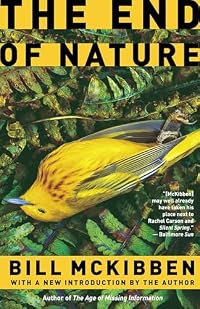
The End of Nature
by Bill McKibben
On This Page
Description
Reissued on the tenth anniversary of its publication, this classic work on our environmental crisis features a new introduction by the author, reviewing both the progress and ground lost in the fight to save the earth. This impassioned plea for radical and life-renewing change is today still considered a groundbreaking work in environmental studies. McKibben's argument that the survival of the globe is dependent on a fundamental, philosophical shift in the way we relate to nature is more show more relevant than ever. McKibben writes of our earth's environmental cataclysm, addressing such core issues as the greenhouse effect, acid rain, and the depletion of the ozone layer. His new introduction addresses some of the latest environmental issues that have risen during the 1990s. The book also includes an invaluable new appendix of facts and figures that surveys the progress of the environmental movement. More than simply a handbook for survival or a doomsday catalog of scientific prediction, this classic, soulful lament on Nature is required reading for nature enthusiasts, activists, and concerned citizens alike. show lessTags
Recommendations





Member Reviews
We have by now pumped out so much toxic gases into the atmosphere that a significant increase in temperature and its effect upon 'Nature' is inevitable.
And?
Published in 1990, this book is interesting for more than a reason. First, written at a time when climate change and its expected dramatic consequences were not as mediatised as now, you have to salute the author for its foresight: he here predicts all the toxic effects to come of our industrial societies; effects that we can clearly see all around (unpredictable and dangerous weather, natural catastrophes not only multiplying themselves but being more and more intense, increase in some medical conditions -allergies, asthmas, cancers...). Then, and most importantly, because he show more advances here an original and striking theory: we have in fact affected our environment in such a dramatic way, that the concept of 'nature' itself as we knew it will be on its way out.
Indeed, if our ancestor defined nature as 'savage', 'wild', 'virgin', in a word free from the interferences of human civilisation, for younger generations and the ones that will follow such concepts will be meaningless and anything but true. Echoing Rachel Carson who had made the point before him, he is here stating the now well-acknowledged fact that even in the most remote corners of the globe the impact of human activities can be deeply felt - you don't need to have human beings actually living in those parts for their ecosystems to be out of balance. So much, then, for 'wild' and 'virgin'!
Now, being of a different generation, he, of course, regrets such redefining and loss. Well... I personally confess, though, to have found him here uselessly dabbling with rampant sentimentalism (maybe readers of my generation or being younger will have the same attitude as mine?). Who cares indeed for a Walden-type of life? I don't.
I don't, yet it doesn't mean his argument is irrelevant to me. In fact, as always when concepts are being redefined, the consequences can be massive, and in that case they talk to us all.
'Nature' is indeed more than a word, and as a metamorphosing idea it brings to the fore a few questions we will all have to face. Natural 'cycles' becoming more and more meaningless, then how are we are going to cope? What will be the impact of a weather now being so deregulated that it has turned unreliable; for example on agriculture? The author strikes here another chord: like it or not, most of the solutions will be brought about by science and technologies... and it thus close his point very nicely by nailing it even further! Our reliance on science and technologies will indeed makes what is perceived as 'natural' even more obsolete too (don't we see this increasingly happening with our food?).
Here's a fascinating read. Yes, I was a tat annoyed by his over-sentimentalism and nostalgic outlook towards a past now way gone. He certainly is right about climate change and the fact that nature has been affected beyond repair, but then it's time to get on with it! Being sorrowful should no longer be on the agendas. Yet, and this is what makes it such a necessary read, this is not a condemnation or an indictment. Here's just a statement of fact: as a result of climate change, the concept of 'nature' itself is changing, and such a change has consequences on how we should deal with our environment. You could be excused to have questioned him thirty years ago; but, now, such rethinking has become quite urgent and necessary.
Here's an interesting and insightful argument. show less
And?
Published in 1990, this book is interesting for more than a reason. First, written at a time when climate change and its expected dramatic consequences were not as mediatised as now, you have to salute the author for its foresight: he here predicts all the toxic effects to come of our industrial societies; effects that we can clearly see all around (unpredictable and dangerous weather, natural catastrophes not only multiplying themselves but being more and more intense, increase in some medical conditions -allergies, asthmas, cancers...). Then, and most importantly, because he show more advances here an original and striking theory: we have in fact affected our environment in such a dramatic way, that the concept of 'nature' itself as we knew it will be on its way out.
Indeed, if our ancestor defined nature as 'savage', 'wild', 'virgin', in a word free from the interferences of human civilisation, for younger generations and the ones that will follow such concepts will be meaningless and anything but true. Echoing Rachel Carson who had made the point before him, he is here stating the now well-acknowledged fact that even in the most remote corners of the globe the impact of human activities can be deeply felt - you don't need to have human beings actually living in those parts for their ecosystems to be out of balance. So much, then, for 'wild' and 'virgin'!
Now, being of a different generation, he, of course, regrets such redefining and loss. Well... I personally confess, though, to have found him here uselessly dabbling with rampant sentimentalism (maybe readers of my generation or being younger will have the same attitude as mine?). Who cares indeed for a Walden-type of life? I don't.
I don't, yet it doesn't mean his argument is irrelevant to me. In fact, as always when concepts are being redefined, the consequences can be massive, and in that case they talk to us all.
'Nature' is indeed more than a word, and as a metamorphosing idea it brings to the fore a few questions we will all have to face. Natural 'cycles' becoming more and more meaningless, then how are we are going to cope? What will be the impact of a weather now being so deregulated that it has turned unreliable; for example on agriculture? The author strikes here another chord: like it or not, most of the solutions will be brought about by science and technologies... and it thus close his point very nicely by nailing it even further! Our reliance on science and technologies will indeed makes what is perceived as 'natural' even more obsolete too (don't we see this increasingly happening with our food?).
Here's a fascinating read. Yes, I was a tat annoyed by his over-sentimentalism and nostalgic outlook towards a past now way gone. He certainly is right about climate change and the fact that nature has been affected beyond repair, but then it's time to get on with it! Being sorrowful should no longer be on the agendas. Yet, and this is what makes it such a necessary read, this is not a condemnation or an indictment. Here's just a statement of fact: as a result of climate change, the concept of 'nature' itself is changing, and such a change has consequences on how we should deal with our environment. You could be excused to have questioned him thirty years ago; but, now, such rethinking has become quite urgent and necessary.
Here's an interesting and insightful argument. show less
Whatever we once thought Nature was – wildness; God; a simple place free from human thumbprints, or intricate machinery sustaining life on earth – we have now given it a kick that will change it forever. Humanity has stepped across the threshold. In his free ranging and provocative book, Bill McKibben explores the philosophies and technologies that have brought us here, and he shows how final a crossing we may have made.
Bill McKibben wrote this book 25 years ago. He gives us a thorough overview of the causes and effects of global warming and considers the way humanity, politics and individuals deal with these new realities. In the first part of the book he lays out the effects of global warming and the most probable outcome in terms of temperature rise, general weather phenomena and sea level rise. Surprisingly this section does not feel dated and it seems the reaction of the global community is much the same today as it was then.
The second section was my favorite part of the book. As he writes about the End of Nature, he does not only contemplate the loss of a natural environment to sustain us but beyond that he considers the loss of nature as a show more defining element to what it means to be human. An environment untouched by humans, which allows us a glimpse at the divine, something beyond our influence. With the recognition of global warming as an effect driven by human civilization, we have finally managed to affect and change even the remotest places on earth and thus robbed ourselves of any truly wild place fully beyond the influence of humans, making us poorer for the barely acknowledged loss. He compares this loss to the disappearance of the Frontier as a defining element of the American identity.
In the last part of the book he goes on to ponder different ways we can react as individuals and society as a whole. Though he firmly believes that the path we're on is leading us down the wrong path, he has little hope that as individuals or communities we will be able to make the radical changes of lifestyle needed to avoid the worst of the effects.
Though it's not a very hopeful book, it does contain a lot of food for thought. show less
The second section was my favorite part of the book. As he writes about the End of Nature, he does not only contemplate the loss of a natural environment to sustain us but beyond that he considers the loss of nature as a show more defining element to what it means to be human. An environment untouched by humans, which allows us a glimpse at the divine, something beyond our influence. With the recognition of global warming as an effect driven by human civilization, we have finally managed to affect and change even the remotest places on earth and thus robbed ourselves of any truly wild place fully beyond the influence of humans, making us poorer for the barely acknowledged loss. He compares this loss to the disappearance of the Frontier as a defining element of the American identity.
In the last part of the book he goes on to ponder different ways we can react as individuals and society as a whole. Though he firmly believes that the path we're on is leading us down the wrong path, he has little hope that as individuals or communities we will be able to make the radical changes of lifestyle needed to avoid the worst of the effects.
Though it's not a very hopeful book, it does contain a lot of food for thought. show less
Bill McKibben is a well-known author and environmentalist.
The End of Nature by Bill McKibben was written in 1989 and a new forward was added on the tenth anniversary in 1999. This book provided one of the first well-researched "wake-up calls" related to global warming. I originally read the book nearly twenty years ago and decided to re-read it before jumping into his new book, Eaarth.
Other than references to current events that now seem dated, the book has stood up remarkably well over twenty years. I had to laugh at references to Al Gore being one of very few people speaking out on the topic. It took another decade before people started listening to Gore's message. Even the author's warnings about the threats of genetic engineering show more have come true through the agricultural exploits of companies like Monsanto.
I was particularly drawn to McKibben's section on religion and nature that explored the reasons that mainstream and fundamentalist religious groups aren't supportive of the environmental movement. His thoughts on man's impact on the natural world and the "end of nature" are on target even in my remote area of southern Utah.
As a fan of Thoreau, Muir, and the many other nature writers throughout history, I has happy to see how he wove these writings through the book along with the work of contemporary authors and scientists. I understand why The End of Nature continues to be quoted after twenty years and has become a classic of the environmental movement.
I look forward to reading his newest book, Eaarth. show less
The End of Nature by Bill McKibben was written in 1989 and a new forward was added on the tenth anniversary in 1999. This book provided one of the first well-researched "wake-up calls" related to global warming. I originally read the book nearly twenty years ago and decided to re-read it before jumping into his new book, Eaarth.
Other than references to current events that now seem dated, the book has stood up remarkably well over twenty years. I had to laugh at references to Al Gore being one of very few people speaking out on the topic. It took another decade before people started listening to Gore's message. Even the author's warnings about the threats of genetic engineering show more have come true through the agricultural exploits of companies like Monsanto.
I was particularly drawn to McKibben's section on religion and nature that explored the reasons that mainstream and fundamentalist religious groups aren't supportive of the environmental movement. His thoughts on man's impact on the natural world and the "end of nature" are on target even in my remote area of southern Utah.
As a fan of Thoreau, Muir, and the many other nature writers throughout history, I has happy to see how he wove these writings through the book along with the work of contemporary authors and scientists. I understand why The End of Nature continues to be quoted after twenty years and has become a classic of the environmental movement.
I look forward to reading his newest book, Eaarth. show less
Even though the climate science that McKibben reports on is over twenty years old, it is still depressingly, and ever more certainly, correct. However, the science has grown more and more accurate as time goes on, so The End of Nature should not be read merely for its scientific reporting.
There's a much better reason to read it, though. McKibben's main argument, that we've become so numerous and powerful so as to (clumsily) wrest control over nature, is fascinating. He explores its philosophical, theological, and social dimensions, and his analysis is insightful and wise.
There's a much better reason to read it, though. McKibben's main argument, that we've become so numerous and powerful so as to (clumsily) wrest control over nature, is fascinating. He explores its philosophical, theological, and social dimensions, and his analysis is insightful and wise.
I was supposed to see McKibben speak, so figured I should delve into his books, having only read his essays in the past. That was maybe a mistake. First, work responsibilities popped up meaning I won't get to go to the presentation. Second, End of Nature is as bleak as the title sounds. I don't think there's anything in it about the environmental crisis that I didn't know prior to picking up this book, but there's two key differences. First, a slew of the problems I already knew about were presented in one book, whereas I learned about them piecemeal through different deep science/environmental works before. Second, McKibben wrote about these problems 32 years ago! That's 32 years that we've done little to address the problems and show more plenty to make them worse. The book overall though, doesn't offer solutions and to be fair, being honest, I agree that there's not any practical solutions. People just don't see the danger and don't care to see. But a lot of the book was personal musings, peppered with science but not as deep a science as I've been used to in other environmental books. It's a dark, dark book and unfortunately, it's honest. show less
McKibben lays out the causes of climate change and explores the possibilities of what it means for the future, and the present.
He doesn't offer many answers, as he recognizes that it's impossible to know exactly what will happen. He does, however, make the case that it's already too late, we've already changed the atmosphere and everywhere on Earth is now touched by humankind.
This is what he means by "end of Nature," our idea of Nature as that which is unspoiled by humanity is forever gone. We've changed the atmosphere and thus there is nowhere left on this planet that is unspoiled.
While he occasionally falls into the nostalgic view of Nature common to many nature writers, his argument is compelling and well-written.
He doesn't offer many answers, as he recognizes that it's impossible to know exactly what will happen. He does, however, make the case that it's already too late, we've already changed the atmosphere and everywhere on Earth is now touched by humankind.
This is what he means by "end of Nature," our idea of Nature as that which is unspoiled by humanity is forever gone. We've changed the atmosphere and thus there is nowhere left on this planet that is unspoiled.
While he occasionally falls into the nostalgic view of Nature common to many nature writers, his argument is compelling and well-written.
Members
- Recently Added By
Lists

Recommended Nature Writing
346 works; 180 members

Penguin Random House
458 works; 4 members

Reading LIst
648 works; 1 member
Author Information

49+ Works 6,639 Members
Bill McKibben grew up in Lexington, Massachusetts. He was president of the Harvard Crimson newspaper in college. Immediately after college he joined the New Yorker magazine as a staff writer, and wrote much of the "Talk of the Town" column from 1982 to early 1987. After quitting this job, he soon moved to the Adirondack Mountains of upstate New show more York. His first book, The End of Nature, was published in 1989 by Random House after being serialized in the New Yorker. It is regarded as the first book for a general audience about climate change, and has been printed in more than 20 languages. Several editions have come out in the United States, including an updated version published in 2006. His next book, The Age of Missing Information, was published in 1992. It is an account of an experiment: McKibben collected everything that came across the 100 channels of cable tv on the Fairfax, Virginia system (at the time among the nation's largest) for a single day. He spent a year watching the 2,400 hours of videotape, and then compared it to a day spent on the mountaintop near his home. This book has been widely used in colleges and high schools, and was reissued in 2006. McKibben's latest book is entitled, Eaarth: Making a Life on a Tough New Planet. Bill currently resides with his wife, writer Sue Halpern, and his daughter, Sophie in Ripton, Vermont. He is a scholar in residence at Middlebury College. 030 (Bowker Author Biography) show less
Some Editions
Awards and Honors
Awards
Distinctions
Work Relationships
Common Knowledge
- Original publication date
- 1989
Classifications
- Genres
- Science & Nature, Nonfiction, General Nonfiction
- DDC/MDS
- 304.28 — Society, Government, and Culture Social sciences, sociology & anthropology Factors affecting social behavior Human ecology
- LCC
- GF75 .M38 — Geography, Anthropology and Recreation Human ecology. Anthropogeography Human ecology. Anthropogeography Human influences on the environment
- BISAC
Statistics
- Members
- 1,007
- Popularity
- 25,719
- Reviews
- 15
- Rating
- (3.64)
- Languages
- 10 — Dutch, English, French, German, Italian, Japanese, Norwegian (Bokmål), Norwegian, Spanish, Swedish
- Media
- Paper, Audiobook, Ebook
- ISBNs
- 24
- ASINs
- 5