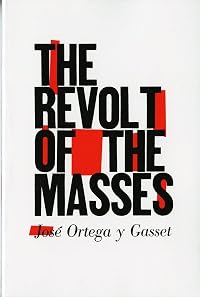
The Revolt of the Masses
by José Ortega y Gasset
On This Page
Description
Social upheaval in early 20th-century Europe is the historical setting for this seminal study by the Spanish philosopher, Jose Ortega y Gasset. Continuously in print since 1932, Ortega's vision of Western culture as sinking to its lowest common denominator and drifting toward chaos brought its author international fame and has remained one of the influential books of the 20th century.Tags
Recommendations


















Member Recommendations

Member Reviews
I recently read Jonathan Haidt's The Righteous Mind. Ortega y Gasset's book is delightful on its own, but the contrast with Haidt's book really brings out its excellence. Of course Ortega y Gasset is as profound as Haidt is shallow, but it goes much further. A cornerstone of Ortega y Gasset's book is the notion of civilization, in contrast with natural man. Civilized man conceives the project of living with strangers in order to pursue some greater mission. Haidt's book is essential an apology for natural man. Haidt views civilization as a fraud. Here, Ortega y Gasset is an eloquent champion of civilization.
Along the way there are just wonderful insights. An authentic person will face the chaos and uncertainty of life, while an show more unauthentic person will paper over all that with platitudes.
Here around 1930, Ortega y Gasset is proposing the European Union as the proper next step in the European project. The struggles between the European nations were part of the process of negotiation, accommodation, etc. It's looking like nowadays the big conflict brewing might be the USA versus China. Certainly since 1930, China has continued to wrestle with Western ways, adopting and integrating and transforming. Are Europe and the USA incorporating Chinese values and practices? I don't have the perspective to be able to see any answer. Hmmm, how much is the current Trump mania a produce of the red scare of the 1950s, driven by Madame Chiang Kai-shek. Well then too, look at the influence of the newspaper The Epoch Times, controlled by the Falun Gong cult out of China.
Anyway, Revolt of the Masses is a jewel! show less
Along the way there are just wonderful insights. An authentic person will face the chaos and uncertainty of life, while an show more unauthentic person will paper over all that with platitudes.
Here around 1930, Ortega y Gasset is proposing the European Union as the proper next step in the European project. The struggles between the European nations were part of the process of negotiation, accommodation, etc. It's looking like nowadays the big conflict brewing might be the USA versus China. Certainly since 1930, China has continued to wrestle with Western ways, adopting and integrating and transforming. Are Europe and the USA incorporating Chinese values and practices? I don't have the perspective to be able to see any answer. Hmmm, how much is the current Trump mania a produce of the red scare of the 1950s, driven by Madame Chiang Kai-shek. Well then too, look at the influence of the newspaper The Epoch Times, controlled by the Falun Gong cult out of China.
Anyway, Revolt of the Masses is a jewel! show less
L’uomo nuovo descritto nel 1930 da Ortega Y Gasset da ha la presunzione di sentirsi “come tutto il mondo”, senza darsene pensiero. La mancanza di responsabilità è la sua natura; la barbarie la condotta tramite cui attua la “ribellione” che dà titolo il libro:
«Interverrà dovunque, imponendo la sua volgare opinione, senza miraggi, senza contemplazioni, senza tramiti né riserve, vale a dire, secondo un regime di “azione diretta”».
L’uomo-massa è un “saggio ignorante”, forte delle sue conoscenze parcellizzate ma del tutto all’oscuro dei saperi che la sua specializzazione non esplora, verso i quali si pone tuttavia con la petulanza di chi sa di sapere.
«Interverrà dovunque, imponendo la sua volgare opinione, senza miraggi, senza contemplazioni, senza tramiti né riserve, vale a dire, secondo un regime di “azione diretta”».
L’uomo-massa è un “saggio ignorante”, forte delle sue conoscenze parcellizzate ma del tutto all’oscuro dei saperi che la sua specializzazione non esplora, verso i quali si pone tuttavia con la petulanza di chi sa di sapere.
In my reading of The Revolt of the Masses I would emphasize Ortega y Gasset's discussion of the new world (circa 1930) as one of "practically limitless possibilities".(p 61) This is a view that he contrasts with the past where the masses felt themselves limited, and rightly so. If anything, eighty years after the first publication of this book there are even larger groups of people that have the possibility of fewer limits on the progress of their lives. However he does not see any guarantee that progress will be the result and later in his book he discusses the danger of the modern state as a limiting factor. Even in western democracies we have seen the power of the state grow over the past eighty years since Ortega y Gasset's show more observations. I wonder if the nobility within mankind will be able to continue to move forward and not be limited by the masses of average men. show less
Surprisingly, and causing disappointment among ideologues of political parties, OyG does not spend much time analyzing "liberal" and "conservative" conflicts, but perceives a rising lay and expert divide. In fact, this 1929 work flatly states that the masses hate experts.
OyG predicts what we see now in the world -- opera companies going bankrupt but pop stars who cannot compose (can you even say Bieber with a straight face) making millions (Beiber made $80 million in 2013). Consumers look at Yelp reviews rather than journalist specialists or experts. Popular Science turned off "comments" because they added so little to the science.
This short book contains many speculations and there is repetition of the points he is making -- perhaps to show more make certain of the "historicity" he teaches. But I find that OyG addresses issues that still resonate today. For example, the rise of consumerism; the possibility for barbarism to flourish among the wealthy or in tandem with technology; specialization which favors science over the humanities; “the loss of prestige of legislative assemblies.” Disrespect for academic achievement.
OyG looks at and describes dysfunctional society, not from Left and Right, or even rich and poor, but from the perspective of the uninformed social "mass" and the informed scientific elite. A kind of ‘up’ versus ‘down’, individual reasoning vs herd instinct. show less
OyG predicts what we see now in the world -- opera companies going bankrupt but pop stars who cannot compose (can you even say Bieber with a straight face) making millions (Beiber made $80 million in 2013). Consumers look at Yelp reviews rather than journalist specialists or experts. Popular Science turned off "comments" because they added so little to the science.
This short book contains many speculations and there is repetition of the points he is making -- perhaps to show more make certain of the "historicity" he teaches. But I find that OyG addresses issues that still resonate today. For example, the rise of consumerism; the possibility for barbarism to flourish among the wealthy or in tandem with technology; specialization which favors science over the humanities; “the loss of prestige of legislative assemblies.” Disrespect for academic achievement.
OyG looks at and describes dysfunctional society, not from Left and Right, or even rich and poor, but from the perspective of the uninformed social "mass" and the informed scientific elite. A kind of ‘up’ versus ‘down’, individual reasoning vs herd instinct. show less
I first heard about and read Ortega in a college Existentialism class and I quickly found out that while he didn't possess the household name power of Kierkegaard or Sartre, he did some quality work, is highly respected among philosophical circles leaning in that position, and for some reason has never really gotten the recognition some of his peers did. Nonetheless, I think this is one of his best works and encourage you to pick this up if such an area interests you...
La obra más difundida y famosa de Ortega y Gasset.
José Ortega y Gasset (Madrid, 1883-1955), doctor en Filosofía y Letras, amplió estudios en las Universidades de Leipzig, Berlín y Marburgo, consiguiendo a los veintisiete años la cátedra de Metafísica de la Universidad Central. En 1923 fundaRevista de Occidente, una de las publicaciones culturales de mayor prestigio internacional. LA REBELIÓN DE LAS MASAS, publicado por primera vez en 1930, es la obra más difundida y famosa de Ortega. Como nos explica Julián Marías en su Introducción, el libro va pareciendo más verdadero, más fiel a la realidad a medida que pasa el tiempo. La razón de su renovada actualidad confirma el carácter filosófico de esa obra frente el show more significado político que con frecuencia se le ha atribuido erróneamente. «Pienso que toda vida–dice Ortega- ... se compone de puros instantes, cada uno de los cuales está relativamente indeterminado respecto al anterior, de suerte que en él la realidad vacila..., y no sabe bien si decidirse por una u otra entre varias posibilidades. Este titubeo metafísico proporciona a todo lo vital esa inconfundible cualidad de vibración y estremecimiento». show less
José Ortega y Gasset (Madrid, 1883-1955), doctor en Filosofía y Letras, amplió estudios en las Universidades de Leipzig, Berlín y Marburgo, consiguiendo a los veintisiete años la cátedra de Metafísica de la Universidad Central. En 1923 fundaRevista de Occidente, una de las publicaciones culturales de mayor prestigio internacional. LA REBELIÓN DE LAS MASAS, publicado por primera vez en 1930, es la obra más difundida y famosa de Ortega. Como nos explica Julián Marías en su Introducción, el libro va pareciendo más verdadero, más fiel a la realidad a medida que pasa el tiempo. La razón de su renovada actualidad confirma el carácter filosófico de esa obra frente el show more significado político que con frecuencia se le ha atribuido erróneamente. «Pienso que toda vida–dice Ortega- ... se compone de puros instantes, cada uno de los cuales está relativamente indeterminado respecto al anterior, de suerte que en él la realidad vacila..., y no sabe bien si decidirse por una u otra entre varias posibilidades. Este titubeo metafísico proporciona a todo lo vital esa inconfundible cualidad de vibración y estremecimiento». show less
"As regards to dictatorships, we have seen only too well how they flatter the mass-man, by trampling on everything that appeared to be above the common level."
Although penned in the early XXth century, very appropriate to those with an open mind on what is happening politically today.
Although penned in the early XXth century, very appropriate to those with an open mind on what is happening politically today.
Members
- Recently Added By
Lists

BEST BOOKS TO UNDERSTAND XX CENTURY'S HISTORY
63 works; 3 members

ORCID Book list
27 works; 1 member

Entender el mundo
46 works; 1 member

Filosofía - Clásicos
217 works; 1 member

Trinity College Booklist (1951): Class Nine, Foreign Literatures
161 works; 3 members

Books Referenced by Izetbegovic's Islam Between East and West
233 works; 2 members

Book wishlist
78 works; 1 member

Philip Ward's Lifetime Reading Plan
592 works; 22 members

España en cien libros
100 works; 1 member

Writers In Public Domain 2026
90 works; 1 member
Author Information

Essayist and philosopher, a thinker influential in and out of the Spanish world, Jose Ortega y Gasset was professor of metaphysics at the University of Madrid from 1910 until the outbreak of the Spanish Civil War in 1936. The Revolt of the Masses, his most famous work, owes much to post-Kantian schools of thought. Ortega's predominant thesis is show more the need of an intellectual aristocracy governing in a spirit of enlightened liberalism. Although Franco, after his victory in the civil war, offered to make Ortega Spain's "official philosopher" and to publish a deluxe edition of his works, with certain parts deleted, the philosopher refused. Instead, he chose the life of a voluntary exile in Argentina, and in 1941 he was appointed professor of philosophy at the University of San Marcos in Lima, Peru. He returned to Spain in 1945 and died in Madrid. Ortega's reformulation of the Cartesian cogito displays the fulcrum of his thought. While Rene Descartes declared "Cogito ergo sum" (I think, therefore I am), Ortega maintained "Cogito quia vivo" (I think because I live). He subordinated reason to life, to vitality. Reason becomes the tool of people existing biologically in a given time and place, rather than an overarching sovereign. Ortega's philosophy consequently discloses affinities in its metaphysics to both American pragmatism and European existentialism in spite of its elitism in social philosophy. (Bowker Author Biography) show less
Some Editions
Awards and Honors
Notable Lists
Series
Belongs to Publisher Series
Work Relationships
Common Knowledge
- Canonical title
- The Revolt of the Masses
- Original title
- La rebelión de las masas
- Alternate titles*
- De opstand der horden
- Original publication date
- 1930; 1932 (English) (English)
- First words
- Prefatory Note
In my book Espana Invertebrada, published 1922, in an article in El Sol entitled "Masas" (1926), and in two lectures given to the Association of Friends of Art in Buenos Aires (1928), I have treated the ... (show all)subject developed in the present essay.
1. The Coming of the Masses
There is one fact which, whether for good or ill, is of utmost importance in the public life of Europe at the present moment. - Last words
- (Click to show. Warning: May contain spoilers.)Perhaps, before long, it may be cried aloud.
- Original language
- Spanish
*Some information comes from Common Knowledge in other languages. Click "Edit" for more information.
Classifications
Statistics
- Members
- 2,147
- Popularity
- 9,507
- Reviews
- 31
- Rating
- (3.94)
- Languages
- 14 — Czech, Dutch, English, Estonian, French, German, Hungarian, Italian, Japanese, Polish, Russian, Spanish, Turkish, Portuguese (Portugal)
- Media
- Paper, Audiobook, Ebook
- ISBNs
- 94
- ASINs
- 58