
Julián Marías (1914–2005)
Author of History of Philosophy
About the Author
Series
Works by Julián Marías
Ensayos de teoria 6 copies
Análisis de los Estados Unidos 6 copies
La devolucion de Espana: Segunda parte de la Espana real (Coleccion boreal ; 7) (Spanish Edition) (1977) 5 copies
Introducción a la filosofía ; Idea de la metafísica ; Biografía de la filosofía (Obras de Julián Marías) (1982) 4 copies
El Oficio del Pensamiento 4 copies
Espana en nuestras manos: (tercera parte de La Espana real) (Coleccion boreal ; 12) (Spanish Edition) (1978) 3 copies
Cinco años de España: (conclusión de La España real) (Colección Boreal) (Spanish Edition) (1981) 3 copies
La Filosofia del Padre Graty. La restauracion de la metafisica en el problema de Dios y de la Persona (1972) 3 copies
Sobre el cristianismo. 2 copies
Idea de la metafísica 1 copy
La Filosofía en sus textos 1 copy
Antropologia metafísica 1 copy
Los españoles 1 copy
NUEVOS ENSAYOS DE FILOSOFIA 1 copy
Miguel de Unamuno. 1 copy
Aquí y ahora. 1 copy
TRATADO DE LO MEJOR 1 copy
PERSONA 1 copy
LA LIBERTAD EN JUEGO 1 copy
No perder la cabeza 1 copy
Una vida presente I y II 1 copy
Estados Unidos en escorzo 1 copy
Ataraxía y alcionismo 1 copy
The History of Philosophy 1 copy
Los españoles 1 1 copy
La novela picaresca española 1 copy
Innovacion y Arcaismo 1 copy
Nuevos ensayos de Filosofía. 1 copy
LA ESCOLASTICA 1 copy
Los españoles 2 1 copy
El uso lingüístico 1 copy
Israel, una resurrección 1 copy
Los espanõles 1 copy
LA FILOSOFÍA ESPAÑOLA ACTUAL 1 copy
Associated Works
Tagged
Common Knowledge
- Canonical name
- Marías, Julián
- Legal name
- Aguilera, Julián Marías
- Birthdate
- 1914-06-17
- Date of death
- 2005-12-15
- Gender
- male
- Education
- Complutense University of Madrid
- Occupations
- philosopher
- Awards and honors
- Real Academia Española (1964)
Prince of Asturias Award (1996) - Relationships
- Marías, Javier (son)
Marías, Fernando (son)
Ortega y Gasset, José (teacher)
Marías, Miguel (son) - Nationality
- Spain
- Birthplace
- Valladolid, Spain
- Places of residence
- Madrid, Spain
- Associated Place (for map)
- Spain
Members
Reviews
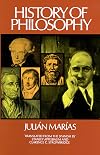
First published in 1941, derived from the notes taken by a young girl in a class taught by a 19 year old peer in his junior year, as a study to help pass the examen intermedio. In a moving "Preface", the author explains that he obtained his degree in philosophy in 1936, one month before the Civil War. When the War ended in 1939, his job possibilities were "extremely limited and uncertain": "I was forced to undertake unusually significant tasks because the lesser jobs were all closed to me." show more [xi] One of the girls in his classes urged him to write "History of Philosophy". She was the one who had done such great notes on their class. By this time I am in tears. Marias dedicated the book to her, and they married in 1941.
This book by an unknown twenty-six year old Spaniard basically supplanted almost entirely the German works that had dominated the intellectual marketplace and universities of the Spanish-speaking world. It appears that the effort to speak with clarity and accuracy, forced by the smiling young girls, resulted in a product, a total clarification, a justification of everything and every philosopher, which is invaluable to all of us.
The following Sections:
GREEK - Pre-Socratics: Milesian, Pythagorean, Parmenides, Eleatics, Heraclitis and Democritus. Socrates and the Sophists. Plato - ideas, man and city. Aristotle - knowledge, metaphysics, being, logic, physics, soul, ethics, politics. Ideals - ethics, stoics, Epicureans, skeptic, eclectics. Neoplatonism.
CHRISTIANITY - Patristic, St. Augustine.
MEDIEVAL PHILOSOPHY - Scholasticism, themes of the middle ages, the philosophers (Scotus Erigena, St Anselm, St Bonaventure, Bacon, Duns Scotus, Occam, Meister Eckart).
MODERN PHILOSOPHY - Renaissance, Humanist, Nicolas of Cusa, Giordano Bruno, Physics, Spanish Scholasticism; Descartes - man, God, world, rationalism and idealism; Cartesian France - Malebranche. Spinoza - ethics, being as a desire to survive. Leibniz - knowledge, theodicy. British - Bacon, Hobbes, Deism, Locke, Berkeley, Hume, Scottish school. The Enlightenment "Aufklarung"; Modern Epoch/loss of God; German Idealism - Kant, Fichte, Schelling, Hegel, Romantics - literary, Schleiermacher, Schopenhauer; 19th century - sensationalism - Biran. Comte - positivism; Kierkegaard, Nietzsche; return to tradition - Gratry.
Contemporary Philosophy - Brentano, Dilthy, Simmel, Bergson, Blondel, Unamuno; English pragmatism, personalism; Husserl's phenomenology; Value Theory; Heidegger's existentialism; Ortega and "vital reason" - school of Madrid.
Follows the entire history of Western philosophy century by century, from Greece to Ortega. Professor Marias's book is better at explaining Kant, than Kant is. After all, Marias had to explain the Critique to a classroom of smiling girls who accepted nothing in verba magistri. This makes it stand alone. In addition, while he covers the major figures, he also includes the contributions of lesser figures and those unfamiliar to the English-speaking world. For example, Auguste Gratry, and Georg Simmel are reprised. However, inexplicably he mentions the journalier Montaigne, without the giant memoirist, Marmontel. And while at times, the insights and links are brilliant, the sense of this just being notes flown quickly by is tiring.
Above all, the author practices what his teacher taught - the central concept in Ortega Y Gasset's work, the philosophy of vital reason [442]-- to take into account the total setting of each philosopher. The historicity of ideas - "historical reason" [xii]. The past is never discarded for its errors, but acknowledged for its roots. show less
This book by an unknown twenty-six year old Spaniard basically supplanted almost entirely the German works that had dominated the intellectual marketplace and universities of the Spanish-speaking world. It appears that the effort to speak with clarity and accuracy, forced by the smiling young girls, resulted in a product, a total clarification, a justification of everything and every philosopher, which is invaluable to all of us.
The following Sections:
GREEK - Pre-Socratics: Milesian, Pythagorean, Parmenides, Eleatics, Heraclitis and Democritus. Socrates and the Sophists. Plato - ideas, man and city. Aristotle - knowledge, metaphysics, being, logic, physics, soul, ethics, politics. Ideals - ethics, stoics, Epicureans, skeptic, eclectics. Neoplatonism.
CHRISTIANITY - Patristic, St. Augustine.
MEDIEVAL PHILOSOPHY - Scholasticism, themes of the middle ages, the philosophers (Scotus Erigena, St Anselm, St Bonaventure, Bacon, Duns Scotus, Occam, Meister Eckart).
MODERN PHILOSOPHY - Renaissance, Humanist, Nicolas of Cusa, Giordano Bruno, Physics, Spanish Scholasticism; Descartes - man, God, world, rationalism and idealism; Cartesian France - Malebranche. Spinoza - ethics, being as a desire to survive. Leibniz - knowledge, theodicy. British - Bacon, Hobbes, Deism, Locke, Berkeley, Hume, Scottish school. The Enlightenment "Aufklarung"; Modern Epoch/loss of God; German Idealism - Kant, Fichte, Schelling, Hegel, Romantics - literary, Schleiermacher, Schopenhauer; 19th century - sensationalism - Biran. Comte - positivism; Kierkegaard, Nietzsche; return to tradition - Gratry.
Contemporary Philosophy - Brentano, Dilthy, Simmel, Bergson, Blondel, Unamuno; English pragmatism, personalism; Husserl's phenomenology; Value Theory; Heidegger's existentialism; Ortega and "vital reason" - school of Madrid.
Follows the entire history of Western philosophy century by century, from Greece to Ortega. Professor Marias's book is better at explaining Kant, than Kant is. After all, Marias had to explain the Critique to a classroom of smiling girls who accepted nothing in verba magistri. This makes it stand alone. In addition, while he covers the major figures, he also includes the contributions of lesser figures and those unfamiliar to the English-speaking world. For example, Auguste Gratry, and Georg Simmel are reprised. However, inexplicably he mentions the journalier Montaigne, without the giant memoirist, Marmontel. And while at times, the insights and links are brilliant, the sense of this just being notes flown quickly by is tiring.
Above all, the author practices what his teacher taught - the central concept in Ortega Y Gasset's work, the philosophy of vital reason [442]-- to take into account the total setting of each philosopher. The historicity of ideas - "historical reason" [xii]. The past is never discarded for its errors, but acknowledged for its roots. show less


MIGUEL DE UNAMUNO
Hace largo tiempo que se hacia sentir con apremiante urgencia la necesidad de una revisión filosófica del pensamiento de Unamuno. Durante muchos años la masa inquietante y equívoca de su obra ha venido gravitando sobre la mente española, sin que se haya podido nunca tomar frente a ella una posición justificada por una conveniente claridad. Unamuno ha sido un pensador azorante, de dificil aprehensión, lleno de íntimas dificultades, disperso, cruzado por errores show more filoscíicos y religiosos, y, concretamente, por una innecesaria heterodoxia que, lejos de brotar de-to-más hondo-d8 5 pensamiento, desvirtúa y entorpece sus más perspicaces hallazgos. Pero, al mismo tiempo, existen en su obra geniales adivinaciones y aciertos a los que no podemos renunciar. Por esto he creido interesante esforzarme por penetrar el sentido de la obra de don Miguel de Unamuno, que es, rigurosamente, un problema de filosofia. show less
Hace largo tiempo que se hacia sentir con apremiante urgencia la necesidad de una revisión filosófica del pensamiento de Unamuno. Durante muchos años la masa inquietante y equívoca de su obra ha venido gravitando sobre la mente española, sin que se haya podido nunca tomar frente a ella una posición justificada por una conveniente claridad. Unamuno ha sido un pensador azorante, de dificil aprehensión, lleno de íntimas dificultades, disperso, cruzado por errores show more filoscíicos y religiosos, y, concretamente, por una innecesaria heterodoxia que, lejos de brotar de-to-más hondo-d8 5 pensamiento, desvirtúa y entorpece sus más perspicaces hallazgos. Pero, al mismo tiempo, existen en su obra geniales adivinaciones y aciertos a los que no podemos renunciar. Por esto he creido interesante esforzarme por penetrar el sentido de la obra de don Miguel de Unamuno, que es, rigurosamente, un problema de filosofia. show less

Awards
You May Also Like


Associated Authors
Statistics
- Works
- 130
- Also by
- 2
- Members
- 1,086
- Popularity
- #23,653
- Rating
- 4.0
- Reviews
- 21
- ISBNs
- 122
- Languages
- 5
- Favorited
- 1
