
I. F. Stone (1907–1989)
Author of The Trial of Socrates
About the Author
Image credit: Kzitelman
Works by I. F. Stone
Associated Works
Reporting World War II Part Two : American Journalism 1944-1946 (1995) — Contributor — 430 copies, 3 reviews
Wrestling with Zion: Progressive Jewish-American Responses to the Israeli-Palestinian Conflict (2003) — Contributor — 84 copies, 1 review
Shaking the Foundations: 200 Years of Investigative Journalism in America (Nation Books) (2003) — Contributor — 45 copies
Democracy in Print: The best of the Progressive Magazine, 1909-2009 (2009) — Contributor — 14 copies
We Accuse: A Powerful Statement of the New Political Anger in America (1965) — Contributor — 8 copies
Tagged
Common Knowledge
- Canonical name
- Stone, I. F.
- Legal name
- Stone, Isador Feinstein
- Other names
- Feinstein, Isador (birth name)
- Birthdate
- 1907-12-24
- Date of death
- 1989-06-18
- Gender
- male
- Education
- University of Pennsylvania, Class of 1928 (BA|1975)
- Occupations
- journalist
biographer - Organizations
- The Philadelphia Inquirer
New York Post
The Nation
PM
I. F. Stone's Weekly - Awards and honors
- George Polk Award (1970)
Conscience-in-Media Award (1976) - Relationships
- Stone, Judy (sister)
Boudin, Kathy (niece)
Boudin, Chesa (greatnephew) - Cause of death
- heart attack
- Nationality
- USA
- Birthplace
- Philadelphia, Pennsylvania, USA
- Place of death
- Boston, Massachusetts, USA
- Burial location
- Mount Auburn Cemetery, Cambridge, Massachusetts, USA
- Associated Place (for map)
- Massachusetts, USA
Members
Reviews
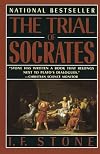
Athens put its most prominent philosopher, Socrates, to death by hemlock in 399 BCE, when he was 70 years old and had been practicing philosophy all over Athens for many decades. Why? And what does the fact of the trial and its resulting death sentence mean?
Here’s the accepted narrative over the centuries: Socrates was a martyr to the cause of philosophy, free speech, and truth-seeking. He was so devoted to questioning everything to find the underlying truth that he came into inevitable show more conflict with the authorities, and eventually the state, even open-minded democratic Athens, had to silence him by execution.
I.F. Stone does a great job digging through all the layers of this story to seek out the underlying facts, to the extent they can be known over 2400 years later. As usual, the truth is much more nuanced - and interesting - than the simple story.
Start with the political backdrop, to which Stone, with his background as a political journalist, is especially attuned. We are used to seeing freethinkers (and speakers and writers) being silenced by authoritarian regimes. But in this case it was the democratic government that did the silencing. And Socrates, although politics was never his focus, had been critical of democracy, a relatively new invention, through the decades.
Furthermore, Athens had suffered through two recent bouts of authoritarian rule by groups of so-called oligarchs. The most recent was just four years before the trial, at the end of the Peloponnesian War, when The Thirty took over, backed by Sparta, and purged their enemies, executing many of their political adversaries and even just wealthy citizens to seize their assets. The strongman leading the regime was Critias. And Critias, it turns out, had been a student of Socrates.
So this is the political counter narrative that Stone promotes: Socrates was a long-standing opponent of democracy in Athens and supporter of authoritarian governments in places like Sparta and Crete. One of his students takes action and overthrows the democratic government, becoming a murderous dictator. When the democratic forces eventually return to power, Socrates is under suspicion and even held to blame for the political disaster. He is put on trial a few years later.
A modern analogy would be democratic Germany putting Hitler’s teacher and mentor on trial in 1949.
Of course, it’s not that simple; it never is. For example, some of the texts cited by Stone in evidence of Socrates’ pro-authoritarian views come from Republic and other Platonic dialogs where Socrates was basically a literary character mouthing positions that Plato held decades after the death of Socrates. Stone then has to speculate the extent to which Plato’s views were “inspired” by the historic Socrates.
And as Stone does acknowledge, the conviction and execution of Socrates did in fact make him the greatest martyr for free speech and free thought in the 2500 year history of Western civilization. So the accepted story has some core of truth after all. And did Socrates actively seek that martyrdom? That’s another of the many interlocking issues that Stone investigates.
Overall I found Stone to be an honest investigator, acknowledging weaknesses and gaps in sources, and counterarguments to his thesis. It is obvious that he has spent a great deal of time investigating both the primary and secondary sources, and his comments about various reference works, commentators, and translations are evidence of the great amount of time and energy he has put in to this work.
Especially notable is Stone’s careful use of ancient Greek to parse the subtle shades of meaning of key words in Plato, Xenophon, Thucydides, and other contemporary writers. He is very eloquent on the beauty of reading Aeschylus’ Oresteia in the original Greek - and the amount of time and effort needed for him to work through the entire trilogy in the original.
Although I don’t accept Stone’s full thesis, he is convincing on key parts, and the depth of the political and social backdrop to the trial make every chapter of this book richly rewarding. show less
Here’s the accepted narrative over the centuries: Socrates was a martyr to the cause of philosophy, free speech, and truth-seeking. He was so devoted to questioning everything to find the underlying truth that he came into inevitable show more conflict with the authorities, and eventually the state, even open-minded democratic Athens, had to silence him by execution.
I.F. Stone does a great job digging through all the layers of this story to seek out the underlying facts, to the extent they can be known over 2400 years later. As usual, the truth is much more nuanced - and interesting - than the simple story.
Start with the political backdrop, to which Stone, with his background as a political journalist, is especially attuned. We are used to seeing freethinkers (and speakers and writers) being silenced by authoritarian regimes. But in this case it was the democratic government that did the silencing. And Socrates, although politics was never his focus, had been critical of democracy, a relatively new invention, through the decades.
Furthermore, Athens had suffered through two recent bouts of authoritarian rule by groups of so-called oligarchs. The most recent was just four years before the trial, at the end of the Peloponnesian War, when The Thirty took over, backed by Sparta, and purged their enemies, executing many of their political adversaries and even just wealthy citizens to seize their assets. The strongman leading the regime was Critias. And Critias, it turns out, had been a student of Socrates.
So this is the political counter narrative that Stone promotes: Socrates was a long-standing opponent of democracy in Athens and supporter of authoritarian governments in places like Sparta and Crete. One of his students takes action and overthrows the democratic government, becoming a murderous dictator. When the democratic forces eventually return to power, Socrates is under suspicion and even held to blame for the political disaster. He is put on trial a few years later.
A modern analogy would be democratic Germany putting Hitler’s teacher and mentor on trial in 1949.
Of course, it’s not that simple; it never is. For example, some of the texts cited by Stone in evidence of Socrates’ pro-authoritarian views come from Republic and other Platonic dialogs where Socrates was basically a literary character mouthing positions that Plato held decades after the death of Socrates. Stone then has to speculate the extent to which Plato’s views were “inspired” by the historic Socrates.
And as Stone does acknowledge, the conviction and execution of Socrates did in fact make him the greatest martyr for free speech and free thought in the 2500 year history of Western civilization. So the accepted story has some core of truth after all. And did Socrates actively seek that martyrdom? That’s another of the many interlocking issues that Stone investigates.
Overall I found Stone to be an honest investigator, acknowledging weaknesses and gaps in sources, and counterarguments to his thesis. It is obvious that he has spent a great deal of time investigating both the primary and secondary sources, and his comments about various reference works, commentators, and translations are evidence of the great amount of time and energy he has put in to this work.
Especially notable is Stone’s careful use of ancient Greek to parse the subtle shades of meaning of key words in Plato, Xenophon, Thucydides, and other contemporary writers. He is very eloquent on the beauty of reading Aeschylus’ Oresteia in the original Greek - and the amount of time and effort needed for him to work through the entire trilogy in the original.
Although I don’t accept Stone’s full thesis, he is convincing on key parts, and the depth of the political and social backdrop to the trial make every chapter of this book richly rewarding. show less
Stone, I. F. The Best of I. F. Stone. Edited by Karl Weber. Introduction by Peter Osnos. Public Affairs, 2006.
The recent death of Pete Hamill got me to thinking about some of my other twentieth-century journalism heroes. Izzy Stone is high on the list. From Pearl Harbor to Vietnam, from McCarthy to Nixon, he did the kind of open-source investigative journalism that few reporters these days have the time or energy to pursue. His small-circulation weekly newspaper was read by everyone on show more Capitol Hill because he attended the dull committee meetings, read the reports, and delved into the seldom-read pages of the Congressional Record. He was a leftist at a time when leftists were called before Congress for public pillorying. He was a Zionist who defended the right of Nazis to speak. He was a friend of Robert Kennedy who was not afraid to charge him with equivocation on Vietnam. Finally, when he closed I. F. Stone’s Weekly, he spent his retirement getting a doctorate in classical literature and writing scholarly books on Socrates and Athenian Democracy. This well-edited and introduced anthology of his journalism will give you some idea of the clarity of his mind. Recommended. show less
The recent death of Pete Hamill got me to thinking about some of my other twentieth-century journalism heroes. Izzy Stone is high on the list. From Pearl Harbor to Vietnam, from McCarthy to Nixon, he did the kind of open-source investigative journalism that few reporters these days have the time or energy to pursue. His small-circulation weekly newspaper was read by everyone on show more Capitol Hill because he attended the dull committee meetings, read the reports, and delved into the seldom-read pages of the Congressional Record. He was a leftist at a time when leftists were called before Congress for public pillorying. He was a Zionist who defended the right of Nazis to speak. He was a friend of Robert Kennedy who was not afraid to charge him with equivocation on Vietnam. Finally, when he closed I. F. Stone’s Weekly, he spent his retirement getting a doctorate in classical literature and writing scholarly books on Socrates and Athenian Democracy. This well-edited and introduced anthology of his journalism will give you some idea of the clarity of his mind. Recommended. show less
I.F. Stone (1907-1989) was a highly respected, independent American journalist of extraordinary skill, integrity and courage. For over 40 years, he analyzed and reported on national and international events; exposed corruption and deception; and offered iconoclastic analyses that countered the claims of governmental leaders and politicians. He frequently traveled to locations around the US and the world (as in his trip to the USSR in the mid- 1950s), to report in person on what he witnessed. show more Never one to cite “confidential sources”, he frequently relied on official documents and statistics to raise difficult questions overlooked or ignored by other journalists. As journalist Bill Moyers put it, “For years he was America’s premier independent journalist, bringing down on his head the sustained wrath of the high and mighty for publishing… the government’s lies and contradictions culled from the government’s own official documents.”
Stone’s independent and idealistic stance put him at odds with the political establishment, particularly the right wing. Nevertheless, he was uncompromising in his commitment to principle; his patriotism; his defense of freedom of thought, speech, and press; and his dream of a free socialistic democracy. With hindsight, it is clear that IF Stone was right on many significant issues, including racial integration and civil rights, the dangers of McCarthyism, and US involvement in the disastrous war Southeast Asia.
This collection brings together essays written by IF Stone from the 1930s through the 1970s. Most were printed in his small independent publication IF Stone’s Weekly; others first appeared in New York Post, Nation, and New York Review of Books. The essays are grouped by category, and roughly chronologically, under the following headings:
1. Worth the Risk presents essays on political repression and freedom of speech in both the 1950s and 1960s. Among the essays are the ones dealing with the demagogue Joseph McCarthy, the Pentagon Papers, and campus rebellions during the Vietnam War.
2. A Good War – But for What? contains essays written during World War II, raising questions about military tactics, the goals of the war, weak leadership by Truman, a “flawed’ investigation of the Pearl Harbor attack, and formation of the United Nations.
3. Twilight Struggles considers conflict between the US and the USSR, the post war rearming of Germany, Stalinist Russia (which Stone characterized as repressive and dishonest, before the evils of Stalinism became entirely apparent to the world), the Cuban missile crisis, and weak leadership of JF Kennedy.
4. The Wall between Black and White focuses on race relations, and the historic struggle for integration and civil rights, as well as the “black- Jewish” conflict in New York City, and implications of the ML King assassination.
5. A Promised Land presents essays on Jewish refugees during WW2, establishment of the new Jewish state (in which Stone argues for a divided Palestine for both Arabs and Jews), and the Israeli Wars.
6. A War made of Lies analyses US involvement in Vietnam, including the Gulf of Tonkin incident (deceptively used by LB Johnson to gain Congressional approval for military action), Robert Kennedy’s “tepid” stance on the war, and on why the military action was bound to fail.
7. Heroes and Others, offers essays on Franklin Roosevelt (“Farewell to F.D.R”), Albert Einstein, Thomas Dewey, Barry Goldwater (“Goldwater and his Tribe”) and General Curtis LeMay (“Caveman in a Jet Bomber.”)
The Best of IF Stone is an excellent collection, a walk through four decades of history and politics, as seen through the eyes of an uncompromising liberal idealist. In reading the book, I earmarked passages for quotation here, but find them too numerous to present. I recommend this work highly for anyone interested in US history and political journalism. show less
Stone’s independent and idealistic stance put him at odds with the political establishment, particularly the right wing. Nevertheless, he was uncompromising in his commitment to principle; his patriotism; his defense of freedom of thought, speech, and press; and his dream of a free socialistic democracy. With hindsight, it is clear that IF Stone was right on many significant issues, including racial integration and civil rights, the dangers of McCarthyism, and US involvement in the disastrous war Southeast Asia.
This collection brings together essays written by IF Stone from the 1930s through the 1970s. Most were printed in his small independent publication IF Stone’s Weekly; others first appeared in New York Post, Nation, and New York Review of Books. The essays are grouped by category, and roughly chronologically, under the following headings:
1. Worth the Risk presents essays on political repression and freedom of speech in both the 1950s and 1960s. Among the essays are the ones dealing with the demagogue Joseph McCarthy, the Pentagon Papers, and campus rebellions during the Vietnam War.
2. A Good War – But for What? contains essays written during World War II, raising questions about military tactics, the goals of the war, weak leadership by Truman, a “flawed’ investigation of the Pearl Harbor attack, and formation of the United Nations.
3. Twilight Struggles considers conflict between the US and the USSR, the post war rearming of Germany, Stalinist Russia (which Stone characterized as repressive and dishonest, before the evils of Stalinism became entirely apparent to the world), the Cuban missile crisis, and weak leadership of JF Kennedy.
4. The Wall between Black and White focuses on race relations, and the historic struggle for integration and civil rights, as well as the “black- Jewish” conflict in New York City, and implications of the ML King assassination.
5. A Promised Land presents essays on Jewish refugees during WW2, establishment of the new Jewish state (in which Stone argues for a divided Palestine for both Arabs and Jews), and the Israeli Wars.
6. A War made of Lies analyses US involvement in Vietnam, including the Gulf of Tonkin incident (deceptively used by LB Johnson to gain Congressional approval for military action), Robert Kennedy’s “tepid” stance on the war, and on why the military action was bound to fail.
7. Heroes and Others, offers essays on Franklin Roosevelt (“Farewell to F.D.R”), Albert Einstein, Thomas Dewey, Barry Goldwater (“Goldwater and his Tribe”) and General Curtis LeMay (“Caveman in a Jet Bomber.”)
The Best of IF Stone is an excellent collection, a walk through four decades of history and politics, as seen through the eyes of an uncompromising liberal idealist. In reading the book, I earmarked passages for quotation here, but find them too numerous to present. I recommend this work highly for anyone interested in US history and political journalism. show less
Stone's thesis is that the charges of impiety and corrupting the youth against Socrates was just a contrived charge to get rid of a man that was always in their face. Stone posits that the real reason Socrates was charged is that there was a fear that Socrates encouraged civic disloyalty by questioning the status quo. Athens had just been defeated in the Peloponnesian War and was suspicious of any anti-democratic activity. The author emphasizes Socrates’ association with oligarchic figures show more such as Critias and Alcibiades (Thirty Tyrants) and his open contempt for democratic decision-making. According to the author, it was a strategic move that the accusers called for the banishment of Socrates, for they knew that would not be acceptable to him, that he would opt for death. By his death, Socrates became one of the most famous martyrs for free speech. Had he lived, he might have become just another old man wandering the streets talking to himself. This book made the New York Times Best-Seller List and the 501 Books YMR List. I may have read this book before—the arguments feel familiar—but if so, it would have been twenty-five to thirty years ago. show less
Lists
Awards


You May Also Like


Associated Authors
Statistics
- Works
- 19
- Also by
- 8
- Members
- 2,424
- Popularity
- #10,582
- Rating
- 3.8
- Reviews
- 23
- ISBNs
- 60
- Languages
- 10
- Favorited
- 5