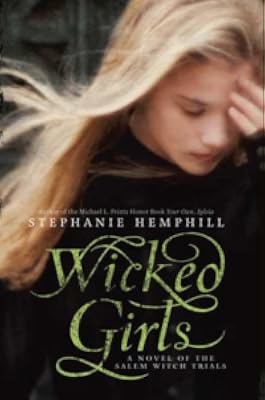
Wicked Girls
by Stephanie Hemphill
On This Page
Description
A fictionalized account, told in verse, of the Salem witch trials, told from the perspective of three young women living in Salem in 1692--Mercy Lewis, Margaret Walcott, and Ann Putnam, Jr.Tags
Recommendations






Member Reviews
This book dragged a bit, especially during the first half. It was interesting to hear how the girls involved in accusing witches were represented, but something about the story lacked momentum. Their lives were so bleak, and the prospects of everyone in that society seemed so dismal, that it was hard to go on reading about their lives. The strongest point of the story was the author's ability to show believable reasons for the girls' actions, and actually cause me to feel compassion for them as much as for the people who were jailed and killed.
Wicked Girls: A Novel of the Salem Witch Trials by Stephanie Hemphill is a historical fiction novel in verse relating the events of the Salem witch trials from the point of view of the accusing girls: Ann Putnam, Jr., Mercy Lewis, Margaret Walcott, Betty Parris, Abigail Williams, Elizabeth Hubbard,, and Susannah Sheldon. Each poem is told from one of the girls' points of view. The novel begins with them playing a game of "folk magic", which they believe unleashes evil into the world. When two of the girls come down with an affliction, the others join suit. Their reputation as "seers" in the village grants them cache, and they wrestle to keep their newfound power through power-plays, tense intergroup dynamics, and finally, crises of show more conscience. When the villagers begin to express doubt and the group begins to fall to infighting, the witch hunt ends, leaving the girls mostly outcasts and rejected. The novel follows shortly before the witch trials began to when the furor began to die down. The last part of the novel gives brief information on the real girls, as well as the people they accused.
Stephanie Hemphill's verse is fluid, with lines of occasional brilliance. The very first poem, "Salem", sets the stage with haunting imagery: "The cold is gray and fierce,/bitter as a widow at the grave" (p. 1). With spare verse and a light touch, Hemphill paints a rich picture of the Salem witch trials from the points of view of the girls who started it.
Though her imagery is rich, the characters are where Hemphill really shines. The three main characters, whose poems take up the bulk of the novel, are Mercy Lewis, the orphan servant girl who is both the most strategic of the girls as well as the most affected by crises of conscience; Margaret Walcott, a spoiled, unlearned girl prone to fits of envy and nastiness; and Ann Putnam, Jr., an innocent twelve-year-old who becomes the ringleader of the group, and slowly turns more calculating and cold as the novel progresses. Hemphill masterfully creates both intriguing characters from the outset, as well as a complex character arc for each as they develop through the novel. The progression of each of the girls’ character arcs is slow, but no less riveting for it. Hemphill’s grasp of pacing is superb.
The girls form a united front until allegiances begin to shift and crumble as guilt and remorse sifts through the group. The interplay between the girls as they revel in their prestige in the village, and as they fall to jealousy and remorse, creates a moving drama that displays Hemphill’s grasp of group dynamics and human relationships. The breaking down of the group to power plays and crises of conscience coincides with the increase in voices around the village saying that the girls are not afflicted by witches, but delusional and lying.
Hemphill paints a convincing, subtle portrayal of the disenfranchisement that women experienced in Puritan times; the power that the girls are afforded by becoming "seers" is intoxicating primarily because they are released from that disenfranchisement. While not excusing the girls' behavior and actions, Hemphill does an excellent job of showing what could have motivated such a dark period of history. Few books give such depth and weight to the real accusers of Salem’s history, but Hemphill shows where a suppressive society and intoxication of power can lead. Hemphill shows a real gift for creating anti-heroes that are at once sympathetic and diabolical.
Wicked Girls is an enthralling novel in verse that combines historical events with fictionalized accounts of the motivations and repercussions of the girls involved. Most historians waffle on whether the accusations were fueled by delusional hysteria or more deliberately targeted, but Hemphill comes down firmly on the latter. Some historians have pointed out that those accused conveniently were rich landowners or had wronged the families in some way, which Hemphill works seamlessly into the text: "Goody Osborne/tried to cheat Ann's father and his brothers/out of her late husband's trust.'/'That be a sin,' Lizzie says/I nod and say,/'And Goody Osborne be a witch.' " (p. 66). The effect, overall, of such a casual discussion to destroy another's life, is chilling. The accusations, when made from deliberate targeting and stratagem, take on an unsettling macabre look at the depths of depravity which the promise of power can plumb. However, she is not entirely unsympathetic to the girls. With a deft hand, she balances a very real motivation to have some influence in a society that regularly disenfranchises women and lower classes, while also portraying the girls as cunning and cognizant of their own wickedness.
The only complaint to be lodged against Wicked Girls is that Hemphill fails to take full advantage of the medium. Hemphill shows aptly that she is a skilled poet, particularly when it comes to imagery, but the book fails to demonstrate this very often. The times that Hemphill's skills are most apparent are in the pieces not narrated by the girls, of which there are only fourteen in all. Additionally, the beginning of the novel can be confusing at first due to how many characters are included; Hemphill might have restricted the points-of-view to the three main girls, Mercy, Margaret, and Ann, Jr. without sacrificing quality. Still, these complaints are minor when compared to the complex characters, believable drama, and superb understanding of humanity that Wicked Girls offers. show less
Stephanie Hemphill's verse is fluid, with lines of occasional brilliance. The very first poem, "Salem", sets the stage with haunting imagery: "The cold is gray and fierce,/bitter as a widow at the grave" (p. 1). With spare verse and a light touch, Hemphill paints a rich picture of the Salem witch trials from the points of view of the girls who started it.
Though her imagery is rich, the characters are where Hemphill really shines. The three main characters, whose poems take up the bulk of the novel, are Mercy Lewis, the orphan servant girl who is both the most strategic of the girls as well as the most affected by crises of conscience; Margaret Walcott, a spoiled, unlearned girl prone to fits of envy and nastiness; and Ann Putnam, Jr., an innocent twelve-year-old who becomes the ringleader of the group, and slowly turns more calculating and cold as the novel progresses. Hemphill masterfully creates both intriguing characters from the outset, as well as a complex character arc for each as they develop through the novel. The progression of each of the girls’ character arcs is slow, but no less riveting for it. Hemphill’s grasp of pacing is superb.
The girls form a united front until allegiances begin to shift and crumble as guilt and remorse sifts through the group. The interplay between the girls as they revel in their prestige in the village, and as they fall to jealousy and remorse, creates a moving drama that displays Hemphill’s grasp of group dynamics and human relationships. The breaking down of the group to power plays and crises of conscience coincides with the increase in voices around the village saying that the girls are not afflicted by witches, but delusional and lying.
Hemphill paints a convincing, subtle portrayal of the disenfranchisement that women experienced in Puritan times; the power that the girls are afforded by becoming "seers" is intoxicating primarily because they are released from that disenfranchisement. While not excusing the girls' behavior and actions, Hemphill does an excellent job of showing what could have motivated such a dark period of history. Few books give such depth and weight to the real accusers of Salem’s history, but Hemphill shows where a suppressive society and intoxication of power can lead. Hemphill shows a real gift for creating anti-heroes that are at once sympathetic and diabolical.
Wicked Girls is an enthralling novel in verse that combines historical events with fictionalized accounts of the motivations and repercussions of the girls involved. Most historians waffle on whether the accusations were fueled by delusional hysteria or more deliberately targeted, but Hemphill comes down firmly on the latter. Some historians have pointed out that those accused conveniently were rich landowners or had wronged the families in some way, which Hemphill works seamlessly into the text: "Goody Osborne/tried to cheat Ann's father and his brothers/out of her late husband's trust.'/'That be a sin,' Lizzie says/I nod and say,/'And Goody Osborne be a witch.' " (p. 66). The effect, overall, of such a casual discussion to destroy another's life, is chilling. The accusations, when made from deliberate targeting and stratagem, take on an unsettling macabre look at the depths of depravity which the promise of power can plumb. However, she is not entirely unsympathetic to the girls. With a deft hand, she balances a very real motivation to have some influence in a society that regularly disenfranchises women and lower classes, while also portraying the girls as cunning and cognizant of their own wickedness.
The only complaint to be lodged against Wicked Girls is that Hemphill fails to take full advantage of the medium. Hemphill shows aptly that she is a skilled poet, particularly when it comes to imagery, but the book fails to demonstrate this very often. The times that Hemphill's skills are most apparent are in the pieces not narrated by the girls, of which there are only fourteen in all. Additionally, the beginning of the novel can be confusing at first due to how many characters are included; Hemphill might have restricted the points-of-view to the three main girls, Mercy, Margaret, and Ann, Jr. without sacrificing quality. Still, these complaints are minor when compared to the complex characters, believable drama, and superb understanding of humanity that Wicked Girls offers. show less
2.5 stars
This is a fictional account of the Salem witch trials, mostly told from the points of view of three of the girls who accused many of the people, two 17-year olds and one 12-year old.
I was initially excited to find a fictional book about the Salem witches, but I skipped entire first chapter, thinking it was a quote. Suddenly the 2nd chapter started with another “quote” and I realized – oh, crap! I think the entire book is written this way: like poetry. Or, I guess the term is “in verse”. Not a fan. I skim/read that kind of thing quickly, and don’t really pay attention.
The good part: it was quick! The book did go right at the end with the notes on the real-life people, both the accusers and the accused. Also a note, show more in general, on why they may have accused so many people. That gave it the extra ½ star, but I’d still like to find a good fictional work on this topic. show less
This is a fictional account of the Salem witch trials, mostly told from the points of view of three of the girls who accused many of the people, two 17-year olds and one 12-year old.
I was initially excited to find a fictional book about the Salem witches, but I skipped entire first chapter, thinking it was a quote. Suddenly the 2nd chapter started with another “quote” and I realized – oh, crap! I think the entire book is written this way: like poetry. Or, I guess the term is “in verse”. Not a fan. I skim/read that kind of thing quickly, and don’t really pay attention.
The good part: it was quick! The book did go right at the end with the notes on the real-life people, both the accusers and the accused. Also a note, show more in general, on why they may have accused so many people. That gave it the extra ½ star, but I’d still like to find a good fictional work on this topic. show less
Wicked Girls is a new topic in historical fiction. Rarely do you see young adult novels discussing issues such as The Salem Witch Trials. I was really excited to read this novel; the Salem Witch Trials is something I am slightly fascinated with. There are so many things that went wrong in that era, so many innocent lives that were lost. Something about this time frame intrigues me. Needless to say I jumped at the opportunity to review this novel.
This novel also stands out on the shelves of historical fiction. This book is written entirely in verse. Also, the characters are real people who lived during the era; these accounts are entirely fictional though.
These characters were well built, I felt as though each one had their own show more distinct reasons for accusing others of witch craft and it was easy to understand why they were doing this. Although the book focused more on Mercy, Ann, and Margaret’s story, it did also touch on the other girls’ interpretation of the story. Each of the characters also had their own history in this story. All of these small details helped make the novel interesting and well rounded.
At one point I felt that the book became a little confusing. It was hard to understand whether the girls actually felt that they were seeing spirits, or if they were merely very good liars. I think a little more detail on this part would have made the story easier to understand.
Anyone who reads this book will be able to appreciate all the research that went into creating this story. The author’s use of language sounds like that of the time period. The descriptions of the character’s beliefs is written as if she lived in the time period herself; I was able to fully imagine this story taking place in front of me.
Wicked Girls was very interesting and a unique historical young adult novel. I would recommend this to those who like books written in verse but also love historical fiction.
Overall, I give this three lanterns. I enjoyed it and felt that it helped give a new take on a huge event in our history. show less
This novel also stands out on the shelves of historical fiction. This book is written entirely in verse. Also, the characters are real people who lived during the era; these accounts are entirely fictional though.
These characters were well built, I felt as though each one had their own show more distinct reasons for accusing others of witch craft and it was easy to understand why they were doing this. Although the book focused more on Mercy, Ann, and Margaret’s story, it did also touch on the other girls’ interpretation of the story. Each of the characters also had their own history in this story. All of these small details helped make the novel interesting and well rounded.
At one point I felt that the book became a little confusing. It was hard to understand whether the girls actually felt that they were seeing spirits, or if they were merely very good liars. I think a little more detail on this part would have made the story easier to understand.
Anyone who reads this book will be able to appreciate all the research that went into creating this story. The author’s use of language sounds like that of the time period. The descriptions of the character’s beliefs is written as if she lived in the time period herself; I was able to fully imagine this story taking place in front of me.
Wicked Girls was very interesting and a unique historical young adult novel. I would recommend this to those who like books written in verse but also love historical fiction.
Overall, I give this three lanterns. I enjoyed it and felt that it helped give a new take on a huge event in our history. show less
This fictional account of the Salem witch trials is told in verse by three of the "afflicted girls". When I first saw that, I actually returned the book to the library, sections of books told this way are okay but the idea of reading a whole book this way kind of made my head spin. But I left my book at home last Saturday and decided to give this another shot. In the beginning I found it confusing, I had to keep going to beginning where they gave a brief description of who the main characters were. Once I got into it I really liked it. I was afraid the verse style would focus more on sounding pretty then getting the story told but that wasn't the case at all. I got a very clear picture of what each of the three girls was going through show more and what they were thinking and going through.
The author gave this tale the spin that the girls felt powerless in their roles as young girls among the Puritans, and this was a way for them to gain power. It was really interesting to see how Ann Putnam's mother manipulated her to take revenge on people and how Ann tried to manipulate her back. I was glad to see the girls feeling guilty although it sometimes felt as though they weren't feeling guilty enough, particulalry the little girls and Margaret who was more obsessed with herself then anything else going on. Susannah really had me thinking, because she didn't fit in with the others and Margaret was the one who told others she was being afflicted. I sometimes wondered if Susannah's affliction wasn't actual siezures or something like that. But that just might be me reading too much into the text.
I really appreciate the authors addition of two sections in the back, one telling us who characters were based on and what happened to them after the trials and a very brief discussion of the various theories regarding why the girls accused others of witchcraft. show less
The author gave this tale the spin that the girls felt powerless in their roles as young girls among the Puritans, and this was a way for them to gain power. It was really interesting to see how Ann Putnam's mother manipulated her to take revenge on people and how Ann tried to manipulate her back. I was glad to see the girls feeling guilty although it sometimes felt as though they weren't feeling guilty enough, particulalry the little girls and Margaret who was more obsessed with herself then anything else going on. Susannah really had me thinking, because she didn't fit in with the others and Margaret was the one who told others she was being afflicted. I sometimes wondered if Susannah's affliction wasn't actual siezures or something like that. But that just might be me reading too much into the text.
I really appreciate the authors addition of two sections in the back, one telling us who characters were based on and what happened to them after the trials and a very brief discussion of the various theories regarding why the girls accused others of witchcraft. show less
This fictional account of the Salem witch trials is told in verse by three of the "afflicted girls". When I first saw that, I actually returned the book to the library, sections of books told this way are okay but the idea of reading a whole book this way kind of made my head spin. But I left my book at home last Saturday and decided to give this another shot. In the beginning I found it confusing, I had to keep going to beginning where they gave a brief description of who the main characters were. Once I got into it I really liked it. I was afraid the verse style would focus more on sounding pretty then getting the story told but that wasn't the case at all. I got a very clear picture of what each of the three girls was going through show more and what they were thinking and going through.
The author gave this tale the spin that the girls felt powerless in their roles as young girls among the Puritans, and this was a way for them to gain power. It was really interesting to see how Ann Putnam's mother manipulated her to take revenge on people and how Ann tried to manipulate her back. I was glad to see the girls feeling guilty although it sometimes felt as though they weren't feeling guilty enough, particulalry the little girls and Margaret who was more obsessed with herself then anything else going on. Susannah really had me thinking, because she didn't fit in with the others and Margaret was the one who told others she was being afflicted. I sometimes wondered if Susannah's affliction wasn't actual siezures or something like that. But that just might be me reading too much into the text.
I really appreciate the authors addition of two sections in the back, one telling us who characters were based on and what happened to them after the trials and a very brief discussion of the various theories regarding why the girls accused others of witchcraft. show less
The author gave this tale the spin that the girls felt powerless in their roles as young girls among the Puritans, and this was a way for them to gain power. It was really interesting to see how Ann Putnam's mother manipulated her to take revenge on people and how Ann tried to manipulate her back. I was glad to see the girls feeling guilty although it sometimes felt as though they weren't feeling guilty enough, particulalry the little girls and Margaret who was more obsessed with herself then anything else going on. Susannah really had me thinking, because she didn't fit in with the others and Margaret was the one who told others she was being afflicted. I sometimes wondered if Susannah's affliction wasn't actual siezures or something like that. But that just might be me reading too much into the text.
I really appreciate the authors addition of two sections in the back, one telling us who characters were based on and what happened to them after the trials and a very brief discussion of the various theories regarding why the girls accused others of witchcraft. show less
This fictional account of the Salem witch trials is told in verse by three of the "afflicted girls". When I first saw that, I actually returned the book to the library, sections of books told this way are okay but the idea of reading a whole book this way kind of made my head spin. But I left my book at home last Saturday and decided to give this another shot. In the beginning I found it confusing, I had to keep going to beginning where they gave a brief description of who the main characters were. Once I got into it I really liked it. I was afraid the verse style would focus more on sounding pretty then getting the story told but that wasn't the case at all. I got a very clear picture of what each of the three girls was going through show more and what they were thinking and going through.
The author gave this tale the spin that the girls felt powerless in their roles as young girls among the Puritans, and this was a way for them to gain power. It was really interesting to see how Ann Putnam's mother manipulated her to take revenge on people and how Ann tried to manipulate her back. I was glad to see the girls feeling guilty although it sometimes felt as though they weren't feeling guilty enough, particulalry the little girls and Margaret who was more obsessed with herself then anything else going on. Susannah really had me thinking, because she didn't fit in with the others and Margaret was the one who told others she was being afflicted. I sometimes wondered if Susannah's affliction wasn't actual siezures or something like that. But that just might be me reading too much into the text.
I really appreciate the authors addition of two sections in the back, one telling us who characters were based on and what happened to them after the trials and a very brief discussion of the various theories regarding why the girls accused others of witchcraft. show less
The author gave this tale the spin that the girls felt powerless in their roles as young girls among the Puritans, and this was a way for them to gain power. It was really interesting to see how Ann Putnam's mother manipulated her to take revenge on people and how Ann tried to manipulate her back. I was glad to see the girls feeling guilty although it sometimes felt as though they weren't feeling guilty enough, particulalry the little girls and Margaret who was more obsessed with herself then anything else going on. Susannah really had me thinking, because she didn't fit in with the others and Margaret was the one who told others she was being afflicted. I sometimes wondered if Susannah's affliction wasn't actual siezures or something like that. But that just might be me reading too much into the text.
I really appreciate the authors addition of two sections in the back, one telling us who characters were based on and what happened to them after the trials and a very brief discussion of the various theories regarding why the girls accused others of witchcraft. show less
Members
- Recently Added By
Lists

1600s to 1700s Historical Fiction: America
6 works; 1 member

Historical Fiction Books
99 works; 5 members
Author Information

8 Works 1,521 Members
Awards and Honors
Awards
Common Knowledge
- Canonical title
- Wicked Girls
- Original publication date
- 2010-06-29
- People/Characters
- Mercy Lewis; Margaret Walcott; Ann Putnam, Jr.; Betty Parris; Abigail Williams; Elizabeth Hubbard (show all 7); Susannah Sheldon
- Important places
- Salem, Massachusetts, USA
- Important events
- Salem witch trials (1692 | 1693)
- Dedication
- For Alessandra
- First words
- Silent, not even the twitter
of insects. The wind stills
against a distant sky of clouds.
The cold is gray and fierce,
bitter as a widow at the grave.
The trees' bare bony fingers
point crookedly
to... (show all)ward Heaven or Hell
or worse than that, toward nowhere. - Quotations
- Margaret's face turns dust and ice.
She says, "I fear we let loose
a thing what leads to the grave." - Last words
- (Click to show. Warning: May contain spoilers.)The snow falls fresh this morning,
I track no ashes of the Invisible World.
In New Hampshire I start anew.
Classifications
Statistics
- Members
- 348
- Popularity
- 90,233
- Reviews
- 32
- Rating
- (3.31)
- Languages
- English
- Media
- Paper, Audiobook, Ebook
- ISBNs
- 13
- ASINs
- 3