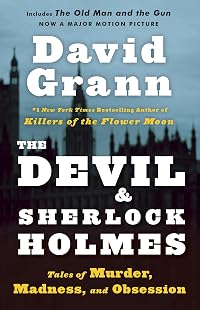
The Devil and Sherlock Holmes: Tales of Murder, Madness and Obsession
by David Grann
On This Page
Description
Collection of the journalist's articles previously published in varous periodicals.Tags
Recommendations











Member Reviews
A masterclass in narrative journalism from David Grann, author of perhaps my favourite non-fiction book, The Lost City of Z. Named after its two bookend chapters, The Devil and Sherlock Holmes is a collection of twelve previously-published articles (mostly about true crime), all of which are intensely readable and expertly crafted. From the first article on the mysterious death of a Sherlock Holmes fanatic (which reads almost like a Sherlock case itself), we are treated to a wide range of fascinating subjects including the suspected innocence of a condemned criminal, an amnesiac New York fireman trying to piece together his memories of 9/11, a chronicle of New York's water tunnel system (much more engrossing than such a summary show more suggests!), the rise of the Aryan Brotherhood in the US prison system, the hunt for the elusive giant squid and, the best and most unusual of all, the Polish writer who murdered a man and planted clues to it in his novel.
It is an incredibly diverse book rich in detail, with the only common link (aside from Grann's impressive writing abilities) being the obsessive nature of the people written about (which also harmonises with the general theme of The Lost City of Z). In every article, there is a key player driven by some compelling and often indefinable force inside them. The only one which I found rather boring was the baseball one (natch). Why is it that whenever someone writes about a sport for a general audience, they don't make any effort to communicate its rules, terminology or culture with readers who aren't die-hard fans? As a Briton – no, scratch that, as someone who is not a baseball fan (which must include many Americans) – a fair chunk of this particular article was incomprehensible to me. Even so, the obsessive streak of the sportsman in question was compelling and, like every other article included in the book, I found myself Googling away to find out more.
The Devil and Sherlock Holmes is one of the best books I've read since I put down The Lost City of Z about eight months ago. (I bought The Devil and Sherlock Holmes immediately after doing so, but only now got around to reading it. So many books, so little time.) For fans of true crime stories, narrative non-fiction, compelling mysteries, or those who just enjoy a great read, I can scarcely recommend anything higher than this. show less
It is an incredibly diverse book rich in detail, with the only common link (aside from Grann's impressive writing abilities) being the obsessive nature of the people written about (which also harmonises with the general theme of The Lost City of Z). In every article, there is a key player driven by some compelling and often indefinable force inside them. The only one which I found rather boring was the baseball one (natch). Why is it that whenever someone writes about a sport for a general audience, they don't make any effort to communicate its rules, terminology or culture with readers who aren't die-hard fans? As a Briton – no, scratch that, as someone who is not a baseball fan (which must include many Americans) – a fair chunk of this particular article was incomprehensible to me. Even so, the obsessive streak of the sportsman in question was compelling and, like every other article included in the book, I found myself Googling away to find out more.
The Devil and Sherlock Holmes is one of the best books I've read since I put down The Lost City of Z about eight months ago. (I bought The Devil and Sherlock Holmes immediately after doing so, but only now got around to reading it. So many books, so little time.) For fans of true crime stories, narrative non-fiction, compelling mysteries, or those who just enjoy a great read, I can scarcely recommend anything higher than this. show less
While "The Devil and Sherlock Holmes" is a bunch of newspaper articles in book form, I found much of what Grann wrote about murder, madness and obsession fascinating, and at times, frightening.
Of particular interest is the expose of arson investigation in Texas, the adult who pretends to be a missing child so he can be sent to the US to stay with his "family", only to find something even scarier than prison (I think this has since been made into a film) and the ex-Haitian war criminal now living in New York (who we also meet in Jon Ronson's "The Psychopath Test").
The major drawback is the article on a baseball player. Baseball never ceases to bore the ever lovin' hell out of me and this example was not the exception that proves the show more rule. Otherwise, enjoy the book. show less
Of particular interest is the expose of arson investigation in Texas, the adult who pretends to be a missing child so he can be sent to the US to stay with his "family", only to find something even scarier than prison (I think this has since been made into a film) and the ex-Haitian war criminal now living in New York (who we also meet in Jon Ronson's "The Psychopath Test").
The major drawback is the article on a baseball player. Baseball never ceases to bore the ever lovin' hell out of me and this example was not the exception that proves the show more rule. Otherwise, enjoy the book. show less
David Grann is one of the finest writers of contemporary long-form investigative journalism, and his new book The Devil and Sherlock Holmes (Doubleday, 2010) collects twelve of his previously-published essays (nine from The New Yorker, one each from The Atlantic, New York Times Magazine, and The New Republic). Grann's style makes for great reading; he takes fascinating subject matter and somehow manages to both compress and expand it into perfectly-paced segments, just right for a leisurely read.
Each of the twelve essays is completely enthralling in its own right, from the first (on the mysterious death of Sherlock Holmes scholar Richard Lancelyn Green), to the last (on Haitian death squad leader Toto Constant). Sandwiched between these show more are careful examinations of whether the state of Texas executed an innocent man, how the Aryan Brotherhood came to control America's prisons, and how Jim Traficant got involved with the Youngstown mob; and profiles of a scientist obsessed with finding the giant squid, baseball player Rickey Henderson, bank robber/escape artist Forrest Tucker, and the "sandhogs" who are working underneath New York to construct a new water system.
Grann's travels take him to small boats in stormy waters of the New Zealand coast, deep into the mucky depths of New York's subterranean tunnels, into prisons and small-town baseball stadiums, arson It was great fun to go along for the ride.
http://philobiblos.blogspot.com/2010/04/book-review-devil-and-sherlock-holmes.ht... show less
Each of the twelve essays is completely enthralling in its own right, from the first (on the mysterious death of Sherlock Holmes scholar Richard Lancelyn Green), to the last (on Haitian death squad leader Toto Constant). Sandwiched between these show more are careful examinations of whether the state of Texas executed an innocent man, how the Aryan Brotherhood came to control America's prisons, and how Jim Traficant got involved with the Youngstown mob; and profiles of a scientist obsessed with finding the giant squid, baseball player Rickey Henderson, bank robber/escape artist Forrest Tucker, and the "sandhogs" who are working underneath New York to construct a new water system.
Grann's travels take him to small boats in stormy waters of the New Zealand coast, deep into the mucky depths of New York's subterranean tunnels, into prisons and small-town baseball stadiums, arson It was great fun to go along for the ride.
http://philobiblos.blogspot.com/2010/04/book-review-devil-and-sherlock-holmes.ht... show less
I love short stories, and collections from great writers. So when I found "The Devil and Sherlock Holmes" in a Denver bookstore in 2019 from an author I had never heard of, David Grann, I knew I had stumbled onto something. (I finished the book this summer after losing the first copy, half-read, on an airplane.) This book brings together twelve non-fiction accounts he crafted in the late 1990s and early 2000s as an investigative journalist for the New Yorker, The Atlantic, and other long-form publications. All are extensively researched, and effortlessly presented--the marks of a great reporter and writer.
Grann is a superb storyteller, who plunges you into the stories of his subjects with force and ease, and propels you alongside them show more with such vigor that you feel like a privileged observer of his retelling. The characters are so outlandish and unique, it's almost beyond belief that they are real. Grann writes with a true storyteller's panache--with superb pacing, just enough detail, and a vividness bounded by efficiency that compels you to churn through the stories with abandon.
Some of my favorites included "The Chameleon", an account of a French identity thief, Frédéric Bourdin, who claimed to be an American boy from San Antonio who had been missing for years, and actually reintegrated himself with the family for a season, and "The Old Man and the Gun", a tale about Forrest Tucker, an elderly stickup man who robbed dozens of banks well into his old age. Perhaps most impressive about these stories is how Grann was given access to the protagonists he featured. How did one man become the ear for such a wide swath of outlaws, outcasts, and anti-heroes? A Haitian paramilitary leader hiding out in New York, a New York fireman who was the sole survivor of his fire engine company on 9/11, an Australian scientist hunting for the elusive giant squid, and more.
Reading this book, you get a sense of the time, talent, and dedication required by Grann to put these pieces together. I enjoyed his style, and I will dive into his other books soon, including "The Lost City of Z", "The White Darkness", and "Killers of the Flower Moon". show less
Grann is a superb storyteller, who plunges you into the stories of his subjects with force and ease, and propels you alongside them show more with such vigor that you feel like a privileged observer of his retelling. The characters are so outlandish and unique, it's almost beyond belief that they are real. Grann writes with a true storyteller's panache--with superb pacing, just enough detail, and a vividness bounded by efficiency that compels you to churn through the stories with abandon.
Some of my favorites included "The Chameleon", an account of a French identity thief, Frédéric Bourdin, who claimed to be an American boy from San Antonio who had been missing for years, and actually reintegrated himself with the family for a season, and "The Old Man and the Gun", a tale about Forrest Tucker, an elderly stickup man who robbed dozens of banks well into his old age. Perhaps most impressive about these stories is how Grann was given access to the protagonists he featured. How did one man become the ear for such a wide swath of outlaws, outcasts, and anti-heroes? A Haitian paramilitary leader hiding out in New York, a New York fireman who was the sole survivor of his fire engine company on 9/11, an Australian scientist hunting for the elusive giant squid, and more.
Reading this book, you get a sense of the time, talent, and dedication required by Grann to put these pieces together. I enjoyed his style, and I will dive into his other books soon, including "The Lost City of Z", "The White Darkness", and "Killers of the Flower Moon". show less
David Grann was, probably still is, a staff writer for The New Yorker magazine, and he's brilliant at writing really engaging, thoroughly researched, non-fiction pieces.
The Devil and Sherlock Holmes is a collection of his shorter pieces, most of them written for The New Yorker, one for The Atlantic, and a couple for other outlets. The title of the book is rather deliberately sensationalist, and I'll bet it was the choice of the publisher rather than of Grann himself. I could be wrong, of course.
There's only one story involving Sherlock Holmes. But the Holmes story, which is the first in the collection, is a very interesting one. It's really the story of Richard Lancelyn Green, an obsessive Sherlock Holmes scholar. Green's father, also show more named Richard Lancelyn Green, had been a writer and a close friend of C. S. Lewis and J. R. R. Tolkien. The younger Green discovered the Sherlock Holmes stories before he turned eleven, and was quickly obsessed, going on to become a prominent member of Sherlockian societies, and wrote a number of serious papers about the character. In his mature years, he was intent on writing a definitive biography of Holmes' creator Sir Arthur Conan Doyle, and was trying to track down an archive of letters, diary entries and manuscripts apparently in the possession of one of Doyle's surviving children. Though she had promised to donate the archive to the British Library, after her death it turned up for auction. I won't describe all the ins and outs of Green's quest for this archive, it makes interesting reading. Suffice it to say that Green made enemies, and one day was found dead in his home, apparently after being garrotted. No one was ever identified as the murderer. So we have a classic Holmesian mystery about this most obsessive of Holmes fans. Fascinating stuff.
There are twelve stories in total in this collection, and each one of them is individual, interesting and very well written.
It's clear that David Grann spares no effort in researching his articles and books: he goes far underground beneath New York to write about the vast construction project to provide the city with drinking water; he voyages in a leaky boat through treacherous seas to research a story about one man's obsessive quest to study the giant squid and perhaps capture and raise some of its young; he goes into a federal prison to talk to an old man who made a life-long career of robbing banks and escaping from imprisonment; back into prison again to study a violent gang within the prison itself; to Haiti to attend the trial in absentia of Toto Constant, a man called 'the devil' by those who suffered from his violent extremism. It's also remarkable how many of those involved in these stories Grann has been able to track down and interview in person.
All of these stories are well worth reading, and they all just convince me to keep tracking down the other books written by this author. Indeed, I am waiting my turn at the local library to get hold of a couple of others of his which I've already put on reserve. Great stuff! show less
The Devil and Sherlock Holmes is a collection of his shorter pieces, most of them written for The New Yorker, one for The Atlantic, and a couple for other outlets. The title of the book is rather deliberately sensationalist, and I'll bet it was the choice of the publisher rather than of Grann himself. I could be wrong, of course.
There's only one story involving Sherlock Holmes. But the Holmes story, which is the first in the collection, is a very interesting one. It's really the story of Richard Lancelyn Green, an obsessive Sherlock Holmes scholar. Green's father, also show more named Richard Lancelyn Green, had been a writer and a close friend of C. S. Lewis and J. R. R. Tolkien. The younger Green discovered the Sherlock Holmes stories before he turned eleven, and was quickly obsessed, going on to become a prominent member of Sherlockian societies, and wrote a number of serious papers about the character. In his mature years, he was intent on writing a definitive biography of Holmes' creator Sir Arthur Conan Doyle, and was trying to track down an archive of letters, diary entries and manuscripts apparently in the possession of one of Doyle's surviving children. Though she had promised to donate the archive to the British Library, after her death it turned up for auction. I won't describe all the ins and outs of Green's quest for this archive, it makes interesting reading. Suffice it to say that Green made enemies, and one day was found dead in his home, apparently after being garrotted. No one was ever identified as the murderer. So we have a classic Holmesian mystery about this most obsessive of Holmes fans. Fascinating stuff.
There are twelve stories in total in this collection, and each one of them is individual, interesting and very well written.
It's clear that David Grann spares no effort in researching his articles and books: he goes far underground beneath New York to write about the vast construction project to provide the city with drinking water; he voyages in a leaky boat through treacherous seas to research a story about one man's obsessive quest to study the giant squid and perhaps capture and raise some of its young; he goes into a federal prison to talk to an old man who made a life-long career of robbing banks and escaping from imprisonment; back into prison again to study a violent gang within the prison itself; to Haiti to attend the trial in absentia of Toto Constant, a man called 'the devil' by those who suffered from his violent extremism. It's also remarkable how many of those involved in these stories Grann has been able to track down and interview in person.
All of these stories are well worth reading, and they all just convince me to keep tracking down the other books written by this author. Indeed, I am waiting my turn at the local library to get hold of a couple of others of his which I've already put on reserve. Great stuff! show less
Terrific collection of nonfiction pieces from Grann's magazine work -- 9 of the 12 appeared in The New Yorker. They're all great tales, most of them about obsessives. You can see how Grann got interested in explorer Percy Fawcett and the people who tried to figure out what happened to him, subject of Grann's excellent 2009 book "The Lost City of Z." There are a number of chilling incidents and characters in this book but the one that stands out, for me, is the account of a Texas arson case where it appears quite likely that an innocent man was executed on charges that he murdered his daughters. That's chilling enough but what really creeped me out was learning 1) That Antonin Scalia believes we've never executed an innocent person and show more 2) Arson investigation is far from the scientific and fact-grounded field I, for one, had assumed it was. Great reads, though, and not all quite so scary. It's wonderful to see long form journalism done so well; I hope Grann writes a lot more magazine articles and books in his career. show less
Six-word review: Vivid profiles of barely imaginable lives.
Extended review:
Literary journalist David Grann pursues his fascination with people who choose to live on the far edges of normality by researching their lives, by meeting them and listening to their stories, and sometimes even by going to their extremes along with them. Insofar as any person's story can be called true, he records the truth of these bizarre histories in twelve absorbing chapters, most of which were previously published in The New Yorker.
To learn how his subjects view the world and interact with it, he puts himself in their places, either figuratively, through documents and interviews, or literally, by going where they go. He hunts with a marine biologist in show more New Zealand who is obsessed with capturing a baby giant squid. He crawls through mud in an excavation hundreds of feet beneath the city of New York. He visits an incarcerated bank robber who, despite a seemingly settled life comfortably financed by his long criminal career, could not resist pulling off one more holdup at the age of 78. He traces the footsteps of a New York firefighter, the lone survivor of an engine company who answered the call on 9/11.
Of all the extraordinary stories he documents, perhaps the most inexplicable is that of Frédéric Bourdin, who into his thirties has repeatedly posed as an orphaned or abandoned teenager and once convinced a family in Texas that he was their missing son. Having made a lifestyle of deception and artifice, the 34-year-old Frenchman apparently spoke candidly with Grann about his many charades. (The article that constitutes this chapter is here.)
Grann recounts each of his tales with a novelist's flair for presentation and a journalist's instinct for authenticity. The result is a collection of stranger-than-fiction narratives that cannot help expanding our awareness of the very broad range of human behavior. show less
Extended review:
Literary journalist David Grann pursues his fascination with people who choose to live on the far edges of normality by researching their lives, by meeting them and listening to their stories, and sometimes even by going to their extremes along with them. Insofar as any person's story can be called true, he records the truth of these bizarre histories in twelve absorbing chapters, most of which were previously published in The New Yorker.
To learn how his subjects view the world and interact with it, he puts himself in their places, either figuratively, through documents and interviews, or literally, by going where they go. He hunts with a marine biologist in show more New Zealand who is obsessed with capturing a baby giant squid. He crawls through mud in an excavation hundreds of feet beneath the city of New York. He visits an incarcerated bank robber who, despite a seemingly settled life comfortably financed by his long criminal career, could not resist pulling off one more holdup at the age of 78. He traces the footsteps of a New York firefighter, the lone survivor of an engine company who answered the call on 9/11.
Of all the extraordinary stories he documents, perhaps the most inexplicable is that of Frédéric Bourdin, who into his thirties has repeatedly posed as an orphaned or abandoned teenager and once convinced a family in Texas that he was their missing son. Having made a lifestyle of deception and artifice, the 34-year-old Frenchman apparently spoke candidly with Grann about his many charades. (The article that constitutes this chapter is here.)
Grann recounts each of his tales with a novelist's flair for presentation and a journalist's instinct for authenticity. The result is a collection of stranger-than-fiction narratives that cannot help expanding our awareness of the very broad range of human behavior. show less
Members
- Recently Added By
Author Information

13+ Works 21,106 Members
David Grann is a staff writer at The New Yorker. He graduated from Connecticut College in 1989, and earned a master's degree in international relations from the Fletcher School of Law & Diplomacy and a master's degree from Boston College in creative writing. He has written for The New York Times Magazine, The Atlantic, The Washington Post, The show more Wall Street Journal, and The New Republic. His stories have been published in numerous anthologies of American writing. His books include The Devil and Sherlock Holmes, The Lost City of Z: A Tale of Deadly Obsession in the Amazon which won the Indies Choice award for the best nonfiction book of 2009, and Killers of the Flower Moon: The Osage Murders and the Birth of the FBI. (Bowker Author Biography) show less
Some Editions
Work Relationships
Contains
Common Knowledge
- Canonical title
- The Devil and Sherlock Holmes: Tales of Murder, Madness and Obsession
- Original title
- The Devil and Sherlock Holmes: Tales of Murder, Madness and Obsession
- Alternate titles
- The Devil and Sherlock Homes: Tales of Murder, Madness, and Obsession
- Original publication date
- 2010
- People/Characters
- Richard Lancelyn Green; Cameron Todd Willingham; Frédéric Bourdin; Krystian Bala; Steve O'Shea; Forrest Tucker (show all 50); Ricky Henderson; James Traficant; Emmanuel "Toto" Constant; Jean Conan Doyle; Arthur Conan Doyle; John Gibson; Owen Dudley Edwards; Charles Foley; Priscilla West; Gerald Hurst; Cameron Todd Willingham; Elizabeth Gilbert; James P. Grigson; Manuel Vasquez; Rick Perry; Nicholas Barclay; Walter Collins; Krystian Bala; Kevin Shea; Olivier de Kersauson; Emile Maceus; Johannes Japetus Smith Steenstrup; Bob Kroner; James Chinn; Billy Martin; Barry Mills; Gregory Jessner; Michael Thompson; Thomas Silverstein; Merle Clutts; Robert Scully; Clayton Fountain; Steven Barnes; Curtis Price; Michael McIlhiney; Brenda Moore; David Sahakian; Lenny Strollo; Paul Gains; Ray Laforest; Donald Terry; John Kambourian; Henry Shelton; Benedict Ferro
- Important places
- New York, New York, USA; Youngstown, Ohio, USA
- Dedication
- For Zachary and Ella
- First words
- Reporting, like detective work, is a process of elimination. (Introduction)
Richard Lancelyn Green, the world's foremost expert on Sherlock Holmes, believed that he had finally solved the case of the missing papers. - Original language
- English
Classifications
- Genres
- General Nonfiction, Nonfiction, History
- DDC/MDS
- 081 — Computer science, information & general works Anthologies and Quotations General collections in American English
- LCC
- PN4874 .G672 .A25 — Language and Literature Literature (General) Literature (General) Journalism. The periodical press, etc. By region or country
- BISAC
Statistics
- Members
- 1,167
- Popularity
- 21,537
- Reviews
- 50
- Rating
- (3.75)
- Languages
- English, French, Portuguese
- Media
- Paper, Audiobook, Ebook
- ISBNs
- 18
- ASINs
- 11