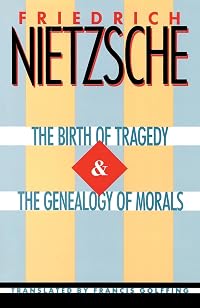
The Birth of Tragedy / The Genealogy of Morals
by Friedrich Nietzsche 
On This Page
Description
Two of Nietzsche's essential works about the conflict between the moral and aesthetic approaches to life, the impact of Christianity on human values, the meaning of science, the contrast between the Apollonian and Dionysian spirits, and other themes central to his thinking.--From publisher description.Tags
Recommendations























Member Reviews
This American translation brings together the first and last of Friedrich Nietzsche's great rants against the social reality of his time - 'The Birth of Tragedy' (1872) and 'The Genealogy of Morals' (1887). It is instructive to compare them.
'The Birth of Tragedy' was his first published book. One can understand why it was not well received by his academic colleagues since it is an extended fantasy on what the Greeks should have been like rather than necessarily what they were like.
There is a paradox (quite in keeping with Nietzsche's entire modus operandi) of having a thinker whose instinct was to attack all forms of socialised essentialism adopting a highly essentialised view of the classical world.
But one suspects that, by this show more point, the young Nietzsche no longer gave a damn about classical philology and simply saw an opportunity to plunder it to make entirely other points about society, politics and philosophy - a sort of 'breaking free' in its earliest stage of development.
The famous Apollonian-Dionysiac conflict (expressed surprisingly like Hegelian dialectic at one point) may have been sincerely meant but it was also a means to a psychological end still in the process of formulation.
There is an air of sustained hysteria throughout. The models for emulation, the mentors, are Schopenhauer and Wagner. Music and drama (and music drama) are presented in high-flown romantic terms as part of an aesthetic view of life and morality.
Germany is presented emotionally as the potential heir of the Greeks. A reference to 'dwarves' probably means the small minds of those who see the world in closely parsed academic terms but could also reference back to Wagner's Alberich and that could lead us to see them as the Jews.
So, in 1872, we have an angry young man, still in thrall to his mentors and the national-racist and pessimistic revolutionary culture of the period, trying to burn his boats, consciously or subconsciously, with the academic community that had nurtured him so far.
The rant allows him to explode not only at that community ('killing daddy') but also start his excoriation of the entire culture around it as decadent and not worthy of the potential for himself, his nation and the species. The ideas are ill-formed as yet but the seeds of the future are there.
Fifteen years later, the ranting methodology has not gone but now he has a market for it. He can say what he really thinks and, boy, does he do so. But he has also changed a great deal in the meantime - not in his core (which is integral) but in jettisoning what had held him back in 1872.
He has totally ditched his mentors. Not only is Wagner rejected but his aesthetic and antisemitism are damned, the first as inauthentic and the second as absurd. Schopenauer has been left behind as a pessimistic nay-sayer who could not see that the Will has to be directed outwards - to Life.
Instead, we now get three essays, not always perfectly coherent, which go straight to the jugular of Christian posturing in the closed-in culture of nineteenth century Europe and he slashes at that jugular without mercy. He clearly wants to kill the beast.
The rating should be five stars for this book but only three stars for the 1872 rant so we end up squaring the circle at four stars but be in no doubt that 'The Genealogy of Morals' is of devastating importance to Western culture as it was to develop over the subsequent decades.
What Nietzsche did (much as he had done in the previous book) was to create a simplistic mythic version of history (one that must upset any serious academic) and then weave out of this myth some remarkable psychological truths that are capable of completely rewiring the reader's mind.
I do not for a moment take seriously the notion that the 'Greeks' thought 'like that' in 'The Birth of Tragedy' nor would I accept the highly simplified account of pagan-Christian relations and history as other than a gross simplification of a complex reality.
However, just as 'The Birth of Tragedy' allows the reader to glimpse the possibility of revolt against the habits imposed on us by an unthinking socialisation, so 'Genealogy of Morals' brilliantly shatters the self-image of society as good rather than evil. It postulates another way of thinking.
Nietzsche's writing, the writing of an aggressive ego, states radical things but the rewiring of the brain comes from the realisation, at a much more subtle level, that, whatever the absurdity of his analyses at this point or another, what he says is psychologically and socially true.
The rewiring comes from a shock tactic, the only way we can ever get out of our habitual ways of thinking. Simple logical argument that takes us from A to B to C might 'persuade' us intellectually but Nietzsche's approach hits a deeper emotional level where change actually happens.
Intellectual persuasion just layers us with another variation of the world into which we are habituated but emotional shock can change how we see that world altogether. If our perception of reality changes, we change.
We have, of course, to throw ourselves backwards in time to the Central European (indeed Western) culture of the 1880s (before Freud) in order to understand just how shocking some of Nietzsche's 'bestial' claims about its moral foundations and social presumptions were.
Nietzsche's influence grew after his death. Although most people now would probably avoid or evade Nietzsche's understanding of our situation, all the 'diseases' he identified are with us still. They are embedded in our species yet our culture is fundamentally different because of him.
Not just our culture - the way individual minds work in the West has been affected consciously or unconsciously by him much as we have been changed by the pre-existence of Descartes, Hume, Darwin or, later, Freud.
The achievement of Nietzsche was to look at the parallel worlds of science and morality and point out that both were secondary. We had become decadent (even if we might see them as necessary for survival) under their domination. We were potentially greater than either but had forgotten this.
Science and morality are useful but they are not necessarily 'true' when it comes to asking the central questions about what is it to be a human being in the world (a theme that Heidegger would take up with more rigour several decades later).
The 'shock' lies not any 'flat earth' denial of science (science is not denied, merely made secondary, which is, in itself, uncomfortable for positivists) but in an undermining of moral claims where they are imposed outside ourselves on us as individuals for the benefit of others.
The central claim of the book is famous, or infamous if you prefer - that Christian morality has insidiously destroyed us as a species, turning the strong into slaves serving slaves who are corralled into their slavery by an insidious priestly class.
Nietzsche goes where few have dared to go and where most, even his admirers, would not go today. His attack on 'compassion' as a virtue would shake most people as cruel and yet it is logical within a much wider critique of the cruelties involved in our own willing repression of ourselves.
His deeper point is that the contingent imposition on us by habit of the morality expressed in unemotional impositions from outside for a greater good do irreparable harm to our own selves - he prefigures Freud in some respects.
Worse, those who are the alleged beneficiaries of this morality are, in fact, its greatest victims, unable to develop themselves to their fullest as livers of a full life with all their animal emotions intact.
The emergence out of our university class of a world of natural victims, intersectionality, activism (the new presbyters), self-imposed liberal middle class guilt, self censorship and submission would have been recognised as the 'eternal return' of the slave culture he excoriates.
I have always thought that Nietzsche's polemic detaches itself here from his own reality. He has to make his point but his breakdown over the flogging of that horse in Turin indicates a man who was not without compassion and that this 'hardness' was as much towards himself as others.
He wanted to gain Life in a society that was built to say 'nay' to every pleasure. And, of course, the English philosophers of the late seventeenth and eighteenth century would have easily allowed good sentiments and paganism to co-exist - but Nietzsche lived in Kaiserine Philistia.
In this paradox of saying one thing and being another, he reminds me of De Sade who sees truths about our species no one else is willing to see, takes those truths to their logical conclusion but, ultimately, and desperately, wants a world where he is wrong about our condition.
The question with Nietzsche is always whether we are prepared to accept the truth he expresses or find a better argument against him. Most critics have not done so without appealing to various forms of magical thinking. We are left with the necessity to reject truth-telling to live in society.
The classic liberal mind finds this very difficult because it has been trained to see the truth as good and that the good is true. To discover (which is the case) that existence is 'beyond good and evil' and that the good is constructed by men out of their circumstances is often too much to bear.
But there is another way of looking at this. That the search for the truth must lead inevitably in unpalatable directions but that, once we are led there and have it, it really no longer matters any more. All that mattered was to discover it and the discovery of it implies no need for meaning.
Meanwhile, the process of creating our own good is a series of choices related to our true selves (such as we make them). Social morality is best created (invented) by us and not by priests. We do not need to rely on either habit or moralists.
Compassion (distinguishable from the patronising Buddhist version or the psychic vampirism of Christian social relations) might re-emerge on a more solid base as the natural magnanimity of the person in full control of themselves with no desire to harm others, ready to assist from strength.
The risk, of course, is that it doesn't - that the reader of Nietzsche is a sociopath (many sociopaths have taken their cue from him). And so we are back to the inevitability of a repressive socialisation where Nietzsche merely enables the salvationary idea of rebellion against its oppressions.
Even today, 'The Genealogy of Morals' remains well worth reading. It strips away our assumptions that the world we have been given is in any way connected to the 'truth of things' and it helps us choose those half-truths necessary to hold things together regardless.
Christianity survives and prospers to this day because it is a sufficient half-truth to hold things together for many individuals and some societies but anyone who reads Nietzsche and does not 'have faith' (magical thinking) at least knows the true basis of its utility and can come to a view. show less
'The Birth of Tragedy' was his first published book. One can understand why it was not well received by his academic colleagues since it is an extended fantasy on what the Greeks should have been like rather than necessarily what they were like.
There is a paradox (quite in keeping with Nietzsche's entire modus operandi) of having a thinker whose instinct was to attack all forms of socialised essentialism adopting a highly essentialised view of the classical world.
But one suspects that, by this show more point, the young Nietzsche no longer gave a damn about classical philology and simply saw an opportunity to plunder it to make entirely other points about society, politics and philosophy - a sort of 'breaking free' in its earliest stage of development.
The famous Apollonian-Dionysiac conflict (expressed surprisingly like Hegelian dialectic at one point) may have been sincerely meant but it was also a means to a psychological end still in the process of formulation.
There is an air of sustained hysteria throughout. The models for emulation, the mentors, are Schopenhauer and Wagner. Music and drama (and music drama) are presented in high-flown romantic terms as part of an aesthetic view of life and morality.
Germany is presented emotionally as the potential heir of the Greeks. A reference to 'dwarves' probably means the small minds of those who see the world in closely parsed academic terms but could also reference back to Wagner's Alberich and that could lead us to see them as the Jews.
So, in 1872, we have an angry young man, still in thrall to his mentors and the national-racist and pessimistic revolutionary culture of the period, trying to burn his boats, consciously or subconsciously, with the academic community that had nurtured him so far.
The rant allows him to explode not only at that community ('killing daddy') but also start his excoriation of the entire culture around it as decadent and not worthy of the potential for himself, his nation and the species. The ideas are ill-formed as yet but the seeds of the future are there.
Fifteen years later, the ranting methodology has not gone but now he has a market for it. He can say what he really thinks and, boy, does he do so. But he has also changed a great deal in the meantime - not in his core (which is integral) but in jettisoning what had held him back in 1872.
He has totally ditched his mentors. Not only is Wagner rejected but his aesthetic and antisemitism are damned, the first as inauthentic and the second as absurd. Schopenauer has been left behind as a pessimistic nay-sayer who could not see that the Will has to be directed outwards - to Life.
Instead, we now get three essays, not always perfectly coherent, which go straight to the jugular of Christian posturing in the closed-in culture of nineteenth century Europe and he slashes at that jugular without mercy. He clearly wants to kill the beast.
The rating should be five stars for this book but only three stars for the 1872 rant so we end up squaring the circle at four stars but be in no doubt that 'The Genealogy of Morals' is of devastating importance to Western culture as it was to develop over the subsequent decades.
What Nietzsche did (much as he had done in the previous book) was to create a simplistic mythic version of history (one that must upset any serious academic) and then weave out of this myth some remarkable psychological truths that are capable of completely rewiring the reader's mind.
I do not for a moment take seriously the notion that the 'Greeks' thought 'like that' in 'The Birth of Tragedy' nor would I accept the highly simplified account of pagan-Christian relations and history as other than a gross simplification of a complex reality.
However, just as 'The Birth of Tragedy' allows the reader to glimpse the possibility of revolt against the habits imposed on us by an unthinking socialisation, so 'Genealogy of Morals' brilliantly shatters the self-image of society as good rather than evil. It postulates another way of thinking.
Nietzsche's writing, the writing of an aggressive ego, states radical things but the rewiring of the brain comes from the realisation, at a much more subtle level, that, whatever the absurdity of his analyses at this point or another, what he says is psychologically and socially true.
The rewiring comes from a shock tactic, the only way we can ever get out of our habitual ways of thinking. Simple logical argument that takes us from A to B to C might 'persuade' us intellectually but Nietzsche's approach hits a deeper emotional level where change actually happens.
Intellectual persuasion just layers us with another variation of the world into which we are habituated but emotional shock can change how we see that world altogether. If our perception of reality changes, we change.
We have, of course, to throw ourselves backwards in time to the Central European (indeed Western) culture of the 1880s (before Freud) in order to understand just how shocking some of Nietzsche's 'bestial' claims about its moral foundations and social presumptions were.
Nietzsche's influence grew after his death. Although most people now would probably avoid or evade Nietzsche's understanding of our situation, all the 'diseases' he identified are with us still. They are embedded in our species yet our culture is fundamentally different because of him.
Not just our culture - the way individual minds work in the West has been affected consciously or unconsciously by him much as we have been changed by the pre-existence of Descartes, Hume, Darwin or, later, Freud.
The achievement of Nietzsche was to look at the parallel worlds of science and morality and point out that both were secondary. We had become decadent (even if we might see them as necessary for survival) under their domination. We were potentially greater than either but had forgotten this.
Science and morality are useful but they are not necessarily 'true' when it comes to asking the central questions about what is it to be a human being in the world (a theme that Heidegger would take up with more rigour several decades later).
The 'shock' lies not any 'flat earth' denial of science (science is not denied, merely made secondary, which is, in itself, uncomfortable for positivists) but in an undermining of moral claims where they are imposed outside ourselves on us as individuals for the benefit of others.
The central claim of the book is famous, or infamous if you prefer - that Christian morality has insidiously destroyed us as a species, turning the strong into slaves serving slaves who are corralled into their slavery by an insidious priestly class.
Nietzsche goes where few have dared to go and where most, even his admirers, would not go today. His attack on 'compassion' as a virtue would shake most people as cruel and yet it is logical within a much wider critique of the cruelties involved in our own willing repression of ourselves.
His deeper point is that the contingent imposition on us by habit of the morality expressed in unemotional impositions from outside for a greater good do irreparable harm to our own selves - he prefigures Freud in some respects.
Worse, those who are the alleged beneficiaries of this morality are, in fact, its greatest victims, unable to develop themselves to their fullest as livers of a full life with all their animal emotions intact.
The emergence out of our university class of a world of natural victims, intersectionality, activism (the new presbyters), self-imposed liberal middle class guilt, self censorship and submission would have been recognised as the 'eternal return' of the slave culture he excoriates.
I have always thought that Nietzsche's polemic detaches itself here from his own reality. He has to make his point but his breakdown over the flogging of that horse in Turin indicates a man who was not without compassion and that this 'hardness' was as much towards himself as others.
He wanted to gain Life in a society that was built to say 'nay' to every pleasure. And, of course, the English philosophers of the late seventeenth and eighteenth century would have easily allowed good sentiments and paganism to co-exist - but Nietzsche lived in Kaiserine Philistia.
In this paradox of saying one thing and being another, he reminds me of De Sade who sees truths about our species no one else is willing to see, takes those truths to their logical conclusion but, ultimately, and desperately, wants a world where he is wrong about our condition.
The question with Nietzsche is always whether we are prepared to accept the truth he expresses or find a better argument against him. Most critics have not done so without appealing to various forms of magical thinking. We are left with the necessity to reject truth-telling to live in society.
The classic liberal mind finds this very difficult because it has been trained to see the truth as good and that the good is true. To discover (which is the case) that existence is 'beyond good and evil' and that the good is constructed by men out of their circumstances is often too much to bear.
But there is another way of looking at this. That the search for the truth must lead inevitably in unpalatable directions but that, once we are led there and have it, it really no longer matters any more. All that mattered was to discover it and the discovery of it implies no need for meaning.
Meanwhile, the process of creating our own good is a series of choices related to our true selves (such as we make them). Social morality is best created (invented) by us and not by priests. We do not need to rely on either habit or moralists.
Compassion (distinguishable from the patronising Buddhist version or the psychic vampirism of Christian social relations) might re-emerge on a more solid base as the natural magnanimity of the person in full control of themselves with no desire to harm others, ready to assist from strength.
The risk, of course, is that it doesn't - that the reader of Nietzsche is a sociopath (many sociopaths have taken their cue from him). And so we are back to the inevitability of a repressive socialisation where Nietzsche merely enables the salvationary idea of rebellion against its oppressions.
Even today, 'The Genealogy of Morals' remains well worth reading. It strips away our assumptions that the world we have been given is in any way connected to the 'truth of things' and it helps us choose those half-truths necessary to hold things together regardless.
Christianity survives and prospers to this day because it is a sufficient half-truth to hold things together for many individuals and some societies but anyone who reads Nietzsche and does not 'have faith' (magical thinking) at least knows the true basis of its utility and can come to a view. show less
Nietzsche seems to have two major themes in this book-- that Greek tragedy was a result of the conflict between opposing ideologies, and that its decline began with the ascendance of one over the other. I think there are several connections/parallels between his description of Greek tragedy and the rise of the novel.
Nietzsche tells of the Dionysian ritual, with its use of music, and makes the claim that tragedy began with this. The music was provided by the chorus, which sang the story. The rituals of Dionysis, we are told, brought about a state like intoxication, in which the sense of individual was lost in the larger community of being; the chorus was the whole audience, and acting out the play provided an intuitive glimpse of the show more metaphysical belief system. Plays, at this level, were probably no more than current responsive reading rituals.
This changed with the Apollonian influence, which was the power of dream, not intoxication; the power to see clearly, as embodied in the epic, and in sculpture, and to notice, rather than lose, the individual particulars, described, rather than participated in, reality. Dionysis symbolized process, Apollo, the ideal as manifested in forms.
The blending of these two cultures brought mythology to the stage. Instead of just having a drunken camp-fire songfest, as Dionysis would, Apollo told the stories of great beings, who had lived up to the ideal despite great consequences. These stories, however, only held the stage for two generations before losing contact with the orgiastic Dionysian spirit of music which had spawned them. Apollo took over when Socrates denied that Dionysis could provide true wisdom, but suggested that, through the knowledge of particulars, Apollo could. I agree with Nietzsche and Blake, that Socrates was mistaken, as does an entire sect of Hinduism. show less
Nietzsche tells of the Dionysian ritual, with its use of music, and makes the claim that tragedy began with this. The music was provided by the chorus, which sang the story. The rituals of Dionysis, we are told, brought about a state like intoxication, in which the sense of individual was lost in the larger community of being; the chorus was the whole audience, and acting out the play provided an intuitive glimpse of the show more metaphysical belief system. Plays, at this level, were probably no more than current responsive reading rituals.
This changed with the Apollonian influence, which was the power of dream, not intoxication; the power to see clearly, as embodied in the epic, and in sculpture, and to notice, rather than lose, the individual particulars, described, rather than participated in, reality. Dionysis symbolized process, Apollo, the ideal as manifested in forms.
The blending of these two cultures brought mythology to the stage. Instead of just having a drunken camp-fire songfest, as Dionysis would, Apollo told the stories of great beings, who had lived up to the ideal despite great consequences. These stories, however, only held the stage for two generations before losing contact with the orgiastic Dionysian spirit of music which had spawned them. Apollo took over when Socrates denied that Dionysis could provide true wisdom, but suggested that, through the knowledge of particulars, Apollo could. I agree with Nietzsche and Blake, that Socrates was mistaken, as does an entire sect of Hinduism. show less
Eccentric? Yes. Overrated? No way. I think the key to read Nietzsche is not to take him too seriously. He provides excellent conversation starters. My copy is full of underlines, highlights, margin notes, and exclamations.
Nietzsche delivered his first major work with The Birth of Tragedy in 1872, a theoretical exploration of Greek tragedy in which he distinguishes between 'Apollonian' (derived from the sun-god Apollo, symbolizing light, form, and clarity) and 'Dionysian' (derived from the god of wine, drunkenness, and ecstasy Dionysus) qualities. The highest Greek art combined the assertive masculine strength and irrational chaos of Dionysus (corresponding with Schopenhauer's world as will; artistically realized in music) with the individuated, gentle feminine grace of Apollo, the foundation for analytic distinctions and rational structure (corresponding with Schopenhauer's world as representation, where reigns the principle of individuation; show more artistically realized in sculpture). Dionysian conquest of pessimism through art was the profoundest feature of Greek drama. "Tragic optimism” is the mood of the strong man who seeks intensity and extent of experience, even at the cost of woe, delighted to find that strife is the law of life.
Near the end of his literary career (1887), Nietzsche delivered The Genealogy of Morals, an unrestrained and confrontational critique of moral values from a historical perspective in which he asserts a Christian inversion of moral values, in which values once deemed "good" (strength, courage, love of adventure, honor) have come to be considered "evil", and values once considered "bad" (humility, pity, security, peace) have come to be considered "good". Nietzsche calls this new "good" morality a morality for the herd or "slave morality", and the new "bad" morality a "master morality", a morality for the noble and aristocratic.
Nietzsche viewed humans as having tragically lost their natural instinct, or having had their primal instinct retarded or dulled through the process of social development, including the development of language. He advocated a rejection of modern comfort and a return to nature to awaken and sharpen the senses and instinct. This reversion to an original state of instinct would elevate the condition of the cultured man to one of an aristocratic type of self-sufficiency. Nietzsche believed that civilization kills nobility, and promotes laziness and weakness. Humans should strive for independence, not democratic domestication.
Nietzsche referred to humans as the "sickest" animal because they are over-cultured, and have moved far away from their natural state. Humans have become nature's most domesticated animal, and through this process of domestication the human body has become sickeningly denigrated. To cure themselves of this affliction, humans must relearn how to live dangerously. Suffering breeds strength when experienced in the proper perspective; "That which does not kill us makes us stronger."
The large number of domesticated humans has led to the development of what Nietzsche termed 'herd-morality'. Nietzsche viewed nature as "beyond good and evil", and observed that humans are naturally unequal. Morality is an invention of the weak to limit and deter the strong. The true morality is the courage of the powerful.
Master Morality: manhood, courage, enterprise, bravery (Roman virtue); love of danger and power; strength; sternness; initiative; pride of honor (pagan, Roman, feudal, aristocratic); strength and health over reason and conscience; morality of the Superman, beyond good and evil
Herd Morality: humility bred by subjection, altruism bred by helplessness; love of security and peace; cunning aroused by secret revenge; pity; imitation; stings of conscience (Jewish, Christian, bourgeois, democratic); reason and conscience over strength and desire; suppression of natural instincts as “evil”. Nietzsche was not a fan of pity. Pity makes one feel superior to the sick and helpless. show less
Near the end of his literary career (1887), Nietzsche delivered The Genealogy of Morals, an unrestrained and confrontational critique of moral values from a historical perspective in which he asserts a Christian inversion of moral values, in which values once deemed "good" (strength, courage, love of adventure, honor) have come to be considered "evil", and values once considered "bad" (humility, pity, security, peace) have come to be considered "good". Nietzsche calls this new "good" morality a morality for the herd or "slave morality", and the new "bad" morality a "master morality", a morality for the noble and aristocratic.
Nietzsche viewed humans as having tragically lost their natural instinct, or having had their primal instinct retarded or dulled through the process of social development, including the development of language. He advocated a rejection of modern comfort and a return to nature to awaken and sharpen the senses and instinct. This reversion to an original state of instinct would elevate the condition of the cultured man to one of an aristocratic type of self-sufficiency. Nietzsche believed that civilization kills nobility, and promotes laziness and weakness. Humans should strive for independence, not democratic domestication.
Nietzsche referred to humans as the "sickest" animal because they are over-cultured, and have moved far away from their natural state. Humans have become nature's most domesticated animal, and through this process of domestication the human body has become sickeningly denigrated. To cure themselves of this affliction, humans must relearn how to live dangerously. Suffering breeds strength when experienced in the proper perspective; "That which does not kill us makes us stronger."
The large number of domesticated humans has led to the development of what Nietzsche termed 'herd-morality'. Nietzsche viewed nature as "beyond good and evil", and observed that humans are naturally unequal. Morality is an invention of the weak to limit and deter the strong. The true morality is the courage of the powerful.
Master Morality: manhood, courage, enterprise, bravery (Roman virtue); love of danger and power; strength; sternness; initiative; pride of honor (pagan, Roman, feudal, aristocratic); strength and health over reason and conscience; morality of the Superman, beyond good and evil
Herd Morality: humility bred by subjection, altruism bred by helplessness; love of security and peace; cunning aroused by secret revenge; pity; imitation; stings of conscience (Jewish, Christian, bourgeois, democratic); reason and conscience over strength and desire; suppression of natural instincts as “evil”. Nietzsche was not a fan of pity. Pity makes one feel superior to the sick and helpless. show less
analysis of what tragedy provides for humans and also a model for appolonian and dyonisus critcal approach--reason and irrational.
Nietzsche is overrated and eccentric.
Members
- Recently Added By
Lists

Junky Paperbacks
15 works; 1 member
Author Information

1,379+ Works 78,160 Members
The son of a Lutheran pastor, Friedrich Wilhelm Nietzsche was born in 1844 in Roecken, Prussia, and studied classical philology at the Universities of Bonn and Leipzig. While at Leipzig he read the works of Schopenhauer, which greatly impressed him. He also became a disciple of the composer Richard Wagner. At the very early age of 25, Nietzsche show more was appointed professor at the University of Basel in Switzerland. In 1870, during the Franco-Prussian War, Nietzsche served in the medical corps of the Prussian army. While treating soldiers he contracted diphtheria and dysentery; he was never physically healthy afterward. Nietzsche's first book, The Birth of Tragedy Out of the Spirit of Music (1872), was a radical reinterpretation of Greek art and culture from a Schopenhaurian and Wagnerian standpoint. By 1874 Nietzsche had to retire from his university post for reasons of health. He was diagnosed at this time with a serious nervous disorder. He lived the next 15 years on his small university pension, dividing his time between Italy and Switzerland and writing constantly. He is best known for the works he produced after 1880, especially The Gay Science (1882), Thus Spake Zarathustra (1883-85), Beyond Good and Evil (1886), On the Genealogy of Morals (1887), The Antichrist (1888), and Twilight of the Idols (1888). In January 1889, Nietzsche suffered a sudden mental collapse; he lived the last 10 years of his life in a condition of insanity. After his death, his sister published many of his papers under the title The Will to Power. Nietzsche was a radical questioner who often wrote polemically with deliberate obscurity, intending to perplex, shock, and offend his readers. He attacked the entire metaphysical tradition in Western philosophy, especially Christianity and Christian morality, which he thought had reached its final and most decadent form in modern scientific humanism, with its ideals of liberalism and democracy. It has become increasingly clear that his writings are among the deepest and most prescient sources we have for acquiring a philosophical understanding of the roots of 20th-century culture. (Bowker Author Biography) show less
Friedrich Nietzsche has a Legacy Library. Legacy libraries are the personal libraries of famous readers, entered by LibraryThing members from the Legacy Libraries group.
Some Editions
Work Relationships
Common Knowledge
- Canonical title
- The Birth of Tragedy / The Genealogy of Morals
- Original title
- Die Geburt der Tragödie aus dem Geiste der Musik / Zur Genealogie der Moral
- Original publication date
- 1872; 1887
- People/Characters
- Friedrich Nietzsche; Zarathustra; Apollo; Dionysos; Arthur Schopenhauer; Johann Wolfgang von Goethe (1749-1832) (show all 7); Socrates (c. 470–399 BC)
- First words
- Much will have been gained for esthetics once we have succeeded in apprehending directly - rather than merely ascertaining - that art owes its continuous evolution to the Apollonian-Dionysiac duality, even as the propagation ... (show all)of the species depends on the duality of the sexes, their constant conflicts and periodic acts of reconciliation.
- Quotations
- "An artist worth his salt is permanently separated from ordinary reality."
The person who is responsive to the stimuli of art behaves toward the reality of dream much the way the philosopher behaves toward the reality of existence: he observes exactly and enjoys his observations, for it is by these ... (show all)images that he interprets life, by these processes that he rehearses it. - Last words
- (Click to show. Warning: May contain spoilers.)"But you should add, extraordinary stranger, what suffering must this race have endured in order to achieve such beauty! Now come with me to the tragedy and let us sacrifice in the temple of both gods."
Classifications
Statistics
- Members
- 1,263
- Popularity
- 19,376
- Reviews
- 8
- Rating
- (3.94)
- Languages
- English, Italian
- Media
- Paper, Ebook
- ISBNs
- 4
- ASINs
- 13