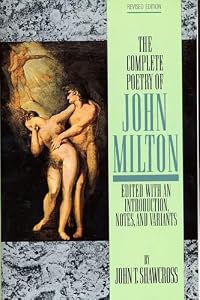
John Milton: The Complete Poems
by John Milton
On This Page
Description
This book draws together case analyses of public-private partnerships in four different countries: Australia, France, Romania and Spain. It represents research efforts conducted from December 2007 to November 2012, and it covers a wide range of experiences in planning and implementing public-private partnerships in countries that belong to two very different socio-economic regions: Europe and Australia. The study on Australia deals with key concepts and types of public-partnerships, as well show more as performance and evaluation issues. While the analysis on France focuses on water sanitation and publi show lessTags
Recommendations










Member Reviews
Somewhat pretentiously, I decided to read some of 'The Classics' in order to inflate an already bloated ego. This was one of those classics. Now I don't doubt Milton's skill, or that some people find it fascinating, but, having been a huge fan of The Secret 7 as a boy, I'm sorry to say that the rather protracted and verbose text left me cold. Perhaps I'm simply not ready for 'The Classics' after all.
I chose this for the prompt "a book on someone else's bookshelf" and the someone else is my daughter. For some reason, she picked this up last year during quarantine and became obsessed with it. She spends lots of her free time researching it, reading critical analysis of it and so she wanted me to read it so we could discuss it. Although I know I studied it at some point in school, I have to say that I didn't remember much of it. It was much more dense in its writing than I remembered and am still confused by my daughter's passion for it. Of course, the most interesting character is the devil since he is written with complexity and all the other characters are pretty one dimensional. We are meant to be taken in by him and feel sympathy show more for him which is quite a blasphemous approach. This is just one of the many issues that I'm sure I will be discussing and debating with my daughter until she's onto her next kick...which hopefully won't be another 500 page epic poem (as I quickly hide The Illiad and The Odyssey...maybe Beowulf is short enough to leave out - lol). I have also just read a lot books on racism, discrimination, civil rights, LGBT rights, and lots of other heavy subjects so my brain needs a few dumb thrillers now. show less
The proto-Whig mind always somewhat gross. Milton has some striking lines--I was surprised how many have become almost proverbial, suggesting a wider readership in times past--but overall he is just tiresome.
One of our university lecturers spent a lot of time trying to convince us that “Milton was better than Shakespeare” because he chose his words more carefully for their exact effect and placing, often with deliberate reference to the Latin derivation. I remained unconvinced. Favourite: the sonnet “On Shakespeare”! I quite enjoy “Hymn on the Morning of Christ’s Nativity” ("the star-led Wizards haste with odours sweet"!) and “Lycidas”, but they are a bit long to be favourites. And I do like “Sabrina fair, listen where thou art sitting”, from “Comus”.
John Milton deserves to be read by everyone - Not only did I enjoy the classic Paradise Lost, but I also found solace in Samson Agonistes and courage in Paradise Regained. The older style of English might take some time to acclimate to, but once done so the reading has a natural flow and beauty to it.
John Milton is a poet who wrote in the 17th century. It was a time of great upheavel in England, and Milton was in the thick of it. I started this book in January read up to Paradise Lost and put it down again and just lately I read that and the last two poems Paradise Regained and Samson Agonistes. I'll review these poems as these are epic works.
Paradise Lost- traces the beginnings of the fall of man in creation. From the moment Satan was cast out of heaven till Adam's expulsion from the garden. I don't know where Milton got all his ideas but it is a very well written poem that manages to capture the tragedy of Adam's sin.
Paradise Regained- Poem about the temptation of Christ in the desert. Connects to Paradise Lost in Jesus' show more substitution of Adam in being tempted by the Devil. I often wonder about Jesus' unique combination of humanity and divinity and while this poem doesn't solve that it provides some idea of the degree of Satan's challenge.
Samson Agonistes- This poem takes place in the jail after Samson's arrest and betrayal by Delilah and ends with his death and the resulting death of the Philistines and the destruction of Dagon's palace. show less
Paradise Lost- traces the beginnings of the fall of man in creation. From the moment Satan was cast out of heaven till Adam's expulsion from the garden. I don't know where Milton got all his ideas but it is a very well written poem that manages to capture the tragedy of Adam's sin.
Paradise Regained- Poem about the temptation of Christ in the desert. Connects to Paradise Lost in Jesus' show more substitution of Adam in being tempted by the Devil. I often wonder about Jesus' unique combination of humanity and divinity and while this poem doesn't solve that it provides some idea of the degree of Satan's challenge.
Samson Agonistes- This poem takes place in the jail after Samson's arrest and betrayal by Delilah and ends with his death and the resulting death of the Philistines and the destruction of Dagon's palace. show less
I am exceedingly grateful to the media for their interest in Milton's 400th anniversary which, encouraged me to revisit the works of one of England's greatest authors.
I find poetry quite difficult to read: it does not take well to speed reading techniques, as every word is significant but, I am willing to struggle with quality such as this. Paradise Lost is unlike anything else I have ever read and, apparently Milton added more new words to the English language than did Shakespeare!
I find poetry quite difficult to read: it does not take well to speed reading techniques, as every word is significant but, I am willing to struggle with quality such as this. Paradise Lost is unlike anything else I have ever read and, apparently Milton added more new words to the English language than did Shakespeare!
Members
- Recently Added By
Lists

Top-Rated Books on LibraryThing
272 works; 117 members

CCE 1000 Good Books List
1,033 works; 12 members

CCE 100 Great Books List
145 works; 8 members

Philip Ward's Lifetime Reading Plan
592 works; 22 members

New Lifetime Reading Plan by Fadiman and Major
225 works; 5 members

My List
302 works; 1 member

Ambleside Year 8
80 works; 1 member
Author Information

764+ Works 35,355 Members
John Milton, English scholar and classical poet, is one of the major figures of Western literature. He was born in 1608 into a prosperous London family. By the age of 17, he was proficient in Latin, Greek, and Hebrew. Milton attended Cambridge University, earning a B.A. and an M.A. before secluding himself for five years to read, write and study show more on his own. It is believed that Milton read evertything that had been published in Latin, Greek, and English. He was considered one of the most educated men of his time. Milton also had a reputation as a radical. After his own wife left him early in their marriage, Milton published an unpopular treatise supporting divorce in the case of incompatibility. Milton was also a vocal supporter of Oliver Cromwell and worked for him. Milton's first work, Lycidas, an elegy on the death of a classmate, was published in 1632, and he had numerous works published in the ensuing years, including Pastoral and Areopagitica. His Christian epic poem, Paradise Lost, which traced humanity's fall from divine grace, appeared in 1667, assuring his place as one of the finest non-dramatic poet of the Renaissance Age. Milton went blind at the age of 43 from the incredible strain he placed on his eyes. Amazingly, Paradise Lost and his other major works, Paradise Regained and Samson Agonistes, were composed after the lost of his sight. These major works were painstakingly and slowly dictated to secretaries. John Milton died in 1674. (Bowker Author Biography) show less
Some Editions
Series
Belongs to Publisher Series
Work Relationships
Is contained in
Contains
Has as a student's study guide
Common Knowledge
- Canonical title
- John Milton: The Complete Poems
- Original publication date
- 1779
- People/Characters
- John Milton; Jesus Christ; Jane Savage, Marchioness of Winchester; William Shakespeare; Lycidas; Horace (show all 18); Thomas Fairfax; Oliver Cromwell; Henry Vane the Younger; Cyriack Skinner; Dante Alighieri; Petrarch; Ludovico Ariosto; Sophocles; Euripides; Seneca the Younger; Satan; Samson
- Important places
- England, UK
- Important events
- 17th century; Stuart Era; Caroline Era; Interregnum; Stuart Restoration
- First words
- John Milton was born on the morning of the 9th December 1608, in Bread Street, London.
- Original language
- English; Latin; Greek
- Disambiguation notice
- Please only combine here works containing the complete poems. Do not combine with selections, or with works containing selections of Milton's prose.
Query: Do you mean COMPLETE Complete Poems (including his Latin poetr... (show all)y) or just Complete ENGLISH Poems. Those aren't quite the same thing but they're combined in this work.
Classifications
Statistics
- Members
- 2,779
- Popularity
- 6,521
- Reviews
- 17
- Rating
- (4.17)
- Languages
- English, French, Italian
- Media
- Paper, Ebook
- ISBNs
- 62
- ASINs
- 153