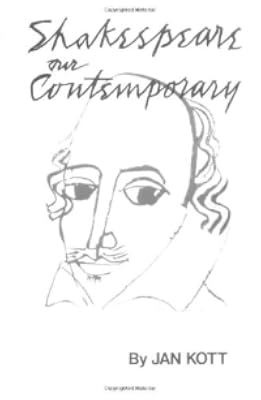
Shakespeare, Our Contemporary
by Jan Kott
On This Page
Description
Shakespeare, Our Contemporary is a provocative, original study of the major plays of Shakespeare. More than that, it is one of the few critical works to have strongly influenced theatrical productions. Peter Brook and Charles Marowitz are among the many directors who have acknowledged their debt to Jan Kott, finding in his analogies between Shakespearean situations and those in modern life and drama the seeds of vital new stage conceptions. Shakespeare, Our Contemporary has been translated show more into nineteen languages since it appeared in 1961, and readers all over the world have similarly found their responses to Shakespeare broadened and enriched. show lessTags
Recommendations














Member Reviews
What I remember most about this book is how much it lives up to its title. For anyone living in a state where power belongs to the most powerful, unscrupulous, or sneakiest, all the issues in Shakespeare's dramas are actual. Kott has lived under communism and knows first hand about the paranoia of those who reign by force and who risk losing power or their life at the hands of others who wish to rule.
Shakespeare Our Contemporary by Jan Kott. 1964. Read in March 2009.
This book is one of the most important ever written about Shakespeare. First published in Polish in the 1960's it brought a radically new view of Shakespeare to Western literature analysis. As Peter Brook points out in the preface, Jan Kott, having lived in Poland in the turbulent 20's, 30's,40's, 50's and 60's, experienced personally many of the things Shakespeare wrote about. He could therefore, unlike almost all other modern scholars, consider Shakespeare his contemporary and unlike any other scholar I have come across so far, Kott succeeds in showing in his book why Shakespeare is not just some clever productive Renaissance author that we have to read because he's show more part of the canon, but that his plays are highly relevant to our lives today.
Careful readers of this blog will have noticed that I have often referred to Kott in my play analyses.
In his chapter “The Kings”, which I used in my texts on Henry VI, the Richards and Henry IV, Kott writes , “There are no gods in Shakespeare. There are only kings, every one of whom is an executioner, and victim in turn. There are also living, frightened people...The greatness of Shakespeare's realism consists in his awareness of the extent to which people are involved in history” (p. 19-20). Kott, himself a Polish Jew, a Marxist, a resistance fighter in World War Two, a literary critic leading the opposition to Stalin in the 50's (all according to Martin Esslin in the book's introduction), should know.
This book is not a cheerful read. Kott's experience and his academic depth find that in Shakespeare, and in life, “the abyss, into which one can jump, is everywhere” (p.146) and that, “[i]n Shakespeare's play [King Lear] there is neither Christian Heaven nor the heaven predicted and believed in by humanists” (p. 147). He shows throughout the book how Shakespeare avoids the absolute, in fact “the absolute has ceased to exist. It has been replaced by the absurdity of the human condition” (p. 137).
A prolific literary critic, Kott spent the last thirty or so years of his life in the United States. He died at the age of 87 in 2001. Since then Shakespeare Our Contemporary has remained one of the most influential books on Shakespeare and references to it can be found almost wherever one looks. I will certainly continue to refer to him. A grim book, yes, but very exciting. After all, what can be more exciting than the absurdity of the human condition? Nobody did it better than Shakespeare and nobody has so far made Shakespeare's connection to the 20th century better than Jan Kott.
First posted on rubyjandshakespearecalling@blogspot.com show less
This book is one of the most important ever written about Shakespeare. First published in Polish in the 1960's it brought a radically new view of Shakespeare to Western literature analysis. As Peter Brook points out in the preface, Jan Kott, having lived in Poland in the turbulent 20's, 30's,40's, 50's and 60's, experienced personally many of the things Shakespeare wrote about. He could therefore, unlike almost all other modern scholars, consider Shakespeare his contemporary and unlike any other scholar I have come across so far, Kott succeeds in showing in his book why Shakespeare is not just some clever productive Renaissance author that we have to read because he's show more part of the canon, but that his plays are highly relevant to our lives today.
Careful readers of this blog will have noticed that I have often referred to Kott in my play analyses.
In his chapter “The Kings”, which I used in my texts on Henry VI, the Richards and Henry IV, Kott writes , “There are no gods in Shakespeare. There are only kings, every one of whom is an executioner, and victim in turn. There are also living, frightened people...The greatness of Shakespeare's realism consists in his awareness of the extent to which people are involved in history” (p. 19-20). Kott, himself a Polish Jew, a Marxist, a resistance fighter in World War Two, a literary critic leading the opposition to Stalin in the 50's (all according to Martin Esslin in the book's introduction), should know.
This book is not a cheerful read. Kott's experience and his academic depth find that in Shakespeare, and in life, “the abyss, into which one can jump, is everywhere” (p.146) and that, “[i]n Shakespeare's play [King Lear] there is neither Christian Heaven nor the heaven predicted and believed in by humanists” (p. 147). He shows throughout the book how Shakespeare avoids the absolute, in fact “the absolute has ceased to exist. It has been replaced by the absurdity of the human condition” (p. 137).
A prolific literary critic, Kott spent the last thirty or so years of his life in the United States. He died at the age of 87 in 2001. Since then Shakespeare Our Contemporary has remained one of the most influential books on Shakespeare and references to it can be found almost wherever one looks. I will certainly continue to refer to him. A grim book, yes, but very exciting. After all, what can be more exciting than the absurdity of the human condition? Nobody did it better than Shakespeare and nobody has so far made Shakespeare's connection to the 20th century better than Jan Kott.
First posted on rubyjandshakespearecalling@blogspot.com show less
Ricordi ... Un corso monografico all'università, quando la letteratura era studiata alla luce di una ideologia. Il libro di Jan Kott "Shakespeare Our Contemporary" (1964) rappresenta proprio una rottura con quella critica ideologicamente orientata che lei ricorda. Kott, critico polacco che aveva vissuto gli orrori del nazismo e dello stalinismo, propose una lettura di Shakespeare radicalmente diversa: non come monumento letterario da studiare attraverso le lenti di questa o quella ideologia, ma come autore che parla direttamente alla nostra condizione umana.
La sua intuizione fondamentale fu di leggere Shakespeare attraverso l'esperienza del XX secolo - la violenza del potere, l'assurdità della storia, la crudeltà dei meccanismi show more politici - e scoprire che quei testi elisabettiani illuminavano con spietata lucidità la contemporaneità. I drammi storici come cronache del potere brutale, King Lear come teatro dell'assurdo ante litteram, Amleto come dramma dell'intellettuale paralizzato di fronte alla storia.
Quello che Kott comprese, e che va sottolineato, è che Shakespeare non è "contemporaneo" perché lo adattiamo alle nostre ideologie del momento, ma perché la sua comprensione della natura umana, del potere, della violenza, dell'amore, della morte, trascende ogni epoca. È contemporaneo non di questo o quel periodo storico, ma dell'uomo stesso.
La differenza con l'approccio ideologico che si voleva noi studiassimo è cruciale: non si tratta di piegare Shakespeare a confermare le nostre idee, ma di lasciare che ci interroghi. show less
La sua intuizione fondamentale fu di leggere Shakespeare attraverso l'esperienza del XX secolo - la violenza del potere, l'assurdità della storia, la crudeltà dei meccanismi show more politici - e scoprire che quei testi elisabettiani illuminavano con spietata lucidità la contemporaneità. I drammi storici come cronache del potere brutale, King Lear come teatro dell'assurdo ante litteram, Amleto come dramma dell'intellettuale paralizzato di fronte alla storia.
Quello che Kott comprese, e che va sottolineato, è che Shakespeare non è "contemporaneo" perché lo adattiamo alle nostre ideologie del momento, ma perché la sua comprensione della natura umana, del potere, della violenza, dell'amore, della morte, trascende ogni epoca. È contemporaneo non di questo o quel periodo storico, ma dell'uomo stesso.
La differenza con l'approccio ideologico che si voleva noi studiassimo è cruciale: non si tratta di piegare Shakespeare a confermare le nostre idee, ma di lasciare che ci interroghi. show less
Nov 2, 2017 (Edited)Italian
Ratings
Members
- Recently Added By
Lists

The Great Courses: Shakespeare's Tragedies
35 works; 1 member

Works concerning William Shakespeare
75 works; 4 members

In Our Time books
4,934 works; 2 members
Author Information

36+ Works 565 Members
Some Editions
Series
Belongs to Publisher Series
Common Knowledge
- Canonical title
- Shakespeare, Our Contemporary
- Original title
- Szkice o Szekspirze
- Original publication date
- 1964
Classifications
- Genres
- Nonfiction, Literature Studies and Criticism, Fiction and Literature
- DDC/MDS
- 822.33 — Literature & rhetoric English & Old English literatures English drama 1558-1625 Elizabethan period William Shakespeare
- LCC
- PR2979 .P58 .K63 — Language and Literature English English Literature English renaissance (1500-1640)
- BISAC
Statistics
- Members
- 342
- Popularity
- 92,761
- Reviews
- 3
- Rating
- (4.30)
- Languages
- 12 — Czech, Danish, Dutch, English, Finnish, French, Italian, Polish, Portuguese, Spanish, Swedish, Turkish
- Media
- Paper, Audiobook, Ebook
- ISBNs
- 25
- ASINs
- 7