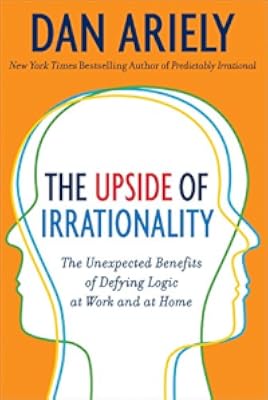
The Upside of Irrationality: The Unexpected Benefits of Defying Logic at Work and at Home
by Dan Ariely
On This Page
Description
How can confusing directions actually help us? Why can large bonuses make CEOs less productive? Why is there such a big difference between what we think will make us happy and what really makes us happy? In his groundbreaking book Predictably Irrational, social scientist Dan Ariely revealed the multiple biases that lead us into making unwise decisions. Now, in The Upside of Irrationality, he exposes the surprising negative and positive effects irrationality can have on our lives. Focusing on show more our behaviors at work and in relationships, he offers new insights about how one unwise action can become a long-term habit, how we learn to love the ones we're with, and more. From our office attitudes, to our romantic relationships, to our search for purpose in life, Ariely explains how to break through our negative patterns of thought and behavior to make better decisions.--From publisher description. show lessTags
Recommendations










Member Recommendations



Member Reviews
Ariely offers a kind of gonzo pop psychology that is enlightening, and entertaining. "Gonzo" because he interjects himself into the science when his life experiences drive questions to be answered and offer revealing anecdotes. Recovering from serious injuries and committing human foibles, Ariely seeks truth and is revealing in this personal work. He outlines the construction and implementation of experiments on either impoverished Indians or nearly impoverished university students to support that motivation is required by workers (duh) and bonuses decrease efficiency and do not incentivise (huh), etc. This becomes a framework to map the topography of irrationality in hums (and chimps, for that matter). Very interesting stuff. It seems show more weird at the end that Ariely underscores both the need of the scientific method and embracing irrationality which presents and unexplored contradiction. show less
This is a book I really wanted to love. I like it, but I don't love it. Ariely is an excellent speaker, so, having heard him speak, my expectations may have been a little too high. It's not that his book is poorly written or his conclusions full of howling errors, just that he is not as entertaining a writer as he is a speaker.
There's a tension in the book, as well. Ariely reveals, through experiments he's carried out in his academic career as a psychologist, ways in which we all fall well short of our rational self-image. It's not just that we occasionally do strange, irrational things, but that, as the title of his previous book says, we behave irrationally in predictable ways -- our buying decisions are influenced by the appearance show more of deals (real or illusory), our happiness is influenced by how close together or far apart in time the things that make us happy occur, our sympathy is aroused more strongly by a single case of suffering than by mass suffering, . . . and so on. Much of what he reveals is surprising, surprising about our own behavior. And all of this goes catastrophically against the grain of theories of rational agents in economics, game theory, etc.
But the title of this book implies that he is going to focus on the "upside" of irrationality. That's where the tension comes in. Often, revealing our irrational patterns is meant to allow us to overcome them (as in the buying decisions); other times it is meant to allow us to take advantage of them (as in his discussions of happiness and "hedonic adaptation"). The tension is between fully embracing and celebrating our irrationalities and resisting them, or even (as in the case of hedonic adaptation) learning how best to live rationally with them. Fully embracing our irrationality might mean such things as enjoying irrational urges to "get back" at someone even though it is against our long-term interests, or, maybe less self-destructively, giving ourselves more permission to play (without justifications in better relationships with our kids, our own fitness, our dog's fitness, . . . ). I don't think Ariely settled on either side -- of course, he doesn't have to, and maybe the tension is exactly right. show less
There's a tension in the book, as well. Ariely reveals, through experiments he's carried out in his academic career as a psychologist, ways in which we all fall well short of our rational self-image. It's not just that we occasionally do strange, irrational things, but that, as the title of his previous book says, we behave irrationally in predictable ways -- our buying decisions are influenced by the appearance show more of deals (real or illusory), our happiness is influenced by how close together or far apart in time the things that make us happy occur, our sympathy is aroused more strongly by a single case of suffering than by mass suffering, . . . and so on. Much of what he reveals is surprising, surprising about our own behavior. And all of this goes catastrophically against the grain of theories of rational agents in economics, game theory, etc.
But the title of this book implies that he is going to focus on the "upside" of irrationality. That's where the tension comes in. Often, revealing our irrational patterns is meant to allow us to overcome them (as in the buying decisions); other times it is meant to allow us to take advantage of them (as in his discussions of happiness and "hedonic adaptation"). The tension is between fully embracing and celebrating our irrationalities and resisting them, or even (as in the case of hedonic adaptation) learning how best to live rationally with them. Fully embracing our irrationality might mean such things as enjoying irrational urges to "get back" at someone even though it is against our long-term interests, or, maybe less self-destructively, giving ourselves more permission to play (without justifications in better relationships with our kids, our own fitness, our dog's fitness, . . . ). I don't think Ariely settled on either side -- of course, he doesn't have to, and maybe the tension is exactly right. show less
I'm almost always more impressed by the creativity of the experiments invented by researchers than I am by the conclusion, and this book is no exception: the conclusions are fairly mainstream - we are much more irrational in our decision-making than we like to think we are. The value of the book comes from how researchers were able to validate that in a variety of ways and under a myriad of circumstances.
Ariely's use of humour and his honesty about his own decisions and how his past informed them give the book a personal appeal which makes it easy to read and sometimes down-right fun.
This book will probably not change my own decision-making process, but it will make me a bit more aware of the influences around me and how my state of show more mind is a key player in my decision-making process. An informative and entertaining read. show less
Ariely's use of humour and his honesty about his own decisions and how his past informed them give the book a personal appeal which makes it easy to read and sometimes down-right fun.
This book will probably not change my own decision-making process, but it will make me a bit more aware of the influences around me and how my state of show more mind is a key player in my decision-making process. An informative and entertaining read. show less
Painless behavioral economics book exploring how we don’t behave like rational actors in the classic economic model—we seek revenge against those who have harmed us even when that is costly. Ariely talks about his history of recovering from extensive burns and experiencing continuing pain, and unfortunately chooses sexist jokes over real science when he talks about pain: in grad school, he did an experiment showing that men would keep their hands in extremely hot water for longer than women would while he was timing them. When he brought these results to his professor, a women, she told him that he hadn’t proven that men had a higher pain threshold, but that men were more foolish, and that if the stakes had been more serious he show more would have seen different results. He reiterates his conclusion and says, “I learned a lot about women that day.” No, he (should have) learned about the scientific method: the alternative hypothesis that men and women value “being able to keep hand in hot water” differently, perhaps because they differ in their response to being under observation, was another perfectly plausible explanation. More data were required, and he probably knows that, but still couldn’t resist the cheap joke.
In another oddity, Ariely has the bizarre idea that it’s unfair to punish a principal for acts of an agent: getting mad at the Gap, for example, because a Gap salesperson treats you badly. Now, it’s not right to take a sweater from the Gap because you’re mad at the salesperson, but the rule that principals are responsible for the acts of agents within the scope of their employment is foundational to the modern economy, and rightly so: if a Ford employee leaves out a key part when putting together my car and my car crashes, my remedy is against Ford, not against the likely impecunious employee. This rule encourages Ford to monitor its employees and to spread the costs of any mistakes. A contrary rule would require a lot more explanation, but Ariely is puzzled by why we’d attribute an agent’s misfeasance to his/her employer, which leads to a weird emphasis in the chapter about how our emotions contaminate logically unrelated transactions—an interesting topic in itself, since when we yell at our kids because our boss was mean we really are aiming in the wrong direction. show less
In another oddity, Ariely has the bizarre idea that it’s unfair to punish a principal for acts of an agent: getting mad at the Gap, for example, because a Gap salesperson treats you badly. Now, it’s not right to take a sweater from the Gap because you’re mad at the salesperson, but the rule that principals are responsible for the acts of agents within the scope of their employment is foundational to the modern economy, and rightly so: if a Ford employee leaves out a key part when putting together my car and my car crashes, my remedy is against Ford, not against the likely impecunious employee. This rule encourages Ford to monitor its employees and to spread the costs of any mistakes. A contrary rule would require a lot more explanation, but Ariely is puzzled by why we’d attribute an agent’s misfeasance to his/her employer, which leads to a weird emphasis in the chapter about how our emotions contaminate logically unrelated transactions—an interesting topic in itself, since when we yell at our kids because our boss was mean we really are aiming in the wrong direction. show less
JVP in expresso curto 23/2/2016
O QUE EU ANDO A LER
É do caos que muitas vezes surgem boas surpresas. Experimente arrumar a sua biblioteca. Daquelas arrumações que duram... e duram... Os montes que se formam avulsos são autênticas caixinhas de surpresas. O mais provável é acabar no chão a ler aquele livro que nunca tinha conseguido abrir ou a reler um que lhe deu verdadeiro prazer.
"O lado bom da irracionalidade", um livro de Dan Ariely, que ficou famoso por escrever uma outra obra —"Previsivelmente Irracional" —, voltou à minha mão cuspido por uma das torres que um dia voltará a estar arrumada na estante.
É difícil descrever o prazer que dá a quem é apaixonado por economia ler as pequenas experiências que este show more cientista social nos traz. Uma atrás de outra, ajudam-nos a explicar a suposta irracionalidade do mundo que nos rodeia.
O jogo do ultimato é uma experiência usada por economistas para estudar o comportamento dos agentes económicos. Dá-se ao líder uma certa quantia (neste caso 20 dólares) e este tem que dividir essa quantia numa qualquer proporção com outra pessoa. Sendo que essa pessoa não sabe quem é o líder, mas sabe que se recusar a divisão nenhum deles recebe qualquer valor.
Com base nestas premissas, alguém profundamente racional aceitaria qualquer divisão mesmo que essa fosse 19-1. Ficar com um dólar que seja é melhor que nada. Só que a economia comportamental descobriu que as pessoas se regem por critérios de justiça e de equidade e que por isso se considerarem a oferta injusta têm tendência a recusá-la, mesmo que isso signifique ficar sem nada. É por isso que este tipo de jogos acaba em média numa divisão de 12-8. Dan Ariely defende que quando são economistas a jogar aceitam qualquer divisão. Mesmo a 19-1.
"Mas quando economistas jogam com não economistas, sofrem uma profunda desilusão quando as suas propostas desiguais são rejeitadas.". Como cientista foi mais longe, expôs vários elementos do seu estudo a situações emocionais antes de tomarem uma decisão. Isto para concluir que uma pessoa que tenha sido, antes da sua escolha, sujeita a uma situação de raiva ou infelicidade tem mais tendência a rejeitar ofertas injustas. Pelo contrário, pessoas que foram sujeitas a situações de alegria ou felicidade têm mais tendência a aceitar divisões desiguais.
Contudo Ariely escreve ainda que, se inverter os papéis e se quem recebia antes a proposta fosse colocado a fazer a divisão, e se antes tivesse sido colocado na categoria infeliz, tem mais tendência a fazer agora uma proposta mais justa. E, pelo contrário, quem foi colocado na categoria feliz tem mais tendência a fazer uma divisão mais injusta. Isto porque existe auto-seguidismo nas decisões que tomamos...
Acredite, vale a pena ler para perceber porque é que são contraproducentes os bónus exagerados aos gestores, ou o que é o efeito IKEA... show less
O QUE EU ANDO A LER
É do caos que muitas vezes surgem boas surpresas. Experimente arrumar a sua biblioteca. Daquelas arrumações que duram... e duram... Os montes que se formam avulsos são autênticas caixinhas de surpresas. O mais provável é acabar no chão a ler aquele livro que nunca tinha conseguido abrir ou a reler um que lhe deu verdadeiro prazer.
"O lado bom da irracionalidade", um livro de Dan Ariely, que ficou famoso por escrever uma outra obra —"Previsivelmente Irracional" —, voltou à minha mão cuspido por uma das torres que um dia voltará a estar arrumada na estante.
É difícil descrever o prazer que dá a quem é apaixonado por economia ler as pequenas experiências que este show more cientista social nos traz. Uma atrás de outra, ajudam-nos a explicar a suposta irracionalidade do mundo que nos rodeia.
O jogo do ultimato é uma experiência usada por economistas para estudar o comportamento dos agentes económicos. Dá-se ao líder uma certa quantia (neste caso 20 dólares) e este tem que dividir essa quantia numa qualquer proporção com outra pessoa. Sendo que essa pessoa não sabe quem é o líder, mas sabe que se recusar a divisão nenhum deles recebe qualquer valor.
Com base nestas premissas, alguém profundamente racional aceitaria qualquer divisão mesmo que essa fosse 19-1. Ficar com um dólar que seja é melhor que nada. Só que a economia comportamental descobriu que as pessoas se regem por critérios de justiça e de equidade e que por isso se considerarem a oferta injusta têm tendência a recusá-la, mesmo que isso signifique ficar sem nada. É por isso que este tipo de jogos acaba em média numa divisão de 12-8. Dan Ariely defende que quando são economistas a jogar aceitam qualquer divisão. Mesmo a 19-1.
"Mas quando economistas jogam com não economistas, sofrem uma profunda desilusão quando as suas propostas desiguais são rejeitadas.". Como cientista foi mais longe, expôs vários elementos do seu estudo a situações emocionais antes de tomarem uma decisão. Isto para concluir que uma pessoa que tenha sido, antes da sua escolha, sujeita a uma situação de raiva ou infelicidade tem mais tendência a rejeitar ofertas injustas. Pelo contrário, pessoas que foram sujeitas a situações de alegria ou felicidade têm mais tendência a aceitar divisões desiguais.
Contudo Ariely escreve ainda que, se inverter os papéis e se quem recebia antes a proposta fosse colocado a fazer a divisão, e se antes tivesse sido colocado na categoria infeliz, tem mais tendência a fazer agora uma proposta mais justa. E, pelo contrário, quem foi colocado na categoria feliz tem mais tendência a fazer uma divisão mais injusta. Isto porque existe auto-seguidismo nas decisões que tomamos...
Acredite, vale a pena ler para perceber porque é que são contraproducentes os bónus exagerados aos gestores, ou o que é o efeito IKEA... show less
The first thing to understand about Dan Ariely's The Upside of Irrationality (and his related book Predictably Irrational) is that by "irrational", Ariely is not describing actions that are insane, foolish, or stupid. Instead, irrationality is used in contrast to the "rational economic agent" model used in standard economics. In that model, people in the aggregate can be treated as rational beings who strive to maximize their benefit while avoiding decisions that are costly, time consuming, or require additional work if they can. As he pointed out in Predicatbly Irrational, experimental evidence shows that people make decisions that don't fit this model, but do so in predictable ways, calling into question the conclusions reached by show more standard economics in many areas. In this volume, Ariely expands upon the ideas in Predictably Irrational and explores the possible reasons behind this consistent irrationality and why it may actually be beneficial in many cases.
One might think that the primary difference between standard economics and behavioral economics is the abandonment of the rational economic actor standard. But the real difference seems to stem from the fact that a behavioral economist seeks to test their assumption and at least make an effort to evaluate whether they are justified, whereas most of the assumptions underlying standard economics are not only untested, but many are to a certain extent untestable. While many adherents to the standard economic models criticize behavioral economists conclusions that are at variance with the standard theories, one has to wonder on what basis they do this? It is certain that many experiments done by behavioral economists are crude at best, as the ones illustrated in The Upside of Irrationality will bear out, but since the standard economists have nothing similar on their side to put forward as evidence for their assumptions, it seems to me that they are infinitely outclassed in the support arena.
Each chapter more or less folows the same format. Ariely identifies an area of human behavior in which actions are taken based upon what seem to be reasonable assumptions, and then sets out to recount experiments he and others have created to test them, and analyse the resulting data. Ariely then connects the experimental data with real world practices, and evaluates why he believes they do or do not work. In this way, Ariely tackles questions including whether large bonuses spark better work (they don't), why people are often dissatisfied with their work, whether we can correctly evaluate our own work product (we can't), why people engage in revenge, even when it is costly to do so, whether we should do all of an unpleasant task at once or break it up into smaller sizes (break it up), why the modern dating market is a failure, and whether online dating sites are a solution (they aren't), why we fel the need to save a single person we can see, but are unwilling to spend less to save many people we cannot and whether we can correct the poor decisions we made while in an emotionally charged state and make better decisions on the same subject in the future (probably not). In each case, Ariely frames the question, describes the experiments, and recounts the results, all in an engaging and interesting way that allows the reader to absorb the large volumes of data without choking on it.
But the real beauty of the book comes when Ariely takes each case and explains why our irrational decisions often amount to a better result than "rational" ones would. For example, Ariely explores the question of charity, and why a person who would jump into a river ruining his thousand dollar suit to save a single six year old girl would not spend an equal amount of money and far less effort to save a thousand children in Africa (or some other farawy place). In short, why does Jessica McClure get outpourings of support while the victims of Rwandan genocide are ignored? And given that this is true, would we want to spur people to be more rational in their decision making? Like the other examples, Ariely conducts and reports on several experiments, and determines that in fact, we would not like the results if people were wholly rational, as rather than leading to more rational empathic decision, people would likely make less empathic decisions in general. Irrationality, it appears, makes us nicer to one another, even if our efforts are not directed in the most efficient manner.
For anyone who is interested in seeing concrete evidence concerning how humans actually behave, The Upside of Irrationality is an excellent resource while remaining emminently readable (despite Ariely's protestations concerning his lack of writing skill). The book is further enhanced by Ariely's injection of recollections from his own life, including the extreme trauma that got him interested in human behavior (while he was a teen, he suffered severe burns over most of his body, requiring prolonged hospitalization), which gives the book a personal touch that many economic texts lack. In the end, this follow-up to Predictably Irrational is just as good as the first book, and a book almost anyone would benefit from reading.
This review has also been posted to my blog Dreaming About Other Worlds. show less
One might think that the primary difference between standard economics and behavioral economics is the abandonment of the rational economic actor standard. But the real difference seems to stem from the fact that a behavioral economist seeks to test their assumption and at least make an effort to evaluate whether they are justified, whereas most of the assumptions underlying standard economics are not only untested, but many are to a certain extent untestable. While many adherents to the standard economic models criticize behavioral economists conclusions that are at variance with the standard theories, one has to wonder on what basis they do this? It is certain that many experiments done by behavioral economists are crude at best, as the ones illustrated in The Upside of Irrationality will bear out, but since the standard economists have nothing similar on their side to put forward as evidence for their assumptions, it seems to me that they are infinitely outclassed in the support arena.
Each chapter more or less folows the same format. Ariely identifies an area of human behavior in which actions are taken based upon what seem to be reasonable assumptions, and then sets out to recount experiments he and others have created to test them, and analyse the resulting data. Ariely then connects the experimental data with real world practices, and evaluates why he believes they do or do not work. In this way, Ariely tackles questions including whether large bonuses spark better work (they don't), why people are often dissatisfied with their work, whether we can correctly evaluate our own work product (we can't), why people engage in revenge, even when it is costly to do so, whether we should do all of an unpleasant task at once or break it up into smaller sizes (break it up), why the modern dating market is a failure, and whether online dating sites are a solution (they aren't), why we fel the need to save a single person we can see, but are unwilling to spend less to save many people we cannot and whether we can correct the poor decisions we made while in an emotionally charged state and make better decisions on the same subject in the future (probably not). In each case, Ariely frames the question, describes the experiments, and recounts the results, all in an engaging and interesting way that allows the reader to absorb the large volumes of data without choking on it.
But the real beauty of the book comes when Ariely takes each case and explains why our irrational decisions often amount to a better result than "rational" ones would. For example, Ariely explores the question of charity, and why a person who would jump into a river ruining his thousand dollar suit to save a single six year old girl would not spend an equal amount of money and far less effort to save a thousand children in Africa (or some other farawy place). In short, why does Jessica McClure get outpourings of support while the victims of Rwandan genocide are ignored? And given that this is true, would we want to spur people to be more rational in their decision making? Like the other examples, Ariely conducts and reports on several experiments, and determines that in fact, we would not like the results if people were wholly rational, as rather than leading to more rational empathic decision, people would likely make less empathic decisions in general. Irrationality, it appears, makes us nicer to one another, even if our efforts are not directed in the most efficient manner.
For anyone who is interested in seeing concrete evidence concerning how humans actually behave, The Upside of Irrationality is an excellent resource while remaining emminently readable (despite Ariely's protestations concerning his lack of writing skill). The book is further enhanced by Ariely's injection of recollections from his own life, including the extreme trauma that got him interested in human behavior (while he was a teen, he suffered severe burns over most of his body, requiring prolonged hospitalization), which gives the book a personal touch that many economic texts lack. In the end, this follow-up to Predictably Irrational is just as good as the first book, and a book almost anyone would benefit from reading.
This review has also been posted to my blog Dreaming About Other Worlds. show less
I enjoyed Predictably Irrational by this author last year, and kept meaning to get around to this book. Ariely is a behavioural economist who studies how people act in unexpected, irrational ways, contrary to the general economic assumption of rationality. His first book focused on explaining how people were irrational, while this one, based on the title, was apparently supposed to highlight some of the benefits of irrational thought. I actually found the title a bit misleading because there didn't seem to be too much focus on the benefits as compared to the general examples of irrationality, but that wasn't really a problem since the book was still enjoyable. It actually made me wonder whether I might be in the wrong field, which is show more saying a lot; Ariely's work is just so interesting and relevant.
One more significant difference from the first book is that The Upside of Irrationality is more personal; I felt like I got a better sense of who Ariely was, which I appreciated on the whole. There were times when I felt like his judgements went a bit beyond the evidence, but ultimately I decided that that wasn't a fatal flaw. I still enjoyed the book, and found a lot of food for thought there. Particularly noteworthy were the studies about how much people are inclined to favour their own ideas over others (does this explain my RSI problems?) and how emotion influences charitable donations: not only will people give more money to a poor suffering individual than to help an abstract group of people suffering more on the whole, but when they're led to think more rationally (by doing math problems beforehand) they actually just give less overall.
Incidentally, I was finally led to pick up this book when I came across another book, More Than Good Intentions, in the store; that one applies ideas in behavioural economics specifically to the problem of reducing world poverty, and is high on my wishlist, but I felt like I should get to this longstanding TBR book on behavioural economics first. show less
One more significant difference from the first book is that The Upside of Irrationality is more personal; I felt like I got a better sense of who Ariely was, which I appreciated on the whole. There were times when I felt like his judgements went a bit beyond the evidence, but ultimately I decided that that wasn't a fatal flaw. I still enjoyed the book, and found a lot of food for thought there. Particularly noteworthy were the studies about how much people are inclined to favour their own ideas over others (does this explain my RSI problems?) and how emotion influences charitable donations: not only will people give more money to a poor suffering individual than to help an abstract group of people suffering more on the whole, but when they're led to think more rationally (by doing math problems beforehand) they actually just give less overall.
Incidentally, I was finally led to pick up this book when I came across another book, More Than Good Intentions, in the store; that one applies ideas in behavioural economics specifically to the problem of reducing world poverty, and is high on my wishlist, but I felt like I should get to this longstanding TBR book on behavioural economics first. show less
Members
- Recently Added By
Lists

Mind Expanding Books by hackerkid
581 works; 8 members
Author Information

43+ Works 10,285 Members
Dan Ariely was born in 1968 in New York, but he grew up in Israel. He was a physics and mathematics major at Tel Aviv University but later switched to philosophy. He holds an M.A. and Ph.D. in cognitive psychology from the University of North Carolina at Chapel Hill, and a Ph.D. in business from Duke University. He has taught at numerous show more universities including MIT Sloan School of Management, MIT's Media Lab, and Duke University. He is considered one of the leading behavioral economists. His work has been featured in several scholarly journals in the areas of psychology, economics, neuroscience, medicine and business. He has also been published in the New York Times, the Wall Street Journal, The New Yorker, and Scientific American. He is a regular commentator on National Public Radio and has appeared on CNN and CNBC. He is the author of Predictably Irrational: The Hidden Forces That Shape Our Decisions, The Upside of Irrationality: The Unexpected Benefits of Defying Logic at Work and at Home, and The (Honest) Truth about Dishonesty: How We Lie to Everyone - Especially Ourselves. (Bowker Author Biography) show less
Some Editions
Awards and Honors
Distinctions
Work Relationships
Common Knowledge
- Canonical title
- The Upside of Irrationality: The Unexpected Benefits of Defying Logic at Work and at Home
- Original title
- The Upside of Irrationality
- Original publication date
- 2010-06-01
- People/Characters
- John Dodson; Leonard Lee; George Loewenstein; Robert Yerkes
- Dedication
- To my teachers, collaborators, and students, for making research fun and exciting.
And to all the participants who took part in our experiments over the years—you are the engine of this research, and I am deeply grat... (show all)eful for all your help. - First words
- Introduction
I don't know about you, but I have never met anyone who never procrastinates.
Imagine that you are a plump, happy laboratory rat. - Last words
- (Click to show. Warning: May contain spoilers.)These are only the first steps of exploring our irrational side, and the journey ahead is long and exciting.
- Publisher's editor
- Wachtel, Claire
- Blurbers
- Anderson, Chris ; Akerlof, George; Oz, Mehmet; Godin, Seth; McDonald, Bob; Pogue, David
Classifications
Statistics
- Members
- 1,545
- Popularity
- 14,883
- Reviews
- 38
- Rating
- (3.78)
- Languages
- 9 — Dutch, English, German, Hebrew, Hungarian, Japanese, Portuguese, Spanish, Chinese, traditional
- Media
- Paper, Audiobook, Ebook
- ISBNs
- 31
- ASINs
- 18