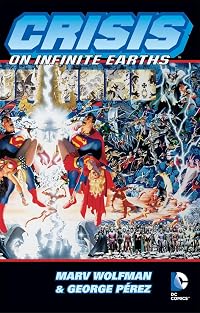
Crisis on Infinite Earths
by Marv Wolfman (Writer), George Pérez (Penciller and cover artist)
DC Comics Crisis (1), Crisis on Infinite Earths (Collections and Selections — 1-12)
On This Page
Description
This is the story that changed the DC Universe forever. A mysterious being known as the Anti-Monitor has begun a crusade across time to bring about the end of all existence. As alternate Earths are systematically destroyed, the Monitor quickly assembles a team of superheroes from across time and space to battle his counterpart and stop the destruction. DC's greatest heroes, including Superman, Batman, Wonder Woman, Green Lantern and Aquaman assemble to stop the menace, but as they watch both show more The Flash and Supergirl die in battle, they begin to wonder if even all of the heroes in the world can stop this destructive force. show lessTags
Recommendations





Member Recommendations


Member Reviews
"Explain that to me, Harbinger! What happened to my life? I am flesh and blood... I exist... yet I don't exist."
This is a wild read. Originally intended as a sort of business move for DC Comics, who had by that time created so many different versions of characters on so many different Earths (for example, Earth 1, Earth 2, Earth 3, Earth X, Earth Prime, etc) that their DC Universe had become unwieldy, this comic was supposed to tidy things up and reset everything into one, congruent universe setting. I am not well versed in comics, however, so the effect of reading this book was kind of amazing. I encountered pages and pages of characters I just had to assume meant something to other people. After 100 or so pages of this, the effect was show more to totally destabilize all notions of centralized, unique "superheros."
The existence of this heterogeneity of superheros, some with other worldly powers, some without even that distinction, causes the reader to follow their collective abstraction, since none have the page space to truly stand out. You follow "superhero-ness" as it fights against the evil... wait for it... Anti-monitor. Awesome name, mostly because it drives an entire dialectical plot towards (strangely) Hegelian concepts.
The Monitor is a character who has functioned throughout the ages as a sort of uber-voyeur/arms dealer. He watches every superhero on every planet and collects data on them (and I gather at one point he was selling this data to villains for cash). One could very easily interpret this character as a stand in for the avid comic book reader, only taller. In this particular story, the main baddy is the Monitor's twin brother, established at the beginning of the Universe's creation yet set in an anti-matter sphere. He is the Anti-monitor and he wants to destroy everything. Insert dramatic music and postmodern irony here.
The binary relationships are set and blurred many times over in this novel: superheros decentralize into the collective, super villains fight to retain their Hegelian dialectical relationships with superhero counterparts, thus calling into question their defining motives, the worldly threat (the anti-monitor's desire to condense all reality into a single anti-matter universe, his own) not only ties indirectly to the comic book reader's identity but underscores a weird sort of "negation of the negation."
In short, 1) all concepts in the DC Universe (characters, settings, origins, etc) are shown to have an opposite and opposing side, 2) as the balance between these sides shifts gradually, then suddenly, gradual changes lead to major turning points, which tumble and shift the nature of reality, and 3) all of these turning points develop as a "negation of the negation" and the DC Universe as well as all its characters are changed forever. In this case, consolidated into a unified universe with separate and unique parts (i.e. only one Earth) among other ways.
I definitely do not recommend this to just anyone. You have to either totally be into the world of comics already (in which case, my reading of it will be as bizarre to you as this novel was for me) or willing to really brave out some strange ideas with a huge collection of characters whom you never even knew existed. I liked reading this but only because I loved how campy it was and I found it intellectually engaging (in my own way). show less
This is a wild read. Originally intended as a sort of business move for DC Comics, who had by that time created so many different versions of characters on so many different Earths (for example, Earth 1, Earth 2, Earth 3, Earth X, Earth Prime, etc) that their DC Universe had become unwieldy, this comic was supposed to tidy things up and reset everything into one, congruent universe setting. I am not well versed in comics, however, so the effect of reading this book was kind of amazing. I encountered pages and pages of characters I just had to assume meant something to other people. After 100 or so pages of this, the effect was show more to totally destabilize all notions of centralized, unique "superheros."
The existence of this heterogeneity of superheros, some with other worldly powers, some without even that distinction, causes the reader to follow their collective abstraction, since none have the page space to truly stand out. You follow "superhero-ness" as it fights against the evil... wait for it... Anti-monitor. Awesome name, mostly because it drives an entire dialectical plot towards (strangely) Hegelian concepts.
The Monitor is a character who has functioned throughout the ages as a sort of uber-voyeur/arms dealer. He watches every superhero on every planet and collects data on them (and I gather at one point he was selling this data to villains for cash). One could very easily interpret this character as a stand in for the avid comic book reader, only taller. In this particular story, the main baddy is the Monitor's twin brother, established at the beginning of the Universe's creation yet set in an anti-matter sphere. He is the Anti-monitor and he wants to destroy everything. Insert dramatic music and postmodern irony here.
The binary relationships are set and blurred many times over in this novel: superheros decentralize into the collective, super villains fight to retain their Hegelian dialectical relationships with superhero counterparts, thus calling into question their defining motives, the worldly threat (the anti-monitor's desire to condense all reality into a single anti-matter universe, his own) not only ties indirectly to the comic book reader's identity but underscores a weird sort of "negation of the negation."
In short, 1) all concepts in the DC Universe (characters, settings, origins, etc) are shown to have an opposite and opposing side, 2) as the balance between these sides shifts gradually, then suddenly, gradual changes lead to major turning points, which tumble and shift the nature of reality, and 3) all of these turning points develop as a "negation of the negation" and the DC Universe as well as all its characters are changed forever. In this case, consolidated into a unified universe with separate and unique parts (i.e. only one Earth) among other ways.
I definitely do not recommend this to just anyone. You have to either totally be into the world of comics already (in which case, my reading of it will be as bizarre to you as this novel was for me) or willing to really brave out some strange ideas with a huge collection of characters whom you never even knew existed. I liked reading this but only because I loved how campy it was and I found it intellectually engaging (in my own way). show less
It's a well-known fact that by the 1980s, the continuity of the DC Universe-- sorry, Multiverse-- was in such a state that students of Russian hermeneutics were rejecting it as too confusing. But Marv Wolfman was a man with a plan: destroy it and replace it with something even more bizarre and inexplicable. The vehicle for this transformation was Crisis on Infinite Earths, an twelve-issue miniseries that would change the state of comics forever, subjecting us to poorly thought out crossovers on a regular basis for the next 25 years and beyond, I'm sure. Actually, I've never read any of the other "crises", but my perusal of Internet bulletin boards has confirmed that I'm supposed to hate them.
Actually, I find it bizarrely hard to pass show more judgment on Crisis on Infinite Earths. It's not so much a work of art as a fact of life. It's not something you can judge, it just is. It's known for what it did, not how it did it. Because even if it had done it all poorly, it still would have been as famous and influential as it is today.
But I don't think it did do it poorly. Sure, it's melodramatic as possible sometimes, but it's a comic book crossover dealing with the collapse of an infinite number of universes, what do you expect? Most of the time, it's just plain fun-- Marv Wolfman has an encyclopedic knowledge of DC characters and continuity, and that shines through here in the ridiculous number of characters who appear in this comic. In fact, he knows so many obscure characters, it frequently becomes a problem-- when the Monitor assembles his team to defend his vibrational forks (whatever), he brings together Superman, Blue Beetle, Dawnstar, Green Lantern, Psimon, Geo-Force, Cyborg, Obsidian, Firebrand, Firestorm, Killer Frost, Psycho Pirate, Doctor Polaris, and a giant gorilla. Who the heck are these people? Obviously I known Superman and the other heavy hitters, but Geo-Force? Firebrand? Doctor Polaris, the Master of Magnetism? I don't think anyone yearning for a crossover of DC's infinite characters was ever clamoring for a Psimon/Doctor Polaris teamup.
The other problem is that when you've got a threat that's big enough to bring all these people together... it's a threat too big for them to actually handle. The protagonists in this story are little more than tools for the Monitor, who is privy to a plot that is never really fully revealed, jerking our heroes from point to point, having them run contrived little tasks, such as guarding his vibrational cutlery. Often, threats are contrived just to spice things up, such as when Lex Luthor, never to be outdone, decides that he's going to take over four Earths at once with the help of every supervillain ever, prompting a protracted battle to fill page space while the heroes fight back.
The deficiency of our own heroes in such cosmic occurrences is really shown fully in "Death at the Dawn of Time", when our heroes stand around watching the Spectre do all of the work that it takes to defeat the Anti-Monitor. Well, one of the times-- the Anti-Monitor comes back from the dead about three times after this, sometimes a mere page after his most recent demise. I was so happy when the Superman of Earth-2 punched him so hard that he exploded. Though why this should have killed him when the power of Darkseid could not, I have no idea.
I guess these are just the natural problems of writing a crossover this big. And most of the time, Wolfman is solid enough to keep you from realizing that the main characters aren't actually doing much other than looking at the oh-so-slow moving walls of antimatter. There's certainly a lot to like here, too. One of the biggest deals that of course happens in this book is that Supergirl is killed off. (Which is convenient, since she doesn't exist in the new continuity at the story's end. Indeed, all of the characters who don't exist in the new timeline are killed off at some point, all of them just happening to get in the way of one of the Anti-Monitor's blasts.) This didn't really affect me a whole lot when I read the story for the first time-- I knew it was going to happen (it's on the cover, for crying out loud), and I've never been attached to the Silver Age Supergirl.
But what did get me was the death of the Flash-- I had no idea! And it's such a great death, too. Despite everything that's happened to him, to his world, he just keeps on running and running and running, doing his best to stop the Anti-Monitor from making a giant cannon or whatever the heck it is, running so hard and so fast that he dissolves. How freaking awesome is that? I was genuinely moved the first time I read the book. Barry Allen, I'll miss you. Even if I've never read another story featuring you.
The other weird thing, but mostly in retrospect, is all the sideplots that were obviously setups for what was going to happen in other comic books. What's all that nonsense about the Red Tornado, anyway? And the blue dude with the horns meeting those guys in space? And you know I'm never going to pick up New Teen Titans #15 to read about Starfire's wedding plans. As for the new Wildcat? Who the crap cares?
I've been remiss-- all this time and I've yet to mention George Pérez's artwork. Because that, more than anything else, is what sells this story. I find it amazing that the man could pump out work of this caliber on a monthly basis-- and some of the issues are double-sized! The level of detail is extraordinary. Some of his panels feature Every Character Ever-- and all of them are recognizable! Well, recognizable to someone much more well-versed in DC minutia than myself. And as for his layouts... some of these pages feature more than a dozen panels! All of them clear and distinct. A Pérez comic does not waste space. He chooses his full-page panels carefully. The destruction of entire universe can sometimes be one panel out of many-- when he does a two-page spread, you know it's important! I wish I could say more about his artwork, but I don't know a thing about artwork, and the best I could do would be to say "It's awesome" again and again. (Oh, I really dig the black-and-white extracts from "The Monitor Tapes" at the bottom of the pages of "Death at the Dawn of Time!" Obviously Pérez was a master of any color scheme.)
Great Rao, this review has been all over the place. But I think that's appropriate for a story like Crisis on Infinite Earths, one so big it could scarcely be contained or summed up in an effective manner, thanks to Marv Wolfman's encyclopedic knowledge and cosmic plotting and George Pérez's masterful artwork and incredible layouts. One can only hope that like Crisis, the legacy of this review will live on... forever! show less
Actually, I find it bizarrely hard to pass show more judgment on Crisis on Infinite Earths. It's not so much a work of art as a fact of life. It's not something you can judge, it just is. It's known for what it did, not how it did it. Because even if it had done it all poorly, it still would have been as famous and influential as it is today.
But I don't think it did do it poorly. Sure, it's melodramatic as possible sometimes, but it's a comic book crossover dealing with the collapse of an infinite number of universes, what do you expect? Most of the time, it's just plain fun-- Marv Wolfman has an encyclopedic knowledge of DC characters and continuity, and that shines through here in the ridiculous number of characters who appear in this comic. In fact, he knows so many obscure characters, it frequently becomes a problem-- when the Monitor assembles his team to defend his vibrational forks (whatever), he brings together Superman, Blue Beetle, Dawnstar, Green Lantern, Psimon, Geo-Force, Cyborg, Obsidian, Firebrand, Firestorm, Killer Frost, Psycho Pirate, Doctor Polaris, and a giant gorilla. Who the heck are these people? Obviously I known Superman and the other heavy hitters, but Geo-Force? Firebrand? Doctor Polaris, the Master of Magnetism? I don't think anyone yearning for a crossover of DC's infinite characters was ever clamoring for a Psimon/Doctor Polaris teamup.
The other problem is that when you've got a threat that's big enough to bring all these people together... it's a threat too big for them to actually handle. The protagonists in this story are little more than tools for the Monitor, who is privy to a plot that is never really fully revealed, jerking our heroes from point to point, having them run contrived little tasks, such as guarding his vibrational cutlery. Often, threats are contrived just to spice things up, such as when Lex Luthor, never to be outdone, decides that he's going to take over four Earths at once with the help of every supervillain ever, prompting a protracted battle to fill page space while the heroes fight back.
The deficiency of our own heroes in such cosmic occurrences is really shown fully in "Death at the Dawn of Time", when our heroes stand around watching the Spectre do all of the work that it takes to defeat the Anti-Monitor. Well, one of the times-- the Anti-Monitor comes back from the dead about three times after this, sometimes a mere page after his most recent demise. I was so happy when the Superman of Earth-2 punched him so hard that he exploded. Though why this should have killed him when the power of Darkseid could not, I have no idea.
I guess these are just the natural problems of writing a crossover this big. And most of the time, Wolfman is solid enough to keep you from realizing that the main characters aren't actually doing much other than looking at the oh-so-slow moving walls of antimatter. There's certainly a lot to like here, too. One of the biggest deals that of course happens in this book is that Supergirl is killed off. (Which is convenient, since she doesn't exist in the new continuity at the story's end. Indeed, all of the characters who don't exist in the new timeline are killed off at some point, all of them just happening to get in the way of one of the Anti-Monitor's blasts.) This didn't really affect me a whole lot when I read the story for the first time-- I knew it was going to happen (it's on the cover, for crying out loud), and I've never been attached to the Silver Age Supergirl.
But what did get me was the death of the Flash-- I had no idea! And it's such a great death, too. Despite everything that's happened to him, to his world, he just keeps on running and running and running, doing his best to stop the Anti-Monitor from making a giant cannon or whatever the heck it is, running so hard and so fast that he dissolves. How freaking awesome is that? I was genuinely moved the first time I read the book. Barry Allen, I'll miss you. Even if I've never read another story featuring you.
The other weird thing, but mostly in retrospect, is all the sideplots that were obviously setups for what was going to happen in other comic books. What's all that nonsense about the Red Tornado, anyway? And the blue dude with the horns meeting those guys in space? And you know I'm never going to pick up New Teen Titans #15 to read about Starfire's wedding plans. As for the new Wildcat? Who the crap cares?
I've been remiss-- all this time and I've yet to mention George Pérez's artwork. Because that, more than anything else, is what sells this story. I find it amazing that the man could pump out work of this caliber on a monthly basis-- and some of the issues are double-sized! The level of detail is extraordinary. Some of his panels feature Every Character Ever-- and all of them are recognizable! Well, recognizable to someone much more well-versed in DC minutia than myself. And as for his layouts... some of these pages feature more than a dozen panels! All of them clear and distinct. A Pérez comic does not waste space. He chooses his full-page panels carefully. The destruction of entire universe can sometimes be one panel out of many-- when he does a two-page spread, you know it's important! I wish I could say more about his artwork, but I don't know a thing about artwork, and the best I could do would be to say "It's awesome" again and again. (Oh, I really dig the black-and-white extracts from "The Monitor Tapes" at the bottom of the pages of "Death at the Dawn of Time!" Obviously Pérez was a master of any color scheme.)
Great Rao, this review has been all over the place. But I think that's appropriate for a story like Crisis on Infinite Earths, one so big it could scarcely be contained or summed up in an effective manner, thanks to Marv Wolfman's encyclopedic knowledge and cosmic plotting and George Pérez's masterful artwork and incredible layouts. One can only hope that like Crisis, the legacy of this review will live on... forever! show less
"Explain that to me, Harbinger! What happened to my life? I am flesh and blood... I exist... yet I don't exist."
This is a wild read. Originally intended as a sort of business move for DC Comics, who had by that time created so many different versions of characters on so many different Earths (for example, Earth 1, Earth 2, Earth 3, Earth X, Earth Prime, etc) that their DC Universe had become unwieldy, this comic was supposed to tidy things up and reset everything into one, congruent universe setting. I am not well versed in comics, however, so the effect of reading this book was kind of amazing. I encountered pages and pages of characters I just had to assume meant something to other people. After 100 or so pages of this, the effect was show more to totally destabilize all notions of centralized, unique "superheros."
The existence of this heterogeneity of superheros, some with other worldly powers, some without even that distinction, causes the reader to follow their collective abstraction, since none have the page space to truly stand out. You follow "superhero-ness" as it fights against the evil... wait for it... Anti-monitor. Awesome name, mostly because it drives an entire dialectical plot towards (strangely) Hegelian concepts.
The Monitor is a character who has functioned throughout the ages as a sort of uber-voyeur/arms dealer. He watches every superhero on every planet and collects data on them (and I gather at one point he was selling this data to villains for cash). One could very easily interpret this character as a stand in for the avid comic book reader, only taller. In this particular story, the main baddy is the Monitor's twin brother, established at the beginning of the Universe's creation yet set in an anti-matter sphere. He is the Anti-monitor and he wants to destroy everything. Insert dramatic music and postmodern irony here.
The binary relationships are set and blurred many times over in this novel: superheros decentralize into the collective, super villains fight to retain their Hegelian dialectical relationships with superhero counterparts, thus calling into question their defining motives, the worldly threat (the anti-monitor's desire to condense all reality into a single anti-matter universe, his own) not only ties indirectly to the comic book reader's identity but underscores a weird sort of "negation of the negation."
In short, 1) all concepts in the DC Universe (characters, settings, origins, etc) are shown to have an opposite and opposing side, 2) as the balance between these sides shifts gradually, then suddenly, gradual changes lead to major turning points, which tumble and shift the nature of reality, and 3) all of these turning points develop as a "negation of the negation" and the DC Universe as well as all its characters are changed forever. In this case, consolidated into a unified universe with separate and unique parts (i.e. only one Earth) among other ways.
I definitely do not recommend this to just anyone. You have to either totally be into the world of comics already (in which case, my reading of it will be as bizarre to you as this novel was for me) or willing to really brave out some strange ideas with a huge collection of characters whom you never even knew existed. I liked reading this but only because I loved how campy it was and I found it intellectually engaging (in my own way). show less
This is a wild read. Originally intended as a sort of business move for DC Comics, who had by that time created so many different versions of characters on so many different Earths (for example, Earth 1, Earth 2, Earth 3, Earth X, Earth Prime, etc) that their DC Universe had become unwieldy, this comic was supposed to tidy things up and reset everything into one, congruent universe setting. I am not well versed in comics, however, so the effect of reading this book was kind of amazing. I encountered pages and pages of characters I just had to assume meant something to other people. After 100 or so pages of this, the effect was show more to totally destabilize all notions of centralized, unique "superheros."
The existence of this heterogeneity of superheros, some with other worldly powers, some without even that distinction, causes the reader to follow their collective abstraction, since none have the page space to truly stand out. You follow "superhero-ness" as it fights against the evil... wait for it... Anti-monitor. Awesome name, mostly because it drives an entire dialectical plot towards (strangely) Hegelian concepts.
The Monitor is a character who has functioned throughout the ages as a sort of uber-voyeur/arms dealer. He watches every superhero on every planet and collects data on them (and I gather at one point he was selling this data to villains for cash). One could very easily interpret this character as a stand in for the avid comic book reader, only taller. In this particular story, the main baddy is the Monitor's twin brother, established at the beginning of the Universe's creation yet set in an anti-matter sphere. He is the Anti-monitor and he wants to destroy everything. Insert dramatic music and postmodern irony here.
The binary relationships are set and blurred many times over in this novel: superheros decentralize into the collective, super villains fight to retain their Hegelian dialectical relationships with superhero counterparts, thus calling into question their defining motives, the worldly threat (the anti-monitor's desire to condense all reality into a single anti-matter universe, his own) not only ties indirectly to the comic book reader's identity but underscores a weird sort of "negation of the negation."
In short, 1) all concepts in the DC Universe (characters, settings, origins, etc) are shown to have an opposite and opposing side, 2) as the balance between these sides shifts gradually, then suddenly, gradual changes lead to major turning points, which tumble and shift the nature of reality, and 3) all of these turning points develop as a "negation of the negation" and the DC Universe as well as all its characters are changed forever. In this case, consolidated into a unified universe with separate and unique parts (i.e. only one Earth) among other ways.
I definitely do not recommend this to just anyone. You have to either totally be into the world of comics already (in which case, my reading of it will be as bizarre to you as this novel was for me) or willing to really brave out some strange ideas with a huge collection of characters whom you never even knew existed. I liked reading this but only because I loved how campy it was and I found it intellectually engaging (in my own way). show less
This is horribly overwritten, it's got massive plotholes, it's sometimes repetitive and it's obviously editorially driven.....but I still have affection for it. The artwork is stunning, and it's a very dense read. I'm a sucker for the old school crossovers, and this certainly qualifies. The are better ones, but probably none more important
I can see how this would have been very poignant and powerful if I was up on my DC Comics history, but as I'm not, I found it noisy and confusing, with occasional moments of iconic majesty. And it was a really cool innovative way of revamping continuity and trying to deal with the mess a shared universe inevitably descends into (INCLUDING OUR UNIVERSE??!?!), so I'll stand it a star or so on credit.
I've been meaning to read this for a long time, though more for curiosity's sake than because I thought I would love it. It's an impressive feat, although it reminds me why I often didn't like comic books back in the 80s--the cheesy dialogue, the redundant information funneled through the cheesy dialogue and silly thought balloons, the often ridiculous characters (Uncle Marvel? Aqualad? Firestorm? Thank God they didn't include Ace the Bat-Hound.) Despite the annoyances, the singularly epic nature of the story is something to be admired.
This book is ridiculous, but it kind of makes it work. I did find the constant need to involve every single character in the DC universe to be not only annoying, but a hindrance to the story being told. Every time a character asks why the Monitor wants some completely obscure and mostly-powerless superhero rather than just calling Superman right off the bat serves only to point out that Crisis (okay, and pretty much every comic book from DC or Marvel) is more about marketing than storytelling.
But Crisis succeeds where other crossover events fail because it's story (ridiculous as it is) is actually pretty epic. The stakes keep getting bigger and the tragedies have a true sense of permanence.
But Crisis succeeds where other crossover events fail because it's story (ridiculous as it is) is actually pretty epic. The stakes keep getting bigger and the tragedies have a true sense of permanence.
Members
- Recently Added By
Lists

Books Read in 2009
464 works; 11 members

Batman: Modern Year 11
122 works; 1 member
Author Information

All Editions
Some Editions
Awards and Honors
Notable Lists
Series


Work Relationships
Contains
Has the adaptation
Has as a reference guide/companion
Common Knowledge
- Canonical title
- Crisis on Infinite Earths
- Original title
- Crisis on Infinite Earths
- Original publication date
- 2000
- People/Characters
- Superman (Clark Kent, Kal-El, Kal-L); Wonder Woman (Diana Prince); Supergirl; Batman; Spectre; Krona (show all 352); Monitor; Anti-Monitor; Harbinger; Pariah; Alexander Luthor; Lex Luthor; Psycho-Pirate; Aquaman (Arthur Curry); The Flash (Barry Allen, Jay Garrick); Superboy-Prime; Nightwing (Dick Grayson); Kid Flash (Wally West); Wonder Girl (Donna Troy); Brainiac; Darkseid; Animal Man (Buddy Baker); Cyborg (Victor Stone); Changeling (Garfield Logan); Lady Quark; Robin (Dick Grayson, Jason Todd); Huntress (Helena Wayne); Blue Beetle (Ted Kord); Question (Vic Sage); Peacemaker; Ultraman; Power Ring; Johnny Quick; Superwoman; Owlman; Lois Lane Kent; Batgirl (Barbara Gordon); Doctor Light (Kimiyo Hoshi); Solovar; Dawnstar; Firebrand (Danette Reilly); Arion; Firestorm (Ronald Raymond, Martin Stein); Killer Frost; Geo-Force; Obsidian; Doctor Polaris; Psimon; Green Lantern (John Stewart, Alan Scott, Katma Tui, Arisia, Tomar Re, Guy Gardner); Green Arrow (Oliver Queen); Colossal Boy; Lightning Lass; Chameleon Boy; Wildfire; Phantom Girl; Brainiac 5; Anthro; The Joker; Chemo; Captain Atom (Ray Palmer, Nathaniel Adams); Captain Marvel (Billy Batson); Lady Chian; Kamandi; Jericho; Starfire (Koriand'r); Halo (Violet Harper); Metamorpho (Rex Mason); Katana (Tatsu Toro); Black Lightning (Jefferson Michael Pierce); Johnny Cloud; Gunner; Sarge; Captain Storm; Sgt. Rock; Wildman; Four-Eyes; Bulldozer; Farmer Boy; Little Sure Shot; Flower; Sun Boy; Mon-El; Dream Girl; Cosmic Boy; Kid Psycho; Haunted Tank; Jeb Stuart; Bat Lash; Scalphunter; Jonah Hex; Nighthawk; Johnny Thunder; Shrinking Violet; Ultra Boy; Kole; Red Tornado; Hawkman (Katar Hol: Carter Hall); Hawkwoman; Zatanna Zatara; Shining Knight; Northwind; Mento; John Constantine; Lord Volt; Starman (Ted Knight); Hippolyta; Lori Lemaris; Ronal; Dolphin; Air Wave (Harold Lawrence Jordan); Blue Devil; Vandal Savage; Sea Devils; Aqualad (Garth); Aquagirl; Red Star; Platinum (Metal Men); Gold (Metal Men); Tin (Metal Men); Mercury (Metal Men); Lead (Metal Men); Iron (Metal Men); Blok; Element Lad; Invisible Kid (Jacques Foccart); Timber Wolf; Black Condor; Uncle Sam; Phantom Lady; Ray; Human Bomb; Dollman; Polar Boy; Chlorophyl Kid; Nuklon; Brain Wave; Fury (Hippolyta "Lyta" Trevor Hall); Silver Scarab; Jade; Star-Spangled Kid (Sylvester Pemberton); Worry Wart; Short Round; Long Round; Jackie Johnson; Ice Cream Soldier; Blackhawk; Challengers of the Unknown; Shimmer; Mammoth; Gizmo; Steel; Power Girl (Karen Starr); Vibe (Cisco Ramon); Adam Strange; Doctor Fate (Kent Nelson); Atom (Al Pratt); Wildcat (Ted Grant, Yolanda Montez); Warp; Plasmus; Tarantula (John Law); Amazing Man; Liberty Belle; Plastic Man (Patrick "Eel" O'Brian); Sargon the Sorcerer; Hourman (Rex Tyler); Hawkgirl (Shiera Sanders); Phobia; Monsieur Mallah; Brain [DC Comics]; Persuader; Validus; Robotman (Cliff Steele); Celsius; Lana Lang; Proty; Stripesy; Captain Comet; B'wana Beast; Creeper (Jack Ryder); Ragdoll; Jonni Thunder; Ragman; Windfall; Swamp Thing (Alec Holland); Black Orchid; Cinnamon; Firehair; Lois Lane; Amethyst (Princess Amaya: Amy Winston); Alanna Strange; Alfred Pennyworth; Rip Hunter; Sinestro; Blockbuster; Copperhead; Star Sapphire; Big Sir; Solomon Grundy; Per Degaton; Cheetah; Brother Blood; Vulcan; Penguin (Oswald Chesterfield Cobblepot); Plastique; Weather Wizard (Marco Mardon); Ultra-Humanite; Captain Cold (Leonard Snart); Catwoman (Selina Kyle); Poison Ivy (Pamela Isley); Ocean Master (Orm); Riddler (Edward Nigma: Edward Nashton); Brain Storm; Mary Marvel; Uncle Marvel; Captain Marvel Jr.; Doctor Sivana; Martian Manhunter (J'onn J'onzz); Black Canary (Dinah Lance); Azrael; Judomaster; Nightshade (Eve Eden); Black Manta; Deathbolt; Shaggy Man; Mister Tawky Tawny; Phantom Stranger; Peter Cannon (Thunderbolt); Hans von Hammer; Negative Woman; Deadman (Boston Brand); Perry White; Jimmy Olsen; Ibac; White Witch; Saturn Girl; Shadow Lass; Star Boy; Vixen (Mari); Firehawk; Desaad; T.O. Morrow; Doctor Mid-Nite (Charles McNider); Tempest (Joshua Clay); Speedy (Roy Harper); Elongated Man (Ralph Dibny); Gypsy; Will Magnus; Morgan Edge; Balloon Buster; Harlequin (Molly Maynne); Queen Bee; Trickster; Punch; Jewelee; Cosmic King; Silver Swan; Black Adam; Count Werner Vertigo (Count Warren Zytle); Cheshire; Eclipso; Quakemaster; Cat Man; Felix Faust; Mirror Master; Icicle; Starro the Conqueror; Kobra; Overmaster; Doctor Psycho; Black Mass; Fiddler; Chronos (David Klinton); Cluemaster; Ghost; The Lord of Time; Deathstroke the Terminator; Killer Moth; Huntress; Matter Master; Kanjar Ro; Rainbow Raider; Mister Mind; Doctor Regulus; Doctor Spectro; Crime Doctor; Mist; Gambler; Houngan; Lady Lunar; Circe; Golden Glider; Captain Nazi; Scarecrow (Jonathan Crane); Black Spider; Hyena; Shadow-Thief; Lightning Lord; Dragon King; Evil Star; Bug-Eyed Bandit; Shark; Mano; Clock King; Floronic Man; Doctor Phosphorous; Tellus; Sensor Girl; Dove (Don Hall); Hawk (Hank Hall); Space Ranger; Atomic Knight; Chris KL-99; Jemm; Magno Lad; Magnetic Kid; Mera; Silver Ghost; Dummy; Maaldor; Doctor Double X; Doctor Cyber; Calendar Man; Despero; Doctor Destiny; Electrocutioner; Insect Queen; Time Trapper; Typhoon; Multiplex; Bolt; Deadshot; Lord Satanis; Robotman (Robert Crane); Joan Garrick; Harvey Bullock; Tomahawk; Johnny Double; Angle Man; Human Target; Cave Carson; Detective Chimp; Zatara; Etrigan the Demon; Prince Ra-Man; Son of Vulcan; Steve Trevor; Clayface; Blackbriar Thorn; Ten-Eyed Man; Tommy Tomorrow; Christopher Chance; Doctor Occult
- Important places
- Earth-One; Earth-Two; Earth-Three; Earth-Four; Earth-S; Earth-X (show all 12); Gorilla City; Paradise Island; Qward; Metropolis, USA; Fortress of Solitude, Arctic; Oa
- Important events
- Crisis on Infinite Earths; World War II (1939 | 1945)
- Related movies
- Justice League: Crisis on Infinite Earths - Part One (2024 | IMDb); Justice League: Crisis on Infinite Earths - Part Two (2024 | IMDb); Justice League: Crisis on Infinite Earths - Part Three (2024 | IMDb)
- First words
- In the beginning there was only one, a single black infinitude
- Last words
- (Click to show. Warning: May contain spoilers.)Not the end; the beginning of the future.
- Original language
- English
Classifications
- Genre
- Graphic Novels & Comics
- DDC/MDS
- 741.5973 — Arts & recreation Drawing & decorative arts Drawing Comic books, graphic novels, fotonovelas, cartoons, caricatures, comic strips History, geographic treatment, biography North American United States (General)
- LCC
- PN6728 .C699 .W65 — Language and Literature Literature (General) Literature (General) Collections of general literature Comic books, strips, etc.
- BISAC
Statistics
- Members
- 1,120
- Popularity
- 22,572
- Reviews
- 20
- Rating
- (3.62)
- Languages
- 6 — English, French, German, Italian, Portuguese, Spanish
- Media
- Paper, Ebook
- ISBNs
- 26
- ASINs
- 7
