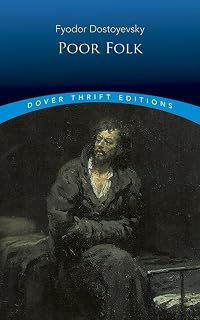
Poor Folk
by Fyodor Dostoyevsky 
On This Page
Description
Delve into the always-timely issue of poverty and socio-economic marginalization in the first novel by acclaimed Russian fiction writer Fyodor Dostoyevsky. Poor Folk recounts the trials and tribulations—and all-too-rare moments of triumph—experienced by several groups of destitute peasants in nineteenth-century Russia..
Tags
Recommendations












Member Reviews
t first glance, there would appear to be just two characters in Dostoevsky's epistolary first novel, Poor Folk, but really there are four. We have the two letter-writing doomed lovers, Barbara (Varvara) Dobroselova and Makar Devushkin, and we have the pair's mental models or emulators of one another. The story told in the letters of this pair of chastely loving neighbors, in which they live out their lives of privation and longing for one another, is thus given an almost unbearable tension as they all but scream at one another for understanding. "Ah, little angel, you are a perfect child! I know well you are weak as a blade of grass," Makar might say to the decidedly not weak Barbara, for instance, projecting quite forcefully his show more distorted ideal of femininity on the woman he has decided he must protect even though it is obvious from the very beginning that, sad as Barbara's straits are, she is doing a much better job of taking care of herself than Makar is.*
It's this tension, rather than the horrible living conditions described or the novel's famed status as a possible satire on Gogol's "The Overcoat" and other works, that kept me reading this**; it's the same inter-character tension that I love best about Dostoevsky in particular, and Russian novels in general, after all. There is a perverse streak in me that loves to watch characters willfully misunderstanding each other while claiming (usually dismissively) to understand each other perfectly. I say perverse because nothing makes me angrier than when this happens to me in real life. In fiction, however, it's my crack.
So, while earlier this year I decided, after having thoroughly loved the first volume of Joseph Frank's giant biography of Doestoeversky, that I needed to read Poor Folk right away, I kind of put it off, largely out of a feeling of obligation to others. I am comrades with lots of writers who released new fiction this year and whose work could benefit from what small light I could shine on it; I finally allowed some friends, new and old, to talk me into reading all the Harry Potter and all the Dark Tower novels.... the year slipped away.
But as it comes to an end, I find myself in what my good pal EssJay aptly describes as a "sneaky hate spiral" in which all fiction annoys me or otherwise fails to keep my attention. I've been here before; I know what I need, and so I keep "guaranteed good stuff" that I know I'll like against such times. Hence Poor Folk at last. AaaaaaAAAAAaaaaahhhhhhhhhhhh.
My own pecadillos notwithstanding, this book is a searingly worthwhile read even if you don't get off on the kind of tension I'm celebrating here. Doestoevsky at the kinda-faltering start of his career is better than almost anyone else at his or her peak. Listen: I hate epistolary novels. Hate them. But if all of them were like Poor Folk, I would love them. They would be my favorites.
For instance, a good chunk of Barbara's correspondence is devoted to a rather lengthy account of her childhood and upbringing, which means Dostoevsky, brand new novelist, has already set for himself the daunting task of writing convincingly in a female voice -- and a unique and specific female voice at that, for Barbara is revealed as a woman whom we would now understand as a survivor of domestic violence, both physical and emotional, whose character has been shaped/warped by terrible events that she simply understands as commonplace, as just the way the world works. Her presentation of self, not precisely from a victim mentality seeking redress but as one who subtly demands a weird blend of pity and respect for her suffering, is astonishing and uncomfortable to read, and utterly masterful. One cringes at lines like "Yet this did not arise from any WANT OF LOVE for me on the part of my father, but rather from the fact that he was incapable of putting himself in my own and my mother's place. It came from a defect of character." Isn't making excuses for one's abuser a classic sign of abuse in the modern paradigm of same? But Dostoevsky knew it and saw it from the very beginning of his career, decades before it got codified into modern social services jargon. He was that good, right from the start.
All that and a bravura depiction of the humiliations and extraordinary degree of unrewarded effort that poverty inflicts on its victims, whatever the century.
Dude. My jaw is still in my lap. And I'm thinking about opening a hot dog stand.**
*Indeed, Barbara spends a lot of the novel berating Makar for spending money on unwanted gifts for her, which he insists on doing despite her many, many protests, because as far as he is concerned, that is what men must do for women they love, and women who claim they don't want them are just being coy. This, of course, enrages Barbara further, even as it also causes her to worry because it is plain that not only can Makar not afford the bonbons and presents of cash he is constantly sending her, but that he is basically endangering his own survival to do so. Her protests just drive her to try harder to please her with gifts. And so on. It would be hilarious if it wasn't so awful. Or vice versa.
**Well, that and the "just enough" funniness, chiefly achieved in exchanges between our lovers about whether or not a writer for whom Makar serves as amanuensis is a genius (Makar's version) or a hilariously bad hack (Barbara's), complete with extensively quoted passages so ridiculously overblown that they can't even be counted as satire. When Barbara continuously declines to read more, Makar's assumption that she is simply reading them in the wrong spirit and might like them better "when you have a bonbon or two in your mouth" makes it all even funnier. If you're the type who can laugh at patriarchy and patronizing, anyway. Which I can.
***Wink again at Unca Harlan. show less
It's this tension, rather than the horrible living conditions described or the novel's famed status as a possible satire on Gogol's "The Overcoat" and other works, that kept me reading this**; it's the same inter-character tension that I love best about Dostoevsky in particular, and Russian novels in general, after all. There is a perverse streak in me that loves to watch characters willfully misunderstanding each other while claiming (usually dismissively) to understand each other perfectly. I say perverse because nothing makes me angrier than when this happens to me in real life. In fiction, however, it's my crack.
So, while earlier this year I decided, after having thoroughly loved the first volume of Joseph Frank's giant biography of Doestoeversky, that I needed to read Poor Folk right away, I kind of put it off, largely out of a feeling of obligation to others. I am comrades with lots of writers who released new fiction this year and whose work could benefit from what small light I could shine on it; I finally allowed some friends, new and old, to talk me into reading all the Harry Potter and all the Dark Tower novels.... the year slipped away.
But as it comes to an end, I find myself in what my good pal EssJay aptly describes as a "sneaky hate spiral" in which all fiction annoys me or otherwise fails to keep my attention. I've been here before; I know what I need, and so I keep "guaranteed good stuff" that I know I'll like against such times. Hence Poor Folk at last. AaaaaaAAAAAaaaaahhhhhhhhhhhh.
My own pecadillos notwithstanding, this book is a searingly worthwhile read even if you don't get off on the kind of tension I'm celebrating here. Doestoevsky at the kinda-faltering start of his career is better than almost anyone else at his or her peak. Listen: I hate epistolary novels. Hate them. But if all of them were like Poor Folk, I would love them. They would be my favorites.
For instance, a good chunk of Barbara's correspondence is devoted to a rather lengthy account of her childhood and upbringing, which means Dostoevsky, brand new novelist, has already set for himself the daunting task of writing convincingly in a female voice -- and a unique and specific female voice at that, for Barbara is revealed as a woman whom we would now understand as a survivor of domestic violence, both physical and emotional, whose character has been shaped/warped by terrible events that she simply understands as commonplace, as just the way the world works. Her presentation of self, not precisely from a victim mentality seeking redress but as one who subtly demands a weird blend of pity and respect for her suffering, is astonishing and uncomfortable to read, and utterly masterful. One cringes at lines like "Yet this did not arise from any WANT OF LOVE for me on the part of my father, but rather from the fact that he was incapable of putting himself in my own and my mother's place. It came from a defect of character." Isn't making excuses for one's abuser a classic sign of abuse in the modern paradigm of same? But Dostoevsky knew it and saw it from the very beginning of his career, decades before it got codified into modern social services jargon. He was that good, right from the start.
All that and a bravura depiction of the humiliations and extraordinary degree of unrewarded effort that poverty inflicts on its victims, whatever the century.
Dude. My jaw is still in my lap. And I'm thinking about opening a hot dog stand.**
*Indeed, Barbara spends a lot of the novel berating Makar for spending money on unwanted gifts for her, which he insists on doing despite her many, many protests, because as far as he is concerned, that is what men must do for women they love, and women who claim they don't want them are just being coy. This, of course, enrages Barbara further, even as it also causes her to worry because it is plain that not only can Makar not afford the bonbons and presents of cash he is constantly sending her, but that he is basically endangering his own survival to do so. Her protests just drive her to try harder to please her with gifts. And so on. It would be hilarious if it wasn't so awful. Or vice versa.
**Well, that and the "just enough" funniness, chiefly achieved in exchanges between our lovers about whether or not a writer for whom Makar serves as amanuensis is a genius (Makar's version) or a hilariously bad hack (Barbara's), complete with extensively quoted passages so ridiculously overblown that they can't even be counted as satire. When Barbara continuously declines to read more, Makar's assumption that she is simply reading them in the wrong spirit and might like them better "when you have a bonbon or two in your mouth" makes it all even funnier. If you're the type who can laugh at patriarchy and patronizing, anyway. Which I can.
***Wink again at Unca Harlan. show less
"Why does it happen that a good man is left forlorn and forsaken, while happiness seems thrust upon another?"...
Dostoyevsky's first novel!... "Poor Folk" or "Poor People" (I had the latter in my version of translation) - written in a form of letters between a man (who considers himself "old" at 47) and a young woman: the two are distantly related, both down on their luck, struggling and poor - the story slowly escalates into more and more anguish and despair - although in the midst of it all there is a bright moment of unexpected charity by Makar's boss, and yet that's overshadowed by the event that follows and that becomes the denouement of sorts....
The two maintain this awkward relationship (mostly through letters - and his short show more visits to her about which we also learn only through letters...) - expressing their innermost thoughts and fears, their ruminations on the life of the poor: "...misfortune is an infectious disease, the poor and unfortunate ought to avoid one another, for fear of making each other worse"..., and yet they cling together, professing platonic love for each other.
Varvara (in her diary, part of which she sends to Devushkin) mourns her happy life growing up in the countryside, she counteracts it to life in the city, where she has been deeply hurt, but where she is happy to find a soulmate in Makar Devushkin, who tries hard to take care of her in his small way. Even though her life changes eventually - for the best but only on the surface - she is inconsolable as she leaves the city for her married life. Makar is even more distraught losing her.
I disagree with some of the reviewers saying that Varvara in the end goes materialistic and marries for money. She did agree to that marriage against her heart, but I think she did it so that not to be a constant burden to Makar; plus, it was her future husband who was making the expensive arrangements and then of course regretting the expenses and being unfair to her about it; and last but not least, in her last letter to Makar, Varvara expresses her uncanny but strong feeling that she will not live long, that she will die very soon after marriage...
On the linguistic side of it, it was interesting picturing some phrases in Russian - as translation at times cannot convey exactly the same thing, especially where Dostoyevsky is concerned. I found myself translating some phrases back into Russian, as I was guessing their true wording; it made my reading much more satisfying.
Here are some of the poignant and heart-rending ruminations about the poor by Makar Devushkin in his letter to Varvara:
"Poor people are touchy - that's in the nature of things.... The poor man is exacting; he takes a different view of God's world, and looks askance at every passer-by and turns a troubled gaze about him and looks at every word, wondering whether people are not talking about him, whether they are saying that he is so ugly, speculating about what he would feel exactly, what he would be on this side and what he would be on that side, and everyone knows... that a poor man is worse than a rag and can get no respect from anyone; whatever they may write, those scribblers..., to their thinking the poor man must be turned inside out, he must have no privacy, no pride whatever."
The above so well depicts Dostoyevsky's own vulnerability at that stage of his life.... show less
Dostoyevsky's first novel!... "Poor Folk" or "Poor People" (I had the latter in my version of translation) - written in a form of letters between a man (who considers himself "old" at 47) and a young woman: the two are distantly related, both down on their luck, struggling and poor - the story slowly escalates into more and more anguish and despair - although in the midst of it all there is a bright moment of unexpected charity by Makar's boss, and yet that's overshadowed by the event that follows and that becomes the denouement of sorts....
The two maintain this awkward relationship (mostly through letters - and his short show more visits to her about which we also learn only through letters...) - expressing their innermost thoughts and fears, their ruminations on the life of the poor: "...misfortune is an infectious disease, the poor and unfortunate ought to avoid one another, for fear of making each other worse"..., and yet they cling together, professing platonic love for each other.
Varvara (in her diary, part of which she sends to Devushkin) mourns her happy life growing up in the countryside, she counteracts it to life in the city, where she has been deeply hurt, but where she is happy to find a soulmate in Makar Devushkin, who tries hard to take care of her in his small way. Even though her life changes eventually - for the best but only on the surface - she is inconsolable as she leaves the city for her married life. Makar is even more distraught losing her.
I disagree with some of the reviewers saying that Varvara in the end goes materialistic and marries for money. She did agree to that marriage against her heart, but I think she did it so that not to be a constant burden to Makar; plus, it was her future husband who was making the expensive arrangements and then of course regretting the expenses and being unfair to her about it; and last but not least, in her last letter to Makar, Varvara expresses her uncanny but strong feeling that she will not live long, that she will die very soon after marriage...
On the linguistic side of it, it was interesting picturing some phrases in Russian - as translation at times cannot convey exactly the same thing, especially where Dostoyevsky is concerned. I found myself translating some phrases back into Russian, as I was guessing their true wording; it made my reading much more satisfying.
Here are some of the poignant and heart-rending ruminations about the poor by Makar Devushkin in his letter to Varvara:
"Poor people are touchy - that's in the nature of things.... The poor man is exacting; he takes a different view of God's world, and looks askance at every passer-by and turns a troubled gaze about him and looks at every word, wondering whether people are not talking about him, whether they are saying that he is so ugly, speculating about what he would feel exactly, what he would be on this side and what he would be on that side, and everyone knows... that a poor man is worse than a rag and can get no respect from anyone; whatever they may write, those scribblers..., to their thinking the poor man must be turned inside out, he must have no privacy, no pride whatever."
The above so well depicts Dostoyevsky's own vulnerability at that stage of his life.... show less
My comments are about this particular publisher and printing of Dostoevsky's "Poor Folk" (aka "Poor People"). I already had the Hesperus Classics edition of this book (titled, "Poor People") when this edition caught my eye on Amazon. I was perplexed by the words "Original Version" printed on the top of the front cover. The name of the publisher caught my eye, too 1st Edition Media. Clearly it couldn't be a first edition (it was, after all, an English translation).
I also could not for the life of me come up with a satisfying explanation as to what was meant by "Original Edition." I saw that it was inexpensive, so I decided just to buy the thing and solve the mystery. I thought perhaps the binding or SOMEthing about it might be imitative show more of a first edition (even though I knew it was first published in a Russian literary magazine over 100 years ago).
Well, it finally came in the mail and I opened the package with my thoughts and attitude teetering back and forth between excitement and skepticism. Then I saw it.
It's a simple paperback translation, obviously brand new with "Original Version Poor Folk by Fyodor Dostoevsky" in beige letters against a dark blue background with a leather texture design printed over the slick paper cover. I laughed - a little disingenuously - and shrugged, a little miffed that my "1st Edition Original Version" didn't even pretend to be any more than it was, an inexpensive paperback of a book I already had and needn't have spent money on.
I flipped through the slim volume (and yes, smelled the relatively freshly printed words upon freshly factory-cut paper) and noticed something. There were, here and there throughout the text, certain words printed in all caps. I immediately realized that ALL CAPS was a substitute for italics. It finally dawned on me that I was holding the most inexpensively published book the publishers could get away with. I went back to the title page and noticed something else odd - the translator's name was not given.
I new that the Constance Garnett version would be in the public domain, but even so I thought she should be given credit. I, for some reason, flipped to the back of the book and noticed that on the bottom of the very last page, there was a bar code and the words, "Made in USA, Lexington, KY, 19 March 2010." This seemed odd, as it was only April 2010 at the time.
Then it hit me. The book was printed to order. Publishing has gotten to the point that a simple, inexpensive paperback can be printed out for me once I order it. March 19 was the date I placed the order. The work is in the public domain, and someone was no doubt paid some nominal price translate it from Russian to English - my ORIGINAL TRANSLATION).
I guess I'm behind the times, but must admit to being a impressed at the entrepreneurship of 1st Edition Media. I wonder how much a profit they turned on me. show less
I also could not for the life of me come up with a satisfying explanation as to what was meant by "Original Edition." I saw that it was inexpensive, so I decided just to buy the thing and solve the mystery. I thought perhaps the binding or SOMEthing about it might be imitative show more of a first edition (even though I knew it was first published in a Russian literary magazine over 100 years ago).
Well, it finally came in the mail and I opened the package with my thoughts and attitude teetering back and forth between excitement and skepticism. Then I saw it.
It's a simple paperback translation, obviously brand new with "Original Version Poor Folk by Fyodor Dostoevsky" in beige letters against a dark blue background with a leather texture design printed over the slick paper cover. I laughed - a little disingenuously - and shrugged, a little miffed that my "1st Edition Original Version" didn't even pretend to be any more than it was, an inexpensive paperback of a book I already had and needn't have spent money on.
I flipped through the slim volume (and yes, smelled the relatively freshly printed words upon freshly factory-cut paper) and noticed something. There were, here and there throughout the text, certain words printed in all caps. I immediately realized that ALL CAPS was a substitute for italics. It finally dawned on me that I was holding the most inexpensively published book the publishers could get away with. I went back to the title page and noticed something else odd - the translator's name was not given.
I new that the Constance Garnett version would be in the public domain, but even so I thought she should be given credit. I, for some reason, flipped to the back of the book and noticed that on the bottom of the very last page, there was a bar code and the words, "Made in USA, Lexington, KY, 19 March 2010." This seemed odd, as it was only April 2010 at the time.
Then it hit me. The book was printed to order. Publishing has gotten to the point that a simple, inexpensive paperback can be printed out for me once I order it. March 19 was the date I placed the order. The work is in the public domain, and someone was no doubt paid some nominal price translate it from Russian to English - my ORIGINAL TRANSLATION).
I guess I'm behind the times, but must admit to being a impressed at the entrepreneurship of 1st Edition Media. I wonder how much a profit they turned on me. show less
The boy will grow callous as he trembles with the cold, a frightened little fledgling fallen from the nest.
I joked midway through that Dickens would've used this as masturbatory material. The plausibility of the novel itself remains a spot suspect. It is challenging to accept such eloquence from those so wracked with stress and despair. That said, we are a great distance from the ontology of Czarist Russia, as David Foster Wallace noted his great confusion that febrile starved Raskolnikov could afford a servant. My best friend Joel noted that when considering that Dostoevsky pawned his underwear it isn't the desperation which is fascinating but rather the society which proffered said possibilities.
Poor Folk is an epistolary novel, a show more series of exchanges between a nascent romance. Unfortunately, the affair is very much an April-December tryst and thus the reader is afforded a certain distance. There is also an aesthetic reverberating in the hovels, which proves to be a theme. The lass rejects literature and instead covets material security. The old coot courts validation by attempting to join a local literary circle. One which he is woefully ill equipped, a brother can dream, can't he?
One might imagine here that we have Humbert wanting to both read the TLS and have the teenage neighbor down on her luck. Well? There is an aspect of this Nabokov relished and it isn't adolescent coquettishness, it coincidence, that Sword of Damocles which says that just as Shelley Winters must die, this scurrying pack of Mayhew's minions are about to come into some needed cash.
Despite the crippling poverty and the spiritual crisis, Poor Folk is more about hating one's neighbor, much as was illustrated 150 years later in the Russian version of Who Wants To Be A Millionaire? show less
I joked midway through that Dickens would've used this as masturbatory material. The plausibility of the novel itself remains a spot suspect. It is challenging to accept such eloquence from those so wracked with stress and despair. That said, we are a great distance from the ontology of Czarist Russia, as David Foster Wallace noted his great confusion that febrile starved Raskolnikov could afford a servant. My best friend Joel noted that when considering that Dostoevsky pawned his underwear it isn't the desperation which is fascinating but rather the society which proffered said possibilities.
Poor Folk is an epistolary novel, a show more series of exchanges between a nascent romance. Unfortunately, the affair is very much an April-December tryst and thus the reader is afforded a certain distance. There is also an aesthetic reverberating in the hovels, which proves to be a theme. The lass rejects literature and instead covets material security. The old coot courts validation by attempting to join a local literary circle. One which he is woefully ill equipped, a brother can dream, can't he?
One might imagine here that we have Humbert wanting to both read the TLS and have the teenage neighbor down on her luck. Well? There is an aspect of this Nabokov relished and it isn't adolescent coquettishness, it coincidence, that Sword of Damocles which says that just as Shelley Winters must die, this scurrying pack of Mayhew's minions are about to come into some needed cash.
Despite the crippling poverty and the spiritual crisis, Poor Folk is more about hating one's neighbor, much as was illustrated 150 years later in the Russian version of Who Wants To Be A Millionaire? show less
This first novel by Dostoevsky, published in 1846, consists of a series of letters between two distant cousins, who happen to live across the street from each other in squalid apartments in St. Petersburg. Makar Dievushkin, by the older of the two, works as a copyist, and lives in the kitchen of an apartment that he shares with another impoverished family. He is completely devoted to his cousin and correspondent, Barbara Alexievna, a young woman who has experienced great tragedies and is in poor health. Dostoevsky is able to vividly portray mid-19th century St. Petersburg and the abject poverty through Makar's letters, and both cousins effectively describe the desperation that they face. Despite their dismal conditions, the story is show more infused with humor, irony, and wit. I thoroughly enjoyed it, and finished it in one sitting. show less
This is Dostoevsky’s first novel, written when he was 25. It’s a short epistolary novel and I think a good introduction to this russian literary giant. It’s essential Dostoyevskian in style and theme - the random thoughts and extreme emotions - the exploration of the destitute people - the solitary underground man who seems on the brink of insanity.
We follow the correspondence between two very poor people - Makar, an old clerk, and his distant relative, the young orphaned girl Varvara - in a period of about eight months in Sct. Petersburg.
It is painful, even embarrassing to read their honest, desperate letters - they are exposed in their most vulnerable state of mind, pleading for help at one point - loosing all their dignity in show more the process, then trying to cover up and apologize and trying to hold the head up high.
The old Makar is clearly in love with Varvara - but trying to brush it of as fatherly affection - Varvara has deep affection for Makar seek a solution to be free and not dependent on him.
The novels conclusion - well, it felt unfinished - I wanted to read on, knowing more about their fate, and yet, maybe it was the right time to end it. Very thought-provoking, very intense, very sad novel. show less
We follow the correspondence between two very poor people - Makar, an old clerk, and his distant relative, the young orphaned girl Varvara - in a period of about eight months in Sct. Petersburg.
It is painful, even embarrassing to read their honest, desperate letters - they are exposed in their most vulnerable state of mind, pleading for help at one point - loosing all their dignity in show more the process, then trying to cover up and apologize and trying to hold the head up high.
The old Makar is clearly in love with Varvara - but trying to brush it of as fatherly affection - Varvara has deep affection for Makar seek a solution to be free and not dependent on him.
The novels conclusion - well, it felt unfinished - I wanted to read on, knowing more about their fate, and yet, maybe it was the right time to end it. Very thought-provoking, very intense, very sad novel. show less
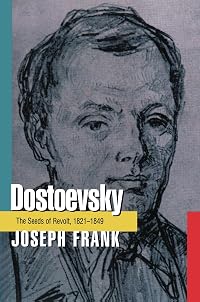
Young D.'s first splash, which I never read; I suppose I had it down as pre-arrest and gauche. I feel I've cheated because I've read the contextualisation of it in Dostoevsky: The Seeds of Revolt, 1821-1849; I suspect this one, unlike his later immortal works, doesn't exactly work without its context, since he does a few radical things here that you wouldn't be aware of unless you're up on your Russian and European history of novels. In brief -- I won't cheat again by going back to Frank, this is from memory -- the novel of letters was in fashion but about the upper classes; here he turns the format to a down-at-heels clerk and his impoverished girlfriend. In Russia, Gogol had written about a lowly clerk in The Overcoat, but remained in show more a 'look down and pity' perspective, instead of the inner life as seen from the inside, and with Gogol's satirical bent. So, Poor Folk was the first in Russia to treat these poor of Petersburg in the manner that he does, and he uses the tropes of the sentimental novel to do so. It's funny when his clerk reads excerpts from a send-up of these sentimental novels, about the upper classes, without himself having the temerity to think, what we the readers notice, that his own sentiments are more fine and genuine than those in this 'fine literature'. At the time D. was under the influence of the French Socialist writers, Victor Hugo and George Sand with her novels about the noble poor.
Anyhow, its history aside, I enjoyed this more than expected; it was a tear-jerker and a spoof, and self-referential, with satire of the writers of the day; and his observations about overcoats are an attempt to deepen Gogol: add psychology, says Dostoyesky. show less
Anyhow, its history aside, I enjoyed this more than expected; it was a tear-jerker and a spoof, and self-referential, with satire of the writers of the day; and his observations about overcoats are an attempt to deepen Gogol: add psychology, says Dostoyesky. show less
Members
- Recently Added By
Lists

Russian Literature
184 works; 35 members

Epistolary Books
105 works; 27 members

Books set in Saint Petersburg
16 works; 1 member

First Novels
373 works; 17 members

Read
293 works; 4 members

Favorite Epistolary Fiction
143 works; 144 members

Fyodor Dostoevsky books
17 works; 1 member
Talk Discussions
Past Discussions
Dostoevsky: Poor Folk in Author Theme Reads (March 2009)
Author Information

1,522+ Works 181,261 Members
One of the most powerful and significant authors in all modern fiction, Fyodor Dostoevsky was the son of a harsh and domineering army surgeon who was murdered by his own serfs (slaves), an event that was extremely important in shaping Dostoevsky's view of social and economic issues. He studied to be an engineer and began work as a draftsman. show more However, his first novel, Poor Folk (1846), was so well received that he abandoned engineering for writing. In 1849, Dostoevsky was arrested for being a part of a revolutionary group that owned an illegal printing press. He was sentenced to be executed, but the sentence was changed at the last minute, and he was sent to a prison camp in Siberia instead. By the time he was released in 1854, he had become a devout believer in both Christianity and Russia - although not in its ruler, the Czar. During the 1860's, Dostoevsky's personal life was in constant turmoil as the result of financial problems, a gambling addiction, and the deaths of his wife and brother. His second marriage in 1887 provided him with a stable home life and personal contentment, and during the years that followed he produced his great novels: Crime and Punishment (1886), the story of Rodya Raskolnikov, who kills two old women in the belief that he is beyond the bounds of good and evil; The Idiots (1868), the story of an epileptic who tragically affects the lives of those around him; The Possessed (1872), the story of the effect of revolutionary thought on the members of one Russian community; A Raw Youth (1875), which focuses on the disintegration and decay of family relationships and life; and The Brothers Karamazov (1880), which centers on the murder of Fyodor Karamazov and the effect the murder has on each of his four sons. These works have placed Dostoevsky in the front rank of the world's great novelists. Dostoevsky was an innovator, bringing new depth and meaning to the psychological novel and combining realism and philosophical speculation in his complex studies of the human condition. (Bowker Author Biography) show less
Fyodor Dostoyevsky has a Legacy Library. Legacy libraries are the personal libraries of famous readers, entered by LibraryThing members from the Legacy Libraries group.
Some Editions
Awards and Honors
Series
Belongs to Publisher Series
Work Relationships
Is contained in
Common Knowledge
- Canonical title
- Poor Folk
- Original title
- Бедные люди
- Original publication date
- 1846
- Quotations
- “Oh literature is a wonderful thing, Varenka, a very wonderful thing: I discovered that from being with those people the day before yesterday. It is a profound thing. It strengthens people’s hearts and instructs them,… ... (show all)Literature is a picture, or rather in a certain sense both a picture and a mirror; it is an expression of emotion, a subtle form of criticism, a didactic lesson and a document…
”As for poetry, I may say that I consider it unbecoming for a man of my years to devote his faculties to the making of verses. Poetry is rubbish. Even boys at school ought to be whipped for writing it. - Publisher's editor
- Rattiner, Susan L.
- Original language
- Russian
Classifications
- Genres
- General Fiction, Fiction and Literature
- DDC/MDS
- 813 — Literature & rhetoric American literature in English American fiction in English
- LCC
- PG3326 .B4 — Language and Literature Slavic languages and literatures. Baltic languages. Albanian language Slavic. Baltic. Albanian Russian literature Individual authors and works 1800-1870 Dostoyevsky
- BISAC
Statistics
- Members
- 1,461
- Popularity
- 16,079
- Reviews
- 39
- Rating
- (3.64)
- Languages
- 25 — Arabic, Catalan, Czech, Danish, Dutch, English, Estonian, Finnish, French, German, Greek, Hebrew, Italian, Japanese, Kurdish, Norwegian (Bokmål), Polish, Romanian, Russian, Serbian, Croatian, Spanish, Swedish, Turkish, Portuguese (Brazil)
- Media
- Paper, Audiobook, Ebook
- ISBNs
- 203
- UPCs
- 1
- ASINs
- 51