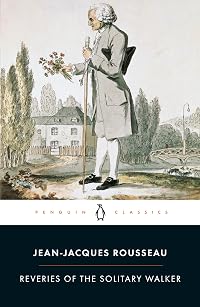
Reveries of the Solitary Walker
by Jean-Jacques Rousseau
On This Page
Description
After a period of forced exile and solitary wandering brought about by his radical views on religion and politics, Jean-Jacques Rousseau returned to Paris in 1770. Here, in the last two years of his life, he wrote his final work, the Reveries. In this eloquent masterpiece the great political thinker describes his sense of isolation from a society he felt had rejected his writings - and the manner in which he has come to terms with his alienation, as he walks around Paris, gazing at plants, show more day-dreaming and finding comfort in the virtues of solitude and the natural world. Meditative, amusing and lyrical, this is a fascinating exploration of Rousseau's thought as he looks back over his life, searching to justify his actions, to defend himself against his critics and to elaborate upon his philosophy. show lessTags
Recommendations









Member Recommendations
Member Reviews
I doubt that there's ever been another exhibit in case studies of clinical paranoia that was written so well as this. Rousseau had a pleasing gift for the fresh & powerful turn of phrase and for conveying in his writing a sincerity so naked as to be child-like but a poisoned one for finding coded references to himself in newspapers, veiled threats to himself in lolling villagers, and an inexplicable malignity focussed upon himself in, well, pretty much everyone.
Well worth reading. For the writing, for the close encounter with mental illness, for the charming survival tip: If an angry Great Dane hurtles toward you, time its speed so that you may jump over it. (Moreover, if you too were required to read Hume in school this book might make show more you feel sympathetic with rather than resentful toward him.) show less
Well worth reading. For the writing, for the close encounter with mental illness, for the charming survival tip: If an angry Great Dane hurtles toward you, time its speed so that you may jump over it. (Moreover, if you too were required to read Hume in school this book might make show more you feel sympathetic with rather than resentful toward him.) show less
There are some people, like that, who, upon reaching a certain age and until death take them away turn bitter, grumpy, always morose, never happy, and constantly complain about everything they can. Rousseau, here, outsmarted them all: he left his jeremiads to posterity.
Of an pretentious vanity, annoying, self-centred and portraying himself as a martyr persecuted by his contemporaries, almost paranoid, the grumpy old man here wobbles in self-pity, moans and whines.
I get it. Honestly, I do. Here are the musings of a man reaching the end of his life, and daring to be honest and confront it all, blah blah blah... It could have been interesting (maybe). The problem is that Rousseau is nothing but a miserable old grump. I am sorry, but, show more here's nothing but the 18th century version of some tart celebrity sobbing their life away on a vain TV talk show. How shallow!
Honestly: stick to his philosophical work. show less
Of an pretentious vanity, annoying, self-centred and portraying himself as a martyr persecuted by his contemporaries, almost paranoid, the grumpy old man here wobbles in self-pity, moans and whines.
I get it. Honestly, I do. Here are the musings of a man reaching the end of his life, and daring to be honest and confront it all, blah blah blah... It could have been interesting (maybe). The problem is that Rousseau is nothing but a miserable old grump. I am sorry, but, show more here's nothing but the 18th century version of some tart celebrity sobbing their life away on a vain TV talk show. How shallow!
Honestly: stick to his philosophical work. show less
Hyperbole*, thy name is Rousseau. In the last work by Jean-Jacques Rousseau he created a memoir like none of his other works. Autobiographical in style, it differs from the Confessions, the Dialogues, and several letters. It has no goal nor any chronological order; indeed, the ten "walks" into which it is divided provide a record of his inner feelings, a sort of barometer of his "soul".
The theme of the walks, if one exists, seems to center on Rousseau's alleged solitude - an isolation from society that is not deserved by such a great man. He spends his days contemplating himself as evidenced by this comment near the end of the First Walk: "But I, detached from them and from everything, what am I?".
His investigation of himself, as the show more walks continue, appears to be sentimental - one that focuses on feeling rather than ideas (perhaps his taste for ideas had declined since the days of his early essays and great Social Contract). He ponders the nature of happiness in the Fifth Walk, however does not identify his own personal happiness with contemplation (as Aristotle or other classical thinkers might). In fact, he considers thinking a chore for him in the Seventh Walk; it is a task he used to perform fro the sake of others so that he could explain the world to them and show them how to live in it correctly (perhaps they could not hear him or were just not listening).
Rousseau's high appreciation of himself is evident from the opening sentence of the First Walk when he sets himself apart from humankind with these words: "I am now alone on earth, no longer having any brother, neighbor, friend, or society other than myself." He goes on to portray himself as the "most sociable and the most loving of humans". Overall the investigation of self in which he is engaged is so clearly and consistently directed at Rousseau's own enlightenment that the problem of why he is in this unusual condition does not arise. The final and tenth walk occurs on on Palm Sunday in 1778. He ends his reveries with a short chapter bemoaning the short period of happiness he had with a woman decades before; unsure of himself or his feelings he commits to reforming so as to be able to love. It seems that will be a losing battle.
* language that describes something as better or worse than it really is. show less
The theme of the walks, if one exists, seems to center on Rousseau's alleged solitude - an isolation from society that is not deserved by such a great man. He spends his days contemplating himself as evidenced by this comment near the end of the First Walk: "But I, detached from them and from everything, what am I?".
His investigation of himself, as the show more walks continue, appears to be sentimental - one that focuses on feeling rather than ideas (perhaps his taste for ideas had declined since the days of his early essays and great Social Contract). He ponders the nature of happiness in the Fifth Walk, however does not identify his own personal happiness with contemplation (as Aristotle or other classical thinkers might). In fact, he considers thinking a chore for him in the Seventh Walk; it is a task he used to perform fro the sake of others so that he could explain the world to them and show them how to live in it correctly (perhaps they could not hear him or were just not listening).
Rousseau's high appreciation of himself is evident from the opening sentence of the First Walk when he sets himself apart from humankind with these words: "I am now alone on earth, no longer having any brother, neighbor, friend, or society other than myself." He goes on to portray himself as the "most sociable and the most loving of humans". Overall the investigation of self in which he is engaged is so clearly and consistently directed at Rousseau's own enlightenment that the problem of why he is in this unusual condition does not arise. The final and tenth walk occurs on on Palm Sunday in 1778. He ends his reveries with a short chapter bemoaning the short period of happiness he had with a woman decades before; unsure of himself or his feelings he commits to reforming so as to be able to love. It seems that will be a losing battle.
* language that describes something as better or worse than it really is. show less
I actually enjoyed Jean-Jacques Rousseau's "Reveries of the Solitary Walker" much more than I expected to. I found Rousseau's 10 essays interesting and occasionally unintentionally amusing in a sad sort of way.
Rousseau would have been insane in this Internet age where every comment about a person's work, behavior or looks can be seen, dissected and analyzed. Rousseau, writing in the late 1700's in France was utterly paranoid and convinced that there were haters out there at every turn.
Still, I found his essays thoughtful and very easily translatable to today's world. His anecdotes were interesting enough that I'll likely put his more formidable "Confessions" on my reading list.
Rousseau would have been insane in this Internet age where every comment about a person's work, behavior or looks can be seen, dissected and analyzed. Rousseau, writing in the late 1700's in France was utterly paranoid and convinced that there were haters out there at every turn.
Still, I found his essays thoughtful and very easily translatable to today's world. His anecdotes were interesting enough that I'll likely put his more formidable "Confessions" on my reading list.
Well, this sounded really good from the description: slightly crazy Rousseau at the end of his life, walking, thinking, bitterness, misanthropy, etc.
However, in practice, it was like listening to that drunk guy at the bar telling you how everybody is against him, and how he really deserves better, and how he's really a great guy and that he's not really mad at these people (he calls them his 'persecuters')... no, in fact he's found peace. But he emphasizes those last points a little too pointedly, so that you start to think he doesn't really believe it. Like he's just saying it to convince himself that it's true. Because, really, he's not over the fact that certain people don't like him. And you end up not caring if he's really a good show more guy or not, you just want him to stop talking so you can enjoy your beer.
While there are some good ideas and thoughts in here, none of them really blew me away, they all seemed like stuff I would write down in my own diary, only to look back on them and feel a slight twinge of shame. And there's not the meandering quality I would associate normally with a walking narrative. These are ten well-formed essays, with forceful agendas. He didn't stop to tell you about his walk, or about something he observed at the corner of Rue Such-and-such and Avenue de So-and-So. No, none of that, it's all Rousseau all the time. He is so much in his own mind that I felt like I was reading a case-study in how not to drive yourself crazy. I see these tendencies in myself sometimes and I hope I don't ever become like him.
PS - the Introduction, written by the translator Peter France, is pretty good though, and gives a good context of how these writings fit into Rousseau's larger body of work. I do want to read more of Rousseau, he was probably a great thinker before he turned sour and inward. show less
However, in practice, it was like listening to that drunk guy at the bar telling you how everybody is against him, and how he really deserves better, and how he's really a great guy and that he's not really mad at these people (he calls them his 'persecuters')... no, in fact he's found peace. But he emphasizes those last points a little too pointedly, so that you start to think he doesn't really believe it. Like he's just saying it to convince himself that it's true. Because, really, he's not over the fact that certain people don't like him. And you end up not caring if he's really a good show more guy or not, you just want him to stop talking so you can enjoy your beer.
While there are some good ideas and thoughts in here, none of them really blew me away, they all seemed like stuff I would write down in my own diary, only to look back on them and feel a slight twinge of shame. And there's not the meandering quality I would associate normally with a walking narrative. These are ten well-formed essays, with forceful agendas. He didn't stop to tell you about his walk, or about something he observed at the corner of Rue Such-and-such and Avenue de So-and-So. No, none of that, it's all Rousseau all the time. He is so much in his own mind that I felt like I was reading a case-study in how not to drive yourself crazy. I see these tendencies in myself sometimes and I hope I don't ever become like him.
Reduced to my own self, it is true that I feed on my own substance.And while the writing is not bad, he repeats his points to the point of tedium, and takes so long in saying it, that I fell asleep reading a few of them.
PS - the Introduction, written by the translator Peter France, is pretty good though, and gives a good context of how these writings fit into Rousseau's larger body of work. I do want to read more of Rousseau, he was probably a great thinker before he turned sour and inward. show less
Read this not know knowing much about his life and he seemed pretty misanthropic and paranoid in much of it (though I liked that!). Having looked at his biog I can now see he had some justification for feeling like this. Elsewhere some nice thoughts about happiness and resilience. Early sections in particular had very long sentences where I lost the thread completely, if there was one..
Some of the previous reviews discard it as boring and self-obsessed. I, however, enjoyed it (in French) as a document of 18th century philosophical preoccupations, as a hymn to nature and as a poetic view of life.
Members
- Recently Added By
Lists

1001 Books You Must Read Before You Die
1,448 works; 1,134 members

My Wishlist
9 works; 1 member

Favourite Books
1,819 works; 316 members

1,001 BYMRBYD Concensus
723 works; 27 members
Author Information

Jean Jacques Rousseau was a Swiss philosopher and political theorist who lived much of his life in France. Many reference books describe him as French, but he generally added "Citizen of Geneva" whenever he signed his name. He presented his theory of education in Emile (1762), a novel, the first book to link the educational process to a scientific show more understanding of children; Rousseau is thus regarded as the precursor, if not the founder, of child psychology. "The greatest good is not authority, but liberty," he wrote, and in The Social Contract (1762) Rousseau moved from a study of the individual to an analysis of the relationship of the individual to the state: "The art of politics consists of making each citizen extremely dependent upon the polis in order to free him from dependence upon other citizens." This doctrine of sovereignty, the absolute supremacy of the state over its members, has led many to accuse Rousseau of opening the doors to despotism, collectivism, and totalitarianism. Others say that this is the opposite of Rousseau's intent, that the surrender of rights is only apparent, and that in the end individuals retain the rights that they appear to have given up. In effect, these Rousseau supporters say, the social contract is designed to secure or to restore to individuals in the state of civilization the equivalent of the rights they enjoyed in the state of nature. Rousseau was a passionate man who lived in passionate times, and he still stirs passion in those who write about him today. (Bowker Author Biography) show less
All Editions
Some Editions
Awards and Honors
Series
Belongs to Publisher Series
Work Relationships
Is contained in
Is abridged in
Has as a student's study guide
Common Knowledge
- Canonical title
- Reveries of the Solitary Walker
- Original title
- Les rêveries du promeneur solitaire
- Alternate titles*
- Overpeinzingen van een eenzaam wandelaar (Het Spectrum) (Het Spectrum)
- Original publication date
- 1782
- First words
- So now I am alone in the world, with no brother, neighbour or friedn, nor anu company left me but my own.
- Quotations*
- "De quoi jouit-on dans une pareille situation? De rien d'extérieur à soi, de rien sinon de soi-même et de sa propre existence comme Dieu".
"Il n'y faut ni un repos absolu ni trop d'agitation, mais un mouvement unifo... (show all)rme et modéré qui n'ait ni secousses ni intervalles. Sans mouvement la vie n'est qu'une léthargie". - Last words*
- (Click to show. Warning: May contain spoilers.)Je pensai qu'une provision de talents était la plus sûre ressource contre la misère, et je résolus d'employer mes loisirs à me mettre en état, s'il était possible, de rendre un jour à la meilleure des femmes l'assistance que j'en avais reçue.
- Original language
- Français
- Disambiguation notice
- DO NOT COMBINE with "Meditations of a Solitary Walker." This version is complete; the latter is an abridgement. If you combine the two by mistake, then kindly do the rest of us a favour and SEPARATE THEM AGAIN.
*Some information comes from Common Knowledge in other languages. Click "Edit" for more information.
Classifications
Statistics
- Members
- 1,748
- Popularity
- 12,623
- Reviews
- 21
- Rating
- (3.50)
- Languages
- 18 — Catalan, Czech, Danish, Dutch, English, Finnish, French, German, Hebrew, Italian, Japanese, Norwegian (Bokmål), Norwegian, Portuguese, Slovak, Spanish, Swedish, Turkish
- Media
- Paper, Audiobook, Ebook
- ISBNs
- 101
- ASINs
- 39