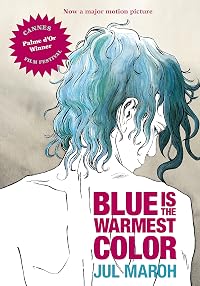
Blue Is the Warmest Color
by Jul Maroh
On This Page
Description
"Blue is the Warmest Color is a graphic novel about growing up, falling in love, and coming out. Clementine, a high school student, has an average life: she has friends, family, and the romantic attention of the boys in her school. When her openly gay best friend takes her out on the town, she wanders into a lesbian bar where she encounters Emma: a punkish, confident girl with blue hair. Their attraction is instant and electric, and Clementine finds herself in a relationship that will test show more her friends, parents, and her own ideas about herself and her identity"-- from publisher's web site. show lessTags
Recommendations














Member Recommendations
Member Reviews
I really loved the way Clem's struggles and self-discovery were portrayed. It felt real, and I ached for her highs and lows. I adored her friendship with Valentin. The romance aspects were often breathtaking, a lovely combination of teenage angst and first-time awe. The story really took a turn after the climax with a huge time and tone jump, and even with the framing from the beginning I really didn't like it, or the trope the story fell into. However, overall I enjoyed the well-fleshed characters and the interwoven details of French social/political issues. Also the way the color blue was deliberately put into each panel/page added so much depth to the experience of the graphic novel.
"Me preguntaste si creía en la existencia del amor eterno. El amor es algo demasiado abstracto e indefinido. Depende de lo que nosotros percibimos y vivimos. No existiría si no existiéramos. Y somos muy volubles… Así que el amor también puede serlo. El amor se consume, nos desfallece, se rompe, nos rompe, se revive…El amor no puede ser eterno, pero nos hace eternos."
Esta es una historia de amor, no de un amor maravilloso, alejado de los problemas y que sobrevive a todas las tempestades, tampoco es la historia de un amor enfermizo, necesitado y lleno de personas que desean separarlos. Es la historia de una relación que tiene su nacimiento como pasión y madura tras conocerse, verse y lastimarse (porque la vida no es rosa...o en show more este caso azul),pero también es una historia de aceptación, del reconocimiento de la propia identidad y combate a los prejuicios, propios y ajenos.
"Te quiero apasionadamente… Y te quiero apaciblemente. Puede que el amor eterno sea eso, esta mezcla de paz y de fuego."
Las protagonistas son Emma, una estudiante de arte que tiene algo que te atrae hacía ella, y Clementine, una adolescente que vive la dificultad de aceptar su sexualidad y por tanto de aceptarse a sí misma. Ambas chicas cambiaran el mundo de la otra, para bien y para mal, pero enriquecerán la historia de ambas. Para el final te das cuenta que azul representaba no a Emma, sino todo lo que ella era para Clementine, y que cuando en las imágenes el azul se va también muestra algo más profundo que la relación.
"El amor que hemos despertado continuara su camino más allá de nuestra muerte"
El dibujo es suave, simple y hermoso...muchas veces deja que veas lo que las protagonistas sienten sin que lo digan. Excelente.
"Amor mío, ya me has salvado. Me has salvado de un mundo de prejuicios y morales absurdas ayudándome a realizarme por completo."
Tal vez el mayor fallo es que, siendo una historia tan poderosa, los sentimientos no se transmiten tan fuertemente como en historias más sencillas, las protagonistas son tan humanas que ese pequeño problema se reciente al final. El mayor acierto es el tratamiento de como logran aceptar su sexualidad, ambas en su momento y contexto, además de lo que su entorno conlleva ese mismo rol.
Nota: Sí llegaste hasta aquí te diré que aun dudo sí el libro merece cuatro estrellas, y por tanto esta calificación puede cambiar sin previo aviso show less
Esta es una historia de amor, no de un amor maravilloso, alejado de los problemas y que sobrevive a todas las tempestades, tampoco es la historia de un amor enfermizo, necesitado y lleno de personas que desean separarlos. Es la historia de una relación que tiene su nacimiento como pasión y madura tras conocerse, verse y lastimarse (porque la vida no es rosa...o en show more este caso azul),pero también es una historia de aceptación, del reconocimiento de la propia identidad y combate a los prejuicios, propios y ajenos.
"Te quiero apasionadamente… Y te quiero apaciblemente. Puede que el amor eterno sea eso, esta mezcla de paz y de fuego."
Las protagonistas son Emma, una estudiante de arte que tiene algo que te atrae hacía ella, y Clementine, una adolescente que vive la dificultad de aceptar su sexualidad y por tanto de aceptarse a sí misma. Ambas chicas cambiaran el mundo de la otra, para bien y para mal, pero enriquecerán la historia de ambas. Para el final te das cuenta que azul representaba no a Emma, sino todo lo que ella era para Clementine, y que cuando en las imágenes el azul se va también muestra algo más profundo que la relación.
"El amor que hemos despertado continuara su camino más allá de nuestra muerte"
El dibujo es suave, simple y hermoso...muchas veces deja que veas lo que las protagonistas sienten sin que lo digan. Excelente.
"Amor mío, ya me has salvado. Me has salvado de un mundo de prejuicios y morales absurdas ayudándome a realizarme por completo."
Tal vez el mayor fallo es que, siendo una historia tan poderosa, los sentimientos no se transmiten tan fuertemente como en historias más sencillas, las protagonistas son tan humanas que ese pequeño problema se reciente al final. El mayor acierto es el tratamiento de como logran aceptar su sexualidad, ambas en su momento y contexto, además de lo que su entorno conlleva ese mismo rol.
Nota: Sí llegaste hasta aquí te diré que aun dudo sí el libro merece cuatro estrellas, y por tanto esta calificación puede cambiar sin previo aviso show less
Stunning. Absolutely, positively beautiful.
My attention was drawn to this graphic novel by one of the podcasts that I listen to. They raved about how gorgeous and important this story was. Of course, that meant I had to know what all the hype was about. Luckily my library had a digital copy of this for loan, and I snatched it up. I am so glad that I did. Blue Is the Warmest Color deserves all the accolades it has garnered, and more. Much more.
Julie Maroh expertly crafts a story about a teenage girl named Clementine. We follow her through a series of drab, grayscale panels to begin with. I thought this was utterly brilliant on Maroh's part. See, Clementine's life lacks color. She moves through each day, without any passion for anything show more in particular. That is, until she sees the girl with blue hair, and blue eyes.
Clementine's initial reaction to Emma, the girl with blue hair, undid me. The art in this book is perfection, but it's never more perfect than when Maroh is crafting the facial expression of one of the characters. Clementine's face when she sees Emma for the first time says it all. Attraction, jealousy, and above all else complete confusion as to why she'd even feel that way in the first place. I can't imagine what it's like to realize that you're attracted to the same sex, and based on the panels that follow Clementine's first glimpse of Emma, neither can she.
What builds from there is one of the most heartbreaking and wonderful stories I've ever read. There's this mid-point where, once these two are together, everything starts to show in color. It was such a subtle change that I almost didn't catch it, but that's also why it's so fitting. Clementine's world fills with passion, and Emma is the center of that. Which, of course, makes the ending all the more devastating. Trust me, you'll need tissues for this.
I feel it necessary to warn any potential readers that there are panels in this book that might bother some. There is nudity, and love making between two women. If you have an issue with those things, this probably isn't for you. If you don't, prepare to be enchanted. I can't express enough how much I agree that this is not only a lovely, but very important book. Blue Is the Warmest Color shows that love crosses all boundaries, no matter how solid we might think they are. show less
My attention was drawn to this graphic novel by one of the podcasts that I listen to. They raved about how gorgeous and important this story was. Of course, that meant I had to know what all the hype was about. Luckily my library had a digital copy of this for loan, and I snatched it up. I am so glad that I did. Blue Is the Warmest Color deserves all the accolades it has garnered, and more. Much more.
Julie Maroh expertly crafts a story about a teenage girl named Clementine. We follow her through a series of drab, grayscale panels to begin with. I thought this was utterly brilliant on Maroh's part. See, Clementine's life lacks color. She moves through each day, without any passion for anything show more in particular. That is, until she sees the girl with blue hair, and blue eyes.
Clementine's initial reaction to Emma, the girl with blue hair, undid me. The art in this book is perfection, but it's never more perfect than when Maroh is crafting the facial expression of one of the characters. Clementine's face when she sees Emma for the first time says it all. Attraction, jealousy, and above all else complete confusion as to why she'd even feel that way in the first place. I can't imagine what it's like to realize that you're attracted to the same sex, and based on the panels that follow Clementine's first glimpse of Emma, neither can she.
What builds from there is one of the most heartbreaking and wonderful stories I've ever read. There's this mid-point where, once these two are together, everything starts to show in color. It was such a subtle change that I almost didn't catch it, but that's also why it's so fitting. Clementine's world fills with passion, and Emma is the center of that. Which, of course, makes the ending all the more devastating. Trust me, you'll need tissues for this.
I feel it necessary to warn any potential readers that there are panels in this book that might bother some. There is nudity, and love making between two women. If you have an issue with those things, this probably isn't for you. If you don't, prepare to be enchanted. I can't express enough how much I agree that this is not only a lovely, but very important book. Blue Is the Warmest Color shows that love crosses all boundaries, no matter how solid we might think they are. show less
I fell in love with a girl for the first time at the age of fifteen, but I remember being attracted to girls far earlier than that. I went to school in a liberal neighborhood where a teacher might let slip a homophobic comment every now and then, but there were many openly gay and bisexual students. Everyone in my life knew that I liked girls, my mother gave me the “it’s okay if you’re gay” talk, and although I didn’t pursue relationships with women until later in life, I never felt like my feelings were shameful or wrong.
Not everyone is so lucky, however, and Blue is the Warmest Color is the story of a young girl named Clementine who finds her feelings at war with the judgments of her parents and her peers. She doesn’t show more understand why she fears intimacy with her boyfriend or what it means that she keeps dreaming about the beautiful blue-haired girl she locked eyes with in the park the other day.
Alternating between present and past, Blue is devastating, funny, and at times achingly vulnerable. We are first introduced to the full-color world of Emma, Clementine’s partner, who accompanies us through the pages of Clementine’s adolescent diaries to discover an innocent inner life where everything is black and white until love walks by.
Blue’s message, that “only love will save the world,” is stunning and necessary. My one complaint about the novel is that the end comes so quickly. I would have liked to linger in Emma and Clementine’s world a little longer. show less
Not everyone is so lucky, however, and Blue is the Warmest Color is the story of a young girl named Clementine who finds her feelings at war with the judgments of her parents and her peers. She doesn’t show more understand why she fears intimacy with her boyfriend or what it means that she keeps dreaming about the beautiful blue-haired girl she locked eyes with in the park the other day.
Alternating between present and past, Blue is devastating, funny, and at times achingly vulnerable. We are first introduced to the full-color world of Emma, Clementine’s partner, who accompanies us through the pages of Clementine’s adolescent diaries to discover an innocent inner life where everything is black and white until love walks by.
Blue’s message, that “only love will save the world,” is stunning and necessary. My one complaint about the novel is that the end comes so quickly. I would have liked to linger in Emma and Clementine’s world a little longer. show less
This is one of my favourite comic books ever.
Maroh's depiction of LGBTIQA issues feels so authentic it hurts my heart. I think Julie Maroh is often asked whether or not this graphic novel is autobiographical, purely because it feels so real for so many who read it. (It's not, but it might be autobiographical for a lot of people.)
I love this book because it has the power to make a person feel less alone. Maroh draws on very human, very basic needs - the need to be acknowledged, the need to be loved, the need to be respected, so you don't have to identify as LGBTIQA to read this book.
This graphic novel is devastatingly sad, and beautiful and at times just absolutely heart-wrenching. Some people might say that it's depressing or difficult show more to read but I think Maroh has produced something very genuine. Yes, a lot of LGBTIQA books and media can be very upsetting or even heavy, but I think we need to ask ourselves why so many stories are sad, rather than criticising the work within that genre.
The artwork itself is beautiful - I love that Clem's life is almost monotone, with flashes of blue. It has a really lovely water colour element to it, and very graphic textures. The style is very structured and fluid - it's a very well-balanced art style and it suits the mood of the novel perfectly.
I love this graphic novel and, when I'm ready, I'll read it again. Until then, I'll pass it on as many times as I can. show less
Maroh's depiction of LGBTIQA issues feels so authentic it hurts my heart. I think Julie Maroh is often asked whether or not this graphic novel is autobiographical, purely because it feels so real for so many who read it. (It's not, but it might be autobiographical for a lot of people.)
I love this book because it has the power to make a person feel less alone. Maroh draws on very human, very basic needs - the need to be acknowledged, the need to be loved, the need to be respected, so you don't have to identify as LGBTIQA to read this book.
This graphic novel is devastatingly sad, and beautiful and at times just absolutely heart-wrenching. Some people might say that it's depressing or difficult show more to read but I think Maroh has produced something very genuine. Yes, a lot of LGBTIQA books and media can be very upsetting or even heavy, but I think we need to ask ourselves why so many stories are sad, rather than criticising the work within that genre.
The artwork itself is beautiful - I love that Clem's life is almost monotone, with flashes of blue. It has a really lovely water colour element to it, and very graphic textures. The style is very structured and fluid - it's a very well-balanced art style and it suits the mood of the novel perfectly.
I love this graphic novel and, when I'm ready, I'll read it again. Until then, I'll pass it on as many times as I can. show less
One of the films I saw at Cannes this year was La Vie d'Adèle (in English, Blue is the Warmest Colour), which eventually and deservedly won the Palme d'Or. I was a little obsessed with it – I dreamed about the film for two nights after I saw it, and I was still going over it in my head weeks later.
One person who was not a fan, though, was Julie Maroh, the author of the original comic book. She said the sex scenes in the film were ‘ridiculous’ and had been ‘turned into porn’, and she complained about the fact that the two lead actresses were not lesbians in real life – which seems a silly objection really, since it's impossible to imagine anyone on earth playing the title role better than Adèle Exarchopoulos.
This isn't a show more film review so I'm not going to go into that, but it did make me really want to read the BD – even though it's always complicated coming to a book after you've seen the film adaptation. With that proviso in mind, I really loved this. It's sometimes described as a coming-out story, which it kind of is, or as a lesbian romance, which it kind of is – but its qualities convince you that such categories seem petty. It's just a very moving love story.
What makes it work so well is the central character of Clémentine, who is utterly charming – wide-eyed and unsure, but also prone to making lots of silly mistakes. At the start of the book she's just 15, struggling with homework and playground cliques, fighting with her parents, slouching around dreary Lille in her hoodie. She can't seem to make things work with her boyfriend Thomas. And then, one day, she meets someone who makes her feel everything she hasn't felt with him – a girl with blue hair….
The visual style is very effective, much more artful and interesting in many ways than the film. The blue of Emma's hair becomes such a icon of Clémentine's life that other colours seem bland and washed-out, and only blue objects stand out, all of them aides-memoires for the new and overwhelming feelings rushing through her.
The comic has more Tragedy! and Melodrama! than the film, but it's still very moving – a beautiful portrait of first love in all its excitement and confusion. Since the Cannes win, an English translation has been rushed into print, so hopefully Maroh's work will be as widely read as it deserves to be. show less
One person who was not a fan, though, was Julie Maroh, the author of the original comic book. She said the sex scenes in the film were ‘ridiculous’ and had been ‘turned into porn’, and she complained about the fact that the two lead actresses were not lesbians in real life – which seems a silly objection really, since it's impossible to imagine anyone on earth playing the title role better than Adèle Exarchopoulos.
This isn't a show more film review so I'm not going to go into that, but it did make me really want to read the BD – even though it's always complicated coming to a book after you've seen the film adaptation. With that proviso in mind, I really loved this. It's sometimes described as a coming-out story, which it kind of is, or as a lesbian romance, which it kind of is – but its qualities convince you that such categories seem petty. It's just a very moving love story.
What makes it work so well is the central character of Clémentine, who is utterly charming – wide-eyed and unsure, but also prone to making lots of silly mistakes. At the start of the book she's just 15, struggling with homework and playground cliques, fighting with her parents, slouching around dreary Lille in her hoodie. She can't seem to make things work with her boyfriend Thomas. And then, one day, she meets someone who makes her feel everything she hasn't felt with him – a girl with blue hair….
The visual style is very effective, much more artful and interesting in many ways than the film. The blue of Emma's hair becomes such a icon of Clémentine's life that other colours seem bland and washed-out, and only blue objects stand out, all of them aides-memoires for the new and overwhelming feelings rushing through her.
The comic has more Tragedy! and Melodrama! than the film, but it's still very moving – a beautiful portrait of first love in all its excitement and confusion. Since the Cannes win, an English translation has been rushed into print, so hopefully Maroh's work will be as widely read as it deserves to be. show less
3.50 sicuro. Disegni splendidi, ma concordo con Altre recensioni: si perde decisamente sul finale. Si ha come l’impressione che manchino dei pezzi.
Consigliato comunque!
Consigliato comunque!
Members
- Recently Added By
Lists

Favorite Literary Love Stories
182 works; 100 members

Books Read in 2016
4,666 works; 199 members

Books recommended by Calgary Public Library staff
1,588 works; 4 members

Best Love Stories
107 works; 14 members

Favorite French Fiction
226 works; 109 members

Recommended Comics / Graphic Novels
595 works; 122 members
Author Information

7 Works 1,306 Members
Some Editions
Awards and Honors
Awards
Notable Lists
Work Relationships
Common Knowledge
- Canonical title*
- Le bleu est une couleur chaude
- Original title
- Le bleu est une couleur chaude
- Original publication date
- 2010
- Related movies
- Blue is the Warmest Color (2013 | IMDb)
- Blurbers
- Spielberg, Steven
*Some information comes from Common Knowledge in other languages. Click "Edit" for more information.
Classifications
- Genres
- LGBTQ+, Graphic Novels & Comics
- DDC/MDS
- 741.5 — Arts & recreation Drawing & decorative arts Drawing Comic books, graphic novels, fotonovelas, cartoons, caricatures, comic strips
- LCC
- PN6747 .M36 .B5413 — Language and Literature Literature (General) Literature (General) Collections of general literature Comic books, strips, etc.
- BISAC
Statistics
- Members
- 1,059
- Popularity
- 24,407
- Reviews
- 58
- Rating
- (3.90)
- Languages
- 9 — Dutch, English, French, German, Italian, Norwegian (Bokmål), Portuguese, Spanish, Swedish
- Media
- Paper, Ebook
- ISBNs
- 19
- UPCs
- 1
- ASINs
- 7