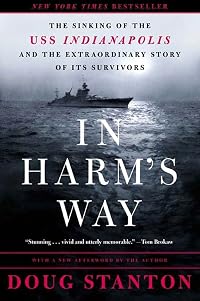
In Harm's Way: The Sinking of the U.S.S. Indianapolis and the Extraordinary Story of Its Survivors
by Doug Stanton
On This Page
Description
A young readers edition of Doug Stanton and Michael Tougias's New York Times bestseller In Harm's Way?a riveting World War II account of the greatest maritime disaster in US naval historyOn July 30, 1945, the USS Indianapolis was torpedoed in the South Pacific by a Japanese submarine. An estimated three hundred men were killed upon impact; close to nine hundred sailors were cast into the Pacific Ocean, where they remained undetected by the navy for nearly four days and nights. Battered by a show more savage sea, they struggled to stay alive, fighting off sharks, hypothermia, and hallucinations.
By the time rescue arrived, all but 316 men had died. The captain's subsequent court-martial left many questions unanswered: How did the navy fail to realize the Indianapolis was missing? And how did these 316 men manage to survive against all odds?
This thrilling wartime account of heroism and survival, Book five in the True Rescue narrative nonfiction series, is inspiring and unforgettable?the perfect choice for young adventure-seekers.
. show less
Tags
Recommendations













Member Recommendations
Member Reviews
True story of the U.S.S. Indianapolis torpedoed and sunk near the end of WWII by a Japanese submarine. Based on interviews with survivors, extensive research, and review of declassified information, the author sheds light on what really happened to the ship and its crew. It starts with an ending, then traces the ship’s last journey from San Francisco to Tinian to deliver an important cargo to its final resting place at the bottom of the Philippine Sea. It brings to light the series of miscommunications, misguided naval directives, and errors in judgment that led to the survivors spending an inordinate amount of time awaiting rescue, resulting in unnecessary deaths at sea. The captain became a scapegoat for an act of war to divert show more attention from this series of fiascos. In addition to the riveting human saga, it includes scientific explanations for the miseries endured by the survivors. This book comprises a crisp, well-told, powerful piece of history. Recommended to those interested in the history of WWII, survival stories, or rectification of injustice. An impressive work that made a difference. show less
"As the heat of the day tempered into relative cool, the boys, lying in their rafts, hanging from floating nets, and bobbing in life vests, began to feel things bumping from below – nudges and kicks that they mistook for the touch of their comrades treading water." (pg. 188)
It is widely accepted that the most horrifying moment in Steven Spielberg's classic blockbuster film Jaws is not the opening scene, despite its being accompanied by that famous music, nor the first appearance of Bruce amongst Brody's scattered chum, nor even the eventual destruction of the famously-undersized boat by the relentless beast. It is the moment on the eve of battle when, in the quiet of the boat's cabin in the middle of the night, Quint relates his show more experience with the USS Indianapolis to Brody and the rapidly-sobering Hooper. Quint may not be real, but the story, unfortunately, is. A ship goes down, torpedoed, and sinks in minutes. No one knows they are there. Four days in the water, exposed to burning sun and coarse salt, no food or water. Eleven hundred men went into the water, three hundred came out, sharks took the rest.
The film quite naturally emphasises the shark angle, and the reality is certainly horrific (on page 285, Stanton estimates that of the approximately 900 who survived the initial sinking, 200 were killed by shark attack – a rate of 50 a day. And that's not counting the already-dead bodies that the sharks feasted on). But what Doug Stanton's detailed factual account In Harm's Way impresses upon you is that the sharks were only part of the horror endured by the forgotten crew as they waited hopelessly for rescue. Alongside the terrifying accounts of shark attack, Stanton also recounts the equally alarming accounts of burns (from the initial explosion and fuel oil slicks), dehydration, drowning, hypothermia, exhaustion and delirium. It's not even a question of endurance; the strongest, most resolute man could choke on fuel oil or see his lifejacket lose buoyancy or have the muscles of his broken arm chewed to the bone by saltwater. Even if he endures all this, there's nothing to stop one of the hundreds of sharks from dragging him away. The horror of the book, aside from your sympathy for these tragic men, is the horror of complete helplessness.
Like Richard Dreyfuss' Hooper, we're completely sobered by the story and locked in to its telling. I thought Stanton's account was, at times, a bit too detailed, particularly in the early stages, but he must have been doing something right because I read the 400 pages of the book in a single day and could easily have read 400 more. It's a simply-written, journalistic account (the book was expanded from an initial feature article in Men's Journal of just 12,000 words) and does justice to the story. I did find myself wanting more insight into certain events (for example, why did Commodore Gillette recall the boats initially sent in response to the Indy's SOS signal?) and in particular I was disappointed the account of the court-martial and post-war inquiry was not of greater depth. Given one of Stanton's stated purposes in writing the book was to exonerate Captain McVay, a more forensic deconstruction of how he was stitched up would have been welcome.
McVay is the only US Navy captain to have faced a court-martial for losing a ship sunk as an act of war (pg. 21) – and convicted, at that, and by a panel including an admiral who was himself perhaps culpable (pg. 294). The government and navy in general wanted to cover up its own culpability in not rescuing the men in the water for four days (and then only after discovering them by chance). As a further insult to a man who had the misfortune to be attacked in a warzone, and had borne the same trials of exposure and shark that the others of the crew had endured, the navy invited the Japanese submarine commander who sunk McVay to testify against him. Only a few months after the war had ended, this must have been a humiliating insult. Even when the Japanese submariner's testimony actually benefits McVay (in that he would have been able to sink the Indy no matter what countermeasures she took (pg. 304)), the inquiry panel finds otherwise. The grubby hands of Admiral King are everywhere (in everything I've read of him over many years as a WW2 history buff, he's always seemed a repellent man) and, as so often in life, the people in charge are choosing where they can safely deflect responsibility. And yet Stanton's account never really delves into King or the Navy scheming, and so does not convey the white-hot anger one should feel at these developments.
Perhaps the best thing Stanton's book does, beyond the justice paid to the survivors and the dead in telling their story respectfully, is contrast the buck-passing and bureaucratic squirming at the top with the understated heroism of those at the sharp end. One of the most affecting anecdotes in In Harm's Way comes on page 266, when the ship's doctor distributes fresh water that has been dropped to them in canisters from a passing plane, to tide them over until the more considered rescue operation can finally begin (four days late). The doctor, assessing the condition of each of the men around him, orders certain men to be given their meagre ration first. A cup of water is passed down the line of men, all of whom have gone four days without a drink and endured much else besides, to each of the targeted men in turn. No one broke under this tantalising test, and each man waited his turn. The doctor still marvels in telling the story to the author decades later. The contrast to the self-serving squirmers and the cruelly bureaucratic might be unintentional, but it is there. The book makes you realise, starkly, just how precious basic humanity can be. In a modern world where sports stars can be heroes for playing well and people who regret a one-night stand twenty years ago can be survivors, we can read true stories like In Harm's Way and think in horror and wonder at what men can endure.
"More than a few of them didn't have life vests. They were half dog-paddling and half drowning, heroically supported by comrades who themselves were close to giving up. The boys supporting these swimmers had enormous sores on their hips from the chafing of their heavy loads. Yet none of them wanted to let go of their charges. They were clinging to them as if saving themselves." (pg. 232) show less
It is widely accepted that the most horrifying moment in Steven Spielberg's classic blockbuster film Jaws is not the opening scene, despite its being accompanied by that famous music, nor the first appearance of Bruce amongst Brody's scattered chum, nor even the eventual destruction of the famously-undersized boat by the relentless beast. It is the moment on the eve of battle when, in the quiet of the boat's cabin in the middle of the night, Quint relates his show more experience with the USS Indianapolis to Brody and the rapidly-sobering Hooper. Quint may not be real, but the story, unfortunately, is. A ship goes down, torpedoed, and sinks in minutes. No one knows they are there. Four days in the water, exposed to burning sun and coarse salt, no food or water. Eleven hundred men went into the water, three hundred came out, sharks took the rest.
The film quite naturally emphasises the shark angle, and the reality is certainly horrific (on page 285, Stanton estimates that of the approximately 900 who survived the initial sinking, 200 were killed by shark attack – a rate of 50 a day. And that's not counting the already-dead bodies that the sharks feasted on). But what Doug Stanton's detailed factual account In Harm's Way impresses upon you is that the sharks were only part of the horror endured by the forgotten crew as they waited hopelessly for rescue. Alongside the terrifying accounts of shark attack, Stanton also recounts the equally alarming accounts of burns (from the initial explosion and fuel oil slicks), dehydration, drowning, hypothermia, exhaustion and delirium. It's not even a question of endurance; the strongest, most resolute man could choke on fuel oil or see his lifejacket lose buoyancy or have the muscles of his broken arm chewed to the bone by saltwater. Even if he endures all this, there's nothing to stop one of the hundreds of sharks from dragging him away. The horror of the book, aside from your sympathy for these tragic men, is the horror of complete helplessness.
Like Richard Dreyfuss' Hooper, we're completely sobered by the story and locked in to its telling. I thought Stanton's account was, at times, a bit too detailed, particularly in the early stages, but he must have been doing something right because I read the 400 pages of the book in a single day and could easily have read 400 more. It's a simply-written, journalistic account (the book was expanded from an initial feature article in Men's Journal of just 12,000 words) and does justice to the story. I did find myself wanting more insight into certain events (for example, why did Commodore Gillette recall the boats initially sent in response to the Indy's SOS signal?) and in particular I was disappointed the account of the court-martial and post-war inquiry was not of greater depth. Given one of Stanton's stated purposes in writing the book was to exonerate Captain McVay, a more forensic deconstruction of how he was stitched up would have been welcome.
McVay is the only US Navy captain to have faced a court-martial for losing a ship sunk as an act of war (pg. 21) – and convicted, at that, and by a panel including an admiral who was himself perhaps culpable (pg. 294). The government and navy in general wanted to cover up its own culpability in not rescuing the men in the water for four days (and then only after discovering them by chance). As a further insult to a man who had the misfortune to be attacked in a warzone, and had borne the same trials of exposure and shark that the others of the crew had endured, the navy invited the Japanese submarine commander who sunk McVay to testify against him. Only a few months after the war had ended, this must have been a humiliating insult. Even when the Japanese submariner's testimony actually benefits McVay (in that he would have been able to sink the Indy no matter what countermeasures she took (pg. 304)), the inquiry panel finds otherwise. The grubby hands of Admiral King are everywhere (in everything I've read of him over many years as a WW2 history buff, he's always seemed a repellent man) and, as so often in life, the people in charge are choosing where they can safely deflect responsibility. And yet Stanton's account never really delves into King or the Navy scheming, and so does not convey the white-hot anger one should feel at these developments.
Perhaps the best thing Stanton's book does, beyond the justice paid to the survivors and the dead in telling their story respectfully, is contrast the buck-passing and bureaucratic squirming at the top with the understated heroism of those at the sharp end. One of the most affecting anecdotes in In Harm's Way comes on page 266, when the ship's doctor distributes fresh water that has been dropped to them in canisters from a passing plane, to tide them over until the more considered rescue operation can finally begin (four days late). The doctor, assessing the condition of each of the men around him, orders certain men to be given their meagre ration first. A cup of water is passed down the line of men, all of whom have gone four days without a drink and endured much else besides, to each of the targeted men in turn. No one broke under this tantalising test, and each man waited his turn. The doctor still marvels in telling the story to the author decades later. The contrast to the self-serving squirmers and the cruelly bureaucratic might be unintentional, but it is there. The book makes you realise, starkly, just how precious basic humanity can be. In a modern world where sports stars can be heroes for playing well and people who regret a one-night stand twenty years ago can be survivors, we can read true stories like In Harm's Way and think in horror and wonder at what men can endure.
"More than a few of them didn't have life vests. They were half dog-paddling and half drowning, heroically supported by comrades who themselves were close to giving up. The boys supporting these swimmers had enormous sores on their hips from the chafing of their heavy loads. Yet none of them wanted to let go of their charges. They were clinging to them as if saving themselves." (pg. 232) show less
I once knew a survivor of the USS Indianapolis. He was kind enough to come to my US Survey classes and share his experiences as a young man facing war, the dramatic tale of the sinking of his beloved ship, the four terrifying days he spent in the water being attacked by sharks and without food or water, the rescue they thought would never come, recovery, and the Navy's treatment of the story. He MOVED these students.
In some ways Stanton's book mirrors the tale the survivor told my students. Only 300 or so of the 1100 sailors survived the torpedo attack and four days in the water. Sharks killed hundreds of sailors who floated in the water for rescue. It was the worst disaster in the history of the US Navy. In the end, the Navy hung the show more cost of the disaster around the neck of Captain McVay who had suspended zigzagging ( a tactic to evade submarine launched torpedoes) at his discretion due to poor visibility. The Navy even took the unprecedented step of calling in the skipper of the Japanese submarine who sunk the Indy to testify for the prosecution! Even he told the court that zigzagging would have made no difference at all. Blaming McVay (which might have been part of a vendetta that Admiral Ernest King had on McVay's father, also a navy officer) was a coverup on a series of failures all along the chain of command that included missed or ignored signals and SOS messages, lack of destroyer escorts, conflicting orders sent to various commands on the location of the Indy (so no one really noticed that if had failed to show up at its destination), etc. This book will make you mad. show less
In some ways Stanton's book mirrors the tale the survivor told my students. Only 300 or so of the 1100 sailors survived the torpedo attack and four days in the water. Sharks killed hundreds of sailors who floated in the water for rescue. It was the worst disaster in the history of the US Navy. In the end, the Navy hung the show more cost of the disaster around the neck of Captain McVay who had suspended zigzagging ( a tactic to evade submarine launched torpedoes) at his discretion due to poor visibility. The Navy even took the unprecedented step of calling in the skipper of the Japanese submarine who sunk the Indy to testify for the prosecution! Even he told the court that zigzagging would have made no difference at all. Blaming McVay (which might have been part of a vendetta that Admiral Ernest King had on McVay's father, also a navy officer) was a coverup on a series of failures all along the chain of command that included missed or ignored signals and SOS messages, lack of destroyer escorts, conflicting orders sent to various commands on the location of the Indy (so no one really noticed that if had failed to show up at its destination), etc. This book will make you mad. show less
http://tinyurl.com/3lro2y3
I finished this in less than 2 days. I think that's a record for a 250+ page book.
Valid criticisms of this book might include that it reads a bit like death porn, knowing as we do the ending, but those criticisms would have missed the boat (or ship, as it were). As Stanton himself explains in an afterword, his ultimate goal in writing this story was to explore the survivors: their ordeal, their suffering, their lives post-Indianapolis. How do you survive something like this? Naturally, exploration of this gives us insights into the human character as well as insights into war itself.
Clearly, the lack of rescue of these men was due to an extraordinary amount of bad luck (if 8 switches will save your life, and 7 show more of them fail, this is the situation you'll find yourself in). It also shows how much at fault the Navy really was in this disaster. It's infuriating to read and propels you forward in the story to the next unbelievable bit... and the next one...
However, what I would have appreciated at the end was a little bit more about how Captain McVay felt after he heard what happened to the largest number of floating men, as well as more about how the men felt about being survivors and the guilt that comes with that. I know Stanton must have heard the latter and I'm surprised at the lack of it in the book.
Regardless, it is beautifully written and for that alone it is worth reading. show less
I finished this in less than 2 days. I think that's a record for a 250+ page book.
Valid criticisms of this book might include that it reads a bit like death porn, knowing as we do the ending, but those criticisms would have missed the boat (or ship, as it were). As Stanton himself explains in an afterword, his ultimate goal in writing this story was to explore the survivors: their ordeal, their suffering, their lives post-Indianapolis. How do you survive something like this? Naturally, exploration of this gives us insights into the human character as well as insights into war itself.
Clearly, the lack of rescue of these men was due to an extraordinary amount of bad luck (if 8 switches will save your life, and 7 show more of them fail, this is the situation you'll find yourself in). It also shows how much at fault the Navy really was in this disaster. It's infuriating to read and propels you forward in the story to the next unbelievable bit... and the next one...
However, what I would have appreciated at the end was a little bit more about how Captain McVay felt after he heard what happened to the largest number of floating men, as well as more about how the men felt about being survivors and the guilt that comes with that. I know Stanton must have heard the latter and I'm surprised at the lack of it in the book.
Regardless, it is beautifully written and for that alone it is worth reading. show less
Right at the end of World War II a ship left from San Francisco carrying pieces of the atom bomb. The secret mission was an important one, crucial to ending the war. A lack of shared information and an unexpected Japanese submarine led to the torpedoing and sinking of the ship. The story of the USS Indianapolis became famous after a scene in Jaws viscerally described the horror the men experienced.
This is nonfiction at its best. The book sweeps you into the story immediately. It moves fast, hooking you and breaking your heart with every page. Trapped in the water, surrounded by sharks and without any drinkable water, the men began to drop like flies.
It’s horrifying to read about what the men in the water experienced. Some show more hallucinated, others gave up, and some fought to save their fellow men by giving them their life vests or diving off rafts to save someone. There were shark attacks, men drank the salt water out of desperation, others were burned badly when the ship was hit and were forced to sit in the water as their wounds festered. There were 1,196 crew members on the ship when it was torpedoed and only 321 survived, four more died in the weeks following. Those are not good odds.
The book also deals with the charges brought against the captain of the ship and how they affected him. There’s something particularly terrible about going through a trauma like that and knowing that it’s still not over when you get out of the water.
BOTTOM LINE: Just fantastic. If you enjoy good nonfiction, war stories or anything along those lines I would highly recommend it. It’s similar to Unbroken, but in my opinion was even better. show less
This is nonfiction at its best. The book sweeps you into the story immediately. It moves fast, hooking you and breaking your heart with every page. Trapped in the water, surrounded by sharks and without any drinkable water, the men began to drop like flies.
It’s horrifying to read about what the men in the water experienced. Some show more hallucinated, others gave up, and some fought to save their fellow men by giving them their life vests or diving off rafts to save someone. There were shark attacks, men drank the salt water out of desperation, others were burned badly when the ship was hit and were forced to sit in the water as their wounds festered. There were 1,196 crew members on the ship when it was torpedoed and only 321 survived, four more died in the weeks following. Those are not good odds.
The book also deals with the charges brought against the captain of the ship and how they affected him. There’s something particularly terrible about going through a trauma like that and knowing that it’s still not over when you get out of the water.
BOTTOM LINE: Just fantastic. If you enjoy good nonfiction, war stories or anything along those lines I would highly recommend it. It’s similar to Unbroken, but in my opinion was even better. show less
This is a fascinating book, written like a thriller even though it's all true and was meticulously researched. I appreciated the fact that the book does not make the Japanese out to be the villians, but rather focuses on the errors in the US Navy that allowed the ship to be torpedoed and for the crew to be left out in the ocean for four days. I also finally understand why some of my friends are afraid of sharks.
A heart-rending account of men battered, killed, and scarred by forces beyond their control--forces of war, forces of nature, and forces of politics. The needless loss of hundreds of sailors' and marines' lives in a tragedy overshadowed by the bombings of Hiroshima and Nagasaki and the surrender of Japan, and suppressed by a military beaurocracy using the victim as a scapegoat will leave your blood boiling with outrage.
This book should, as much as anything could, vindicate the survivors from the guilt they place on themselves and from the guilt placed on them by the hubris of the politics of war. But vindication will not bring back the heroes of the Indianapolis' survivors whose psychological wounds proved fatal in the intervening show more years.
This story is a horrible lesson that every military leader should read about the horrible consequences of discarding personal discretion, initiative, and reason in the interest of following the letter of the law. show less
This book should, as much as anything could, vindicate the survivors from the guilt they place on themselves and from the guilt placed on them by the hubris of the politics of war. But vindication will not bring back the heroes of the Indianapolis' survivors whose psychological wounds proved fatal in the intervening show more years.
This story is a horrible lesson that every military leader should read about the horrible consequences of discarding personal discretion, initiative, and reason in the interest of following the letter of the law. show less
Members
- Recently Added By
Lists

r/AskHistorians' Recommended Books
1,068 works; 18 members
Author Information

6+ Works 2,944 Members
A former contributing editor at Esquire & Outside, Doug Stanton is now a contributing editor at Men's Journal. He received an MFA from The Writers' Workshop at the University of Iowa. He lives in Traverse City, Michigan. (Bowker Author Biography)
Some Editions
Awards and Honors
Awards
Distinctions
Work Relationships
Is abridged in
Common Knowledge
- Canonical title
- In Harm's Way: The Sinking of the U.S.S. Indianapolis and the Extraordinary Story of Its Survivors
- Original publication date
- 2001-05
- Important places
- USS Indianapolis (CA-35); Pacific Ocean
- Important events
- World War II (1939 | 1945); World War II, Pacific Theater (1941-12-07 | 1945-09-02); Sinking of the USS Indianapolis (1945-07-30)
- Epigraph
- First say to yourself what would you be,
then do what you have to do.
-EPICTETUS - Dedication
- FOR
ANNE, JOHN,
AND
KATHERINE STANTON
And my mother and father,
who told me about the war
And the boys of the USS Indianapolis,
who fought it
IN MEMORIAM
LEONARD K. DAILEY
Died October 25, 1944 - First words
- The ship was still tied up in the harbor at Mare Island, but already the captain felt it was drifting out of his control.
- Quotations
- Eternal father strong to save whose arm does rule the restless wave ... Oh here us when we pray to thee for those in peril on sea.
- Last words
- (Click to show. Warning: May contain spoilers.)What was left of Charles Butler McVay melted on the water and was gone.
- Blurbers
- Brokaw, Tom
- Original language
- English
Classifications
Statistics
- Members
- 1,594
- Popularity
- 14,300
- Reviews
- 43
- Rating
- (4.21)
- Languages
- Danish, English, Italian
- Media
- Paper, Audiobook, Ebook
- ISBNs
- 27
- ASINs
- 15