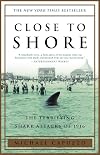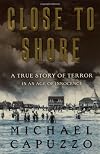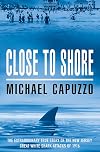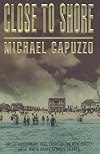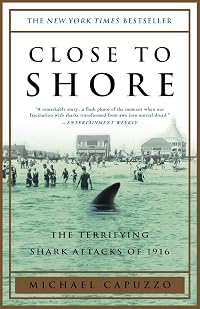
Close to Shore: The Terrifying Shark Attacks of 1916
by Michael Capuzzo
On This Page
Description
Details the first documented cases in American history of sharks attacking swimmers, which occured along the Atlantic coast of New Jersey in 1916.Tags
Recommendations

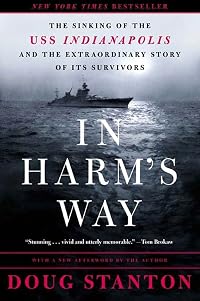

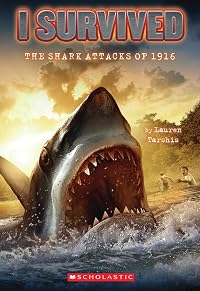


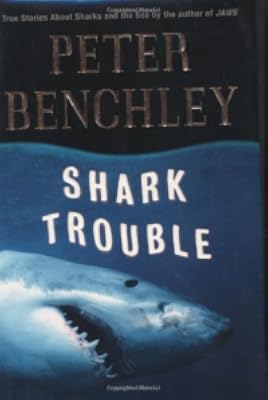


























Member Recommendations


Member Reviews
Close to Shore is not your typical non-fiction. It is a period piece that attempts to transport the reader back to New Jersey and New York in 1916, providing lots of period detail, manner of dress, bathing costumes, medical thinking, and scientific knowledge of the era. It tells the story of the people who were attacked, and also attempts to track the shark itself. Now, of course, we do not truly know where the shark originated or how it got to New Jersey. Nor do we know for sure the same shark attacked all of these victims. But the author did extensive research with noted shark experts to formulate a likely scenario and he presents a compelling case.
I found it interesting that scientists in 1916 doubted that sharks would attack humans. show more The attacks were blamed on sea turtles, orcas, and swordfish, along with other unusual suspects. One of the main strengths of the book is that it shows how difficult it is for people to let go of previously held beliefs. The narrative presents the great white shark as the culprit, though other accounts I have read blame the bull shark, and I am not certain if the experts agree that it was a single shark. These attacks certainly changed the public’s view of sharks. The 1916 attacks were the inspiration behind Peter Benchley’s novel Jaws. show less
I found it interesting that scientists in 1916 doubted that sharks would attack humans. show more The attacks were blamed on sea turtles, orcas, and swordfish, along with other unusual suspects. One of the main strengths of the book is that it shows how difficult it is for people to let go of previously held beliefs. The narrative presents the great white shark as the culprit, though other accounts I have read blame the bull shark, and I am not certain if the experts agree that it was a single shark. These attacks certainly changed the public’s view of sharks. The 1916 attacks were the inspiration behind Peter Benchley’s novel Jaws. show less
"Combining rich historical detail and a harrowing, pulse-pounding narrative, Close to Shore brilliantly re-creates the summer of 1916, when a rogue Great White shark attacked swimmers along the New Jersey shore, triggering mass hysteria and launching the most extensive shark hunt in history.
During the summer before the United States entered World War I, when ocean swimming was just becoming popular and luxurious Jersey Shore resorts were thriving as a chic playground for an opulent yet still innocent era's new leisure class, Americans were abruptly introduced to the terror of sharks. In July 1916 a lone Great White left its usual deep-ocean habitat and headed in the direction of the New Jersey shoreline. There, near the towns of Beach show more Haven and Spring Lake-and, incredibly, a farming community eleven miles inland-the most ferocious and unpredictable of predators began a deadly rampage: the first shark attacks on swimmers in U.S. history.
For Americans celebrating an astoundingly prosperous epoch much like our own, fuelled by the wizardry of revolutionary inventions, the arrival of this violent predator symbolized the limits of mankind's power against nature.
Interweaving a vivid portrait of the era and meticulously drawn characters with chilling accounts of the shark's five attacks and the frenzied hunt that ensued, Michael Capuzzo has created a non fiction historical thriller with the texture of Ragtime and the tension of Jaws. From the unnerving inevitability of the first attack on the esteemed son of a prosperous Philadelphia physician to the spine-tingling moment when a farm boy swimming in Matawan Creek feels the sandpaper-like skin of the passing shark, Close to Shore is an undeniably gripping saga.
Heightening the drama are stories of the resulting panic in the citizenry, press and politicians, and of colourful personalities such as Herman Oelrichs, a flamboyant millionaire who made a bet that a shark was no match for a man (and set out to prove it); Museum of Natural History ichthyologist John Treadwell Nichols, faced with the challenge of stopping a mythic sea creature about which little was known; and, most memorable, the rogue Great White itself moving through a world that couldn't conceive of either its destructive power or its moral right to destroy.
Scrupulously researched and superbly written, Close to Shore brings to life a breathtaking, pivotal moment in American history. Masterfully written and suffused with fascinating period detail and insights into the science and behaviour of sharks, Close to Shore recounts a breathtaking, pivotal moment in American history with startling immediacy.
Details the first documented cases in American history of sharks attacking swimmers, which occured along the Atlantic coast of New Jersey in 1916."
http://www.barnesandnoble.com/ show less
During the summer before the United States entered World War I, when ocean swimming was just becoming popular and luxurious Jersey Shore resorts were thriving as a chic playground for an opulent yet still innocent era's new leisure class, Americans were abruptly introduced to the terror of sharks. In July 1916 a lone Great White left its usual deep-ocean habitat and headed in the direction of the New Jersey shoreline. There, near the towns of Beach show more Haven and Spring Lake-and, incredibly, a farming community eleven miles inland-the most ferocious and unpredictable of predators began a deadly rampage: the first shark attacks on swimmers in U.S. history.
For Americans celebrating an astoundingly prosperous epoch much like our own, fuelled by the wizardry of revolutionary inventions, the arrival of this violent predator symbolized the limits of mankind's power against nature.
Interweaving a vivid portrait of the era and meticulously drawn characters with chilling accounts of the shark's five attacks and the frenzied hunt that ensued, Michael Capuzzo has created a non fiction historical thriller with the texture of Ragtime and the tension of Jaws. From the unnerving inevitability of the first attack on the esteemed son of a prosperous Philadelphia physician to the spine-tingling moment when a farm boy swimming in Matawan Creek feels the sandpaper-like skin of the passing shark, Close to Shore is an undeniably gripping saga.
Heightening the drama are stories of the resulting panic in the citizenry, press and politicians, and of colourful personalities such as Herman Oelrichs, a flamboyant millionaire who made a bet that a shark was no match for a man (and set out to prove it); Museum of Natural History ichthyologist John Treadwell Nichols, faced with the challenge of stopping a mythic sea creature about which little was known; and, most memorable, the rogue Great White itself moving through a world that couldn't conceive of either its destructive power or its moral right to destroy.
Scrupulously researched and superbly written, Close to Shore brings to life a breathtaking, pivotal moment in American history. Masterfully written and suffused with fascinating period detail and insights into the science and behaviour of sharks, Close to Shore recounts a breathtaking, pivotal moment in American history with startling immediacy.
Details the first documented cases in American history of sharks attacking swimmers, which occured along the Atlantic coast of New Jersey in 1916."
http://www.barnesandnoble.com/ show less
Excellently written, this page turner was well worth the time spent reading. I was particularly drawn to it because the New Jersey shore is approximately a two hour drive from where I live, and it contains many good memories of riding the waves, tasting the salt water for the first time, the sounds and smells of the boardwalk, and wonderful family vacations.
During the summer of 1916, when vacationing at the "shore" became a new experience, a rouge shark thrown out of the gulf stream into the Atlantic ocean shore, caused five attacks and deaths. Little was known about the great white shark at the time. And those who were "experts" disbelieved that a shark would be capable of chomping off the legs and body parts of human prey.
Even the show more ichthyologist John Treadwell from the New York Museum of Natural History was challenged to confront what he thought was true compared to what actually occurred. The first attack in July of 1916 occurred at Beach Heaven, NJ. The target was a seasoned swimmer, and son of a wealthy Philadelphia physician. From there, the shark hugged the coast northward as a farrm boy in the Matawan Creek who, with his pals frequently took a dip to cool themselves became another target.
Not only does the author vividly portray the attacks, but it is obvious that he has done his homework and researched the behavior of the great white! This fascinating true life story occurred at a time when jazz was new, Philadelphia high society carved a niche as New Jersey shore became their playground, while the poor who road the trains to the water for relief from the high temperatures were deemed unfit for the company of the wealthy. Swimming in the ocean was a novelty, and none thought that death could be a part of their experience. show less
During the summer of 1916, when vacationing at the "shore" became a new experience, a rouge shark thrown out of the gulf stream into the Atlantic ocean shore, caused five attacks and deaths. Little was known about the great white shark at the time. And those who were "experts" disbelieved that a shark would be capable of chomping off the legs and body parts of human prey.
Even the show more ichthyologist John Treadwell from the New York Museum of Natural History was challenged to confront what he thought was true compared to what actually occurred. The first attack in July of 1916 occurred at Beach Heaven, NJ. The target was a seasoned swimmer, and son of a wealthy Philadelphia physician. From there, the shark hugged the coast northward as a farrm boy in the Matawan Creek who, with his pals frequently took a dip to cool themselves became another target.
Not only does the author vividly portray the attacks, but it is obvious that he has done his homework and researched the behavior of the great white! This fascinating true life story occurred at a time when jazz was new, Philadelphia high society carved a niche as New Jersey shore became their playground, while the poor who road the trains to the water for relief from the high temperatures were deemed unfit for the company of the wealthy. Swimming in the ocean was a novelty, and none thought that death could be a part of their experience. show less
"Close To Shore" by Michael Capuzzo is a fascinating book that details the series of shark attacks on the New Jersey coast during the summer of 1916. Through vivid descriptions of the luxurious hotels, posh lifestyle, and attitudes towards leisure time on the East Coast, the author immerses the reader in the mood of the times. Against the backdrop of war and polio, swimming in the ocean for better health has become a popular trend. However, a rogue great white shark took advantage of this and caused widespread horror and panic. The book is a thrilling and informative account of the events and compares today's scientific knowledge with the theories of the early twentieth century. It is a must-read for anyone interested in sharks and show more their interactions with humans. show less
I listened to an abridged version of this, which I think was the right call judging by the other comments. I always go for the full length books, but in this case I just wanted to meat (haha) of the story. It's crazy how little we knew about sharks a century ago, all the men saying so confidently that sharks would never eat a human, they weren't strong enough, they were just docile fish. Tell that to the guy with no feet now, the kid with no leg, the man with what remains of his torso. For a critter that is older than trees, we sure took our sweet time learning about it.
From the disaster response reading program, this is a melodramatic page turner, but a well-done melodramatic page-turner. Author Michael Capuzzo is a journalist, so we get a lot of the tradition for this sort of thing – backstories of the doomed and the survivors. Charles Vansant was a doctor’s son and recent Penn graduate; Charles Bruder was the bell captain at a beachfront hotel; Lester Stilwell was a preteen taking a break from his summer job in a basket factory, and Stanley Fisher was a tailor who went to rescue Stilwell. Of course, the shark has no name.
Being a nerd, I don’t really care about the backstories; that Charles Vansant’s father wore a pocket watch; that Charles Bruder sent money home to his mom in Switzerland; show more that Lester Stilwell was frail or that Stanley Fisher’s friend were surprised when the amateur athlete took up a career as a tailor. Still, it’s well done; Capuzzo does manage to evoke a summer at the beach in 1916, with ladies in long white dresses promenading along the shore while their bolder girlfriends entered the water and young men showed off their physiques as far as it was possible in a two piece bathing suit. I want to know more about the shark. Alas, that’s still mysterious. The shark is a character and Capuzzo tries to portray its “thoughts” insofar as it had any; but those chapters are unsatisfactory. What’s known is that there were fatal attacks at Beach Haven on July 1, 1916 (Charles Vansant - in three feet of water); at Spring Lake on July 6 (Charles Bruner, about 130 feet from shore); and at Matawan on July 12 (Lester Stilwell and Stanley Fisher, in Matawan Creek, 15 miles from the ocean and in perhaps 8 feet of brackish water). There was a nonfatal attack downstream in Matawan Creek later on July 12; Joseph Dunn’s friends were able to pull him free from the shark. On July 14 Michael Schleisser and John Murphy were fishing in Raritan Bay when they caught something large in their net. This turned out to be a shark; its struggles were so fierce the engine stopped and for a while the boat was pulled backward. The shark then apparently tried to get into the boat; Schleisser hit it on the head with an oar until it died. Schleisser was a taxidermist; the shark was a juvenile great white, about seven feet long and three hundred pounds. Schleisser removed about 15 pounds of flesh and bones from the stomach. Schleisser sent the stomach contents of his shark to Dr. Fredrick Lucas at the AMNH for identification, and Lucas replied “They are parts of the left radius and ulna of[sic] one of the anterior left ribs.” – which fit the description of what was missing from Lester Stilwell when his body was recovered. Nowadays there would be DNA matching but it wasn’t available in 1916.
The experts of the day, both scientists and fishermen, initially didn’t believe a shark was responsible. And they had no reason to; there had been no documented shark attack north of Cape Hatteras in the entire recorded history of North America. The general belief was that sharks didn’t attack humans; about 20 years before New York sportsman had offered a $1000 reward for proof of a shark attack and there were no takers. Certainly there were rumors from the tropics and even a photograph of what seemed to be a shark engulfing a boy but these were dismissed. Although the eyewitnesses said it was a “fish” that had attacked Vansant, the story was garbled by the time it got to the press. Local fishermen speculated a giant swordfish or a sea turtle might have been responsible; ichthyologists at the American Museum of Natural History confirmed that sharks didn’t attack humans, and couldn’t bite hard enough to sever a bone even if they did attack. After Bruder was killed John Nichols of the AMNH inspected his body; he still didn’t think a shark was involved and decided it must have been an orca. The creek attacks finally convinced people there was a shark; the AMNH scientists retracted their previous position. Locals set out shark patrols, firing at everything that moved and dynamiting the creek and the ocean in the interim. The Coast Guard cutter Mohawk was deployed. Schleisser and Murphy’s catch finally put an end to the panic.
Capuzzo is pleasantly readable when he talks about life on the beach in 1916; he good at evoking the atmosphere. Elegant ladies in long dresses and huge hats stroll along the boardwalk while their more adventurous sisters don their bathing dresses, bathing trunks, bathing hose, and bathing shoes to enter the water with police matrons ready to arrest anyone who shows too much skin. Young men disport themselves hoping to impress some of the bathing beauties (Their chests, of course, had to be covered but you had the right to bare arms in New Jersey). It being Jersey, mosquitoes are ubiquitous. There’s a war on in Europe but Wilson has kept us out of it.
The shark is less well handled. The chapters that describe things from the shark’s point of view seem contrived. While Capuzzo uses a lot of primary sources – newspaper articles, college yearbooks, etc. – for the human characters, shark behavior comes from popular works. Popular works are OK as far as they go, of course, but Capuzzo’s speculations and assumptions on why the shark broke precedent and attacked people in New Jersey in 1916 aren’t very convincing. Caught in the Gulf Stream and carried away for normal foraging ground? Phase of the moon? Confused by numerous signals in the water? Capuzzo implies that the same shark was responsible for all the attacks and that it was the shark that Schleisser and Murphy caught, and that that shark was a juvenile great white; that’s the way I’d bet too but a little googling discloses shark experts aren’t completely sure; bull sharks are frequently implicated in attacks on people and are much more comfortable in fresh water. In 1937 a five-foot bull shark was caught in Alton, Illinois, 1750 miles (as the shark swims) up the Mississippi. Makes me kind of nervous about wading in the Platte. Or taking a bath.
Well, pleasant enough and just the thing for summer beach reading. No pictures; as mentioned references are mostly contemporary for 1916 ambiance but modern popular works for sharks. One good map of New Jersey, but it could use some symbols showing where the attacks took place and the dates. show less
Being a nerd, I don’t really care about the backstories; that Charles Vansant’s father wore a pocket watch; that Charles Bruder sent money home to his mom in Switzerland; show more that Lester Stilwell was frail or that Stanley Fisher’s friend were surprised when the amateur athlete took up a career as a tailor. Still, it’s well done; Capuzzo does manage to evoke a summer at the beach in 1916, with ladies in long white dresses promenading along the shore while their bolder girlfriends entered the water and young men showed off their physiques as far as it was possible in a two piece bathing suit. I want to know more about the shark. Alas, that’s still mysterious. The shark is a character and Capuzzo tries to portray its “thoughts” insofar as it had any; but those chapters are unsatisfactory. What’s known is that there were fatal attacks at Beach Haven on July 1, 1916 (Charles Vansant - in three feet of water); at Spring Lake on July 6 (Charles Bruner, about 130 feet from shore); and at Matawan on July 12 (Lester Stilwell and Stanley Fisher, in Matawan Creek, 15 miles from the ocean and in perhaps 8 feet of brackish water). There was a nonfatal attack downstream in Matawan Creek later on July 12; Joseph Dunn’s friends were able to pull him free from the shark. On July 14 Michael Schleisser and John Murphy were fishing in Raritan Bay when they caught something large in their net. This turned out to be a shark; its struggles were so fierce the engine stopped and for a while the boat was pulled backward. The shark then apparently tried to get into the boat; Schleisser hit it on the head with an oar until it died. Schleisser was a taxidermist; the shark was a juvenile great white, about seven feet long and three hundred pounds. Schleisser removed about 15 pounds of flesh and bones from the stomach. Schleisser sent the stomach contents of his shark to Dr. Fredrick Lucas at the AMNH for identification, and Lucas replied “They are parts of the left radius and ulna of[sic] one of the anterior left ribs.” – which fit the description of what was missing from Lester Stilwell when his body was recovered. Nowadays there would be DNA matching but it wasn’t available in 1916.
The experts of the day, both scientists and fishermen, initially didn’t believe a shark was responsible. And they had no reason to; there had been no documented shark attack north of Cape Hatteras in the entire recorded history of North America. The general belief was that sharks didn’t attack humans; about 20 years before New York sportsman had offered a $1000 reward for proof of a shark attack and there were no takers. Certainly there were rumors from the tropics and even a photograph of what seemed to be a shark engulfing a boy but these were dismissed. Although the eyewitnesses said it was a “fish” that had attacked Vansant, the story was garbled by the time it got to the press. Local fishermen speculated a giant swordfish or a sea turtle might have been responsible; ichthyologists at the American Museum of Natural History confirmed that sharks didn’t attack humans, and couldn’t bite hard enough to sever a bone even if they did attack. After Bruder was killed John Nichols of the AMNH inspected his body; he still didn’t think a shark was involved and decided it must have been an orca. The creek attacks finally convinced people there was a shark; the AMNH scientists retracted their previous position. Locals set out shark patrols, firing at everything that moved and dynamiting the creek and the ocean in the interim. The Coast Guard cutter Mohawk was deployed. Schleisser and Murphy’s catch finally put an end to the panic.
Capuzzo is pleasantly readable when he talks about life on the beach in 1916; he good at evoking the atmosphere. Elegant ladies in long dresses and huge hats stroll along the boardwalk while their more adventurous sisters don their bathing dresses, bathing trunks, bathing hose, and bathing shoes to enter the water with police matrons ready to arrest anyone who shows too much skin. Young men disport themselves hoping to impress some of the bathing beauties (Their chests, of course, had to be covered but you had the right to bare arms in New Jersey). It being Jersey, mosquitoes are ubiquitous. There’s a war on in Europe but Wilson has kept us out of it.
The shark is less well handled. The chapters that describe things from the shark’s point of view seem contrived. While Capuzzo uses a lot of primary sources – newspaper articles, college yearbooks, etc. – for the human characters, shark behavior comes from popular works. Popular works are OK as far as they go, of course, but Capuzzo’s speculations and assumptions on why the shark broke precedent and attacked people in New Jersey in 1916 aren’t very convincing. Caught in the Gulf Stream and carried away for normal foraging ground? Phase of the moon? Confused by numerous signals in the water? Capuzzo implies that the same shark was responsible for all the attacks and that it was the shark that Schleisser and Murphy caught, and that that shark was a juvenile great white; that’s the way I’d bet too but a little googling discloses shark experts aren’t completely sure; bull sharks are frequently implicated in attacks on people and are much more comfortable in fresh water. In 1937 a five-foot bull shark was caught in Alton, Illinois, 1750 miles (as the shark swims) up the Mississippi. Makes me kind of nervous about wading in the Platte. Or taking a bath.
Well, pleasant enough and just the thing for summer beach reading. No pictures; as mentioned references are mostly contemporary for 1916 ambiance but modern popular works for sharks. One good map of New Jersey, but it could use some symbols showing where the attacks took place and the dates. show less
A nicely written, deeply researched work and un-sensational in its approach, this is a gripping account of a series of shark attacks – most probably by a single ‘rogue’ – along the popular USA beaches frequented by a growing number of people interested in the relatively new idea of public sea-swimming. As it eventually transpired – the reason that shark attacks on humans is increasing is the increasing number of swimmers in waters that are shared with sharks!
But during this same period that author Capuzzo covers most “shark experts” were busily confirming that old saw that an EXPERT is a “Has-been under pressure”, as most professional marine biologists of the 1920’s insisted that sharks “do not attack humans” … show more despite international records of such attacks as far back as 1870. Indeed, despite overwhelming evidence to the contrary this “fact” was still being supported through the Second World War, even as sailors from all the combatants’ navies were being not just attacked, but eaten by sharks. The US Navy’s possibly greatest loss was the USS Indianapolis where 800 men were savaged and attacked by sharks. See In Harm’s Way(http://www.librarything.com/work/99476).
I have a personal resentment of such expert advice as amazingly I was actually taught this as a ‘fact’ during a Survival at Sea Naval training-course as late as 1962 – but then there was still a product known as “Shark Repellant” carefully stored in every ship’s lifeboat and issued to airmen with detailed instructions on how to surround oneself once in the sea with a ‘cloud’ of the magic repellent.
With what horror did any survivor at sea, having deployed his ‘repellant’ as instructed, feel at that first investigating tug from the sharks? show less
But during this same period that author Capuzzo covers most “shark experts” were busily confirming that old saw that an EXPERT is a “Has-been under pressure”, as most professional marine biologists of the 1920’s insisted that sharks “do not attack humans” … show more despite international records of such attacks as far back as 1870. Indeed, despite overwhelming evidence to the contrary this “fact” was still being supported through the Second World War, even as sailors from all the combatants’ navies were being not just attacked, but eaten by sharks. The US Navy’s possibly greatest loss was the USS Indianapolis where 800 men were savaged and attacked by sharks. See In Harm’s Way(http://www.librarything.com/work/99476).
I have a personal resentment of such expert advice as amazingly I was actually taught this as a ‘fact’ during a Survival at Sea Naval training-course as late as 1962 – but then there was still a product known as “Shark Repellant” carefully stored in every ship’s lifeboat and issued to airmen with detailed instructions on how to surround oneself once in the sea with a ‘cloud’ of the magic repellent.
With what horror did any survivor at sea, having deployed his ‘repellant’ as instructed, feel at that first investigating tug from the sharks? show less
Members
- Recently Added By
Published Reviews
More of a "home-page' for the book but contains several reviews and other snippets.
added by John_Vaughan
Lists

Non-Fiction Worth Reading
1,016 works; 257 members

Accidents, Disasters, and Tragedies
175 works; 7 members

Best Books on Fisheries, Fishing Fleets and Fish
42 works; 3 members
Author Information

8 Works 1,898 Members
A four-time Pulitzer Prize nominee, Michael Capuzzo has been a feature writer for the Philadelphia Inquirer and Miami Herald. His stories have also appeared in Esquire, Sports Illustrated, Life, and Reader's Digest. He lives with his wife in rural New Jersey
Awards and Honors
Awards
Distinctions
Notable Lists
Common Knowledge
- Original title
- Close to Shore: A True Story of Terror in an Age of Innocence
- Original publication date
- 2001
- People/Characters
- The Shark; Robert Fy Engle; Dr. Eugene LaRue Vansant; Louisa Vansant; Charles Vansant; Louise Vansant (show all 53); Alexander Ott; Gertrude Schuyler; Robert W Dowling; Leonard Hill; Charles Bruder; Henry Nolan; Captain George White; Christopher Anderson; Mrs. George W. Childs (Emma Peterson); Dr. John Treadwell Nichols; David Plummer; Oliver Hush Brown; Dr. Frederic Augustus Lucas; Captain Thomas V. Cottrell; Sarah Cottrell Johnson; Rensselaer Cartan; Johnson Cartan; Lieutenant Dennis Colohan; Captain Watson Fisher; Stanley Fisher; John Mulsoff; Bill Stilwell; Albert O'Hara; Anthony Bublin; Charles E. Van Brunt, Jr.; Frank Clowes; Lester Stilwell; Asher Wooley; Russell Stilwell; Luella Stilwell; Mary Stilwell; Anna Stilwell; Jennie Stilwell; George Burlew; Dr. Reynolds; Joseph Dunn; Michael Dunn; Jerry Hollohan; Jacob Lefferts; Dr. Herbert Cooley; John Nichols; Ralph Gall; Ed Craven; Gertrude Hoffman; Woodrow Wilson; Michael Schleisser; John Murphy
- Important places
- New Jersey, USA; Ocean Grove, New Jersey, USA; Philadelphia, Pennsylvania, USA; Beach Haven, New Jersey USA; Cape May, New Jersey, USA; Matawan Creek, New Jersey, USA (show all 10); South Amboy, New Jersey, USA; Jamaica Bay, New York, USA; Coney Island, Brooklyn, New York, New York, USA; Sandy Hook, New Jersey, USA
- Epigraph
- "The beach was such a novel experience that most were completely unfamiliar with the health hazards--and risks to life and limb--it posed." -Gideon Bosker and Lena Lencek "The Beach: The History of Paradise on Earth"
"We're not just afraid of predators, we're transfixed by them, prone to weave stories and fables and chatter endlessly about them, because fascination creates preparedness, and preparedness, survival. In a deeply tribal sens... (show all)e, we love our monsters." -E.O. Wilson - Dedication
- To my father, William, who was born in the time of the shark and died while I was writing this story; my wife, Teresa, first ever in my heart, who turned the nightmares of predators into dreams; and finally Cosmo, a beagle, w... (show all)ho sat on my lap all during the writing, watching for prey moving in the fields.
- First words
- The smell of the sea pulled him east. The Atlantic spread before him like a pool of diamonds, liquefied, tossing gently in gleaming tips and shards of changeable, fading bronze light.
- Last words
- (Click to show. Warning: May contain spoilers.)Still, in an era of fisheries that would eradicate it, science that would plumb all its mysteries, and global media that would reveal its every move, the great white endures in the depths where it has always reigned: in cautionary tales told by mothers and fathers, in whispers in the unconscious, in offshore shadows, and in ripples on a tidal creek.
- Blurbers
- Bowden, Mark; Connelly, Michael; Talese, Gay; Bissinger, Buzz
- Canonical DDC/MDS
- 597.31566
- Canonical LCC
- QL638.93
Classifications
Statistics
- Members
- 999
- Popularity
- 26,218
- Reviews
- 38
- Rating
- (3.85)
- Languages
- English, German, Italian
- Media
- Paper, Audiobook, Ebook
- ISBNs
- 22
- UPCs
- 2
- ASINs
- 10