
Steven Saylor
Author of Roman Blood
About the Author
Steven Saylor (born March 23, 1956) is an American author of historical novels. He is a graduate of the University of Texas at Austin, where he studied history and Classics. Although he also has written novels about Texas history, Saylor's best-known work is his Roma Sub Rosa series, set in ancient show more Rome. The novels' hero is a detective named Gordianus the Finder, active during the time of Sulla, Cicero, Julius Caesar, and Cleopatra. He divides his time residing in California and texas. (Bowker Author Biography) show less
Image credit: Jerry Bauer
Series
Works by Steven Saylor
A Gladiator Dies Only Once 6 copies
The Eagle and the Rabbit 3 copies
A Will is a Way 2 copies
The Cherries of Lucullus 2 copies
Utsukushii emono 美しい獲物 1 copy
The White Fawn 1 copy
Ill Seen in Tyre 1 copy
The Alexandrian Cat 1 copy
Death by Eros 1 copy
Mordestwo na Via Appia 1 copy
King Bee and Honey 1 copy
Poppy and the Poisoned Cake 1 copy
Something Fishy in Pompeii 1 copy
The Lemures 1 copy
Associated Works
Flesh and the Word: An Anthology of Erotic Writing (1992) — Contributor; Pseudonym — 209 copies, 1 review
Crime Through Time: Original Tales of Historical Mystery (1997) — Contributor — 137 copies, 2 reviews
Once Upon a Crime: Historical Mysteries From Ellery Queen's Mystery Magazine (1994) — Contributor — 29 copies
The Magazine of Fantasy and Science Fiction July/August 2011, Vol. 121, Nos. 1 & 2 (2011) — Contributor — 16 copies, 1 review
The Devil's Novice / The Disappearance of the Saturnalia Silver / Blind Justice / He Came with the Rain (2000) — Contributor — 6 copies
Tagged
Common Knowledge
- Canonical name
- Saylor, Steven
- Legal name
- Saylor, Steven
- Other names
- Travis, Aaron
- Birthdate
- 1956-03-23
- Gender
- male
- Education
- University of Texas, Austin (BA|1978|History ∙ Classics)
- Occupations
- novelist
- Awards and honors
- Robert L. Fish Memorial Award (1993)
Lambda Literary Award (1993)
Violet Crown Award (2000) - Agent
- Alan Nevins
- Relationships
- Solomon, Richard (spouse)
- Short biography
- [from Raiders of the Nile]
Steven Saylor is the author of the acclaimed historical mystery novels featuring Gordianus the Finder, including The Seven Wonders, as well as the internationally bestselling historical novels Empire and Roma. he has appeared on the History Channel as an expert on Roman politics and life. He divides his time between Berkeley, California, and Austin, Texas. - Nationality
- USA
- Birthplace
- Port Lavaca, Texas, USA
- Places of residence
- Berkeley, California, USA
Austin, Texas, USA - Associated Place (for map)
- Texas, USA
Members
Discussions
Steven Saylor- Roma sub Rosa in Historical Mysteries (October 2007)
Reviews

I love Steven Saylor's Roma Sub Rosa series. Yes, Gordianus is far too modern in his attitudes for an ancient Roman, but Saylor's descriptions of ancient Rome are wonderful and make you feel like you're really there. And at least Gordianus' oddities are acknowledged in-universe, so there's some concession there to the fact that he often does things a typical Roman man and father would not have done.
A Murder on the Appian Way deals with the death of Publius Clodius Pulcher, a famous populist show more rabble-rousing politician of the late Roman Republic. There's a lot of foreshadowing of the Republic's fall in this book; especially in the early conversations Gordianus has with his daughter Diana.
The murder of Clodius sparks riots and the burning down of the Senate house. Gordianus is eventually approached by his widow, Fulvia, to investigate what happened and also to check if Marc Antony had anything to do with the murder. He also runs into Clodia again, who also wants to know what happened. However, he doesn't really commit to working for Fulvia, and winds up getting hired instead by Pompey Magnus, usually referred to within the book as "The Great One." Heh.
So Gordianus and his son (along with Gordianus' new slave, Davus), set off to the Appian Way to investigate what happened. I'm not really going to get into the details of the investigation except to say that they eventually wind up being kidnapped, except for Davus, who is left for dead, and that while Milo was ultimately behind it, Cicero knew what had happened and let it happen (though he did convince Milo not to kill them).
To which my reaction was "Whoa. Steven Saylor really hates Cicero!" He had certainly portrayed him as the epitome of the scummy lawyer in past books, with some justification. But I really hadn't thought that his portrayal of him could get any more unsympathetic, but clearly I was wrong. Which is interesting to me, since while Gordianus' and Cicero's relationship had been deteriorating for quite some time now, this really marks the end of good relations between them presumably, and I wonder what means for future books. While I can certainly understand Gordianus' (and probably Saylor's) problems with Cicero's methods, I think ultimately Gordianus and Cicero want the same thing: which is for the Roman Republic to stay a republic. And we all know it's not going to for very long.
A few other items of note: we get introduced to Marcus Antonius for the first time in this book, and I was nerdily disappointed (and somewhat surprised) that Saylor has chosen to call him "Marc Antony." I figured if anyone was going to refer to him by his proper Roman name, it would have been Saylor, as he did so with Catalina after all (who's usually referred to as Cataline). Ah well. Most of the Marc Antony stuff seemed like obvious setup for future novels, including a somewhat shoehorned reference to a young Cleopatra.
We also get a broken Minerva statue being used as a rather obvious metaphor for the broken Republic, complete with a detailed description of how it must have had an internal flaw that was invisible on the outside but that ultimately made it vulnerable enough to get broken where it did. Really, Saylor? That was rather anvilicious of you.
I don't mean to bash this book though; it was pretty good. And I always enjoy Saylor's take on Clodia. He manages to never quite settle the question of whether or not she and her brother were having "improper relations," while at the same time portraying her as a definitely lusty, but ultimately sympathetic character, who in this book was genuinely grieving for her brother. I liked the scene at the end when Gordianus delivers Clodius' ring to her; a nice touch.
Another thing I'd like to mention is that this book marks the reappearance of Marcus Tullius Tiro, Cicero's slave who was introduced in Roman Blood. He was an extremely likable character in that book and remains so here, and it was a pleasure to see him again (and to see that he'd finally been freed). Something about the way Saylor portrays him is just so huggable. show less
A Murder on the Appian Way deals with the death of Publius Clodius Pulcher, a famous populist show more rabble-rousing politician of the late Roman Republic. There's a lot of foreshadowing of the Republic's fall in this book; especially in the early conversations Gordianus has with his daughter Diana.
The murder of Clodius sparks riots and the burning down of the Senate house. Gordianus is eventually approached by his widow, Fulvia, to investigate what happened and also to check if Marc Antony had anything to do with the murder. He also runs into Clodia again, who also wants to know what happened. However, he doesn't really commit to working for Fulvia, and winds up getting hired instead by Pompey Magnus, usually referred to within the book as "The Great One." Heh.
So Gordianus and his son (along with Gordianus' new slave, Davus), set off to the Appian Way to investigate what happened. I'm not really going to get into the details of the investigation except to say that they eventually wind up being kidnapped, except for Davus, who is left for dead, and that while Milo was ultimately behind it, Cicero knew what had happened and let it happen (though he did convince Milo not to kill them).
To which my reaction was "Whoa. Steven Saylor really hates Cicero!" He had certainly portrayed him as the epitome of the scummy lawyer in past books, with some justification. But I really hadn't thought that his portrayal of him could get any more unsympathetic, but clearly I was wrong. Which is interesting to me, since while Gordianus' and Cicero's relationship had been deteriorating for quite some time now, this really marks the end of good relations between them presumably, and I wonder what means for future books. While I can certainly understand Gordianus' (and probably Saylor's) problems with Cicero's methods, I think ultimately Gordianus and Cicero want the same thing: which is for the Roman Republic to stay a republic. And we all know it's not going to for very long.
A few other items of note: we get introduced to Marcus Antonius for the first time in this book, and I was nerdily disappointed (and somewhat surprised) that Saylor has chosen to call him "Marc Antony." I figured if anyone was going to refer to him by his proper Roman name, it would have been Saylor, as he did so with Catalina after all (who's usually referred to as Cataline). Ah well. Most of the Marc Antony stuff seemed like obvious setup for future novels, including a somewhat shoehorned reference to a young Cleopatra.
We also get a broken Minerva statue being used as a rather obvious metaphor for the broken Republic, complete with a detailed description of how it must have had an internal flaw that was invisible on the outside but that ultimately made it vulnerable enough to get broken where it did. Really, Saylor? That was rather anvilicious of you.
I don't mean to bash this book though; it was pretty good. And I always enjoy Saylor's take on Clodia. He manages to never quite settle the question of whether or not she and her brother were having "improper relations," while at the same time portraying her as a definitely lusty, but ultimately sympathetic character, who in this book was genuinely grieving for her brother. I liked the scene at the end when Gordianus delivers Clodius' ring to her; a nice touch.
Another thing I'd like to mention is that this book marks the reappearance of Marcus Tullius Tiro, Cicero's slave who was introduced in Roman Blood. He was an extremely likable character in that book and remains so here, and it was a pleasure to see him again (and to see that he'd finally been freed). Something about the way Saylor portrays him is just so huggable. show less

Roman Blood (book one of the Roma Sub Rosa series) by Steven Saylor centers around the real life patricide trial of a country farmer by the name of Sextus Roscius. The advocate of Sextus Roscius, the well known Marcus Tullius Cicero, employs the help of a man named Gordianus to dig up information about the murder in order to prove his client innocent. Gordianus is known as ‘the finder,’ a man well experienced in finding facts no matter how well hidden or obscure. Of course, such facts show more don’t come easy. There is much lying, much danger, and tons of characters only out for their own benefit that all together paint a picture of a corrupt Roman aristocracy. It is a very perilous time in Rome, after all, which has only just caught its breath from the proscription of Sulla and his restoration of the aristocracy over the common people. In order to prove Sextus Roscius innocent, Cicero and Gordianus must attack those very aristocrats that now hold Rome in a powerful grip.
I avoided reading this book for a while because I didn’t want it to disappoint me. And it didn’t.
Saylor is clearly a historian. If it’s not obvious in his reader’s notes, it’s apparent in his clear delivery of accurate and compelling historical detail. You can almost see the dark dilapidation of the Roman Subura that is as hazardous as it is teeming with life, or see the immaculate scene of Carthage on the Rostra, or imagine the men in togas sitting around the Senate. What Saylor does is bring Rome to life, but not without insult and credit where credit is due. He doesn’t present a Rome that is glorious and magnificent as some are prone to do, but neither does it portray it as a place irredeemably corrupt as others would have it. Saylor gives his readers Rome in all her shameless glory without falling into some one of the most common traps of those who attempt to write historical fiction. A tendency of most historical writers is to accentuate what is ‘abnormal’ by today’s standards because they imagine it will help people understand the time period more, or respect it for how different it is, but this often backfires. I like how Saylor did not give excuses for Rome, but didn’t gloss over the many faults. Details are presented in an easy and matter of fact way, which I found helped me get into the time period more simply because it was all given so casually.
Roman Blood is not a ‘great men of Rome’ sort of book, though it does feature many of the people we know: Cicero and Sulla to name a few. They all play their roles, as great men do, but without stealing the spotlight. Gordianus is a great character because he is likable, realistic and humble. And very Roman. I also quite like the portrayal of Cicero in Roman Blood because I think it captured his peculiarities perfectly while still redeeming him at the end when it was shown to Gordianus the doubter that Cicero is more than just a picky nag and really is one of the greatest statesmen.
Roman Blood is as much mystery as it is historical fiction. It’s full of murder, perversion, ruthlessness, and doubt. There are enough twists and turns to make the plot interesting while not so many that you lose sense of the thing. In the end, you come to understand that everyone is guilty of something in some way and even an ‘innocent’ man has committed plenty of crimes of his own. show less
I avoided reading this book for a while because I didn’t want it to disappoint me. And it didn’t.
Saylor is clearly a historian. If it’s not obvious in his reader’s notes, it’s apparent in his clear delivery of accurate and compelling historical detail. You can almost see the dark dilapidation of the Roman Subura that is as hazardous as it is teeming with life, or see the immaculate scene of Carthage on the Rostra, or imagine the men in togas sitting around the Senate. What Saylor does is bring Rome to life, but not without insult and credit where credit is due. He doesn’t present a Rome that is glorious and magnificent as some are prone to do, but neither does it portray it as a place irredeemably corrupt as others would have it. Saylor gives his readers Rome in all her shameless glory without falling into some one of the most common traps of those who attempt to write historical fiction. A tendency of most historical writers is to accentuate what is ‘abnormal’ by today’s standards because they imagine it will help people understand the time period more, or respect it for how different it is, but this often backfires. I like how Saylor did not give excuses for Rome, but didn’t gloss over the many faults. Details are presented in an easy and matter of fact way, which I found helped me get into the time period more simply because it was all given so casually.
Roman Blood is not a ‘great men of Rome’ sort of book, though it does feature many of the people we know: Cicero and Sulla to name a few. They all play their roles, as great men do, but without stealing the spotlight. Gordianus is a great character because he is likable, realistic and humble. And very Roman. I also quite like the portrayal of Cicero in Roman Blood because I think it captured his peculiarities perfectly while still redeeming him at the end when it was shown to Gordianus the doubter that Cicero is more than just a picky nag and really is one of the greatest statesmen.
Roman Blood is as much mystery as it is historical fiction. It’s full of murder, perversion, ruthlessness, and doubt. There are enough twists and turns to make the plot interesting while not so many that you lose sense of the thing. In the end, you come to understand that everyone is guilty of something in some way and even an ‘innocent’ man has committed plenty of crimes of his own. show less
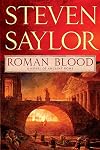
“Roman Blood” was recommended to me by a staffer at the Oak Brook, Illinois, Borders. Not something that I would have chosen of my own accord, I was pleasantly surprised at how decent it turned out to be. There are, to be sure, plenty of clichéd bits of stagecraft (i.e., wispy linens draped provocatively over sexy women, gladiators described in purely animalistic terms, street scenes that play on our preconceived ideas of ancient licentiousness and filth, etc.), but there is an show more underlying smartness that propels the narrative and upholds fidelity to the historical record.
The first of a series of such novels, “Roman Blood” is essentially detective fiction – complete with the modern traditions of the genre – shoehorned into the waning days of the ancient Roman Republic. There is plenty of sex and violence to keep things interesting, and a fair dose of political intrigue and history as well. The balance between the demands of the genre and the allure of the mise-en-scène is expertly rendered. This isn’t a difficult or terribly complex book, but it is redeemed in the simple integrity of its execution. show less
The first of a series of such novels, “Roman Blood” is essentially detective fiction – complete with the modern traditions of the genre – shoehorned into the waning days of the ancient Roman Republic. There is plenty of sex and violence to keep things interesting, and a fair dose of political intrigue and history as well. The balance between the demands of the genre and the allure of the mise-en-scène is expertly rendered. This isn’t a difficult or terribly complex book, but it is redeemed in the simple integrity of its execution. show less

This is the 11th in the Gordianus series and a welcome return for me over two years after reading the previous one. This is set entirely in Alexandria in Egypt which Gordianus is visiting as his wife Bethesda wants to bathe in the Nile to cure herself of a wasting sickness. Gordianus manages to be present at many key historical events such as the murder of Pompey, the unveiling of his head in the presence of Caesar and Cleopatra's smuggling herself into Caesar's presence in the famous rolled show more up carpet. The whodunnit aspect only takes up the final third of the book. There are a couple of key dramatic developments in Gordianus's family life that I won't give spoilers for here, but they are as eclectic and as likeable a group of characters as ever. I really enjoyed this one and there will definitely be a much shorter gap between this and my reading the next one. show less
Lists
Awards


You May Also Like


Associated Authors
Statistics
- Works
- 61
- Also by
- 34
- Members
- 13,631
- Popularity
- #1,702
- Rating
- 3.7
- Reviews
- 403
- ISBNs
- 525
- Languages
- 17
- Favorited
- 50


