
Will James (1892–1942)
Author of Smoky, the Cowhorse
About the Author
Will James was born Joseph Ernest Nephtali Dufault in the province of Quebec on June 6, 1892. He left home as a teenager to live out his dream of becoming a cowboy in the American West. James went on to write and illustate twenty-four books and numerous magazine articles about horses, cowboying, show more and the West. His works consistently captured the imagination of the public. He died in 1942, at the age of fifty show less
Series
Works by Will James
Sing and Rejoice 2 copies
This week in Laguna magazine 1 copy
Will James Collection 1 copy
All in a Day's Ride 1 copy
Cow Countryi 1 copy
Smoky The Story Of A Horse 1 copy
Vildhästen från pärien 1 copy
Associated Works
The Big Book of Favorite Horse Stories: Twenty-Five Outstanding Stories by Distinguished Authors (1965) — Contributor — 170 copies, 1 review
A Newbery Zoo: A dozen animal stories by Newbery Award-winning authors (1995) — Contributor — 39 copies, 2 reviews
Tagged
Common Knowledge
- Birthdate
- 1892-06-06
- Date of death
- 1942-09-03
- Gender
- male
- Occupations
- cowhand
stuntman - Organizations
- United States Army (WWI)
- Awards and honors
- Nevada Writers Hall of Fame
- Nationality
- USA
Canada (birth) - Birthplace
- Saint-Nazaire-d'Acton, Quebec, Canada
- Places of residence
- Pryor Creek, Montana, USA
Apple Valley, California, USA
Washoe Valley, Nevada, USA
Billings, Montana, USA - Place of death
- Hollywood, California, USA
- Associated Place (for map)
- USA
Members
Reviews
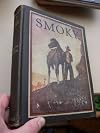
I was on a convention panel talking about horse books last weekend, and author Will James came up. I remembered that I owned a library discard of his classic book Smoky, that I probably haven't read since I was 9 or 10. Before I bought this discard copy, even. I needed to read a classic book for my goal this month, so I decided to read this one for the first time in decades.
Oooooh boy. How to sum this up.
First of all, there's no way this would be a kid book these days. All the major human show more characters are adults. There is rampant animal abuse, even by the 'good guy.' And wow, is this book racist. Jaw-droppingly so. The major villain is described as "being a breed of Mexican and other blood that's darker" and is often just named as "the breed," and is so abusive to the titular character that the horse straight-out tries to kill every man with dark skin for years afterward.
Yeah.
The thing is, the first 2/3 of the book is actually a decent horse book, complete with beautiful action-packed illustrations by the author. James is an incredibly descriptive writer, and the chapters on Smoky's colthood on the range and his training (which is cringe-worthy in some ways) and growing relationship with Clint is fascinating in its deep detail. But then Smoky is stolen, and the book decides to go "Black Beauty on a western-grimdark" route.
The good news is, I feel like I can now donate-away this hardcover book that I've been hauling around for over twenty years. I definitely won't be reading it again, now do I feel much inclined to pick up Will James's other books. show less
Oooooh boy. How to sum this up.
First of all, there's no way this would be a kid book these days. All the major human show more characters are adults. There is rampant animal abuse, even by the 'good guy.' And wow, is this book racist. Jaw-droppingly so. The major villain is described as "being a breed of Mexican and other blood that's darker" and is often just named as "the breed," and is so abusive to the titular character that the horse straight-out tries to kill every man with dark skin for years afterward.
Yeah.
The thing is, the first 2/3 of the book is actually a decent horse book, complete with beautiful action-packed illustrations by the author. James is an incredibly descriptive writer, and the chapters on Smoky's colthood on the range and his training (which is cringe-worthy in some ways) and growing relationship with Clint is fascinating in its deep detail. But then Smoky is stolen, and the book decides to go "Black Beauty on a western-grimdark" route.
The good news is, I feel like I can now donate-away this hardcover book that I've been hauling around for over twenty years. I definitely won't be reading it again, now do I feel much inclined to pick up Will James's other books. show less

Winner of the 1927 Newbery Medal, this children's novel about a mouse-colored cow-horse named Smoky has been favorably compared to that classic (and pioneering) pony story, Black Beauty, and I think the pairing is rather apt. Both books follow the same basic narrative trajectory, beginning with a horse whose owners are responsible and kind, following him through his early years of prosperity and well-being, his traumatic middle years, suffering at the hands of less enlightened human beings, show more and his eventual reunion, as a broken-down older horse, with his original keeper/companion. Both books do an excellent job of capturing the horse's perspective, and both offer a moving portrait of their equine heroes and the humans they encounter.
Of course, Smoky, The Cow Horse is set in the ranching country of the western United States, in the early years of the twentieth century, and Black Beauty in nineteenth-century England. While Black Beauty is a saddle-horse (to begin with, anyway), Smoky spends his first few years in the wild, before being broken as a working horse. And my, how beautifully James captures that early time in Smoky's life, the dynamics of the wild horse herd, the instincts of a young colt! The writing here is highly idiomatic - a sort of western/cowboy dialect that, while not "correct" English, has a poetic and highly descriptive quality to it. Many readers seem to have had trouble with James' language, but I found that, after a period of adjustment, it really resonated with me, and added to the beauty of the story.
There are many things I enjoyed about this book, from the language to the characters, and I will not soon forget the understated pathos of the love that develops between Smoky and Clint, the cowboy who breaks the high-spirited horse in, and becomes his only human friend. The mistreatment that Smoky suffers, after being stolen by a brutal horse thief, and eventually turned into a rodeo attraction, was very difficult to read about, and even the happy ending, with its reunion of horse and man, can't quite take away its sting. The illustrations - done by James himself - are absolutely delightful, although I found myself wishing that I had an older edition, rather than this 1970s reprint, so I could see them as color plates, rather than black and white reproductions.
In short, this was in many ways an excellent book, and had it not been for one thing, I might have awarded it four stars. And that "thing," is the racism to be found in the portrait of "the breed" - the mixed-race horse thief who steals Smoky. The constant references to his dark face/complexion, the way this is tied to his brutal treatment of Smoky, seems too pointed (to borrow a friend's word for it) to be dismissed as simply "of the times." Especially when one considers that the inhumane vegetable seller who ends up owning Smoky (Cloudy by then) towards the end of the story, is also described as dark-skinned. When James describes the horse thief as "a degenerate halfbreed and not fit to be classed amongst humans," it's a difficult thing to overlook.
Thankfully, the section involving the horse-thief (I refuse to call him "the breed!") is short. But although I wouldn't say it was the focus of the story, the racism is pronounced enough that it is a real detraction from the book's appeal. This is one I would recommend only to more mature horse-book lovers, who are old enough to have a discussion about the unfortunate racism to be found within its covers, either with a parent or a teacher. show less
Of course, Smoky, The Cow Horse is set in the ranching country of the western United States, in the early years of the twentieth century, and Black Beauty in nineteenth-century England. While Black Beauty is a saddle-horse (to begin with, anyway), Smoky spends his first few years in the wild, before being broken as a working horse. And my, how beautifully James captures that early time in Smoky's life, the dynamics of the wild horse herd, the instincts of a young colt! The writing here is highly idiomatic - a sort of western/cowboy dialect that, while not "correct" English, has a poetic and highly descriptive quality to it. Many readers seem to have had trouble with James' language, but I found that, after a period of adjustment, it really resonated with me, and added to the beauty of the story.
There are many things I enjoyed about this book, from the language to the characters, and I will not soon forget the understated pathos of the love that develops between Smoky and Clint, the cowboy who breaks the high-spirited horse in, and becomes his only human friend. The mistreatment that Smoky suffers, after being stolen by a brutal horse thief, and eventually turned into a rodeo attraction, was very difficult to read about, and even the happy ending, with its reunion of horse and man, can't quite take away its sting. The illustrations - done by James himself - are absolutely delightful, although I found myself wishing that I had an older edition, rather than this 1970s reprint, so I could see them as color plates, rather than black and white reproductions.
In short, this was in many ways an excellent book, and had it not been for one thing, I might have awarded it four stars. And that "thing," is the racism to be found in the portrait of "the breed" - the mixed-race horse thief who steals Smoky. The constant references to his dark face/complexion, the way this is tied to his brutal treatment of Smoky, seems too pointed (to borrow a friend's word for it) to be dismissed as simply "of the times." Especially when one considers that the inhumane vegetable seller who ends up owning Smoky (Cloudy by then) towards the end of the story, is also described as dark-skinned. When James describes the horse thief as "a degenerate halfbreed and not fit to be classed amongst humans," it's a difficult thing to overlook.
Thankfully, the section involving the horse-thief (I refuse to call him "the breed!") is short. But although I wouldn't say it was the focus of the story, the racism is pronounced enough that it is a real detraction from the book's appeal. This is one I would recommend only to more mature horse-book lovers, who are old enough to have a discussion about the unfortunate racism to be found within its covers, either with a parent or a teacher. show less

Do you like horses? Do you like racist horses? Then you might like this slow-paced, plodding book. In all seriousness, it was an interesting study on award-winning literature from that time. The latter half of the book has a little more of a plot, but still will not likely captivate the modern reader.

It's Black Beauty, only not as well written. Happy colthood, humans train him to be useful and he bonds with one particular man. I was amused to note that in his first encounter with humans, he's branded and the book specifically says that's all that happens...but after that, "the colt" is referred to as "the gelding". Hmm. And then he's stolen, abused, trained to buck, stops being abused and eventually loses the hatred that made him such a good bucking horse. So he's sold, and sold, and show more sold, going lower each time, until he's half-starved and still being forced to pull a heavy wagon. And then he's saved - his one particular man discovers and rescues him. Yay. The ending was nice, Smoky doesn't suddenly become happy and healthy and regain his trust in humans - it takes a while. But eventually, a happy ending.
The story was trite. The dialect that was used throughout - not just speech (in fact that was often clearer) but description and narration - drove me nuts. I don't know if it's an accurate depiction of some dialect, but it utterly did not work for me. It reads awkwardly, sounding like a put-on accent, and...it just sounds unlikely, not like anything a real person would say (word choice (and spelling of same), phrases, everything read fake to me). It made it very hard to read the story - which wasn't worth the effort. Not a winner. show less
The story was trite. The dialect that was used throughout - not just speech (in fact that was often clearer) but description and narration - drove me nuts. I don't know if it's an accurate depiction of some dialect, but it utterly did not work for me. It reads awkwardly, sounding like a put-on accent, and...it just sounds unlikely, not like anything a real person would say (word choice (and spelling of same), phrases, everything read fake to me). It made it very hard to read the story - which wasn't worth the effort. Not a winner. show less
Lists
Newbery Adjacent (1)
Sonlight Books (1)
Awards


You May Also Like


Associated Authors
Statistics
- Works
- 42
- Also by
- 10
- Members
- 2,387
- Popularity
- #10,753
- Rating
- 3.7
- Reviews
- 30
- ISBNs
- 126
- Languages
- 3
- Favorited
- 3