

Ian G. Barbour (1923–2013)
Author of Religion and Science: Historical and Contemporary Issues
About the Author
Throughout his career, Ian Barbour has been at the forefront of the dialogue between scientists and theologians. Trained as a physicist, with a Ph.D. from the University of Chicago (1950), and as a theologian, with a B.D. from Yale University (1956), Barbour has drawn on the philosophical insights show more of both disciplines to transcend their boundaries. As a professor of both physics and religion, Barbour's initial books depict the relationships between physical science and religion. For example, his broad-ranging overview Issues in Science and Religion (1966) and his classic Myths, Models and Paradigms (1974) focus on the language parallels between these disciplines. During the 1970s and 1980s, Barbour began to expand his focus to include technological and environmental themes; at that time, the field of STS emerged in response to increased concern over technology's societal impacts, especially regarding energy and the environment. During this period he published Technology, Environment, and Human Values (1980) and Energy and American Values (1982), as well as several edited collections of essays, including Earth Might Be Fair: Reflections on Ethics, Religion, and Ecology, (1971) and Western Man and Environmental Ethics (1972). All of the books focus on the need for an enhanced technological and environmental ethic. Recently, Barbour has continued to pursue these intertwined themes in his 1989-91 Gifford Lectures at the University of Aberdeen, Scotland, which were published as Religion in an Age of Science (1990) and Ethics in an Age of Technology (1993). Barbour serves as Winifred and Atherton Bean Professor Emeritus of Science, Technology, and Society at Carlton College. (Bowker Author Biography) show less
Image credit: via Carleton College
Works by Ian G. Barbour
Problemas de religion y ciencia 2 copies
Ciencia y secularidad 2 copies
Sciernce and Religion 1 copy
Associated Works
Tagged
Common Knowledge
- Legal name
- Barbour, Ian Graeme
- Birthdate
- 1923-10-05
- Date of death
- 2013-12-24
- Gender
- male
- Education
- University of Chicago (PhD)
Yale University Divinity School - Occupations
- professor
- Awards and honors
- Templeton Prize (1999)
- Nationality
- USA
- Birthplace
- Beijing, China
- Place of death
- Northfield, Minnesota, USA
- Associated Place (for map)
- USA
Members
Reviews
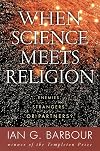
Published in the year 2000, Ian Barbour’s When Science Meets Religion might already be partly out of date, but its arguments stand the test of time, and one can only hope present arguments about the enmity of science and religion might become as out of date (but still relevant) as Galileo’s revolution in world-view, as presented early in this book.
The author divides faith-and-science arguments into four types—conflict between the different ideas, independence (therefore no place to show more argue), dialogue, and integration. Each major “conflict” is then viewed through these four lenses, leading the reader from creation and the Big Bang, through the uncertainties of quantum physics, and then to today’s most frequent argument—evolution! There’s more, of course, with neuroscience and the question of self, identity, nature and nurture, and whether our “selves” are anything more than the way we make sense of our surroundings.
The arguments are systematically presented and analyzed, making the book a slow, dense, and very well-reasoned read. No simple answers are offered. But many directions are followed to their logical conclusions. Many topics and areas are covered, from cosmology to philosophy, mind to matter, robot to sentience, theism to deism and more. Familiar names appear, and the background is mostly Christian, though other beliefs take their place among the arguments. A fascinating read!
With lots to offer, the arguments remain relevant in 2020, and the book is a enjoyable, serious presentation of both where and how faith and science intersect.
Disclosure: A friend gave me a copy and thought I’d be interested. She was right! show less
The author divides faith-and-science arguments into four types—conflict between the different ideas, independence (therefore no place to show more argue), dialogue, and integration. Each major “conflict” is then viewed through these four lenses, leading the reader from creation and the Big Bang, through the uncertainties of quantum physics, and then to today’s most frequent argument—evolution! There’s more, of course, with neuroscience and the question of self, identity, nature and nurture, and whether our “selves” are anything more than the way we make sense of our surroundings.
The arguments are systematically presented and analyzed, making the book a slow, dense, and very well-reasoned read. No simple answers are offered. But many directions are followed to their logical conclusions. Many topics and areas are covered, from cosmology to philosophy, mind to matter, robot to sentience, theism to deism and more. Familiar names appear, and the background is mostly Christian, though other beliefs take their place among the arguments. A fascinating read!
With lots to offer, the arguments remain relevant in 2020, and the book is a enjoyable, serious presentation of both where and how faith and science intersect.
Disclosure: A friend gave me a copy and thought I’d be interested. She was right! show less
Science is not as objective, nor religion as subjective, as is sometimes supposed. This is one of the important conclusions in Professor Barber's book, which argues that scientists and philosophers have more in common than might first appear, especially when the language used in the two disciplines receives closer scrutiny.
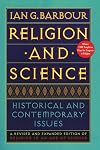
A detailed explanation on issues, models of Science and Religion. It is a challenging read, I got exposed to new authors.
Barbour pins four models between Science and Religion. I appreciate, how he is bringing everything that he learnt in this interesting book.
a) Conflict Model
b) Independence Model
c) Dialogue/Complementary Model
d) Coherent or Integration
I learnt that different fields of Inquiry in Science are persuading, inspiring another field of inquiry.
He shares Newtonian mechanics, show more Darwinism changing paradigms within field of scientific inquiry.
He also goes on to talk about Structure of Science, And Structure of Religion, showing both to be similar.
The best book to read on Religion and Science. show less
Barbour pins four models between Science and Religion. I appreciate, how he is bringing everything that he learnt in this interesting book.
a) Conflict Model
b) Independence Model
c) Dialogue/Complementary Model
d) Coherent or Integration
I learnt that different fields of Inquiry in Science are persuading, inspiring another field of inquiry.
He shares Newtonian mechanics, show more Darwinism changing paradigms within field of scientific inquiry.
He also goes on to talk about Structure of Science, And Structure of Religion, showing both to be similar.
The best book to read on Religion and Science. show less
This is considered the leading, all-in-one-place book of the field. I used it for the equivalent of a 4000-level undergrad class. Barbour calls if 'religion and science' but it's 99% 'Christianity and science'.
Awards

You May Also Like


Associated Authors
Statistics
- Works
- 21
- Also by
- 2
- Members
- 1,320
- Popularity
- #19,470
- Rating
- 3.6
- Reviews
- 13
- ISBNs
- 47
- Languages
- 7
- Favorited
- 2