

John F. Haught
Author of God After Darwin: A Theology of Evolution
About the Author
John F. Haught, PhD, is Distinguished Research Professor, Georgetown University, Washington, DC. He specializes in systematic theology, with a particular interest in issues pertaining to science, cosmology, evolution, ecology, and religion. His many books include Resting on the Future: Catholic show more Theology for an Unfinished Universe, The New Cosmic Story, and A John Haught Reader. show less
Image credit: Fora.TV
Works by John F. Haught
God and the New Atheism: A Critical Response to Dawkins, Harris, and Hitchens (2008) 176 copies, 5 reviews
John Haught 1 copy
Associated Works
The Believing Primate: Scientific, Philosophical, and Theological Reflections on the Origin of Religion (2009) — Contributor — 44 copies
Tagged
Common Knowledge
- Canonical name
- Haught, John F.
- Birthdate
- 1942-11-12
- Gender
- male
- Education
- Catholic University (PhD)
- Occupations
- professor (Georgetown University)
theologian - Organizations
- Georgetown University (Woodstock Theological Center)
- Awards and honors
- University of Louvain (Doctor Honoris Causa)
- Nationality
- USA
- Places of residence
- Falls Church, Virginia, USA
- Associated Place (for map)
- Virginia, USA
Members
Reviews
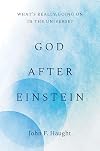
I stopped reading this book after 90 plus pages. The polemics were unrelenting. Pantheism was given special attention, calling it "time-denying naturalism," and rejected by the Nicene Creed. "...it (pantheism) snatches time up into eternity without giving the universe the opportunity to become something." The book is filled with such declarations. Spinoza -- a pantheist -- found favor in Einstein's view of the world. Theologically, I would expect Haught to disagree, of course. But does a show more universe without God not give itself opportunity to become somelthing?, as Haught claims. 13.8 billion years! The age of the universe. After rapid acceleration, the expansion of space slowed just enough for planets to form, atomic reactions allowed formation of carbon -- an essential element of life -- before speeding up again. Whatever your view, this process has been sceintifically establsihed. Surely the universe became something, whether that becoming is consistent with Haught's outlook or not. I recommend the author read Thomas Hertog, "On the Origin of Time" -- Stephen Hawkings Final Theory. I have read Simone Weil, a Catholic convert and mystic. Weil is quoted by Catholic bishops and theologians regularly. Christian Wiman -- a Christian poet -- and Weil both speak directly to those of us who remain comfortable with mystery. When I read the morning Word posted on-line by the nearby mother house, recommending Haught's book, I checked out the e-book from our library, and began reading with hope. Finally, after three attempts, I stopped. For those of us who embrace mystery, who prefer open questions, who see God manifested in the swaying of tallgrass prairies, or a handsome Elm, polemical books such as this, treating dogma as truth, turns hope into sorrow. It is no accident that Thomas Merton, more mystic than theologian, just before he died, met and embraced Buddhist monks in Thialand. Catholicism offers us wonderment and mystery. Peace. Hope. Those of us drawn to it cannot help but be repelled by a dogma declared with an arrogance and pride which brooks no discussion. It was no serendipity of Dante's creativity that this great Italian poet placed no few number of cardinals in the first cornice of Purgatory -- the circular terrace for people who committed the sin of Pride. It is with more sorrow than anger that I offer this review and rating. show less
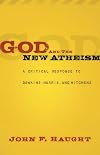
I've read most of the books that Haught critiques and decided to read his rebuttal in the interest of fairness. I came away wondering if Haught had read any of them himself. The objections he raises to atheism are tired and easily-dismissed, and all of them are addressed in the books he's responding to.
When discussing his own views, Haught defines his terms in ways that are obviously self-serving. "Mainline theology" is a particular view of god that happens to match his view, and is show more supported by the writings of theologians that he happens to agree with. The god that atheists don't believe in is a creationist caricature, and the god he believes in is much more profound and abstract (and equally, if not more, unfalsifiable.) He never gives any concrete reasons why his conception of God is more accurate than the creationist one. At the same time, he claims that he's discussing a generic deity and not Christianity specifically. This isn't true (almost every theological scholar he mentions is Christian) but it allows him to talk about God in very abstract terms and avoid addressing the miraculous claims in the Bible.
In the second half of the book, Haught goes off on a really strange line of reasoning. He claims that God *cannot* be thought about in scientific terms... and then spends several more pages explaining why God *shouldn't* be thought of in this way, with specific examples that seem to refute his earlier claim that thinking about God in scientific terms is impossible. He also reveals reveals his poor understanding of science. At one point he comments that if religious belief really is a trait that evolved in humans, "there would be little reason to complain about it – as if evolution has never resulted in traits that were less than perfect (see: the recurrent laryngeal nerve, the blind spot in the human eye, vestigial organs, etc.)
I wouldn't recommend this book to anyone. Atheists would only be bored with Haught's rehashing of arguments that they've probably seen dozens of times before, and theists should read something that honestly represents the arguments it's claiming to refute. show less
When discussing his own views, Haught defines his terms in ways that are obviously self-serving. "Mainline theology" is a particular view of god that happens to match his view, and is show more supported by the writings of theologians that he happens to agree with. The god that atheists don't believe in is a creationist caricature, and the god he believes in is much more profound and abstract (and equally, if not more, unfalsifiable.) He never gives any concrete reasons why his conception of God is more accurate than the creationist one. At the same time, he claims that he's discussing a generic deity and not Christianity specifically. This isn't true (almost every theological scholar he mentions is Christian) but it allows him to talk about God in very abstract terms and avoid addressing the miraculous claims in the Bible.
In the second half of the book, Haught goes off on a really strange line of reasoning. He claims that God *cannot* be thought about in scientific terms... and then spends several more pages explaining why God *shouldn't* be thought of in this way, with specific examples that seem to refute his earlier claim that thinking about God in scientific terms is impossible. He also reveals reveals his poor understanding of science. At one point he comments that if religious belief really is a trait that evolved in humans, "there would be little reason to complain about it – as if evolution has never resulted in traits that were less than perfect (see: the recurrent laryngeal nerve, the blind spot in the human eye, vestigial organs, etc.)
I wouldn't recommend this book to anyone. Atheists would only be bored with Haught's rehashing of arguments that they've probably seen dozens of times before, and theists should read something that honestly represents the arguments it's claiming to refute. show less
What a disappointment. Even at a mere 107 pages, Haught's rebuttal is tedious, saying very little and repeating it far too often. Diligently I plodded on, waiting for the main course to arrive, until at last the book was over, and, alas, my plate was still empty. Haught attempts to discredit Dawkins, Harris and Hitchens by summarizing their work, observing that most of what they proclaim breaks no new philosophical ground, and alleging that scientific naturalism is a self-destructing show more proposition because of the fact that its reliance on objective evidence as truth cannot be proven by scientific experiementation (and thus scientific naturalism is merely another brand of faith). If you find the arguments put forward in "God Delusion", "God Is Not Great" and "The End of Faith" sensible and rational, then you are unlikely to be persuaded otherwise by Haught's weak defense of his theology. show less
John Haught takes on the likes of Dawkins, Harris and the crowd of "New Atheists" who are making a splash with their recent books ("The God Delusion" and the like). Haught shows how these authors seem never to have read any works of serious theologians or serious philosophers; in fact it seems that they have never read any works of serious atheists either! Haught shows how the simplistic truth claims of the new atheists are typically self- referentially incoherent and that the entire basis show more of their arguments is one of blind faith ("scientism" as it is known). It is a shame that the new atheists do not read works by theologians because they really need to read Haught's book so they don't continue to embarrass themselves in public by claiming (as new) ideas that have been the subject of intellectual debate for centuries and by making claims that are philosophically outrageous. show less
Awards

You May Also Like


Associated Authors
Statistics
- Works
- 26
- Also by
- 5
- Members
- 1,046
- Popularity
- #24,627
- Rating
- 3.2
- Reviews
- 11
- ISBNs
- 74
- Languages
- 6