
Stanley I. Greenspan (1941–2010)
Author of The First Idea: How Symbols, Language, and Intelligence Evolved from Our Primate Ancestors to Modern Humans
About the Author
Stanley I. Greenspan is Clinical Professor of Psychiatry and Pediatrics at George Washington University Medical School and Chairman of the Interdisciplinary Council on Developmental and Learning Disorders.
Works by Stanley I. Greenspan
The First Idea: How Symbols, Language, and Intelligence Evolved from Our Primate Ancestors to Modern Humans (2009) 223 copies, 3 reviews
Engaging Autism: Using the Floortime Approach to Help Children Relate, Communicate, and Think (A Merloyd Lawrence Book) (2006) 149 copies, 1 review
The Challenging Child: Understanding, Raising, and Enjoying the Five "Difficult" Types of Children (1995) 147 copies
The Child With Special Needs: Encouraging Intellectual and Emotional Growth (A Merloyd Lawrence Book) (1998) 139 copies, 1 review
First Feelings: Milestones in the Emotional Development of Your Baby and Child (1985) 66 copies, 1 review
Building Healthy Minds: The Six Experiences That Create Intelligence And Emotional Growth In Babies And Young Children (1999) 59 copies, 1 review
The Essential Partnership: How Parents and Children Can Meet the Emotional Challenges of Infancy (1989) 21 copies
Infancy and early childhood : the practice of clinical assessments and intervention with emotional and developmental challenges (1992) 18 copies
Overcoming ADHD: Helping Your Child Become Calm, Engaged, and Focused--Without a Pill (2009) 17 copies
The Learning Tree: Overcoming Learning Disabilities from the Ground Up (A Merloyd Lawrence Book) (2010) 17 copies
Great Kids: Helping Your Baby and Child Develop the Ten Essential Qualities for a Healthy, Happy Life (A Merloyd Lawrence Book) (2007) 16 copies, 1 review
Infant and Early Childhood Mental Health: A Comprehensive, Developmental Approach to Assessment and Intervention (2005) 14 copies
The development of the ego : implications for personality theory, psychopathology, and the psychotherapeutic process (1989) 10 copies
The Course of life : psychoanalytic contributions toward understanding personality development 5 copies
Infants in Multirisk Families: Case Studies in Preventive Intervention (Clinical Infant Reports) (1987) 5 copies
Intelligence and adaptation : an integration of psychoanalytic and Piagetian developmental psychology (1980) 5 copies
De ontwikkeling van intelligentie de groei van intelligentie, moraal en bewustzijn van baby tot volwassene (1998) 4 copies
The Functional Emotional Assessment Scale (FEAS) for Infancy and Early Childhood: Clinical and Research Applications (2001) 3 copies
Mein Kind lernt anders : ein Handbuch zur Begleitung förderbedürftiger Kinder (2001) 3 copies, 1 review
The Course of Life: Psychoanalytic Contributions Toward Understanding Personality Development, Vol. 2: Latency, Adolescence, and Youth (1980) 2 copies
Niños felices : cómo enseñar a tu hijo las diez cualidades esenciales para alcanzar una vida feliz (2008) 2 copies
Bipolar Patterns in Children: New Perspectives on Developmental Pathways and a Comprehensive Approach to Prevention and (2002) 2 copies
Assessing and Treating Infants and Young Children with Severe Difficulties in Relating and Communicating (1997) 2 copies
Autism Solutions 1 copy
DIR Information 1 copy
Early childhood 1 copy
challenging child, The 1 copy
Tagged
Common Knowledge
- Canonical name
- Greenspan, Stanley I.
- Birthdate
- 1941-06-01
- Date of death
- 2010-04-27
- Gender
- male
- Education
- Harvard University (A.B.)
Yale Medical School (M.D.) - Occupations
- psychiatrist
psychoanalyst - Organizations
- American Psychiatric Association
American College of Psychiatry
American College of Psychoanalysis - Awards and honors
- Ittleson Award (1981)
Strecker Award (1982) - Nationality
- USA
- Associated Place (for map)
- USA
Members
Reviews
The First Idea: How Symbols, Language, and Intelligence Evolved from Our Primate Ancestors to Modern Humans by Stanley I. Greenspan
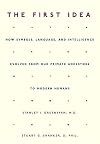
This interesting book is categorized as evolutionary psychology. I like reading these types of books, on occasion. This book’s authors pose an unusual theory for the future of first America and then perhaps the world. The unusual part of this book is that they place the role of Descartes in human history to help plot a possible jump forward for humanity. Greenspan and Shanker say that they provide not a theory but a lens for looking at human history. That lens is structural in shape.
There show more are a lot dots to be connected here but basically they want to propose a society where all people are at home with emotional intelligence and especially autistic children. They say that autistic children can suffer from “mental deficits” but that is older terminology taken from developmental capacities. In any case their cognitive skills are so valuable, the authors posit, that they need to be nourished within environments that will not overlook their higher-level abilities. They say that these children/adults should be put in positions of global independent authority to be the launch point for innovations for the future since their way of seeing the world is not limited to ways normal people within the societal structure apprehend things. The future of the whole world depends on these problem solvers to keep us all from intellectual stagnation as had occurred with rational dichotomies (solved by Kant, they say). This arrangement is something like we see in a science fiction film Minority Report by Phillip Dick who used “Precogs” to engage the future by their mental powers and used that knowledge to intercept crimes before they happened in real time. This “First Idea” concept is a Utopian fantasy but the authors try to base it in developmental psychology, autism, sociology of Navajos, abstract symbolic thinking, and history of philosophy.
This book is very entertaining but would be hard to follow for most people. I like theories of the world, and theories of future worlds, so this appeals to my speculative nature. Many of the great works of literature also have theories of human nature embedded in them such as More’s Utopia, Plato’s Republic, Cervantes’ Don Quixote, and Dostoevsky’s Grand Inquisitor. The First Idea is a long work (456 pp) but is filled with a kaleidoscope of sources for their lens on humanity. It probably isn’t worth the effort to read for most people, but I found it clever enough to keep on toward the final conclusion which seems to pull back at the end.
The most striking thing I found in this book was its placement of Descartes and his thought. Most writers in our time will dismiss Descartes as part of the obsolete medieval tradition and who only inserted a now worthless distinction between soul and body. Descartes, to post-modernity, is normally considered a relic of a bygone era where deconstruction had yet to play out its part.
The authors laud Descartes as a beacon of rationality who challenged the Christian cosmology of the Great Chain of Being (p. 411). This is a kind of midpoint between sheer rejection and acceptance of the medieval tradition. I accept the medieval tradition as valid and Descartes as key to Modernity but I can also understand the critical view of rationality that flows from Nietzsche and existentialism into deconstruction.
This is a good quotation to see how Descartes is a champion of higher reflective capabilities: “The human body, according to Descartes, is a machine (which was itself a heretical view) but, unlike animal humans also possess the capacities to reason, speak a language, control their actions, and be conscious of their cognitions and sensations. The reason we are said to know that animals don’t have minds is because they lack the ability to describe their thoughts. For us to say an animal is capable of speaking, the animal would have to respond appropriately in varying situations, acquire words spontaneously, and combine words creatively. Only humans, according to Descartes, are born with such a capacity.” Descartes used here use as an example of an intellectual breakthrough which must happen if humans would continue advancing and become even more integrated and self-reflective, so they say. Of course, animals can and do communicate at a high level just not at a level equal to that which most humans experience with other humans. That’s not required at every instance, but Descartes was here defining what was distinctive about humans.
Great bibliography, Notes show less
There show more are a lot dots to be connected here but basically they want to propose a society where all people are at home with emotional intelligence and especially autistic children. They say that autistic children can suffer from “mental deficits” but that is older terminology taken from developmental capacities. In any case their cognitive skills are so valuable, the authors posit, that they need to be nourished within environments that will not overlook their higher-level abilities. They say that these children/adults should be put in positions of global independent authority to be the launch point for innovations for the future since their way of seeing the world is not limited to ways normal people within the societal structure apprehend things. The future of the whole world depends on these problem solvers to keep us all from intellectual stagnation as had occurred with rational dichotomies (solved by Kant, they say). This arrangement is something like we see in a science fiction film Minority Report by Phillip Dick who used “Precogs” to engage the future by their mental powers and used that knowledge to intercept crimes before they happened in real time. This “First Idea” concept is a Utopian fantasy but the authors try to base it in developmental psychology, autism, sociology of Navajos, abstract symbolic thinking, and history of philosophy.
This book is very entertaining but would be hard to follow for most people. I like theories of the world, and theories of future worlds, so this appeals to my speculative nature. Many of the great works of literature also have theories of human nature embedded in them such as More’s Utopia, Plato’s Republic, Cervantes’ Don Quixote, and Dostoevsky’s Grand Inquisitor. The First Idea is a long work (456 pp) but is filled with a kaleidoscope of sources for their lens on humanity. It probably isn’t worth the effort to read for most people, but I found it clever enough to keep on toward the final conclusion which seems to pull back at the end.
The most striking thing I found in this book was its placement of Descartes and his thought. Most writers in our time will dismiss Descartes as part of the obsolete medieval tradition and who only inserted a now worthless distinction between soul and body. Descartes, to post-modernity, is normally considered a relic of a bygone era where deconstruction had yet to play out its part.
The authors laud Descartes as a beacon of rationality who challenged the Christian cosmology of the Great Chain of Being (p. 411). This is a kind of midpoint between sheer rejection and acceptance of the medieval tradition. I accept the medieval tradition as valid and Descartes as key to Modernity but I can also understand the critical view of rationality that flows from Nietzsche and existentialism into deconstruction.
This is a good quotation to see how Descartes is a champion of higher reflective capabilities: “The human body, according to Descartes, is a machine (which was itself a heretical view) but, unlike animal humans also possess the capacities to reason, speak a language, control their actions, and be conscious of their cognitions and sensations. The reason we are said to know that animals don’t have minds is because they lack the ability to describe their thoughts. For us to say an animal is capable of speaking, the animal would have to respond appropriately in varying situations, acquire words spontaneously, and combine words creatively. Only humans, according to Descartes, are born with such a capacity.” Descartes used here use as an example of an intellectual breakthrough which must happen if humans would continue advancing and become even more integrated and self-reflective, so they say. Of course, animals can and do communicate at a high level just not at a level equal to that which most humans experience with other humans. That’s not required at every instance, but Descartes was here defining what was distinctive about humans.
Great bibliography, Notes show less
The Child With Special Needs: Encouraging Intellectual and Emotional Growth (Merloyd Lawrence Book) by Stanley I. Greenspan
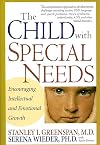
Greenspan is famous for his FloorTime model of working with even the most nonresponsive children. He provides excellent insight into the minds of young children who cannot or do not communicate or make their needs known. I'm glad this was the first book I read after my son was diagnosed because it not only helped me to undertand him better, it immediately improved our relations and gave me a realistic view of the future, at the same time unexpected and hopeful. Most importantly, it explained show more that I could actually do something, and how to do it, and helped me to feel less of the uselessness and despair that many parents in these situations tend to feel. Not only was I no longer alone, but I had a reasonable game plan, and it worked.
Mind you, my son is no longer a toddler; he's ten. He's still autistic, and he always will be. Yet he's come such a long, long, long way, and this book got us started on that path. show less
Mind you, my son is no longer a toddler; he's ten. He's still autistic, and he always will be. Yet he's come such a long, long, long way, and this book got us started on that path. show less
Great Kids: Helping Your Baby and Child Develop the Ten Essential Qualities for a Healthy, Happy Life by Stanley I. Greenspan
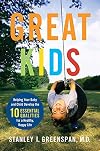
We all know "great kids." As parents, we want our children to become great kids. Dr. Greenspan identifies ten traits that are necessary to have to become a great kid: engagement, empathy, curiosity, communication, emotional range, genuine self-esteem, internal discipline, creativity and vision, logical thinking and moral integrity. He devotes a chapter to each trait, giving examples of what that trait looks like at various age levels. Each chapter also includes a listing of ways to encourage show more that particular trait. These lists include ideas for infants through teenagers.
This book is fairly easy to read. I don't know if it's the best book on this topic, but it can certainly provide affirmation and/or reasons why we do certain things as parents, as well as new ideas to help us develop "great kids." show less
This book is fairly easy to read. I don't know if it's the best book on this topic, but it can certainly provide affirmation and/or reasons why we do certain things as parents, as well as new ideas to help us develop "great kids." show less
Engaging autism : using the floortime approach to help children relate, communicate, and think by Stanley I. Greenspan
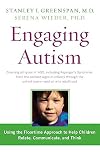
Could use a more linear approach in editing. Great concepts.
You May Also Like


Associated Authors
Statistics
- Works
- 82
- Members
- 1,369
- Popularity
- #18,785
- Rating
- 3.8
- Reviews
- 9
- ISBNs
- 86
- Languages
- 8
- Favorited
- 2