
Anton Gill
Author of Art Lover: A Biography of Peggy Guggenheim
About the Author
Anton Gill was educated at Chigwell School and Clare College, Cambridge. He became a full-time writer in 1984 after a few years working in the theatre, for the Arts Council, and for the BBC. He is the author of a number of books, largely in the field of contemporary history, including studies of show more Germany before, during, and after World War II. He is also the author of Art Lover, a highly acclaimed biography of the collector of surreal and abstract art Peggy Guggenheim. When he isn't writing, Anton Gill travels. When he is, he lives in Bloomsbury, London show less
Disambiguation Notice:
He uses the pseudonyms Oliver Bowden and Ray Evans.
Series
Works by Anton Gill
The Journey Back from Hell: An Oral History : Conversations With Concentration Camp Survivors (1988) 164 copies, 1 review
The Great Escape: The Full Dramatic Story with Contributions from Survivors and Their Families (2002) 53 copies
Who Do You Think You Are? Trace Your Family History Back to the Tudors (Bk. 3) (2006) 48 copies, 1 review
Meditations on Love 1 copy
Associated Works
Tagged
Common Knowledge
- Canonical name
- Gill, Anton
- Birthdate
- 1948
- Gender
- male
- Education
- University of Cambridge (Clare College)
Chigwell School - Occupations
- writer
actor
director - Organizations
- English Stage Company
Arts Council of Great Britain
British Broadcasting Corporation - Nationality
- UK
- Birthplace
- Ilford, Essex, England, UK
- Places of residence
- London, England, UK
- Disambiguation notice
- He uses the pseudonyms Oliver Bowden and Ray Evans.
- Associated Place (for map)
- England, UK
Members
Reviews

The character of a city is a hard subject to capture in words, even the partial character of 20 years, and Gill does his best, in a whirlwind political, social, and artistic history of Berlin between the First and Second World Wars.
This book is at its best when it lets ordinary Berliners speak, using journals and interviews to remember the texture of ordinary life. A few people lived in great comfort, many more lived on a ragged edge of starvation, and the ominous politics of the era show more overshadowed everything. Nightlife, promiscuous sex, cocaine: Weimar Berlin was a city where anything could happen.
Of course the most important 'anything' was the politics, the shaky political norms of Republican politics, and how the apparatus of the State was seized by Nazis and then turned against the world. Gill does an okay job with the politics, though I don't think he does a great job explaining the rise of the Nazis in contemporary terms, rather than the historical horror we know them as.
Where this book spends most of its time is in the arts, the glittering cabarets, concerts, plays, films, poems, paintings, etc. I'd estimate 2/3rds of this book are about artists, and as someone weak on the period, I found my attention drifting. Too much of the art is inherently ephemeral, cabarets and concerts never recorded. The most lasting legacy is the Bauhaus design school, which laid out a visual grammar we still use today.
I appreciated the detail, but this a book that left me with more confusion than clarity. show less
This book is at its best when it lets ordinary Berliners speak, using journals and interviews to remember the texture of ordinary life. A few people lived in great comfort, many more lived on a ragged edge of starvation, and the ominous politics of the era show more overshadowed everything. Nightlife, promiscuous sex, cocaine: Weimar Berlin was a city where anything could happen.
Of course the most important 'anything' was the politics, the shaky political norms of Republican politics, and how the apparatus of the State was seized by Nazis and then turned against the world. Gill does an okay job with the politics, though I don't think he does a great job explaining the rise of the Nazis in contemporary terms, rather than the historical horror we know them as.
Where this book spends most of its time is in the arts, the glittering cabarets, concerts, plays, films, poems, paintings, etc. I'd estimate 2/3rds of this book are about artists, and as someone weak on the period, I found my attention drifting. Too much of the art is inherently ephemeral, cabarets and concerts never recorded. The most lasting legacy is the Bauhaus design school, which laid out a visual grammar we still use today.
I appreciated the detail, but this a book that left me with more confusion than clarity. show less

This is a nice part-narrative part-thematic acccount of Berlin from the collapse of Wilhelmine Germany to the start of the Second World War. Don't demand too much of it - it is a light but well written cultural history which gives us a good sense of how one large city made its way through crisis after crisis.
It is much stronger on the period before the Nazi Seizure of Power than the 1933-1939 period. Gill clearly and understandably does not like Nazis and it shows. There is nothing wrong show more with this attitude and I share it but it does mean that the story-telling is weaker here than it need have been and is driven by his and our knowledge of where these thugs were heading.
In this respect, Gill seems to suffer a little from that modern German discomfort with this particular episode in German history and lose interest in telling an important story still poorly understood outside Germany. What he does do though, before the book elides into standard condemnation strategies, is give a good on-the-ground sense of the malice underpinning national socialism, a useful corrective to any partial apologists still out there.
He also helps us to understand that many people would have seen its arrival as much more temporary than it proved to be in its first years of power. Even Kristallnacht in 1938 would be patchy in its effect on the line of sight of many Berliners and would have been noted far more by the intended future victims of the regime than the bystanders. There really was a lot of sleepwalking go on - much as there is today in our culture.
The earlier chapters are better though and Gill has a fine inside judgment that periodically puts the cultural life of the 1920s into proportion so that we do not romanticise the era beyond what it will bear. There is much to be learned from this book in an easy-going way if only where to look next for study since Gill is clearly giving us material that may be readily available to Germans but not front of mind for English or American readers. Basically, solid popular history without pretension. There is always a place for such work. show less
It is much stronger on the period before the Nazi Seizure of Power than the 1933-1939 period. Gill clearly and understandably does not like Nazis and it shows. There is nothing wrong show more with this attitude and I share it but it does mean that the story-telling is weaker here than it need have been and is driven by his and our knowledge of where these thugs were heading.
In this respect, Gill seems to suffer a little from that modern German discomfort with this particular episode in German history and lose interest in telling an important story still poorly understood outside Germany. What he does do though, before the book elides into standard condemnation strategies, is give a good on-the-ground sense of the malice underpinning national socialism, a useful corrective to any partial apologists still out there.
He also helps us to understand that many people would have seen its arrival as much more temporary than it proved to be in its first years of power. Even Kristallnacht in 1938 would be patchy in its effect on the line of sight of many Berliners and would have been noted far more by the intended future victims of the regime than the bystanders. There really was a lot of sleepwalking go on - much as there is today in our culture.
The earlier chapters are better though and Gill has a fine inside judgment that periodically puts the cultural life of the 1920s into proportion so that we do not romanticise the era beyond what it will bear. There is much to be learned from this book in an easy-going way if only where to look next for study since Gill is clearly giving us material that may be readily available to Germans but not front of mind for English or American readers. Basically, solid popular history without pretension. There is always a place for such work. show less
Art Lover: A Biography of Peggy Guggenheim – The Notorious Heiress and Indefatigable Patron of Twentieth-Century Modern Art by Anton Gill
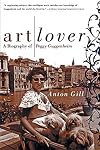
I really enjoyed reading this book. She was a fascinating person from a dysfunctional family who herself was very quirky and a very poor mother to her two children. She lived in a fascinating time and hung out with an amazing number of focus artist is of the period. I don't think I would have liked her. I do, however, want to see her collection in Venice some time.
If you have an appreciation of art (even if it's not for the Surrealist movement), this is a great read. Very informative and full of references to writers and artists of the early 20th century. Well researched.
Imo, although Ms. Guggenheim lived a personal life most people probably wouldn't wish on anyone, her collection is a tribute and an inspiration to all who appreciate art. I think even today if she were here, something she could be proud of.
Imo, although Ms. Guggenheim lived a personal life most people probably wouldn't wish on anyone, her collection is a tribute and an inspiration to all who appreciate art. I think even today if she were here, something she could be proud of.
Lists
You May Also Like


Associated Authors
Statistics
- Works
- 39
- Also by
- 1
- Members
- 1,499
- Popularity
- #17,140
- Rating
- 3.4
- Reviews
- 18
- ISBNs
- 115
- Languages
- 9
- Favorited
- 4