
William H. Rehnquist (1924–2005)
Author of The Supreme Court: A New Edition of the Chief Justice's Classic History
About the Author
Disambiguation Notice:
Full name: William Hubbs Rehnquist
Born as: William Donald Rehnquist
Image credit: Official portrait of Chief Justice of the United States William Rehnquist
Works by William H. Rehnquist
The Supreme Court: A New Edition of the Chief Justice's Classic History (2001) 471 copies, 3 reviews
Grand Inquests: The Historic Impeachments of Justice Samuel Chase and President Andrew Johnson (1992) 176 copies, 2 reviews
Associated Works
Booknotes: America's Finest Authors on Reading, Writing, and the Power of Ideas (1997) — Contributor — 459 copies, 5 reviews
The Supreme Court and the Constitution: Readings in American Constitutional History (1969) — Contributor, some editions — 68 copies
The Supreme Court Justices: Illustrated Biographies, 1789-1993 (The Supreme Court Historical Society) (1993) — Foreword — 43 copies, 1 review
Black, White, and Brown: The Landmark School Desegregation Case in Retrospect (2004) — Foreword — 17 copies, 1 review
Daniel Webster, The Completest Man: Essays by Richard Current, Irving Bartlett, Maurice Baxter & Howard Jones. (1990) — Foreword — 17 copies
MHQ: The Quarterly Journal of Military History — Winter 1999 (1998) — Author "The Milligan Decision" — 11 copies
Tagged
Common Knowledge
- Legal name
- Rehnquist, William Hubbs
- Other names
- Rehnquist, William Donald (born)
- Birthdate
- 1924-10-01
- Date of death
- 2005-09-03
- Gender
- male
- Education
- Shorewood High School, Shorewood, Wisconsin, USA (1942)
Kenyon College
Stanford University (M.A.|Political Science|1948)
Harvard University (M.A.|Government)
Stanford Law School (J.D.|1952) - Occupations
- Associate Justice of the Supreme Court of the United States (1972-1986)
Chief Justice of the United States (1986-2005)
lawyer
judge
public official
United States Assistant Attorney General for the Office of Legal Counsel (1969-1971) - Organizations
- Supreme Court of the United States (Associate Justice & Chief Justice|1972-2005)
Richard Nixon administration (1969-1971) - Awards and honors
- Thomas Jefferson Foundation Medal in Law (1993)
- Nationality
- USA
- Birthplace
- Milwaukee, Wisconsin, USA
- Places of residence
- Shorewood, Wisconsin, USA
Phoenix, Arizona, USA - Place of death
- Arlington, Virginia, USA
- Burial location
- Arlington National Cemetery, Arlington, Virginia, USA
- Disambiguation notice
- Full name: William Hubbs Rehnquist
Born as: William Donald Rehnquist - Associated Place (for map)
- USA
Members
Reviews
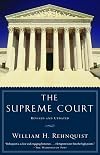
Following the epic 2022 Supreme Court decision overturning Roe v Wade (1973), the nature and role of the United States Supreme Court are being re-evaluated and criticized more intensely than at any time since the 1940s. This is a perfect time for an informed, scholarly, yet accessible history of the court, written at a moment when passions were not running so high. This is precisely what is available in former Chief Justice Rehnquist's 2004 study, written with sharp insight, a scrupulous show more regard for history, and even bits of subtle humor. This is not a casebook, detailing the Court's "greatest hits," but a study of why those cases, and many more, were and are so important. Although Rehnquist was regarded as a member of the "conservative" wing of the Court during his lifetime, the book is free of any hint of partisanship or polemical bias. History may regard Rehnquist as one of the Court's greatest justices; he is certainly one of its most gifted and enjoyable historians. show less
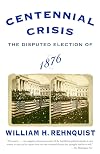
Centennial Crisis is Chief Justice William Rehnquist's interesting but ultimately disappointing telling of the disputed election of 1876.
The book is quite good at giving us the background of the central characters in the 1876 election - Grant, the outgoing President, Hayes, the candidate who ultimately won, Tilden his opponent. This takes up the first four chapters.
Chapter 5 covers the election itself, and here's where things get disappointing. Over the preceding 90 some pages Rehnquist show more covers the players in detail, but the play itself gets only eighteen pages, and there are twists and turns here that clearly could have benefited from further detail. I got to the end of Chapter 5 more than a bit confused by it all - Louisiana had a committee that simply threw out votes until they got the result they wanted? Oregon's governor simply substitutes electors because why? It's all really strange and not well explained - even to a reader going through the strange contortions of the 2020 election.
Suffice it to say that more than one state (Hello Florida) submitted votes from more than one slate of electors to the Electoral College, throwing the election to Congress. How Congress made it's way through the electoral mess, and managed to enlist Justices of the Supreme Court while doing so is the subject of the rest of the book.
Centennial Crisis is interesting as the product of the legal mind of the Chief Justice whose court ruled on the Florida ballot disputes in the 2000 election. It's worth a read for that reason alone. But if you are looking to understand the environment and the politics of 1876 that led to the dispute in the first place, then it's best to look elsewhere. Rehnquist, legal wizard he, is of course much more interested in the legal process of resolving the dispute, and it's impact on the Supreme Court, and that is the story he tells here. show less
The book is quite good at giving us the background of the central characters in the 1876 election - Grant, the outgoing President, Hayes, the candidate who ultimately won, Tilden his opponent. This takes up the first four chapters.
Chapter 5 covers the election itself, and here's where things get disappointing. Over the preceding 90 some pages Rehnquist show more covers the players in detail, but the play itself gets only eighteen pages, and there are twists and turns here that clearly could have benefited from further detail. I got to the end of Chapter 5 more than a bit confused by it all - Louisiana had a committee that simply threw out votes until they got the result they wanted? Oregon's governor simply substitutes electors because why? It's all really strange and not well explained - even to a reader going through the strange contortions of the 2020 election.
Suffice it to say that more than one state (Hello Florida) submitted votes from more than one slate of electors to the Electoral College, throwing the election to Congress. How Congress made it's way through the electoral mess, and managed to enlist Justices of the Supreme Court while doing so is the subject of the rest of the book.
Centennial Crisis is interesting as the product of the legal mind of the Chief Justice whose court ruled on the Florida ballot disputes in the 2000 election. It's worth a read for that reason alone. But if you are looking to understand the environment and the politics of 1876 that led to the dispute in the first place, then it's best to look elsewhere. Rehnquist, legal wizard he, is of course much more interested in the legal process of resolving the dispute, and it's impact on the Supreme Court, and that is the story he tells here. show less

Book was written in 1987 and WR clearly states he is not discussing current legal cases or the actions of his colleagues on the Court. Initial chapter is somewhat folksy and has unnecessary personal details IMO.
Background info on Hugo Black somewhat disturbing, esp that he admitted membership in KKK during his youth. This was long before borking became common practice, and can only wonder how it would be handled by society in this day and age. Amazing...
Interesting that during 19th and 20th show more century it was quite common for national politicians to be SC justices, and now days none are. Sandra Day O Conner being the last elected official.
Some pretty dry reading in the first 2/3 of the book and I struggled to maintain interest. A strength is his descriptions of various SC Justices..
Gets more interesting IMO when he speaks to process within the system ie certeriori?
Overall I think editor did a horrible job with an inexperienced author in his first book. Poorly organized
Procedures for analyzing cases and presentation styles of lawyers presenting cases before court show less
Background info on Hugo Black somewhat disturbing, esp that he admitted membership in KKK during his youth. This was long before borking became common practice, and can only wonder how it would be handled by society in this day and age. Amazing...
Interesting that during 19th and 20th show more century it was quite common for national politicians to be SC justices, and now days none are. Sandra Day O Conner being the last elected official.
Some pretty dry reading in the first 2/3 of the book and I struggled to maintain interest. A strength is his descriptions of various SC Justices..
Gets more interesting IMO when he speaks to process within the system ie certeriori?
Overall I think editor did a horrible job with an inexperienced author in his first book. Poorly organized
Procedures for analyzing cases and presentation styles of lawyers presenting cases before court show less
I really enjoyed reading this book. It read more like a novel than a factual history book. The author managed to transport you back to the 1800's and bring all the historical figures to life. I got reacquainted with figures from the past I had barely remembered and learned more about those I was familiar with. This fleshed out the bare paragraph or two that I remember from school. It added a thing or two I never knew or had forgotten about the native sons of my growing-up years in Ohio. This show more is no dry history book but an enjoyable read. show less
You May Also Like


Associated Authors
Statistics
- Works
- 7
- Also by
- 8
- Members
- 1,026
- Popularity
- #25,102
- Rating
- 3.8
- Reviews
- 10
- ISBNs
- 20

