
Philip Bobbitt
Author of The Shield of Achilles: War, Peace, and the Course of History
About the Author
Philip Bobbitt teaches constitutional law at the University of Texas, where he holds the A.W. Walker Centennial Chair. He served as associate counsel to the President for intelligence and international security, Counsel to the Senate Select Committee on the Iran-Contra Affair, and Counselor on show more International Law at the Department of State. He lives in Austin, Texas. show less
Image credit: Matthew Fuller
Works by Philip Bobbitt
The Garments of Court and Palace: Machiavelli and the World That He Made (2013) 94 copies, 2 reviews
Associated Works
Tagged
Common Knowledge
- Legal name
- Bobbitt, Philip Chase
- Birthdate
- 1948-07-22
- Gender
- male
- Education
- Princeton University (AB|1971)
Yale University (JD|1975)
University of Oxford (DPhil) - Occupations
- legal scholar
law professor
lawyer - Organizations
- Oxford University
King's College London
University of Texas
Columbia University - Awards and honors
- Fellow, American Academy of Arts and Sciences
- Nationality
- USA
- Birthplace
- Temple, Texas, USA
- Places of residence
- USA
England, UK - Associated Place (for map)
- USA
Members
Reviews

The Garments of Court and Palace poses an interesting challenge for me. It is essentially a review of Machiavelli’s The Prince. A 288 page review. How much more can one say? How does a reviewer review a review? Worse (or better yet), Bobbitt does in his review what readers of my reviews come to expect of me: a completely different take, with aspects and interpretations no other reviewer has caught, and which sometimes the author has missed, being mired in the trees of the forest.
The show more discovery here would never have occurred to me. It is that The Prince is actually a study in the evolution of constitutional government, and not a recipe for oppression and subjugation of a people. Only someone steeped in constitutional law and philosophy would interpret it that way, but Bobbitt makes an absolutely commanding case for it. In fact, by massaging Machiavelli into this thesis, Bobbitt solves a number of contradictions and conundrums that reviews have used to criticize Machiavelli and diminish his accomplishment with his book, which by the way, he never called The Prince.
In places, it is positively Talmudic in its incorporation of outside voices and critics. Commentators through the ages are shredded or vetted. He backs his premise thoroughly and completely, enlisting Machiavelli’s words despite centuries of them being interpreted in a completely different direction. It is fascinating.
Millions of us (had to) read The Prince in high school. Our teachers drummed into us exactly what it was about, and all our appreciation of it was framed in that context. But it’s wrong. And that makes this book compelling, valuable, and important.
I’m delighted to have come across it. show less
The show more discovery here would never have occurred to me. It is that The Prince is actually a study in the evolution of constitutional government, and not a recipe for oppression and subjugation of a people. Only someone steeped in constitutional law and philosophy would interpret it that way, but Bobbitt makes an absolutely commanding case for it. In fact, by massaging Machiavelli into this thesis, Bobbitt solves a number of contradictions and conundrums that reviews have used to criticize Machiavelli and diminish his accomplishment with his book, which by the way, he never called The Prince.
In places, it is positively Talmudic in its incorporation of outside voices and critics. Commentators through the ages are shredded or vetted. He backs his premise thoroughly and completely, enlisting Machiavelli’s words despite centuries of them being interpreted in a completely different direction. It is fascinating.
Millions of us (had to) read The Prince in high school. Our teachers drummed into us exactly what it was about, and all our appreciation of it was framed in that context. But it’s wrong. And that makes this book compelling, valuable, and important.
I’m delighted to have come across it. show less
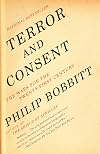
I had an opportunity to hear Philip Bobbitt talk about this book. He mentioned the review below. He said the review author "really gets what I am saying" in the book.
--------
Archbishop of Canterbury reviews Philip Bobbitt's new book, 'Terror and Consent: The Wars for the Twenty-first Century' in The Daily Telegraph on Saturday 17 May (2008).
Armies are always preparing, so the saying goes, to fight the last war
rather than the next one. Philip Bobbitt's enormous, courageous new
book is show more basically a long reflection on what it might take to jolt us out
of this habit, given that, as he argues with passion and erudition, we
are in the middle of a major change in the global constitutional
settlement and that this change is also one of the factors making us
vulnerable as never before to violent destabilisation.
This constitutional change is what he described in an earlier book, The
Shield of Achilles, as the shift from the nation-state to the
'market-state'. The legitimacy of a government, its assumed right to be
obeyed in its directions, used to rest on its capacity to protect and
nurture a fairly closely defined national sovereign unit by the
management of economic growth and public welfare internally and secure
defence externally. Increasingly, this is changing to a situation where
legitimacy rests on government's ability to maximise the choices of its
citizens. Centralised welfare is no longer at the heart of such a
project, nor is the balancing of a national economy: national economies
are inextricably bound up with the global market, citizens will seek the
best deal for themselves within the options available both privately and
publicly. The state is now a 'porous' reality in all sorts of ways.
This is neither a prescription for a desirable future nor a lament for
lost values. It is simply an observation about where we are currently
headed, on the basis of a candid examination of various social trends.
But the importance of the analysis is that it highlights the radically
changing nature of war in such a context. Up to the end of the 'Long
War' of the twentieth century between democratic and totalitarian
states, the assumption was that war was fought between geographically
distinct adversaries, by means of large-scale armaments and professional
standing forces, and that its conclusion was by means of a peace
publicly concluded between the parties.
No longer. The information explosion and the globalisation of markets
have proved to be the perfect vehicles for a new style of terrorism - a
terrorism no longer about localised protest for political ends, but
aimed at the dissolution of an entire culture of political consent.
Pluralism, negotiation, the rule of law as constantly evolving through
public discernment and discussion, are all placed in jeopardy by the
terrorist's goal of creating what Bobbitt calls a 'state of terror' -
that is, a system of government maintained by unchallengeable authority
and enforced by internal violence. Yet the state of terror is itself,
bizarrely, a 'market state', arguing its legitimacy by claiming to give
its citizens exactly what they both want and need, which is the security
of always being able to choose what is guaranteed to be good.
And the porous character of the modern state combined with internet
technology means that, en route to the creation of states of terror, it
is possible for a 'virtual state' to be created, with no centralised
bureaucracy, no official armed forces, no geographical heartland - only
an endlessly flexible and mobile fighting force, able to construct
high-damage, low-cost 'weapons' (including hijacked planes) calculated
for maximal civilian damage, and able also to display in the global
theatre of electronic communication a series of carefully staged
atrocities to individuals. Al Qaeda, Bobbitt claims, is such a virtual
state; and the conventions of warfare as they have been learned thus far
cannot touch it.
He is adamant that, nonetheless, we need still to use the language of
war; and the greater part of the book proposes some of the ways in which
'states of consent' should adapt to the new situation. As he cheerfully
admits, there is something here to offend practically everyone. The
left will be uncomfortable with the robust defence of preventative
action and streamlined intelligence gathering; the right will be shocked
by his uncompromising critique of current assumptions about national
sovereignty and his insistence that enforceable international law,
shaped by clear strategic doctrine, must overrule the 'opaque' concept
of sovereignty that has prevailed in the last century and more, in which
the relation of states to each other is like that of individuals within
the nation-state, with non-interference as the bottom line.
It is not only global terror that makes the old model increasingly
useless, he argues; it is also the transnational impact of natural
disaster and epidemic. These can be as destabilising as terror itself
(and can be exploited by terrorists); they can destroy infrastructure
and civil society and so undermine the possibility of a politics of
consent. And so a state that, for example, ignores a major
epidemiological or humanitarian crisis becomes, in Bobbitt's view,
liable to international police response, just as much as a state that
perpetrates systematic human rights abuses. What has been happening in
Burma in the last two weeks painfully shows the intersection of these
issues; humanitarian crisis within an already repressive political
context reinforces the dissolution of ordinary civil society and
stability.
Those who have read Bobbitt as some sort of apologist for American
hegemony because of his early support for intervention in Iraq will be
surprised to read his fierce and detailed dissections of the crass
failures of coalition policy in respect of Iraq. He notes the confusion
of intelligence gathering and analysis that has bedevilled US planning,
including the shared US and UK fiasco over weapons of mass destruction;
he pinpoints the weakness of a military strategy almost wholly oblivious
to what would be required to rebuild civil society in Iraq, observing
that, when victory is won, the primary need is for a policing function
in a disintegrating society. He is still, on balance, convinced that
the overthrow of Saddam was desirable for strategic reasons (at some
point the regime would have obtained WMDs), but grants that there is an
argument to be had about this. And he is insistent that the cavalier
treatment of the processes of law by the Bush administration has done
almost irreparable damage to the moral credibility of the struggle
against Al Qaeda. Once a 'state of consent' abandons legality, as in
Guantanamo, it is fatally compromised. Hence the need to address any
arguably necessary restrictions on civil freedoms in the face of terror
strictly through a transparent process of argument and a clear
demonstration of how law and strategy can work together without either
being sacrificed.
This is anything but an uncontroversial book, but it is one of the most
important works you are likely to read this year. Bobbitt's painstaking
rebuttal of Dershowitz's argument for some limited legitimation of
torture is excellent; his spelling out of what would be needed for the
reconstruction of a wrecked society ought to be required reading in the
British and American corridors of power; and his argument for rethinking
sovereignty, or at least redefining it in what he calls 'transparent'
terms, is one of the very, very few clear statements I have seen of what
might be demanded by the growing number of issues to which national
boundaries are completely irrelevant - disease as well as terror.
There are loose ends, even in a book of this size. Government is bound
to be concerned with public strategy and, even in the market state, with
some measure of corporate security; how then does it work with actors
for whom these things are not priorities? I wanted more about how
governments and transnational business could work together coherently in
the climate Bobbitt describes. And I wondered what if any restriction
his models might entail for a world of global newsgathering and
communication that is almost inevitably indifferent to the delicacies of
strategy as he understands it. I suspect too that his list (pp 420-421)
of countries where US intervention has been decisive for the triumph of
democracy (Nicaragua? South Korea? Lebanon?) will read as a bit
Panglossian to some. But the thrust of the book, for all its express
commitment to the primacy of the US as a global gatekeeper for political
'consent', is an immensely powerful argument for a new regime of
international law and an effective system of democratic alliances, for
the sharing of intelligence and of peacekeeping and reconstructive
resources.
It is also, like his earlier book, written with remarkable literary
grace (occasionally one sees the frustrated novelist peeping through in
the vividness of the scenarios for possible future crises). And behind
its pragmatic and unsparing struggles with how we are to manage all this
frighteningly rapid change in how we understand our political
possibilities, there lies, not too surprisingly, and very lightly
sketched, an Augustinian Christian sense of the tragic obligation to
achieve even a temporary and flawed good in the face of endemic
untruthfulness and evil, within as well as without. We may fail, in
other words, but we shall not have let ourselves be quite captured by
illusion and selfishness. Whether the reader agrees or not, this is a
quality that puts Bobbitt's work in a class rather apart from most
essays on international affairs; the level clarity of its exposition
allows us to look through into a depth that is neither consoling nor
despairing but patiently hopeful. show less
--------
Archbishop of Canterbury reviews Philip Bobbitt's new book, 'Terror and Consent: The Wars for the Twenty-first Century' in The Daily Telegraph on Saturday 17 May (2008).
Armies are always preparing, so the saying goes, to fight the last war
rather than the next one. Philip Bobbitt's enormous, courageous new
book is show more basically a long reflection on what it might take to jolt us out
of this habit, given that, as he argues with passion and erudition, we
are in the middle of a major change in the global constitutional
settlement and that this change is also one of the factors making us
vulnerable as never before to violent destabilisation.
This constitutional change is what he described in an earlier book, The
Shield of Achilles, as the shift from the nation-state to the
'market-state'. The legitimacy of a government, its assumed right to be
obeyed in its directions, used to rest on its capacity to protect and
nurture a fairly closely defined national sovereign unit by the
management of economic growth and public welfare internally and secure
defence externally. Increasingly, this is changing to a situation where
legitimacy rests on government's ability to maximise the choices of its
citizens. Centralised welfare is no longer at the heart of such a
project, nor is the balancing of a national economy: national economies
are inextricably bound up with the global market, citizens will seek the
best deal for themselves within the options available both privately and
publicly. The state is now a 'porous' reality in all sorts of ways.
This is neither a prescription for a desirable future nor a lament for
lost values. It is simply an observation about where we are currently
headed, on the basis of a candid examination of various social trends.
But the importance of the analysis is that it highlights the radically
changing nature of war in such a context. Up to the end of the 'Long
War' of the twentieth century between democratic and totalitarian
states, the assumption was that war was fought between geographically
distinct adversaries, by means of large-scale armaments and professional
standing forces, and that its conclusion was by means of a peace
publicly concluded between the parties.
No longer. The information explosion and the globalisation of markets
have proved to be the perfect vehicles for a new style of terrorism - a
terrorism no longer about localised protest for political ends, but
aimed at the dissolution of an entire culture of political consent.
Pluralism, negotiation, the rule of law as constantly evolving through
public discernment and discussion, are all placed in jeopardy by the
terrorist's goal of creating what Bobbitt calls a 'state of terror' -
that is, a system of government maintained by unchallengeable authority
and enforced by internal violence. Yet the state of terror is itself,
bizarrely, a 'market state', arguing its legitimacy by claiming to give
its citizens exactly what they both want and need, which is the security
of always being able to choose what is guaranteed to be good.
And the porous character of the modern state combined with internet
technology means that, en route to the creation of states of terror, it
is possible for a 'virtual state' to be created, with no centralised
bureaucracy, no official armed forces, no geographical heartland - only
an endlessly flexible and mobile fighting force, able to construct
high-damage, low-cost 'weapons' (including hijacked planes) calculated
for maximal civilian damage, and able also to display in the global
theatre of electronic communication a series of carefully staged
atrocities to individuals. Al Qaeda, Bobbitt claims, is such a virtual
state; and the conventions of warfare as they have been learned thus far
cannot touch it.
He is adamant that, nonetheless, we need still to use the language of
war; and the greater part of the book proposes some of the ways in which
'states of consent' should adapt to the new situation. As he cheerfully
admits, there is something here to offend practically everyone. The
left will be uncomfortable with the robust defence of preventative
action and streamlined intelligence gathering; the right will be shocked
by his uncompromising critique of current assumptions about national
sovereignty and his insistence that enforceable international law,
shaped by clear strategic doctrine, must overrule the 'opaque' concept
of sovereignty that has prevailed in the last century and more, in which
the relation of states to each other is like that of individuals within
the nation-state, with non-interference as the bottom line.
It is not only global terror that makes the old model increasingly
useless, he argues; it is also the transnational impact of natural
disaster and epidemic. These can be as destabilising as terror itself
(and can be exploited by terrorists); they can destroy infrastructure
and civil society and so undermine the possibility of a politics of
consent. And so a state that, for example, ignores a major
epidemiological or humanitarian crisis becomes, in Bobbitt's view,
liable to international police response, just as much as a state that
perpetrates systematic human rights abuses. What has been happening in
Burma in the last two weeks painfully shows the intersection of these
issues; humanitarian crisis within an already repressive political
context reinforces the dissolution of ordinary civil society and
stability.
Those who have read Bobbitt as some sort of apologist for American
hegemony because of his early support for intervention in Iraq will be
surprised to read his fierce and detailed dissections of the crass
failures of coalition policy in respect of Iraq. He notes the confusion
of intelligence gathering and analysis that has bedevilled US planning,
including the shared US and UK fiasco over weapons of mass destruction;
he pinpoints the weakness of a military strategy almost wholly oblivious
to what would be required to rebuild civil society in Iraq, observing
that, when victory is won, the primary need is for a policing function
in a disintegrating society. He is still, on balance, convinced that
the overthrow of Saddam was desirable for strategic reasons (at some
point the regime would have obtained WMDs), but grants that there is an
argument to be had about this. And he is insistent that the cavalier
treatment of the processes of law by the Bush administration has done
almost irreparable damage to the moral credibility of the struggle
against Al Qaeda. Once a 'state of consent' abandons legality, as in
Guantanamo, it is fatally compromised. Hence the need to address any
arguably necessary restrictions on civil freedoms in the face of terror
strictly through a transparent process of argument and a clear
demonstration of how law and strategy can work together without either
being sacrificed.
This is anything but an uncontroversial book, but it is one of the most
important works you are likely to read this year. Bobbitt's painstaking
rebuttal of Dershowitz's argument for some limited legitimation of
torture is excellent; his spelling out of what would be needed for the
reconstruction of a wrecked society ought to be required reading in the
British and American corridors of power; and his argument for rethinking
sovereignty, or at least redefining it in what he calls 'transparent'
terms, is one of the very, very few clear statements I have seen of what
might be demanded by the growing number of issues to which national
boundaries are completely irrelevant - disease as well as terror.
There are loose ends, even in a book of this size. Government is bound
to be concerned with public strategy and, even in the market state, with
some measure of corporate security; how then does it work with actors
for whom these things are not priorities? I wanted more about how
governments and transnational business could work together coherently in
the climate Bobbitt describes. And I wondered what if any restriction
his models might entail for a world of global newsgathering and
communication that is almost inevitably indifferent to the delicacies of
strategy as he understands it. I suspect too that his list (pp 420-421)
of countries where US intervention has been decisive for the triumph of
democracy (Nicaragua? South Korea? Lebanon?) will read as a bit
Panglossian to some. But the thrust of the book, for all its express
commitment to the primacy of the US as a global gatekeeper for political
'consent', is an immensely powerful argument for a new regime of
international law and an effective system of democratic alliances, for
the sharing of intelligence and of peacekeeping and reconstructive
resources.
It is also, like his earlier book, written with remarkable literary
grace (occasionally one sees the frustrated novelist peeping through in
the vividness of the scenarios for possible future crises). And behind
its pragmatic and unsparing struggles with how we are to manage all this
frighteningly rapid change in how we understand our political
possibilities, there lies, not too surprisingly, and very lightly
sketched, an Augustinian Christian sense of the tragic obligation to
achieve even a temporary and flawed good in the face of endemic
untruthfulness and evil, within as well as without. We may fail, in
other words, but we shall not have let ourselves be quite captured by
illusion and selfishness. Whether the reader agrees or not, this is a
quality that puts Bobbitt's work in a class rather apart from most
essays on international affairs; the level clarity of its exposition
allows us to look through into a depth that is neither consoling nor
despairing but patiently hopeful. show less

Bobbitt is surprising and his book is surprisingly nuanced. From any end of the political spectrum, there's much to agree on in this book. Many of the things you think you'll want to disagree with in this book (e.g., that a war on terror exists and may be a good thing) you may end up finding yourself compelled by, at least a bit. Ultimately it's nice to read a book laced with poetry and drama, relishing in intellectual history, and trying to wrap a temporary dilemma into a larger discourse show more about changes in the nature of political sovereignty. Best enjoyed as the author himself would have it, with cigars and single malt. show less

Fundamentally, Bobbitt believes that in the soundness of the morality that underlay the strategy of the bourgeois Western alliance and that defeated fascism and communism in what he considers the “wars of the nation state” while preserving fundamental freedoms of speech and association, and he aspires to lay the groundwork for preserving core values during what he considers the “wars of the market state” (which many readers on the left will disupte).
In both cases, he believes that show more the key is “the interposition of law . . . but not law that is interposed to block the demands of strategy, but rather law that is integrated with strategy.”
However, Bobbitt neglects evidence of the Bush administration’s bad faith in hijacking the intelligence to accomplish neoconservative ends, ignoring evidence such as the Downing Street Memo and such elements as the Project for a New American Century, the role of oil and oil companies (Bobbitt rebuts this charge on pp. 492-93), the role of Israel and the Israel Lobby (briefly acknowledged on pp. 525-26), the complicity of corporate-owned media, and the facilitation of this through media concentration. (Perhaps this is because he does not wish to contribute to delegitimizing the state?) Also, Bobbitt’s “market state” concept implicitly legitimates a number of these influences—making their omission all the more striking. show less
In both cases, he believes that show more the key is “the interposition of law . . . but not law that is interposed to block the demands of strategy, but rather law that is integrated with strategy.”
However, Bobbitt neglects evidence of the Bush administration’s bad faith in hijacking the intelligence to accomplish neoconservative ends, ignoring evidence such as the Downing Street Memo and such elements as the Project for a New American Century, the role of oil and oil companies (Bobbitt rebuts this charge on pp. 492-93), the role of Israel and the Israel Lobby (briefly acknowledged on pp. 525-26), the complicity of corporate-owned media, and the facilitation of this through media concentration. (Perhaps this is because he does not wish to contribute to delegitimizing the state?) Also, Bobbitt’s “market state” concept implicitly legitimates a number of these influences—making their omission all the more striking. show less
Awards


The Shield of Achilles: War, Peace, and the Course of History (Team Favorites – Lewis Sage-Passant – Founder and Editor-in-Chief – 2024)
The Shield of Achilles: War, Peace, and the Course of History (Team Favorites – Lewis Tallon – Co-Editor and EMEA Analyst – 2021)
You May Also Like


Associated Authors
Statistics
- Works
- 9
- Also by
- 1
- Members
- 1,405
- Popularity
- #18,284
- Rating
- 3.9
- Reviews
- 20
- ISBNs
- 40
- Favorited
- 3