
Russell T. Davies
Author of Doctor Who: The Complete First Series
About the Author
Image credit: Tony Hassall
Series
Works by Russell T. Davies
Doctor Who: Now We Are Six Hundred: A Collection of Time Lord Verse (2017) — Illustrator — 102 copies, 4 reviews
Doctor Who: Series 1, Volume 2 23 copies
Doctor Who: The Doctors Revisited: 9-11 (2013) — Writer (Bad Wolf, Parting of the Ways, Stolen Earth & Journey's End) — 15 copies
Years and Years [2019 TV series] — Screenwriter — 10 copies
Doctor Who: Series 2, Volume 4 9 copies
Doctor Who: Series 4, Volume 3 7 copies
Doctor Who: Series 2, Volume 5 6 copies
Doctor Who: Series 4, Volume 4 5 copies
Torchwood [TV series] — Creator — 3 copies
Torchwood: Season 1: Part 3 3 copies
Doctor Who (2005-2022) - Stagione 1 2 copies
Torchwood: Season 1: Part 2 2 copies
TORCHWOOD 1 and 2 2 copies
Doctor Who (2023) - Specials 1 copy
Century Falls [DVD] 1 copy
Doctor Who: Season one 1 copy
Doctor Who and The Time War 1 copy
Associated Works
The Hitchhiker's Guide to the Galaxy: A Trilogy in Five Parts (1979) — Foreword, some editions — 4,605 copies, 47 reviews
Love from the Pink Palace: Memories of Love, Loss and Cabaret through the AIDS Crisis (2022) — Foreword — 12 copies, 1 review
Doctor Who Magazine #581 — Contributor — 2 copies
Tagged
Common Knowledge
- Legal name
- Davies, Stephen Russell
- Birthdate
- 1963-04-27
- Gender
- male
- Education
- University of Oxford (Worcester College)
Olchfa Comprehensive School
Tycoch Primary School, Sketty - Occupations
- screenwriter
television producer - Organizations
- British Broadcasting Corporation
Granada Television - Awards and honors
- Order of the British Empire (Officer ∙ 2008)
Siân Phillips Award (2006) - Nationality
- UK
- Birthplace
- Swansea, Wales, UK
- Map Location
- Wales, UK
Members
Reviews
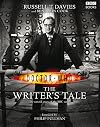
An account of once and future Doctor Who/showrunner Russell T. Davies' work on the show from the 2007 Christmas special through the end of Season 5 of the new series. It's told in the form of a long-running, casual email exchange between Davies and writer Benjamin Cook, in which Davies answers Cook's questions about his job and his writing process, sends him drafts of the scripts he's currently working on, and generally offers up thoughts and reflections, as well as more than a few emotional show more outbursts about how stressed he is trying to get things finished.
I actually picked up my copy of this book in 2008, when it was first published, but for some reason I just kept never getting around to reading it. With Davies' return to the show, though, now seemed very much like the time for it.
I'll admit, at first I wasn't at all sure just how glad I was to finally be reading the thing. It seemed like this might be a deeper dive into Russell Davies' mind than I actually wanted. It's disconcertingly horny in there, for one thing, and he's prone to be a bit... wallow-y. Although, in fairness, he was kind of asked to be, and he's at least quite self-aware about it. And it didn't help, I'm sure, that the early parts of the book are mostly about his work on the script for "Voyage of the Damned,' which... well, let's face it, that's not really anybody's favorite episode, is it?
I did come to appreciate it at lot more as things went on, though. I always find it interesting to get a glimpse into a writer's thought process, and Davies does have some interesting and occasionally even insightful things to say about that process, and about working in television, specifically. It was also very interesting to get this much of a look into the nitty-gritty details of how a television script evolves from its first conception in the writer's brain through the actual filmed product that appears on our screens. I knew sort of intellectually how vulnerable the effective telling of any TV story is to the harsh realities of run time, and actor availability, and production schedules, and FX budgets, but seeing it unfolding in front of me here honestly leaves me boggling a little at the fact that any TV episode actually works and holds together and makes sense at all after it's been through all of that. Not that that's ever going to stop me nitpicking the ones that don't, mind you.
So, anyway. I am glad I finally got to it, after all. Although, boy, has it just made all my mixed feelings about RTD's return even more mixed. The depictions of how he finishes every script at or after the very last minute (whether or not he's had any sleep or, say, contracted chicken pox) may actually explain a few things about his stories, but it doesn't inspire huge amounts of confidence. And, on the one hand, this book prompted me to remember just how much I loved "Partners in Crime" and how entertaining Davies' particular brand of silliness can be when it comes off well. On the other hand, ye gods, "The Stolen Earth" and "Journey's End" were more of a ridiculous mess than I even remembered them being, and reading about them just gives me a front row seat to what I still regard as probably the most infuriatingly bad storytelling decision in the history of television. But don't worry, I'll spare you my rant on that subject. And, hey, who knows? Maybe he'll finally fix it, leaving me blissfully free to send all my nerd rage elsewhere. I can hope, right? show less
I actually picked up my copy of this book in 2008, when it was first published, but for some reason I just kept never getting around to reading it. With Davies' return to the show, though, now seemed very much like the time for it.
I'll admit, at first I wasn't at all sure just how glad I was to finally be reading the thing. It seemed like this might be a deeper dive into Russell Davies' mind than I actually wanted. It's disconcertingly horny in there, for one thing, and he's prone to be a bit... wallow-y. Although, in fairness, he was kind of asked to be, and he's at least quite self-aware about it. And it didn't help, I'm sure, that the early parts of the book are mostly about his work on the script for "Voyage of the Damned,' which... well, let's face it, that's not really anybody's favorite episode, is it?
I did come to appreciate it at lot more as things went on, though. I always find it interesting to get a glimpse into a writer's thought process, and Davies does have some interesting and occasionally even insightful things to say about that process, and about working in television, specifically. It was also very interesting to get this much of a look into the nitty-gritty details of how a television script evolves from its first conception in the writer's brain through the actual filmed product that appears on our screens. I knew sort of intellectually how vulnerable the effective telling of any TV story is to the harsh realities of run time, and actor availability, and production schedules, and FX budgets, but seeing it unfolding in front of me here honestly leaves me boggling a little at the fact that any TV episode actually works and holds together and makes sense at all after it's been through all of that. Not that that's ever going to stop me nitpicking the ones that don't, mind you.
So, anyway. I am glad I finally got to it, after all. Although, boy, has it just made all my mixed feelings about RTD's return even more mixed. The depictions of how he finishes every script at or after the very last minute (whether or not he's had any sleep or, say, contracted chicken pox) may actually explain a few things about his stories, but it doesn't inspire huge amounts of confidence. And, on the one hand, this book prompted me to remember just how much I loved "Partners in Crime" and how entertaining Davies' particular brand of silliness can be when it comes off well. On the other hand, ye gods, "The Stolen Earth" and "Journey's End" were more of a ridiculous mess than I even remembered them being, and reading about them just gives me a front row seat to what I still regard as probably the most infuriatingly bad storytelling decision in the history of television. But don't worry, I'll spare you my rant on that subject. And, hey, who knows? Maybe he'll finally fix it, leaving me blissfully free to send all my nerd rage elsewhere. I can hope, right? show less

http://nwhyte.livejournal.com/1581275.html
Davies and Cook exchanged emails and texts for the last two years of Davies' tenure as show-runner of Doctor Who (ie 2007-2009), so the narrative is spontaneous, spur of the moment, and feels very genuine (though of course the reader cannot know what has been edited out in the process). I had already read the first half, and Cook and Davies spend some time in the second half discussing the reception of the original version. Davies is perpetually show more struggling with deadlines, with his other responsibilities as showrunner, with his role as a public figure and spokesman not only for his own show but for his industry.
The book offers insights into the process of writing, crafting and drafting, trying to get it right, over the period of weeks and months of producing Doctor Who. Occasionally one can trace particular elements to the outside world: Ben Cook, normally a passionate but detached observer, persuades Davies not to end Journey's End with a Cyberman teaser for The Next Doctor. But more often the writers are drawing on their own emotional resources and imagination, trying as it were to find the story that is trying to get out - there is a nice moment when Davies, emailing Cook, suddenly realises that Wilf Mott should be the instrument of the Tenth Doctor's demise.
Structured as a dialogue between two writers, with lots of pretty pictures and extra amaterial, it is also about a success: whether or not one is a fan of Who or of Davies' treatment of it, the fact is that he revived a faded franchise and made it a hit, and that in itself is a good story even if we are only getting the final years. I commented about the first edition that there were a lot of deaths in it; there is only one in the second half, but it is significant - the mother of the Executive Producer, Julie Gardner, of the same illness which Davies' own mother had succumbed to a few years earlier. While of course all authors draw on many life experiences, it's not too fanciful, I think, to see a direct link between this and the creation of the Claire Bloom character in The End of Time, who in Davies' mind is very explicitly the Doctor's own mother.
The Writer's Tale, however, is probably the best book about Doctor Who that will ever be written, and of immense interest to anyone who cares about television, sf, or indeed the creative process. show less
Davies and Cook exchanged emails and texts for the last two years of Davies' tenure as show-runner of Doctor Who (ie 2007-2009), so the narrative is spontaneous, spur of the moment, and feels very genuine (though of course the reader cannot know what has been edited out in the process). I had already read the first half, and Cook and Davies spend some time in the second half discussing the reception of the original version. Davies is perpetually show more struggling with deadlines, with his other responsibilities as showrunner, with his role as a public figure and spokesman not only for his own show but for his industry.
The book offers insights into the process of writing, crafting and drafting, trying to get it right, over the period of weeks and months of producing Doctor Who. Occasionally one can trace particular elements to the outside world: Ben Cook, normally a passionate but detached observer, persuades Davies not to end Journey's End with a Cyberman teaser for The Next Doctor. But more often the writers are drawing on their own emotional resources and imagination, trying as it were to find the story that is trying to get out - there is a nice moment when Davies, emailing Cook, suddenly realises that Wilf Mott should be the instrument of the Tenth Doctor's demise.
Structured as a dialogue between two writers, with lots of pretty pictures and extra amaterial, it is also about a success: whether or not one is a fan of Who or of Davies' treatment of it, the fact is that he revived a faded franchise and made it a hit, and that in itself is a good story even if we are only getting the final years. I commented about the first edition that there were a lot of deaths in it; there is only one in the second half, but it is significant - the mother of the Executive Producer, Julie Gardner, of the same illness which Davies' own mother had succumbed to a few years earlier. While of course all authors draw on many life experiences, it's not too fanciful, I think, to see a direct link between this and the creation of the Claire Bloom character in The End of Time, who in Davies' mind is very explicitly the Doctor's own mother.
The Writer's Tale, however, is probably the best book about Doctor Who that will ever be written, and of immense interest to anyone who cares about television, sf, or indeed the creative process. show less
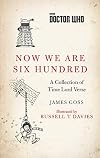
Book 143 - Doctor Who - Now we are six hundred
Written by James Goss - Illustrated by Russell T Davies
As a parody of A.A. Milne’s ‘Now we are six’ this joyous little book takes us from the end of the universe and back again through the eyes of the last (?) Gallifreyan…Doctor Who…or the Doctor as he is known.
Poems in a fabulous short little book
Gets into every alien cranny and nook
We fly through adventure like a marathon race
Through the depths of time and space.
With gems show more reminiscent about being on stairs half way up
We meet Daleks and Cybermen and a K9 pup
Travelling with a Time Lord who knows that he rocks
Are all his companions in that strange blue box.
I could keep going with this poem that rhymes
But as with most things Who, there isn’t the time.
So before both people who read this, loudly scream out
I’ll stop with a whimper and a bit of a pout
I thoroughly recommend this book full of odes
Where we met green monsters with faces like toads
There was even a clown who moved like a mime
The Doctor faced them all in space and time.
Time to put my nerd away
He only comes out on special days.
The drawings are incredible and oh so cute
Made me laugh, a bit of a hoot.
Russell T Davies drew them with aplomb
He writes and draws, so much fun.
They add to the tales of our Time Lord friend
That’s it..all done…that’s The End. show less
Written by James Goss - Illustrated by Russell T Davies
As a parody of A.A. Milne’s ‘Now we are six’ this joyous little book takes us from the end of the universe and back again through the eyes of the last (?) Gallifreyan…Doctor Who…or the Doctor as he is known.
Poems in a fabulous short little book
Gets into every alien cranny and nook
We fly through adventure like a marathon race
Through the depths of time and space.
With gems show more reminiscent about being on stairs half way up
We meet Daleks and Cybermen and a K9 pup
Travelling with a Time Lord who knows that he rocks
Are all his companions in that strange blue box.
I could keep going with this poem that rhymes
But as with most things Who, there isn’t the time.
So before both people who read this, loudly scream out
I’ll stop with a whimper and a bit of a pout
I thoroughly recommend this book full of odes
Where we met green monsters with faces like toads
There was even a clown who moved like a mime
The Doctor faced them all in space and time.
Time to put my nerd away
He only comes out on special days.
The drawings are incredible and oh so cute
Made me laugh, a bit of a hoot.
Russell T Davies drew them with aplomb
He writes and draws, so much fun.
They add to the tales of our Time Lord friend
That’s it..all done…that’s The End. show less

http://nwhyte.livejournal.com/2310165.html
I think Russell T. Davies is the only Who showrunner to have written a novel set in the Whoniverse before he took over, and this is it: published in 1996, set in 1987, and a really important taproot text for New Who and particularly for Rose, its very first episode. The number of common elements is pretty remarkable:
All of this is not to say that Rose, let alone New Who as a whole, is "just" a rewrite of Damaged Goods; there's a lot of bloke-on-bloke sex and cocaine in this novel, which I think even RTD might have been prevented from bringing to the small screen by the BBC higher-ups, and it's also tied rather more directly into the mythos of Gallifrey than any New Who until (and possibly including) The End of Time.
Having said all that, I thought this was a cracking good book of the New Adventures series, taking the Doctor Who framework and fitting it to an unexpected setting, a gritty council estate. It's a complex plot with lots of elements, and Davies keeps all the balls in the air, juggling furiously. Even his monstrous maternal characters are a bit more sympathetic than they somehow ever came across on screen. I'm surprised that this isn't better known among fans; a lot of the elements that brought the show back are here, and also we can see some ways in which it might have gone differently. I would strongly recommend it to anyone interested in how New Who came to be the way it was in 2005. show less
I think Russell T. Davies is the only Who showrunner to have written a novel set in the Whoniverse before he took over, and this is it: published in 1996, set in 1987, and a really important taproot text for New Who and particularly for Rose, its very first episode. The number of common elements is pretty remarkable:
- The first character we encounter in the story is the daughter of Mrs Tyler, who is a single mother
- She says to the Doctor at one point,
- "You think you're so funny", a line almost echoed by Rose Tyler a decade later
- The Tylers live on a council estate where strange things are happening
- The strange things include (but are not restricted to) a doppelganger of a black neighbour created by an evil alien intelligence
- The Doctor's female companion is Roz
- At the very end the Doctor goes back in time to meet the young Tyler girl before the adventure started in her time line
- As the alien invasion fully manifests lots of people die horribly and swiftly
- There are several pretty mosntrous middle-aged women characters for whom motherhood is a driving motivation
All of this is not to say that Rose, let alone New Who as a whole, is "just" a rewrite of Damaged Goods; there's a lot of bloke-on-bloke sex and cocaine in this novel, which I think even RTD might have been prevented from bringing to the small screen by the BBC higher-ups, and it's also tied rather more directly into the mythos of Gallifrey than any New Who until (and possibly including) The End of Time.
Having said all that, I thought this was a cracking good book of the New Adventures series, taking the Doctor Who framework and fitting it to an unexpected setting, a gritty council estate. It's a complex plot with lots of elements, and Davies keeps all the balls in the air, juggling furiously. Even his monstrous maternal characters are a bit more sympathetic than they somehow ever came across on screen. I'm surprised that this isn't better known among fans; a lot of the elements that brought the show back are here, and also we can see some ways in which it might have gone differently. I would strongly recommend it to anyone interested in how New Who came to be the way it was in 2005. show less
Lists
Awards


You May Also Like


Associated Authors
Statistics
- Works
- 121
- Also by
- 16
- Members
- 3,697
- Popularity
- #6,853
- Rating
- 4.2
- Reviews
- 71
- ISBNs
- 96
- Languages
- 2
- Favorited
- 3
