
Ronald Stuart Thomas (1913–2000)
Author of Collected poems, 1945-1990
About the Author
Works by Ronald Stuart Thomas
Penguin Modern Poets 1: Lawrence Durrell, Elizabeth Jennings, R.S. Thomas (1970) — Author — 113 copies, 2 reviews
Pietà 5 copies
Undod personol y Duw-Ddyn 1 copy
Reading the Poems 1 copy
Selected poems 1 copy
Frieze 1 copy
Associated Works
Edexcel Poetry Anthology for Advanced subsidiary and advanced GCE examinations in English Literature (2000) — Contributor, some editions — 6 copies
Tagged
Common Knowledge
- Legal name
- Thomas, Ronald Stuart
- Birthdate
- 1913-03-29
- Date of death
- 2000-09-25
- Gender
- male
- Education
- University of North Wales, Bangor
St Michael's College, LLandaff - Occupations
- clergyman (Church in Wales)
poet
autobiographer - Organizations
- Cyfeillion Llŷn
- Awards and honors
- Queen's Gold Medal for Poetry (1964)
- Relationships
- Eldridge, Mildred Elsie (wife)
- Nationality
- UK
- Birthplace
- Cardiff, Wales, UK
- Place of death
- Pentrefelin, Gwynedd, Wales
- Burial location
- Porthmadog, Wales (St John's Church)
- Associated Place (for map)
- UK
Members
Reviews
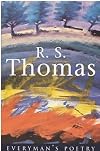
I bought this edition of R.S. Thomas' 'Selected Poems' when it came out in the mid-1990s - around the time that the Welsh former priest was nominated for the Nobel Prize - and have dipped in and out of it ever since. This was the first time that I had read it cover to cover, however (by virtue of being laid up with a bad back).
'Bleak' is the adjective most commonly applied to Thomas' poetry and 'solitary' to the man himself. He wrote about life in one small corner of the world and revisited show more familiar themes. How easy, then, it would be to write one of those reviews 'in the style of'. Fortunately, I resisted. The best of his short verses build ineluctably into powerful structures like grey parish churches from Welsh granite. 'An Old Woman' concludes:
'...and now and then she laughs,
A high, shrill, mirthless laugh, half cough, half whistle,
Tuneless and dry as east wind through a thistle.'
'In Church', one of many questioning the poet's faith ends:
'There is no other sound
In the darkness but the sound of a man
Breathing, testing his faith
On emptiness, nailing his questions
One by one to an untenanted cross.'
Most moving of all is the last poem in the collection, lines written on the death of his wife of more than fifty years:
'And she,
who in life
had done everything
with a bird's grace,
opened her bill now
for the shedding
of one sigh no
heavier than a feather.'
Thomas was also known for his opposition to the erosion of Welsh culture by that of England. I can empathise with his perspective and recall a heated discussion about the issue with friends in Suffolk long ago. Alongside his unfashionable concern with God, this may add to his difficulty for some English readers.
This copy in the Everyman's series cost me £1 when it was new. I cannot imagine a pound better spent. show less
'Bleak' is the adjective most commonly applied to Thomas' poetry and 'solitary' to the man himself. He wrote about life in one small corner of the world and revisited show more familiar themes. How easy, then, it would be to write one of those reviews 'in the style of'. Fortunately, I resisted. The best of his short verses build ineluctably into powerful structures like grey parish churches from Welsh granite. 'An Old Woman' concludes:
'...and now and then she laughs,
A high, shrill, mirthless laugh, half cough, half whistle,
Tuneless and dry as east wind through a thistle.'
'In Church', one of many questioning the poet's faith ends:
'There is no other sound
In the darkness but the sound of a man
Breathing, testing his faith
On emptiness, nailing his questions
One by one to an untenanted cross.'
Most moving of all is the last poem in the collection, lines written on the death of his wife of more than fifty years:
'And she,
who in life
had done everything
with a bird's grace,
opened her bill now
for the shedding
of one sigh no
heavier than a feather.'
Thomas was also known for his opposition to the erosion of Welsh culture by that of England. I can empathise with his perspective and recall a heated discussion about the issue with friends in Suffolk long ago. Alongside his unfashionable concern with God, this may add to his difficulty for some English readers.
This copy in the Everyman's series cost me £1 when it was new. I cannot imagine a pound better spent. show less
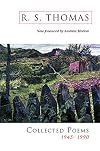
R.S. Thomas was a Welsh clergyman posted to a rural parish in Wales and his poetry (particularly early on) reflects this. Poems discuss the landscape, individuals and society he finds himself immersed in and how they relate to each other. He finds the farmers, though illiterate, unable to appreciate the beauty of their surroundings and incapable of a profound relationship with God, admirable simply because of their capability to scratch a life out of their hills and valleys. He also notes show more the changes coming to farms in Wales - famously in Cynddylan on a Tractor. Later, many of his poems discuss God, who seems to come and go from Thomas' life, causing considerable distress, even despair, when absent. Another theme seems to be reflecting on his earlier poems and earlier life.
I once tried out a few poems from this collection on a Frenchman and an American woman; they didn't appreciate it at all. It made me wonder if you have to have lived in rural Wales (as I have) to really appreciate the early works. I would still recommend this to any poetry lover - Thomas is a monument of post-war Welsh literature in English. show less
I once tried out a few poems from this collection on a Frenchman and an American woman; they didn't appreciate it at all. It made me wonder if you have to have lived in rural Wales (as I have) to really appreciate the early works. I would still recommend this to any poetry lover - Thomas is a monument of post-war Welsh literature in English. show less
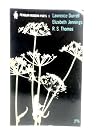
[Penguin Modern Poets 1]- Lawrence Durrell, Elizabeth Jennings, R.S. Thomas
Penguin Modern Poets was a series of 27 poetry books published by Penguin Books in the 1960s and 1970s, each containing work by three contemporary poets (mostly but not exclusively British and American). The series was begun in 1962 and published an average of two volumes per year throughout the 1960s. and beyond. Each volume was stated to be "an attempt to introduce contemporary poetry to the general reader, by show more publishing some thirty poems by each of three modern poets in a single volume. In each case the selection will be made to illustrate the poet's characteristics in style and form."
This was a new departure; publishing contemporary poetry in paperbacks and so should be lauded for making the poems affordable to many, being priced originally at 2 shillings and sixpence (half a crown). I must certainly have been able to afford them as I have managed to track down nineteen of them on my bookshelves. I have certainly not read them all, but a few do bear some notes that I made at the time. They are of a nice size to slip into a pocket and I usually took one of them away on holiday. One of them still bears the stain and the faint smell of sun tan lotion and brings back fond memories. Most of the books now have a fairly battered appearance and reading again this first volume has resulted in a few pages coming away from the binding.
I remember being excited to buy them the first time around and then being a bit dismayed when I got around to opening them, to discover that some of the poets were writing in a style or language that I could not get to grips with and so although we can congratulate the publishers for making the poems available, a few paragraphs serving as an introduction would have been useful. After all the aim was to introduce the poets to the general reader. The approach here seems to have been "just print the poems". They are nicely spaced out with each poem starting on a new page and there is a list of all the poems at the front of the book.
The first poet in the first collection is Lawrence Durrell who is perhaps not the easiest of poets to appreciate and by the time the general reader had got to his third poem 'Carol on Corfu' he may have found himself as all at sea as I was. Remember in the 1960's no internet connection to help with background knowledge and any Encyclopaedia to hand would not have covered contemporary poetry. Information easily available today would alert the reader to some of Durrell's themes. His ability to connect the past with the present, his love of Greek mythology and his ability to evoke the atmosphere of Greece and its islands; its light its colour and its nature and of course the sea. He sometimes looks at life with amusement, but death is also not far away and he is a poet who feels his his aloneness in the world, love seems to be important, but ephemeral I think that all this is expressed in my favourite poem from this selection:
This unimportant morning
This unimportant morning
Something goes singing where
The capes turn over on their sides
And the warm Adriatic rides
Her blue and sun washing
At the edge of the world and its brilliant cliffs.
Day rings in the higher airs
Pure with cicadas, and slowing
Like a pulse to smoke from farms,
Extinguished in the exhausted earth,
Unclenching like a fist and going.
Trees fume, cool, pour - and overflowing
Unstretch the feathers of birds and shake
Carpets from windows, brush with dew
The up-and-doing: and young lovers now
Their little resurrections make.
And now lightly to kiss all whom sleep
Stitched up - and wake, my darling, wake.
The impatient Boatman has been waiting
Under the house, his long oars folded up
Like wings in waiting on the darkling lake.
In many of Durrell's poems there are stanzas of vivid beauty and thoughts that coalesce with the atmosphere he has created. Other poems where he achieves this are Sarajevo and A Water-Colour of Venice. I have on my shelves his collected poems and I love his novels that form the Alexandria Quartet. I have to acknowledge that some of his thoughts in his poems and his novels still remain just out of reach for me; I can almost see them but they remain just out of focus, but that is the beauty of poetry.
Elizabeth Jennings is represented by thirty poem here and I think she is more approachable than Durrell. She is said to be a religious poet and although I do not share her faith this does not prevent me from enjoying her poems. She is noted for her so-called emotional restraint, but this does not stop her from tackling highly emotional subjects for example her poem entitled 'For a Child Born Dead' where typically she keeps her distance from the event itself but still expresses thoughts that are quietly caring. She was a poet that paid great attention to the form of her poems making them a joy to read. She is also a poet who can lead the reader by the nose through a poem and then suddenly in a couple of lines take away the ground from under your feet, making you think outside of the box that she has created for you.
Here is one of her most popular poems included in this selection
My Grandmother
She kept an antique shop – or it kept her.
Among Apostle spoons and Bristol glass,
The faded silks, the heavy furniture,
She watched her own reflection in the brass
Salvers and silver bowls, as if to prove
Polish was all, there was no need of love.
And I remember how I once refused
To go out with her, since I was afraid.
It was perhaps a wish not to be used
Like antique objects. Though she never said
That she was hurt, I still could feel the guilt
Of that refusal, guessing how she felt.
Later, too frail to keep a shop, she put
All her best things in one narrow room.
The place smelt old, of things too long kept shut,
The smell of absences where shadows come
That can’t be polished. There was nothing then
To give her own reflection back again.
And when she died I felt no grief at all,
Only the guilt of what I once refused.
I walked into her room among the tall
Sideboards and cupboards – things she never used
But needed; and no finger marks were there,
Only the new dust falling through the air.
This is another poet that has become a favourite of mine and I also have her collected poems.
The final poet is R. S. Thomas and he seems to be the most approachable poet of the three. His poems in this collection could be summed as: Life is hard for a peasant farmer and he can look forward to a lonely death especially if he lives in Wales. Ok I know that this is a bit flippant as some of his poems can reach right to the bone. Women do not figure much in his poems and a couple of his poems verge on misogyny. The search for the fertile earth in barren conditions seems the lot of Thomas's peasant farmers. The poems are in sharp contrast to the two previous poets and seem to belong perhaps to an older generation. Here is a poem simply entitles Song:
We, who are men, how shall we know
Earth's ecstasy, who feels the plough
Probing her womb,
And after the sweet gestation
And the year's care for her condition?
We, who have forgotten, so long ago
It happened, our own orgasm,
When the wind mixed with out limbs
And the sun had suck at our bosom;
We, who have affected the livery
Of the times' prudery,
How shall we quicken again
To the lust and thrust of the sun,
And the seedling rain?
A nature poet who saw life in the raw: R. S. Thomas seems to be celebrating the hardness of life. He says at the end of his poem entitled 'A Peasant':
Remember him, then, for he, too, is a winner of wars,
Enduring like a tree under the curious stars.
Looking back and re-reading or perhaps reading some these poems for the first time I feel that these books are a treasure trove for poetry lovers. One hopes that the series as a whole did introduce contemporary poets to a wider audience, they certainly broadened my horizons as a young man and these battered, ink stained little poetry books are among my favourite books on my shelves. This volume 1 was a great start to the series, introducing three great poets who stamped their individual genius through all the poems here: 5 stars show less
Penguin Modern Poets was a series of 27 poetry books published by Penguin Books in the 1960s and 1970s, each containing work by three contemporary poets (mostly but not exclusively British and American). The series was begun in 1962 and published an average of two volumes per year throughout the 1960s. and beyond. Each volume was stated to be "an attempt to introduce contemporary poetry to the general reader, by show more publishing some thirty poems by each of three modern poets in a single volume. In each case the selection will be made to illustrate the poet's characteristics in style and form."
This was a new departure; publishing contemporary poetry in paperbacks and so should be lauded for making the poems affordable to many, being priced originally at 2 shillings and sixpence (half a crown). I must certainly have been able to afford them as I have managed to track down nineteen of them on my bookshelves. I have certainly not read them all, but a few do bear some notes that I made at the time. They are of a nice size to slip into a pocket and I usually took one of them away on holiday. One of them still bears the stain and the faint smell of sun tan lotion and brings back fond memories. Most of the books now have a fairly battered appearance and reading again this first volume has resulted in a few pages coming away from the binding.
I remember being excited to buy them the first time around and then being a bit dismayed when I got around to opening them, to discover that some of the poets were writing in a style or language that I could not get to grips with and so although we can congratulate the publishers for making the poems available, a few paragraphs serving as an introduction would have been useful. After all the aim was to introduce the poets to the general reader. The approach here seems to have been "just print the poems". They are nicely spaced out with each poem starting on a new page and there is a list of all the poems at the front of the book.
The first poet in the first collection is Lawrence Durrell who is perhaps not the easiest of poets to appreciate and by the time the general reader had got to his third poem 'Carol on Corfu' he may have found himself as all at sea as I was. Remember in the 1960's no internet connection to help with background knowledge and any Encyclopaedia to hand would not have covered contemporary poetry. Information easily available today would alert the reader to some of Durrell's themes. His ability to connect the past with the present, his love of Greek mythology and his ability to evoke the atmosphere of Greece and its islands; its light its colour and its nature and of course the sea. He sometimes looks at life with amusement, but death is also not far away and he is a poet who feels his his aloneness in the world, love seems to be important, but ephemeral I think that all this is expressed in my favourite poem from this selection:
This unimportant morning
This unimportant morning
Something goes singing where
The capes turn over on their sides
And the warm Adriatic rides
Her blue and sun washing
At the edge of the world and its brilliant cliffs.
Day rings in the higher airs
Pure with cicadas, and slowing
Like a pulse to smoke from farms,
Extinguished in the exhausted earth,
Unclenching like a fist and going.
Trees fume, cool, pour - and overflowing
Unstretch the feathers of birds and shake
Carpets from windows, brush with dew
The up-and-doing: and young lovers now
Their little resurrections make.
And now lightly to kiss all whom sleep
Stitched up - and wake, my darling, wake.
The impatient Boatman has been waiting
Under the house, his long oars folded up
Like wings in waiting on the darkling lake.
In many of Durrell's poems there are stanzas of vivid beauty and thoughts that coalesce with the atmosphere he has created. Other poems where he achieves this are Sarajevo and A Water-Colour of Venice. I have on my shelves his collected poems and I love his novels that form the Alexandria Quartet. I have to acknowledge that some of his thoughts in his poems and his novels still remain just out of reach for me; I can almost see them but they remain just out of focus, but that is the beauty of poetry.
Elizabeth Jennings is represented by thirty poem here and I think she is more approachable than Durrell. She is said to be a religious poet and although I do not share her faith this does not prevent me from enjoying her poems. She is noted for her so-called emotional restraint, but this does not stop her from tackling highly emotional subjects for example her poem entitled 'For a Child Born Dead' where typically she keeps her distance from the event itself but still expresses thoughts that are quietly caring. She was a poet that paid great attention to the form of her poems making them a joy to read. She is also a poet who can lead the reader by the nose through a poem and then suddenly in a couple of lines take away the ground from under your feet, making you think outside of the box that she has created for you.
Here is one of her most popular poems included in this selection
My Grandmother
She kept an antique shop – or it kept her.
Among Apostle spoons and Bristol glass,
The faded silks, the heavy furniture,
She watched her own reflection in the brass
Salvers and silver bowls, as if to prove
Polish was all, there was no need of love.
And I remember how I once refused
To go out with her, since I was afraid.
It was perhaps a wish not to be used
Like antique objects. Though she never said
That she was hurt, I still could feel the guilt
Of that refusal, guessing how she felt.
Later, too frail to keep a shop, she put
All her best things in one narrow room.
The place smelt old, of things too long kept shut,
The smell of absences where shadows come
That can’t be polished. There was nothing then
To give her own reflection back again.
And when she died I felt no grief at all,
Only the guilt of what I once refused.
I walked into her room among the tall
Sideboards and cupboards – things she never used
But needed; and no finger marks were there,
Only the new dust falling through the air.
This is another poet that has become a favourite of mine and I also have her collected poems.
The final poet is R. S. Thomas and he seems to be the most approachable poet of the three. His poems in this collection could be summed as: Life is hard for a peasant farmer and he can look forward to a lonely death especially if he lives in Wales. Ok I know that this is a bit flippant as some of his poems can reach right to the bone. Women do not figure much in his poems and a couple of his poems verge on misogyny. The search for the fertile earth in barren conditions seems the lot of Thomas's peasant farmers. The poems are in sharp contrast to the two previous poets and seem to belong perhaps to an older generation. Here is a poem simply entitles Song:
We, who are men, how shall we know
Earth's ecstasy, who feels the plough
Probing her womb,
And after the sweet gestation
And the year's care for her condition?
We, who have forgotten, so long ago
It happened, our own orgasm,
When the wind mixed with out limbs
And the sun had suck at our bosom;
We, who have affected the livery
Of the times' prudery,
How shall we quicken again
To the lust and thrust of the sun,
And the seedling rain?
A nature poet who saw life in the raw: R. S. Thomas seems to be celebrating the hardness of life. He says at the end of his poem entitled 'A Peasant':
Remember him, then, for he, too, is a winner of wars,
Enduring like a tree under the curious stars.
Looking back and re-reading or perhaps reading some these poems for the first time I feel that these books are a treasure trove for poetry lovers. One hopes that the series as a whole did introduce contemporary poets to a wider audience, they certainly broadened my horizons as a young man and these battered, ink stained little poetry books are among my favourite books on my shelves. This volume 1 was a great start to the series, introducing three great poets who stamped their individual genius through all the poems here: 5 stars show less
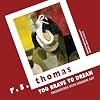
It never ceases to amaze me how many poems dead authors write - how do they do it? Is there a secret compound somewhere, where recently dead poets are ressurrected and forced to write new poems? Or do they just leave poems on bits of paper hidden in obscure places, not to be discovered until years after their passing? E.g. inside modern art books they owned, responding to the images in them? The latter, slightly less preposterous, idea is in fact the truth behind this slim book. The poems show more and reproductions of the art works they respond to are printed facing each other. It's an interesting addition to the ouvre of one of my favourite poets. show less
Lists
Awards


You May Also Like


Associated Authors
Statistics
- Works
- 62
- Also by
- 14
- Members
- 1,427
- Popularity
- #18,035
- Rating
- 4.0
- Reviews
- 17
- ISBNs
- 85
- Languages
- 5