
Rudy Wiebe
Author of A discovery of strangers
About the Author
A firm belief in the redemptive possibilities of history dominates Rudy Wiebe's fiction. His characters search for community, for a spiritual collective informed and strengthened by historical consciousness. This attempt to unite the present and the past stems from Wiebe's Mennonite religious show more background. Central to the Mennonite belief is the rejection of loyalty to contemporary and worldly government; personal commitment belongs, instead, to the religious community, with its hard-earned historical heritage as a nonconformist movement. Wiebe was born in a northern Saskatchewan farming community; in 1947 the family moved to Alberta, and he completed his education at the University of Alberta, where he teaches. Wiebe's first novel, Peace Shall Destroy Many (1962), addresses pacifism, a belief central to Mennonites. The novel's hero faces a moral quandary when forced to choose between religious convictions and Canadian nationalistic fervor during World War II. While The Blue Mountains of China (1970) records Mennonite history, The Temptations of Big Bear (1973) examines the destruction of Indian culture in white Canada, and The Scorched-Wood People (1977) takes up the plight of the Metis---those with mixed blood; all three novels focus on minorities who must struggle to maintain their sense of community. Ideas repugnant to the Mennonite sensibility, violence and self-destruction, figure in The Mad Trapper (1980), which recounts the hunt for a man whose isolation has driven him into madness. In 1980 Wiebe's short stories were collected in The Angel of the Tar Sands and Other Stories. Stylistically, Wiebe gives little ground to the reader, for his fiction is characterized by difficult dialects, a web of details, and a dense style. (Bowker Author Biography) Rudy Wiebe is the author of several short story collections and essays. He is also the author of eight novels, including A Discovery of Strangers and The Temptations of Big Bear, both winners of the Governor General's Award for Fiction. He lives in Edmonton, Alberta. (Publisher Provided) show less
Works by Rudy Wiebe
Associated Works
Lost Classics: Writers on Books Loved and Lost, Overlooked, Under-read, Unavailable, Stolen, Extinct, or Otherwise Out of Commission (2000) — Contributor — 319 copies, 6 reviews
Tagged
Common Knowledge
- Legal name
- Wiebe, Rudy Henry
- Birthdate
- 1934-10-04
- Gender
- male
- Education
- University of Alberta
University of Tubingen
Mennonite Brethren Bible College - Occupations
- professor
author - Organizations
- University of Alberta
- Awards and honors
- Lorne Pierce Medal (1986)
Order of Canada (2000)
Western Literature Association's Distinguished Achievement Award (1998) - Nationality
- Canada
- Birthplace
- Speedwell, Saskatchewan, Canada
- Places of residence
- Fairholme, Saskatchewan, Canada
Coaldale, Alberta, Canada
Goshen, Indiana, USA
Winnipeg, Manitoba, Canada - Associated Place (for map)
- Canada
Members
Reviews

This book has been in my TBR pile for at least 15 years, and I finally got around to reading it. I hesitate to write a review because the book description on the main page is so thorough, but I'll try to add some of my own impressions here. The blurb on the back cover of my edition is also an excellent description: "Rudy Wiebe's celebrated first novel about religious intolerance, and the problems that can be caused by rigid adherence to traditions of non-violence . . ." It's interesting that show more this novel created such a hub-bub when it was first published. Rather than make statements, all it does is question "why do we behave this way?" I guess some found that question threatening. I expected this novel to be an apology of pacifism, so I was surprised that it wasn't at all. Instead it was a philosophical questioning of pacifism that left answers up to the reader. Other themes explored in the novel are traditionalism, isolationism and the immigrant experience. All those -isms sound very dry, but the novel tells a story of a group of unique characters who grapple with these issues as they go about their day to day lives. I think it helps to have some knowledge of Mennonite culture to properly appreciate this book. Overall, an interesting novel that makes you think. show less
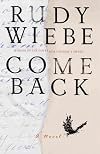
Hal Wiens, a retired professor, is mourning the sudden death of his loving wife, Yo. To get through each day, he relies on the bare comfort of routine and regular phone calls to his children Dennis and Miriam, who live in distant cities with their families. One snowy April morning, while drinking coffee with his Dené friend Owl in south-side Edmonton, he sees a tall man in an orange downfill jacket walk past on the sidewalk. The jacket, the posture, the head and hair are unmistakable: it's show more his beloved oldest son, Gabriel. But it can't be--Gabriel killed himself 25 years ago. The sighting throws Hal's inert life into tumult. While trying to track down the man, he is irresistibly compelled to revisit the diaries, journals and pictures Gabe left behind, to unfold the mystery of his son's death. Through Gabe's own eyes we begin to understand the covert sensibilities that corroded the hope and light his family knew in him. As he becomes absorbed in his son's life, lost on a tide of "relentless memory," Hal's grief--and guilt--is portrayed with a stunning immediacy, drawing us into a powerful emotional and spiritual journey. show less
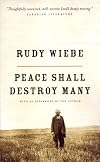
There are so many things to unpack in this novel. Nurture vs nature, the beliefs of the father and the son, acceptance of change, racism and so much more.
Thom is becoming a man. One who, as all of us must, is questioning his place in the world. He asks those deep questions about God and the practice of his religion by his elders. We're follow him in his daily life learning about his community and it's practices. Seeing through his eyes the descrepencies between their teachings and their actions.
Thom is becoming a man. One who, as all of us must, is questioning his place in the world. He asks those deep questions about God and the practice of his religion by his elders. We're follow him in his daily life learning about his community and it's practices. Seeing through his eyes the descrepencies between their teachings and their actions.
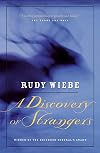
Rudy Wiebe's writing is careful but not cautious, dense but almost painfully clear, sensual and never explicit. I loved this book: the ways Wiebe juxtaposed the Tsot'sine and British perspectives, acknowledging the arrogance of early Canadian explorers and yet allowing them their humanity. He writes people in all their complexity, their strengths, their poor choices, their assumptions and limitations.
A key theme is the specificity and limits of cultural knowledge, depicted through the show more metaphor of eating and the eventual death by starvation of many in Franklin's expedition. One scene that particularly stands out is that of the Dene character Greenstockings feeding caribou stomach to Robert Hood, her British lover; probably the most erotic depiction of eating I have ever read. show less
A key theme is the specificity and limits of cultural knowledge, depicted through the show more metaphor of eating and the eventual death by starvation of many in Franklin's expedition. One scene that particularly stands out is that of the Dene character Greenstockings feeding caribou stomach to Robert Hood, her British lover; probably the most erotic depiction of eating I have ever read. show less
Lists
Awards


You May Also Like


Associated Authors
Statistics
- Works
- 37
- Also by
- 6
- Members
- 1,294
- Popularity
- #19,838
- Rating
- 3.8
- Reviews
- 27
- ISBNs
- 99
- Languages
- 2
- Favorited
- 1