
Gareth L. Powell
Author of Embers of War
About the Author
Disambiguation Notice:
Not to be confused with the author Gareth Powell who writes travel guides to Australia and New Zealand.
Series
Works by Gareth L. Powell
Associated Works
The Year's Best Science Fiction: Thirty-Second Annual Collection (2015) — Contributor — 206 copies, 8 reviews
Shine: An Anthology of Near-future, Optimistic Science Fiction (2010) — Contributor — 147 copies, 7 reviews
Solaris Rising 3: The New Solaris Book of Science Fiction (2014) — Contributor — 48 copies, 6 reviews
Solaris Rising 1.5: An Exclusive ebook of New Science Fiction (2012) — Contributor — 16 copies, 1 review
Starshipsofa Stories Vol 3 — Contributor — 4 copies
BSFA Awards 2019: Featuring All the Nominated Short Stories and Non-Fiction for the 2019 BSFA Awards (2020) — Contributor — 2 copies
Tagged
Common Knowledge
- Legal name
- Powell, Gareth Lyn
- Birthdate
- 1970
- Gender
- male
- Relationships
- Gammon, Jendia (spouse)
- Short biography
- Gareth L Powell is a science fiction writer from the United Kingdom. He's a regular contributor to Interzone and winner of the Interzone Readers’ Poll for best short story of 2007. His work has been published all over the world, included in a number of anthologies, and translated into seven languages. His first collection of fiction, The Last Reef and Other Stories, is now available to buy in hardback and paperback from Elastic Press. His first novel, Silversands, will be available from Pendragon Press in 2010.
- Nationality
- UK
- Places of residence
- UK
- Disambiguation notice
- Not to be confused with the author Gareth Powell who writes travel guides to Australia and New Zealand.
- Associated Place (for map)
- UK
Members
Reviews

"Light of Impossible Stars" is a deeply satisfying read that does something very rare: it ends a trilogy in a way that not only doesn't disappoint but excites and surprises.
I loved the first two books in this trilogy, "Embers Of War" and "Fleet of Knives" so I'd pre-ordered the final book and dived into it as soon as it arrived.
Like it's predecessors, it was a fast-paced, page-turning, epic science fiction story, crammed with original ideas and strong world-building, yet what kept me reading show more were the characters in the book and the empathy and humour of the writing.
All of the books have followed multiple storylines that slowly reveal the big picture. The strength of the characterisation, especially in this final book, keeps those storylines intimate and relevant.
I'd say it kept the book human but some of the main characters are not human and part of the strength of the book comes from how clearly their thoughts and hopes are articulated,
Gareth Powell is very good at letting his characters be themselves, without judgement or apology, where the character is a genocidal psychopathic poet, a warship who has grown a conscience and resigned her commission, a non-human engineer who believes in work and rest and the world tree, a young woman trying to discover who or what she is or an ex-military officer looking for redemption through service.
I like the fact that, in this world, actions have consequences: not everyone survives, those that do survive are often damaged and neither the pain nor the occasional love is glossed over. I like that some characters fail to learn and are doomed to repeat their mistakes while others grow, develop and find new mistakes to make and some just get by day to day as best they can.
I admire the truly epic scale of the plot and the depth of the world-building and that, despite how strong the plot and SF ideas are, they never push the characters out of the way.
Now that I've read all three books, I want to go back and read them again, so that I can take in the grandeur of the big picture and spend more time with characters I've grown to know well.
Finally, I have to say that I am, as I'm sure I'm supposed to be, deeply attached to Trouble Dog and I hope to hear more of what happens to her now the trilogy is over.
"Light Of Impossible Stars" works very well as an audiobook with different narrators presenting chapters written from the point of view of the main characters. Click on the SoundCloud link below to hear a sample.
https://soundcloud.com/nicol-zanzarella/light-of-impossible-stars-by-gareth-powe... show less
I loved the first two books in this trilogy, "Embers Of War" and "Fleet of Knives" so I'd pre-ordered the final book and dived into it as soon as it arrived.
Like it's predecessors, it was a fast-paced, page-turning, epic science fiction story, crammed with original ideas and strong world-building, yet what kept me reading show more were the characters in the book and the empathy and humour of the writing.
All of the books have followed multiple storylines that slowly reveal the big picture. The strength of the characterisation, especially in this final book, keeps those storylines intimate and relevant.
I'd say it kept the book human but some of the main characters are not human and part of the strength of the book comes from how clearly their thoughts and hopes are articulated,
Gareth Powell is very good at letting his characters be themselves, without judgement or apology, where the character is a genocidal psychopathic poet, a warship who has grown a conscience and resigned her commission, a non-human engineer who believes in work and rest and the world tree, a young woman trying to discover who or what she is or an ex-military officer looking for redemption through service.
I like the fact that, in this world, actions have consequences: not everyone survives, those that do survive are often damaged and neither the pain nor the occasional love is glossed over. I like that some characters fail to learn and are doomed to repeat their mistakes while others grow, develop and find new mistakes to make and some just get by day to day as best they can.
I admire the truly epic scale of the plot and the depth of the world-building and that, despite how strong the plot and SF ideas are, they never push the characters out of the way.
Now that I've read all three books, I want to go back and read them again, so that I can take in the grandeur of the big picture and spend more time with characters I've grown to know well.
Finally, I have to say that I am, as I'm sure I'm supposed to be, deeply attached to Trouble Dog and I hope to hear more of what happens to her now the trilogy is over.
"Light Of Impossible Stars" works very well as an audiobook with different narrators presenting chapters written from the point of view of the main characters. Click on the SoundCloud link below to hear a sample.
https://soundcloud.com/nicol-zanzarella/light-of-impossible-stars-by-gareth-powe... show less
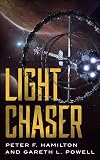
A work written in cooperation by Peter Hamilton and Gareth Powell was bound to pique my curiosity, so as soon as this novella became available I had to read it: it was a strange experience - in a good way, of course - because it offered many tantalizing glimpses into what might have been a broader, much more layered narrative, while telling a compact, circumscribed story whose arc encompasses only a handful of pages.
The titular Light Chaser is Amahle, a lone traveler who is almost immortal: show more genetic modifications and the time-dilation factor of her ship’s near-lightspeed velocity allowed her to live for millennia as she completes her unchanging circuit through a number of planets where her visits are hailed as extraordinary events. Her employers, Ever Life, are the alien creatures called the Exalted and living on Glisten, the final port of call of each circuit: in the course of her stopovers Amahle retrieves her employers’ memory collars from the planets’ dwellers and leaves new ones for the next generations - these are artifacts that record a person’s life experiences for the vicarious enjoyment of the Exalted and are considered a great honor for the individuals so entrusted, who pass them on as precious heirlooms to the family’s various members.
Amahle herself experiences these lives as a form of pastime during the long journeys from one planet to the other, when her only companionship on the Mnemosyne comes from the highly advanced ship’s AI. Someday though, a man addresses the Light Chaser directly in one of those recordings, stating that his real name is Carloman, that they share a common history and - more important - that she should not trust the onboard AI. I prefer to leave the synopsis at that, because the story is so short that more details would certainly spoil your enjoyment…
Memory is indeed the front and center theme in Light Chaser - and the ship’s name is certainly not a random choice, given that in Greek mythology Mnemosyne was the goddess of memory: the concept of the memory collars is an intriguing one, at first looking like a way of monitoring the evolutionary situation on the many planets in Amahle’s circuit - places that range from medieval societies to more technologically advanced ones - but then taking on a sinister connotation as the Light Chaser is made aware of the reality behind the clever smokescreen. This change in perspective transforms the story into a puzzle-solving quest first and a history-changing mission later, with Amahle having to literally find herself again thanks to the mysterious Carloman’s clues scattered throughout other people’s memories and encounters she searches for in her collection of collars.
Given the novella’s shortness and its strong reliance on plot, characters are somehow left by the wayside, particularly where Amahle is concerned: I could never fully connect with her even though I was invested in her journey, but I guess this depends on the fact that she is detached from herself as well. In order to fulfill her ages-long mission, and to keep experiencing those vicarious memories, she must purge her own from time to time, in a way discarding the old to make room for the new: this entails losing pieces of herself and of her past, something that she struggles to reconnect with thanks to Carloman’s influence and the clues offered through his various appearances in the stored memories.
In the end, I came to understand that my lack of connection with Amahle was the result of her lack of connection with herself, of her loss of everything that made her the person she originally was: giving up the memories of her own past (and at some point we understand the reason she would choose to take that path, either consciously or not) she let herself drift aimlessly through space and time losing any power of choice - at some point Amahle likens herself to a comet:
A frozen wanderer sidling in from the darkness to briefly warm myself by the light of the sun, before being flung back out on the next lap of my long, solitary orbit.
It’s only with the appearance of the enigmatic Carloman that she is able to regain that power as she reconnects piece by piece with the memories of who she was and who Carloman was to her. And to finally choose to break out of the unending cycle that kept her prisoner for so long while she believed she was the one in control…
If I have to find any fault in this story it might be in the way many details are left vague and incomplete: we get short peeks at those planetary societies Amahle visits and as soon as we become invested in their peculiar layout we are taken away by the Mnemosyne as it departs for another station of its circuit; or again we are kept wondering how Carloman - once his real identity is revealed - was able to do what he did (apologies for the ambiguity but I want to avoid spoilers here) time and again.
On hindsight, this novella looks like a trailer for a much longer, much more layered novel that could have taken on the scope of a sweeping space opera - still, for all its shortness, Light Chaser works well offering an intriguing, and often suspenseful, story and some food for thought about identity and memory and the meaning of life.
It will be interesting to see if these two authors team up again and what they might come up with next… show less
The titular Light Chaser is Amahle, a lone traveler who is almost immortal: show more genetic modifications and the time-dilation factor of her ship’s near-lightspeed velocity allowed her to live for millennia as she completes her unchanging circuit through a number of planets where her visits are hailed as extraordinary events. Her employers, Ever Life, are the alien creatures called the Exalted and living on Glisten, the final port of call of each circuit: in the course of her stopovers Amahle retrieves her employers’ memory collars from the planets’ dwellers and leaves new ones for the next generations - these are artifacts that record a person’s life experiences for the vicarious enjoyment of the Exalted and are considered a great honor for the individuals so entrusted, who pass them on as precious heirlooms to the family’s various members.
Amahle herself experiences these lives as a form of pastime during the long journeys from one planet to the other, when her only companionship on the Mnemosyne comes from the highly advanced ship’s AI. Someday though, a man addresses the Light Chaser directly in one of those recordings, stating that his real name is Carloman, that they share a common history and - more important - that she should not trust the onboard AI. I prefer to leave the synopsis at that, because the story is so short that more details would certainly spoil your enjoyment…
Memory is indeed the front and center theme in Light Chaser - and the ship’s name is certainly not a random choice, given that in Greek mythology Mnemosyne was the goddess of memory: the concept of the memory collars is an intriguing one, at first looking like a way of monitoring the evolutionary situation on the many planets in Amahle’s circuit - places that range from medieval societies to more technologically advanced ones - but then taking on a sinister connotation as the Light Chaser is made aware of the reality behind the clever smokescreen. This change in perspective transforms the story into a puzzle-solving quest first and a history-changing mission later, with Amahle having to literally find herself again thanks to the mysterious Carloman’s clues scattered throughout other people’s memories and encounters she searches for in her collection of collars.
Given the novella’s shortness and its strong reliance on plot, characters are somehow left by the wayside, particularly where Amahle is concerned: I could never fully connect with her even though I was invested in her journey, but I guess this depends on the fact that she is detached from herself as well. In order to fulfill her ages-long mission, and to keep experiencing those vicarious memories, she must purge her own from time to time, in a way discarding the old to make room for the new: this entails losing pieces of herself and of her past, something that she struggles to reconnect with thanks to Carloman’s influence and the clues offered through his various appearances in the stored memories.
In the end, I came to understand that my lack of connection with Amahle was the result of her lack of connection with herself, of her loss of everything that made her the person she originally was: giving up the memories of her own past (and at some point we understand the reason she would choose to take that path, either consciously or not) she let herself drift aimlessly through space and time losing any power of choice - at some point Amahle likens herself to a comet:
A frozen wanderer sidling in from the darkness to briefly warm myself by the light of the sun, before being flung back out on the next lap of my long, solitary orbit.
It’s only with the appearance of the enigmatic Carloman that she is able to regain that power as she reconnects piece by piece with the memories of who she was and who Carloman was to her. And to finally choose to break out of the unending cycle that kept her prisoner for so long while she believed she was the one in control…
If I have to find any fault in this story it might be in the way many details are left vague and incomplete: we get short peeks at those planetary societies Amahle visits and as soon as we become invested in their peculiar layout we are taken away by the Mnemosyne as it departs for another station of its circuit; or again we are kept wondering how Carloman - once his real identity is revealed - was able to do what he did (apologies for the ambiguity but I want to avoid spoilers here) time and again.
On hindsight, this novella looks like a trailer for a much longer, much more layered novel that could have taken on the scope of a sweeping space opera - still, for all its shortness, Light Chaser works well offering an intriguing, and often suspenseful, story and some food for thought about identity and memory and the meaning of life.
It will be interesting to see if these two authors team up again and what they might come up with next… show less

Ragged Alice is a smooth blend of police procedural and supernatural thriller with an authentic Welsh setting and lyrical descriptions.
I consumed the 202 pages of "Ragged Alice" in a single sitting, partly because I needed to know where Gareth Powell would take the story and partly because I was beguiled by the language.
"Ragged Alice" is the start of a new series featuring DCI Holly Craig, No, don't groan and say "not another one?" True she's a police officer who drinks too much and has poor show more social skills but trust me, she's not the typical Brit cop. She has an ability (you might call it a gift, she often calls ita curse held at bay only by whisky) to look into a person's eyes and know how far they've been eroded by guilt, shame and dissolution.
She's returned to her native Wales fifteen years after escaping it with the intention never to return and immediately finds herself investigating a murder in the small seaside town she grew up.
This is a short, fast-moving story, where the body count seems to rise with every tide, the violence is graphic and the spirits of the dead are always with those who have the eyes to see them.
One of the joys of the book for me was the wonderful language used to describe the place and its people. One chapter starts with a single sentence evoking a rainy day in Wales in a way that reminded me of Dylan Thomas:
RAIN FELL ACROSS THE bracken-brown hills like a biblical punishment. It dripped from the town’s slick slate roofs, overflowed the gutters and ran in gurgling torrents down the steep-sided streets.
The story features, Mrs Phillips, a flamboyant woman in her nineties who makes an immediate impression. Here's how her first meeting with DCI Craig is described:
An old woman waited on the hotel steps. She wore a man’s white tuxedo jacket over a lilac ball gown and was smoking a cigarette.
´Are you the detective, love?”
Holly paused. The old girl must have been « ninety if she was a day. Her hands looked like sausage skins filled with walnuts. She leant her weight on a silver-topped cane and had slicked back her silver hair with fragrant pomade.
Isn't that a wonderful way to describe hands?
Later, when Holly Craig thinks back on Mrs Phillips, she describes her to herself as:
the living personification of the Victorian buildings on the seafront—their facades once proud and enthusiastic but now washed out, half-forgotten and clinging to past glories, their lungs ravaged by years of smoke, black mould and neglect.
I admire the aptness and exuberance of that.
I also like the small but telling ways in which life in a small town in Wales was evoked, for example, when DCI Craig is surprised that Mrs Phillips knows of something that happened only a few hours ago, the irrepressible old woman says:
“Oh, you know what this place is like, love. If you lose your virginity at lunchtime, someone will have found it and brought it home to your mam in time for tea.”
I recommend "Ragged Alice" if you're in the mood for a trope-twisting police procedural with a supernatural edge, a distinctive Welsh flavour and language that makes you go "I wish I'd written that". show less
I consumed the 202 pages of "Ragged Alice" in a single sitting, partly because I needed to know where Gareth Powell would take the story and partly because I was beguiled by the language.
"Ragged Alice" is the start of a new series featuring DCI Holly Craig, No, don't groan and say "not another one?" True she's a police officer who drinks too much and has poor show more social skills but trust me, she's not the typical Brit cop. She has an ability (you might call it a gift, she often calls ita curse held at bay only by whisky) to look into a person's eyes and know how far they've been eroded by guilt, shame and dissolution.
She's returned to her native Wales fifteen years after escaping it with the intention never to return and immediately finds herself investigating a murder in the small seaside town she grew up.
This is a short, fast-moving story, where the body count seems to rise with every tide, the violence is graphic and the spirits of the dead are always with those who have the eyes to see them.
One of the joys of the book for me was the wonderful language used to describe the place and its people. One chapter starts with a single sentence evoking a rainy day in Wales in a way that reminded me of Dylan Thomas:
RAIN FELL ACROSS THE bracken-brown hills like a biblical punishment. It dripped from the town’s slick slate roofs, overflowed the gutters and ran in gurgling torrents down the steep-sided streets.
The story features, Mrs Phillips, a flamboyant woman in her nineties who makes an immediate impression. Here's how her first meeting with DCI Craig is described:
An old woman waited on the hotel steps. She wore a man’s white tuxedo jacket over a lilac ball gown and was smoking a cigarette.
´Are you the detective, love?”
Holly paused. The old girl must have been « ninety if she was a day. Her hands looked like sausage skins filled with walnuts. She leant her weight on a silver-topped cane and had slicked back her silver hair with fragrant pomade.
Isn't that a wonderful way to describe hands?
Later, when Holly Craig thinks back on Mrs Phillips, she describes her to herself as:
the living personification of the Victorian buildings on the seafront—their facades once proud and enthusiastic but now washed out, half-forgotten and clinging to past glories, their lungs ravaged by years of smoke, black mould and neglect.
I admire the aptness and exuberance of that.
I also like the small but telling ways in which life in a small town in Wales was evoked, for example, when DCI Craig is surprised that Mrs Phillips knows of something that happened only a few hours ago, the irrepressible old woman says:
“Oh, you know what this place is like, love. If you lose your virginity at lunchtime, someone will have found it and brought it home to your mam in time for tea.”
I recommend "Ragged Alice" if you're in the mood for a trope-twisting police procedural with a supernatural edge, a distinctive Welsh flavour and language that makes you go "I wish I'd written that". show less

Gareth Powell's first novel punches above its (159 page) weight on ideas, plot and credible people.
I came to Gareth Powell via his "Ragged Alice" stand-alone novel and his "Embers Of War" galaxy-spanning epic Science Fiction trilogy. He's on my 'read whatever he writes' list, so when I saw that his first short novel had been given a makeover and was on available as an ebook for $0.99, I had to get a copy.
"Silversands" is only 159 pages long but it punches above its weight.
The universe it's show more set in has enough scope for at least a trilogy - an Earth diaspora through wormhole gates built by an unknown race and which we know so little about that ships can't select a destination, they just have to roll the dice.
The plot is paced like a thriller, with action almost from the first page, murky relationships, betrayals, power plays and everyone trying to kill or capture our heroine.
There are big themes in common with Gareth Powell's other books: the relationships between AIs and humans, the impact of living long lives and what it means to be human once you can be cybernetically augmented, genetically modified or cloned.
While I love all this stuff, the things that keep me coming back to Gareth Powell are that, in his books, actions have consequences and even key characters may not make it to the end of the book and that the people are real, relatable and central to the story. Powell's talent for making me believe in his characters is what makes his books special for me.
Here's an example of the kind of writing he uses to do this. This is a description of one of the characters meeting with his ex-wife:¨¨
'She smiled. The corners of her lips crinkled up in a way that had once been irresistible but was now only comfortably familiar. The passion in their relationship had been one of the first things to go, second only to trust. In its place, however, there was a stubborn fondness.'
'stubborn fondness' - there's a phrase to conjure with. show less
I came to Gareth Powell via his "Ragged Alice" stand-alone novel and his "Embers Of War" galaxy-spanning epic Science Fiction trilogy. He's on my 'read whatever he writes' list, so when I saw that his first short novel had been given a makeover and was on available as an ebook for $0.99, I had to get a copy.
"Silversands" is only 159 pages long but it punches above its weight.
The universe it's show more set in has enough scope for at least a trilogy - an Earth diaspora through wormhole gates built by an unknown race and which we know so little about that ships can't select a destination, they just have to roll the dice.
The plot is paced like a thriller, with action almost from the first page, murky relationships, betrayals, power plays and everyone trying to kill or capture our heroine.
There are big themes in common with Gareth Powell's other books: the relationships between AIs and humans, the impact of living long lives and what it means to be human once you can be cybernetically augmented, genetically modified or cloned.
While I love all this stuff, the things that keep me coming back to Gareth Powell are that, in his books, actions have consequences and even key characters may not make it to the end of the book and that the people are real, relatable and central to the story. Powell's talent for making me believe in his characters is what makes his books special for me.
Here's an example of the kind of writing he uses to do this. This is a description of one of the characters meeting with his ex-wife:¨¨
'She smiled. The corners of her lips crinkled up in a way that had once been irresistible but was now only comfortably familiar. The passion in their relationship had been one of the first things to go, second only to trust. In its place, however, there was a stubborn fondness.'
'stubborn fondness' - there's a phrase to conjure with. show less
Lists
Awards


You May Also Like


Associated Authors
Statistics
- Works
- 52
- Also by
- 14
- Members
- 2,264
- Popularity
- #11,338
- Rating
- 3.5
- Reviews
- 113
- ISBNs
- 107
- Languages
- 6
- Favorited
- 1

