
Peter F. Hamilton
Author of Pandora's Star
About the Author
Peter F. Hamilton was born in Rutland, England on March 2, 1960. He started writing in 1987 and sold his first short story to Fear magazine in 1988. His first novel, Mindstar Rising, was published in 1993. His other works include the Night's Dawn series; Fallen Dragon; and the Void series. (Bowker show more Author Biography) show less
Disambiguation Notice:
Peter F. Hamilton (this page) who writes science fiction should not be confused with the many other authors named Peter Hamilton
Series
Works by Peter F. Hamilton
The Void Trilogy: The Dreaming Void / The Temporal Void / The Evolutionary Void (2014) 37 copies, 1 review
O Alquimista de Neutrónio 3 8 copies
Softlight Sins 6 copies
EXODUS: The Helium Sea 3 copies
Salvation Sequence Series 3 Books Collection Set By Peter F Hamilton (Salvation, Salvation Lost, The Saints of Salvation) (2020) 3 copies
Sonnie's Edge 3 copies
Manhattan In Reverse [short story] 3 copies
Random House 2014 Free Sampler 3 copies
Almost Complete Short Fiction 2 copies
Deathday 2 copies
the lives and loves of Tiarella Rosa 2 copies
New Days Old Times 2 copies
Commonwealth Saga 1 copy
Void Trilogy 1 copy
Life of Dreams 1 copy
Lightstorm [short story] 1 copy
2000 1 copy
Pandore menacée 1 copy
Falling Stones 1 copy
pandora's box 1 copy
Associated Works
The Year's Best Science Fiction: Twenty-Second Annual Collection (2005) — Contributor — 580 copies, 11 reviews
The Year's Best Science Fiction: Eighteenth Annual Collection (2001) — Contributor — 505 copies, 2 reviews
The Year's Best Science Fiction: Fifteenth Annual Collection (1998) — Contributor — 469 copies, 2 reviews
Solaris Rising: The New Solaris Book of Science Fiction (2011) — Contributor — 138 copies, 4 reviews
Flying Cups and Saucers: Gender Explorations in Science Fiction and Fantasy (1998) — Author — 57 copies, 3 reviews
Stories of Hope and Wonder: In Support of the UK's Healthcare Workers (2020) — Contributor — 11 copies, 1 review
Peter F. Hamilton: Audible Sessions: FREE Exclusive Interview (2018) — Narrator, some editions — 4 copies
Monolith 003 : Almanah Znanstveno-fantasticne Knjizevnosti (Monolith, No. 003) (2000) — Contributor — 3 copies
Sonnie's Edge [2019 Love, Death & Robots TV episode] — Orginal story — 1 copy
Tagged
Common Knowledge
- Birthdate
- 1960-03-02
- Gender
- male
- Occupations
- author
- Agent
- Antony Harwood
- Relationships
- Hamilton, Kate (wife)
Hamilton, Sophie (daughter) - Nationality
- UK
- Birthplace
- Oakham, Rutland, England, UK
- Places of residence
- Rutland, England, UK
- Map Location
- England, UK
- Disambiguation notice
- Peter F. Hamilton (this page) who writes science fiction should not be confused with the many other authors named Peter Hamilton
Members
Discussions
Peter F. Hamilton, where to start? in Science Fiction Fans (February 2021)
Pandora's Star in Science Fiction Fans (February 2011)
Sell me on Peter Hamilton's Void trilogy in Science Fiction Fans (October 2010)
Reviews
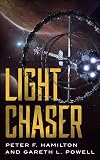
A work written in cooperation by Peter Hamilton and Gareth Powell was bound to pique my curiosity, so as soon as this novella became available I had to read it: it was a strange experience - in a good way, of course - because it offered many tantalizing glimpses into what might have been a broader, much more layered narrative, while telling a compact, circumscribed story whose arc encompasses only a handful of pages.
The titular Light Chaser is Amahle, a lone traveler who is almost immortal: show more genetic modifications and the time-dilation factor of her ship’s near-lightspeed velocity allowed her to live for millennia as she completes her unchanging circuit through a number of planets where her visits are hailed as extraordinary events. Her employers, Ever Life, are the alien creatures called the Exalted and living on Glisten, the final port of call of each circuit: in the course of her stopovers Amahle retrieves her employers’ memory collars from the planets’ dwellers and leaves new ones for the next generations - these are artifacts that record a person’s life experiences for the vicarious enjoyment of the Exalted and are considered a great honor for the individuals so entrusted, who pass them on as precious heirlooms to the family’s various members.
Amahle herself experiences these lives as a form of pastime during the long journeys from one planet to the other, when her only companionship on the Mnemosyne comes from the highly advanced ship’s AI. Someday though, a man addresses the Light Chaser directly in one of those recordings, stating that his real name is Carloman, that they share a common history and - more important - that she should not trust the onboard AI. I prefer to leave the synopsis at that, because the story is so short that more details would certainly spoil your enjoyment…
Memory is indeed the front and center theme in Light Chaser - and the ship’s name is certainly not a random choice, given that in Greek mythology Mnemosyne was the goddess of memory: the concept of the memory collars is an intriguing one, at first looking like a way of monitoring the evolutionary situation on the many planets in Amahle’s circuit - places that range from medieval societies to more technologically advanced ones - but then taking on a sinister connotation as the Light Chaser is made aware of the reality behind the clever smokescreen. This change in perspective transforms the story into a puzzle-solving quest first and a history-changing mission later, with Amahle having to literally find herself again thanks to the mysterious Carloman’s clues scattered throughout other people’s memories and encounters she searches for in her collection of collars.
Given the novella’s shortness and its strong reliance on plot, characters are somehow left by the wayside, particularly where Amahle is concerned: I could never fully connect with her even though I was invested in her journey, but I guess this depends on the fact that she is detached from herself as well. In order to fulfill her ages-long mission, and to keep experiencing those vicarious memories, she must purge her own from time to time, in a way discarding the old to make room for the new: this entails losing pieces of herself and of her past, something that she struggles to reconnect with thanks to Carloman’s influence and the clues offered through his various appearances in the stored memories.
In the end, I came to understand that my lack of connection with Amahle was the result of her lack of connection with herself, of her loss of everything that made her the person she originally was: giving up the memories of her own past (and at some point we understand the reason she would choose to take that path, either consciously or not) she let herself drift aimlessly through space and time losing any power of choice - at some point Amahle likens herself to a comet:
A frozen wanderer sidling in from the darkness to briefly warm myself by the light of the sun, before being flung back out on the next lap of my long, solitary orbit.
It’s only with the appearance of the enigmatic Carloman that she is able to regain that power as she reconnects piece by piece with the memories of who she was and who Carloman was to her. And to finally choose to break out of the unending cycle that kept her prisoner for so long while she believed she was the one in control…
If I have to find any fault in this story it might be in the way many details are left vague and incomplete: we get short peeks at those planetary societies Amahle visits and as soon as we become invested in their peculiar layout we are taken away by the Mnemosyne as it departs for another station of its circuit; or again we are kept wondering how Carloman - once his real identity is revealed - was able to do what he did (apologies for the ambiguity but I want to avoid spoilers here) time and again.
On hindsight, this novella looks like a trailer for a much longer, much more layered novel that could have taken on the scope of a sweeping space opera - still, for all its shortness, Light Chaser works well offering an intriguing, and often suspenseful, story and some food for thought about identity and memory and the meaning of life.
It will be interesting to see if these two authors team up again and what they might come up with next… show less
The titular Light Chaser is Amahle, a lone traveler who is almost immortal: show more genetic modifications and the time-dilation factor of her ship’s near-lightspeed velocity allowed her to live for millennia as she completes her unchanging circuit through a number of planets where her visits are hailed as extraordinary events. Her employers, Ever Life, are the alien creatures called the Exalted and living on Glisten, the final port of call of each circuit: in the course of her stopovers Amahle retrieves her employers’ memory collars from the planets’ dwellers and leaves new ones for the next generations - these are artifacts that record a person’s life experiences for the vicarious enjoyment of the Exalted and are considered a great honor for the individuals so entrusted, who pass them on as precious heirlooms to the family’s various members.
Amahle herself experiences these lives as a form of pastime during the long journeys from one planet to the other, when her only companionship on the Mnemosyne comes from the highly advanced ship’s AI. Someday though, a man addresses the Light Chaser directly in one of those recordings, stating that his real name is Carloman, that they share a common history and - more important - that she should not trust the onboard AI. I prefer to leave the synopsis at that, because the story is so short that more details would certainly spoil your enjoyment…
Memory is indeed the front and center theme in Light Chaser - and the ship’s name is certainly not a random choice, given that in Greek mythology Mnemosyne was the goddess of memory: the concept of the memory collars is an intriguing one, at first looking like a way of monitoring the evolutionary situation on the many planets in Amahle’s circuit - places that range from medieval societies to more technologically advanced ones - but then taking on a sinister connotation as the Light Chaser is made aware of the reality behind the clever smokescreen. This change in perspective transforms the story into a puzzle-solving quest first and a history-changing mission later, with Amahle having to literally find herself again thanks to the mysterious Carloman’s clues scattered throughout other people’s memories and encounters she searches for in her collection of collars.
Given the novella’s shortness and its strong reliance on plot, characters are somehow left by the wayside, particularly where Amahle is concerned: I could never fully connect with her even though I was invested in her journey, but I guess this depends on the fact that she is detached from herself as well. In order to fulfill her ages-long mission, and to keep experiencing those vicarious memories, she must purge her own from time to time, in a way discarding the old to make room for the new: this entails losing pieces of herself and of her past, something that she struggles to reconnect with thanks to Carloman’s influence and the clues offered through his various appearances in the stored memories.
In the end, I came to understand that my lack of connection with Amahle was the result of her lack of connection with herself, of her loss of everything that made her the person she originally was: giving up the memories of her own past (and at some point we understand the reason she would choose to take that path, either consciously or not) she let herself drift aimlessly through space and time losing any power of choice - at some point Amahle likens herself to a comet:
A frozen wanderer sidling in from the darkness to briefly warm myself by the light of the sun, before being flung back out on the next lap of my long, solitary orbit.
It’s only with the appearance of the enigmatic Carloman that she is able to regain that power as she reconnects piece by piece with the memories of who she was and who Carloman was to her. And to finally choose to break out of the unending cycle that kept her prisoner for so long while she believed she was the one in control…
If I have to find any fault in this story it might be in the way many details are left vague and incomplete: we get short peeks at those planetary societies Amahle visits and as soon as we become invested in their peculiar layout we are taken away by the Mnemosyne as it departs for another station of its circuit; or again we are kept wondering how Carloman - once his real identity is revealed - was able to do what he did (apologies for the ambiguity but I want to avoid spoilers here) time and again.
On hindsight, this novella looks like a trailer for a much longer, much more layered novel that could have taken on the scope of a sweeping space opera - still, for all its shortness, Light Chaser works well offering an intriguing, and often suspenseful, story and some food for thought about identity and memory and the meaning of life.
It will be interesting to see if these two authors team up again and what they might come up with next… show less
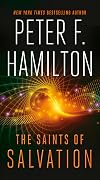
In which Hamilton tries to tie together the multiple threads into one knot, with a string or two left loose for future side stories, if not another trilogy. Doing this is harder than in other trilogies with multiple story lines, given that the threads are thousands of years apart.When that happens, as in, say, The Cloud Atlas, the merger is one of themes and perhaps some relics left from one age to the next. Here Hamilton brings them all literally together, by doing some serious jiggering show more around with both time (fast and slow) and space (wormholes and portals).
This is a trilogy a la Lord of the Rings. It makes no sense without the previous two books. The Olyix are aliens sent a message from the future have spent millennia traveling through the galaxy, collecting all members of every other species they find, to debone, dehydrate, and save for one big gathering at the end of time. The trilogy threads are bookended by the Saints, i.e., a small group of humans who led the initial efforts to fight the Olyix, and a band of humans 10,000 years later who grew up being trained for some ultimate battle. As with Stapledon and EE Smith, once you span one millennia, you can't help upping the ante to lots of them. There are many other story lines, at least one of which, while prominent at the start of this final entry, peters out so much that it's hard to believe people are still talking about it 10,000 years later.
I have a problem with mega-scale space opera (and mega-scale SF like Benford's Galactic Center series) . There's no sense of scale when distances and times are multiplied willy-nilly. Douglas Adams made an observation in the Hitchhiker's Guide about a room feeling incredibly huge precisely because it was finite.
A perfectly reasonable conclusion, but not one that will lead me to pick up another set of Hamilton doorstoppers. Recommended if you like that sort of thing. show less
This is a trilogy a la Lord of the Rings. It makes no sense without the previous two books. The Olyix are aliens sent a message from the future have spent millennia traveling through the galaxy, collecting all members of every other species they find, to debone, dehydrate, and save for one big gathering at the end of time. The trilogy threads are bookended by the Saints, i.e., a small group of humans who led the initial efforts to fight the Olyix, and a band of humans 10,000 years later who grew up being trained for some ultimate battle. As with Stapledon and EE Smith, once you span one millennia, you can't help upping the ante to lots of them. There are many other story lines, at least one of which, while prominent at the start of this final entry, peters out so much that it's hard to believe people are still talking about it 10,000 years later.
I have a problem with mega-scale space opera (and mega-scale SF like Benford's Galactic Center series) . There's no sense of scale when distances and times are multiplied willy-nilly. Douglas Adams made an observation in the Hitchhiker's Guide about a room feeling incredibly huge precisely because it was finite.
A perfectly reasonable conclusion, but not one that will lead me to pick up another set of Hamilton doorstoppers. Recommended if you like that sort of thing. show less

Mr. Hamilton does it again. But this time, rather than kicking off an epic war of dead people versus the living in a high-tech far-future space-opera, he twists us around a truly desperate struggle against very powerful aliens coming to "save" us, preserving us and sending us to the end of the universe where we will all share the experience together.
Sound like some religious nutters? They FEEL like religious nutters. And it's awesome. This is the start of the full-on conflict right here. All show more the human worlds, some alien help, and the full efforts of our own far-future humanity are set against this odd invasion.
And it's an extinction-level event.
Never mind that we have near-immortality, quantum entanglement transporters, von Neumann transhumanists, or some extreme printing technology, minds as big as moons, or anything we thought would make us amazingly resilient.
This is total war. And the twists to come are pretty damn amazing. No spoilers, but this is one of the more impressive novels by Hamilton. And when it comes to worldbuilding and storytelling and the epic, that's saying a lot. show less
Sound like some religious nutters? They FEEL like religious nutters. And it's awesome. This is the start of the full-on conflict right here. All show more the human worlds, some alien help, and the full efforts of our own far-future humanity are set against this odd invasion.
And it's an extinction-level event.
Never mind that we have near-immortality, quantum entanglement transporters, von Neumann transhumanists, or some extreme printing technology, minds as big as moons, or anything we thought would make us amazingly resilient.
This is total war. And the twists to come are pretty damn amazing. No spoilers, but this is one of the more impressive novels by Hamilton. And when it comes to worldbuilding and storytelling and the epic, that's saying a lot. show less
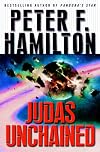
Impressive conclusion to the epic Sci-fi saga that began with Pandora's Star. Not quite as unqualified a success as that previous volume, since I found the writing a bit uneven this time around and everything did fall into place rather neatly at the end. It was almost as if Hamilton was experiencing writer's fatigue at times. Understandable given that the two books are in fact one continuous 2,000 page novel.
Those minor quibbles aside, Hamilton succeed admirably here. The scale and show more complexity is unlike anything I've read. But since Hamilton has complete command of the story and offers good character development and mostly smooth writing, I did not find it hard to keep track of the myriad plot threads and characters. The denouement, juggling 3 or 4 different climaxes at once, was exciting. These 2 books would make one helluva Sci-Fi TV series a la Battlestar Galactica.
There is plenty of political intrigue, mysteries, danger, explosive action, and exotic technology. There is gritty realism. Aliens are attacking. Yet, Hamilton also has a great sense of humor. I found myself laughing out loud several times. Like when one character visits the NYC of 300 years in the future: "As always, the antics of the city's yellow cabs drew a frown on her forehead; whoever programmed their drive arrays did an appalling job. Her own car had to break sharply several times as they cut in front".
Or this, when one of the characters encounters an alien: “Who are you?” Ozzie asked.
The Silfen’s circular mouth opened wide, allowing the long slender tongue to vibrate between his rows of teeth. “I am the one who dances in the endless wind streams which flow along the tumbling white clouds as they circle in eternal orbit within the star of life.” He gave a sharp whistle. “But you may call me Clouddancer. I know how you humans have to be so quick and shallow.”
I found those two examples, and others, hilarious. You don't often find laugh out loud humor in Sci-Fi, at least not the books I've read. I've become quite a fan of Hamilton and his prodigious talent. Looking forward to Great North Road, Fallen Dragon, and the Void trilogy. show less
Those minor quibbles aside, Hamilton succeed admirably here. The scale and show more complexity is unlike anything I've read. But since Hamilton has complete command of the story and offers good character development and mostly smooth writing, I did not find it hard to keep track of the myriad plot threads and characters. The denouement, juggling 3 or 4 different climaxes at once, was exciting. These 2 books would make one helluva Sci-Fi TV series a la Battlestar Galactica.
There is plenty of political intrigue, mysteries, danger, explosive action, and exotic technology. There is gritty realism. Aliens are attacking. Yet, Hamilton also has a great sense of humor. I found myself laughing out loud several times. Like when one character visits the NYC of 300 years in the future: "As always, the antics of the city's yellow cabs drew a frown on her forehead; whoever programmed their drive arrays did an appalling job. Her own car had to break sharply several times as they cut in front".
Or this, when one of the characters encounters an alien: “Who are you?” Ozzie asked.
The Silfen’s circular mouth opened wide, allowing the long slender tongue to vibrate between his rows of teeth. “I am the one who dances in the endless wind streams which flow along the tumbling white clouds as they circle in eternal orbit within the star of life.” He gave a sharp whistle. “But you may call me Clouddancer. I know how you humans have to be so quick and shallow.”
I found those two examples, and others, hilarious. You don't often find laugh out loud humor in Sci-Fi, at least not the books I've read. I've become quite a fan of Hamilton and his prodigious talent. Looking forward to Great North Road, Fallen Dragon, and the Void trilogy. show less
Lists
al.vick-series (1)
Wishlist (3)
Awards


You May Also Like


Associated Authors
Statistics
- Works
- 127
- Also by
- 42
- Members
- 42,832
- Popularity
- #396
- Rating
- 4.0
- Reviews
- 775
- ISBNs
- 657
- Languages
- 13
- Favorited
- 162


