
Iain M. Banks (1954–2013)
Author of Consider Phlebas
About the Author
Iain Banks was born in Fife in 1954 and was educated at Stirling University where he studied English Literature, Philosophy and Psychology. Banks came to widespread and controversial public note with the publication of his first novel, The Wasp Factory, in 1984. His first science fiction novel, show more Consider Phlebas, was published in 1987. He continued to write both mainstream fiction (as Iain Banks) and science fiction (as Iain M. Banks). Banks' mainstream fiction included The Wasp Factory (1984), Walking on Glass (1985), The Bridge (1986), Espedair Street (1987), Canal Dreams (1989), The Crow Road (1992), Complicity (1993), Whit (1995), A Song of Stone (1997), The Business (1999), Dead Air (2002) and The Steep Approach to Garbadale (2007). His final book, The Quarry, was released posthumously on June 20, 2013. Banks died on June 9, 2013 of terminal gall bladder cancer. (Bowker Author Biography) show less
Disambiguation Notice:
There are multiple authors with the name Iain Banks. Do not combine this entry with any of them. The Iain Banks author entry is correctly split into sections for the different authors, and the books of Iain M. Banks listed there are included here by aliasing. You cannot combine this author page with just one of the split entries, it doesn't work that way.
Series
Works by Iain M. Banks
The Culture, Books 1-3 (Consider Phlebas ∙ The Player of Games ∙ Use of Weapons) (2012) 77 copies, 2 reviews
Personal Effects 3 copies
The Spheres 3 copies
Overload 1 copy
The game Azad 1 copy
The Culture Companion 1 copy
Associated Works
The Big Book of Science Fiction: The Ultimate Collection (2016) — Contributor — 521 copies, 8 reviews
Das Science Fiction Jahr 1994. Ein Jahrbuch für den Science Fiction Leser (1994) — Contributor — 10 copies
Tagged
Common Knowledge
- Legal name
- Banks, Iain Menzies
- Other names
- Banks, Iain
- Birthdate
- 1954-02-16
- Date of death
- 2013-06-09
- Gender
- male
- Education
- Gourock High School
Greenock High School
University of Stirling (BA 1975) - Occupations
- writer
- Organizations
- National Secular Society
Humanist Society of Scotland - Awards and honors
- Guest of Honour, Eastercon, UK (1990)
Granta's Best Of Young British Novelists (1993)
Guest of Honour (posthumous), Loncon 3 (World Science Fiction Convention) (2014) - Relationships
- Hartley, Adele (wife)
- Cause of death
- gallbladder cancer
- Nationality
- UK
- Birthplace
- Dunfermline, Fife, Scotland, UK
- Places of residence
- North Queensferry, Fife, Scotland, UK
Edinburgh, Midlothian, Scotland, UK - Place of death
- Kirkcaldy, Fife, Scotland, UK
- Map Location
- Scotland, UK
- Disambiguation notice
- There are multiple authors with the name Iain Banks. Do not combine this entry with any of them. The Iain Banks author entry is correctly split into sections for the different authors, and the books of Iain M. Banks listed there are included here by aliasing. You cannot combine this author page with just one of the split entries, it doesn't work that way.
Members
Discussions
British Author Challenge May 2026: MM Kaye & Iain M. Banks in 75 Books Challenge for 2026 (June 4)
Group Reda, February 2022: The Crow Road in 1001 Books to read before you die (March 2022)
THE STATE OF THE ART discussion (The Culture group read) in 75 Books Challenge for 2014 (August 2015)
MATTER discussion (The Culture group read) in 75 Books Challenge for 2014 (June 2015)
SURFACE DETAIL discussion (The Culture group read) in 75 Books Challenge for 2014 (November 2014)
LOOK TO WINDWARD discussion (The Culture group read) in 75 Books Challenge for 2014 (October 2014)
THE HYDROGEN SONATA discussion (The Culture group read) in 75 Books Challenge for 2014 (October 2014)
INVERSIONS discussion (The Culture group read) in 75 Books Challenge for 2014 (September 2014)
EXCESSION discussion (The Culture group read) in 75 Books Challenge for 2014 (July 2014)
USE OF WEAPONS discussion (The Culture group read) in 75 Books Challenge for 2014 (May 2014)
The Culture group read (Organisational Thread) in 75 Books Challenge for 2014 (April 2014)
CONSIDER PHLEBAS discussion (The Culture group read) in 75 Books Challenge for 2014 (April 2014)
THE PLAYER OF GAMES discussion (The Culture group read) in 75 Books Challenge for 2014 (March 2014)
September 2013: Iain M. Banks in Monthly Author Reads (January 2014)
Group Read: The Wasp Factory by Iain Banks in 75 Books Challenge for 2013 (August 2013)
Sad news: Iain Banks Very Poorly in Science Fiction Fans (August 2013)
Reviews
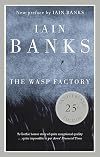
Why, yes, this was the very copy of the Wasp Factory I purchased with the same book token I used to buy that copy of One Hundred Years Of Solitude. Well spotted.
By all accounts this caused a bit of a storm when it first came out, as witnessed by the infamous Irish Times review, now used as a blurb of pride, though not on my edition. It can't be the murders or the paganism or the dysfunctional family or the gruesome bit or the cruelty to animals, because there was nothing there that you show more couldn't have found in horror fiction in one form or another over the years. I imagine what rankled was the language and the realism and the psychological acuity, not to mention the literary packaging. Nowadays, from that point of view, it seems relatively tame. Still packs a bit of a wallop, though.
Frank lives with his father on a small island in Scotland. He mounts animal skulls on poles, embeds wasps in candle wax, hunts rabbits with a flame thrower and keeps the skull of his enemy, Old Saul, in a bunker. The island is his domain and he rules it like a god. Now his brother, Eric, who sets dogs on fire, has escaped from his asylum and is on his way home.
Frank's a monster, a fledgling serial killer who capriciously decided on a different career track after his first three victims. His rituals and his ceremonies and his totemic objects make sense of the world and make sense of his own mind. His voice is sane, articulate, witty and intelligent. He uses it to describe his odd activities, makes them seem strange, unhealthy, perhaps, but essentially harmless. Then he seamlessly uses that same voice to describe catapulting small animals into river mud, the murder of his brother and two cousins or his attitude to women. One clings to the voice as a sign of potential redemption, but redemption is something you do, not something you are, and Frank is utterly aware of what he is and of what he has done. Or so he thinks.
A familiar pattern of secrets, ideas, family circles, social lives and horrible accidents and bizarre occurrences marks this as the proto-Banks novel, but for a debut it springs fully formed with voice, attitude and gleeful cunning intact and ready to rip it up through the twin worlds of literary and science fiction. show less
By all accounts this caused a bit of a storm when it first came out, as witnessed by the infamous Irish Times review, now used as a blurb of pride, though not on my edition. It can't be the murders or the paganism or the dysfunctional family or the gruesome bit or the cruelty to animals, because there was nothing there that you show more couldn't have found in horror fiction in one form or another over the years. I imagine what rankled was the language and the realism and the psychological acuity, not to mention the literary packaging. Nowadays, from that point of view, it seems relatively tame. Still packs a bit of a wallop, though.
Frank lives with his father on a small island in Scotland. He mounts animal skulls on poles, embeds wasps in candle wax, hunts rabbits with a flame thrower and keeps the skull of his enemy, Old Saul, in a bunker. The island is his domain and he rules it like a god. Now his brother, Eric, who sets dogs on fire, has escaped from his asylum and is on his way home.
Frank's a monster, a fledgling serial killer who capriciously decided on a different career track after his first three victims. His rituals and his ceremonies and his totemic objects make sense of the world and make sense of his own mind. His voice is sane, articulate, witty and intelligent. He uses it to describe his odd activities, makes them seem strange, unhealthy, perhaps, but essentially harmless. Then he seamlessly uses that same voice to describe catapulting small animals into river mud, the murder of his brother and two cousins or his attitude to women. One clings to the voice as a sign of potential redemption, but redemption is something you do, not something you are, and Frank is utterly aware of what he is and of what he has done. Or so he thinks.
A familiar pattern of secrets, ideas, family circles, social lives and horrible accidents and bizarre occurrences marks this as the proto-Banks novel, but for a debut it springs fully formed with voice, attitude and gleeful cunning intact and ready to rip it up through the twin worlds of literary and science fiction. show less
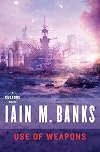
Another solid, well-written, and often thoughtful novel in the "Culture" series. This time our protagonist is a mercenary called Zakalwe who makes his living doing the Culture's dirty work. He finds himself in a dusty outpost of a planet fighting a relatively low-tech, low-stakes conflict, haunted by past failures and a troubled, tragic childhood marred by unspeakable violence. There are, as usual, lots of nice touches here. Along with his curiously fascinating accounts of wartime strategy show more and bureaucratic maneuvering, the author's account of his main character's backstory allows him to describe a dreamlike privileged childhood and, eventually, some especially grisly body horror. Mutilation's a theme that recurs throughout this book, so readers with weak stomachs are duly warned. We also get a formidable alpha female boss character and a touching sequence in which Zakalwe becomes a hermit to cope with the tragic outcome of a mission gone wrong. Banks's prose here is as flowing and as pleasing as ever.
I also rather liked the fact that "Use of Weapons" resembles many other modern war stories in that, despite our main characters' centrality to his own story and his heroic efforts, he finds himself, at the end of the day, to be something of a bit player in a conflict he cannot influence or understand. This is a pretty subtle take on what I suspect is often the reality of mechanized warfare, and it's a welcome contrast to a book that, despite its best efforts, often seems too loud and flashy for its own good. I think, honestly, that my beef might be with the science fiction genre as a whole. Despite the writer's obvious talent and the obvious care that he put into his narrative, Zakalwe comes off as terribly similar to many other modern science fiction heroes: that is, a near-invincible cybernetic superman troubled by a tragic past whose scars won't heal. It doesn't sound so bad when you put it that way, but there aren't any emotions here that aren't amped up to eleven and, after a while, that gets sort of wearying. The best I can say is that Banks's talent for describing the more mundane aspects of a super-advanced society and his decision to set "Use of Weapons" on an arid planet in a sleepy, distant part of the galaxy does tend to even things out. I liked this one, sure, but I may be approaching my limit for these kinds of books. Maybe I should go read some Dickens or something. show less
I also rather liked the fact that "Use of Weapons" resembles many other modern war stories in that, despite our main characters' centrality to his own story and his heroic efforts, he finds himself, at the end of the day, to be something of a bit player in a conflict he cannot influence or understand. This is a pretty subtle take on what I suspect is often the reality of mechanized warfare, and it's a welcome contrast to a book that, despite its best efforts, often seems too loud and flashy for its own good. I think, honestly, that my beef might be with the science fiction genre as a whole. Despite the writer's obvious talent and the obvious care that he put into his narrative, Zakalwe comes off as terribly similar to many other modern science fiction heroes: that is, a near-invincible cybernetic superman troubled by a tragic past whose scars won't heal. It doesn't sound so bad when you put it that way, but there aren't any emotions here that aren't amped up to eleven and, after a while, that gets sort of wearying. The best I can say is that Banks's talent for describing the more mundane aspects of a super-advanced society and his decision to set "Use of Weapons" on an arid planet in a sleepy, distant part of the galaxy does tend to even things out. I liked this one, sure, but I may be approaching my limit for these kinds of books. Maybe I should go read some Dickens or something. show less
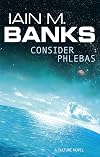
Stands up well on rereading, 30 years after the late Blessed Iain M. first delighted up with his canny, rich and witty snapshots of life in the Culture, his post-scarcity, post-irony and post-Singularity society. The humanoids are just as angst-ridden, the planets just as bizarre and the AIs just as snarky as I remembered.[return][return]If I have one quibble, it's that there is some serious padding: there are one-and-a-half unnecessary chapters, and the final showdown in the abandoned show more tunnels beneath the ice-bound Planet of the Dead is ground out almost beyond endurance. But I don't blame Banks: the fashion in the 80s for SF novels was for doorstop length. show less

I read this book first on release, and I was shocked, on picking it up again, to see that it is now 25 years old. But I wanted to re-read the Culture novels in light of Ian Banks' appallingly early death. I'm pleased I have started down this road.
This was Banks' first sf novel, and indeed is based around a novel he wrote quite some time earlier. And yet there is so much of the Culture already worked out but unstated in the book. The very first line made my jaw drop open when I re-read it; it show more was something that neither I nor anyone else could possibly have noticed on a first reading, because we all still had the whole Culture to discover.
"The ship didn't even have a name."
Reading that as a newcomer to Banks' SF, still to discover what the Culture was about, that sounds just like a striking opening line that grabs the attention. But just read that again, this time in the light of everything we've learnt since about the Culture, Minds, and the sort of gonzo names Ships choose for themselves.
"The ship didn't even have a name."
Now we see that the situation isn't just life and death, it's much more serious than that. This is a Mind in extremis, who is having to put its very survival before everything else. Of course, by the end of the book, we see that same Mind and the name that it chose for itself; and it's a name that has personal resonance for it, not just a throwaway comment on the nature of Life, the Universe and Everything (as someone else once said).
And it shows that Iain Banks could store up surprises for us that could go off like a depth charge in our own fragile minds years after he committed the words to the page.
We are rapidly thrust into an interstellar war, and again we are somewhat confounded, because the story is told from the point of view of a character working as a spy for the side we would not assume Banks would be rooting for. The Culture is painted for big segments of this book as the villains; only as we get closer to the end (and the appendices) do we realise that Banks is taking the big view here.
The Idirans, the religious race opposing the Culture, are painted a bit as central casting warriors - all big, Brian Blessed voices and 'today is a good day to die'. Yet the Idiran characters are also drawn with reasonable sympathy. And whilst the main character, Horza, has a series of adventures that could be out of any "space pirate/mercenary" story, the characters in the rag-tag band he allies with, are equally well-drawn. It's true to say that the cast of characters contracts rather towards the end of the book, and as the cast list gets smaller, the remaining characters get better described. And that includes the mechanicals. Banks has intelligent machines in his Culture universe, and they are characterised as well as the biologicals. The drone in this story, Unaha-Closp, comers over a slightly peevish and irritable, but essentially a solid character who delivers when the chips are down.
The protagonist's nemesis, the Culture agent Balveda Perosteck, seems to be playing the femme fatale at the beginning of the book; later, when she is taken prisoner, she begins to display Munchhausen-like symptoms as the situation changes around the band of protagonists.
This book came out in the general renaissance of space opera that took place in British sf during the 1980s and 1990s, and it has its share of what Brian Aldiss called "wide-screen baroque" set-pieces. These are carried off with cinematic relish. There is also some of the Banksian grand guignol that he was renowned for from his first novel, The Wasp Factory. Those of a squeamish disposition and vivid imagination might be advised to look elsewhere. And the humour is specifically Iain Banks' own, as well. It's a particularly Scots wit, and none the worse for all that.
On reflection, as I have read Banks' later Culture novels, I've come to think that the problem some people have with this book is rooted precisely in its place in Banks' writing career. Consider Phlebas is a straight space opera: admittedly one with a fantastic imagination for detail churning away under the surface, and a great precursor to what was to come; but at root it is a science fiction adventure story, written with an eye to selling it to a publisher as a solid entry in an sf catalogue. With this introduction to the Culture out of the way, Banks' later explorations of this universe are very different in pace and plotting.
The novel ends with something of a whimper rather than a neat conclusion (and with a 'Rosebud' moment). But isn't that what life's like, the big difference between reality and novels? Real life doesn't often have neat endings with all the loose ends tied up, and neither does this novel. But above all, the book is an introduction to the Culture universe, a rich and fascinating playground that Banks never finished exploring. Later novels may well have been deeper and may well have had more literary complexity; but when I first read this book, I was blown away and wanted to read more. And in the years that followed, I was duly rewarded. What more can you ask? show less
This was Banks' first sf novel, and indeed is based around a novel he wrote quite some time earlier. And yet there is so much of the Culture already worked out but unstated in the book. The very first line made my jaw drop open when I re-read it; it show more was something that neither I nor anyone else could possibly have noticed on a first reading, because we all still had the whole Culture to discover.
"The ship didn't even have a name."
Reading that as a newcomer to Banks' SF, still to discover what the Culture was about, that sounds just like a striking opening line that grabs the attention. But just read that again, this time in the light of everything we've learnt since about the Culture, Minds, and the sort of gonzo names Ships choose for themselves.
"The ship didn't even have a name."
Now we see that the situation isn't just life and death, it's much more serious than that. This is a Mind in extremis, who is having to put its very survival before everything else. Of course, by the end of the book, we see that same Mind and the name that it chose for itself; and it's a name that has personal resonance for it, not just a throwaway comment on the nature of Life, the Universe and Everything (as someone else once said).
And it shows that Iain Banks could store up surprises for us that could go off like a depth charge in our own fragile minds years after he committed the words to the page.
We are rapidly thrust into an interstellar war, and again we are somewhat confounded, because the story is told from the point of view of a character working as a spy for the side we would not assume Banks would be rooting for. The Culture is painted for big segments of this book as the villains; only as we get closer to the end (and the appendices) do we realise that Banks is taking the big view here.
The Idirans, the religious race opposing the Culture, are painted a bit as central casting warriors - all big, Brian Blessed voices and 'today is a good day to die'. Yet the Idiran characters are also drawn with reasonable sympathy. And whilst the main character, Horza, has a series of adventures that could be out of any "space pirate/mercenary" story, the characters in the rag-tag band he allies with, are equally well-drawn. It's true to say that the cast of characters contracts rather towards the end of the book, and as the cast list gets smaller, the remaining characters get better described. And that includes the mechanicals. Banks has intelligent machines in his Culture universe, and they are characterised as well as the biologicals. The drone in this story, Unaha-Closp, comers over a slightly peevish and irritable, but essentially a solid character who delivers when the chips are down.
The protagonist's nemesis, the Culture agent Balveda Perosteck, seems to be playing the femme fatale at the beginning of the book; later, when she is taken prisoner, she begins to display Munchhausen-like symptoms as the situation changes around the band of protagonists.
This book came out in the general renaissance of space opera that took place in British sf during the 1980s and 1990s, and it has its share of what Brian Aldiss called "wide-screen baroque" set-pieces. These are carried off with cinematic relish. There is also some of the Banksian grand guignol that he was renowned for from his first novel, The Wasp Factory. Those of a squeamish disposition and vivid imagination might be advised to look elsewhere. And the humour is specifically Iain Banks' own, as well. It's a particularly Scots wit, and none the worse for all that.
On reflection, as I have read Banks' later Culture novels, I've come to think that the problem some people have with this book is rooted precisely in its place in Banks' writing career. Consider Phlebas is a straight space opera: admittedly one with a fantastic imagination for detail churning away under the surface, and a great precursor to what was to come; but at root it is a science fiction adventure story, written with an eye to selling it to a publisher as a solid entry in an sf catalogue. With this introduction to the Culture out of the way, Banks' later explorations of this universe are very different in pace and plotting.
The novel ends with something of a whimper rather than a neat conclusion (and with a 'Rosebud' moment). But isn't that what life's like, the big difference between reality and novels? Real life doesn't often have neat endings with all the loose ends tied up, and neither does this novel. But above all, the book is an introduction to the Culture universe, a rich and fascinating playground that Banks never finished exploring. Later novels may well have been deeper and may well have had more literary complexity; but when I first read this book, I was blown away and wanted to read more. And in the years that followed, I was duly rewarded. What more can you ask? show less
Lists
First Novels (1)
Five star books (1)
A Novel Cure (1)
Finished in 2020 (1)
io9 Book Club (1)
BBC Big Read (1)
Sentient ships (1)
Best War Stories (1)
To Read - Horror (1)
GeoCAT 2016 (1)
Favourite Books (1)
Greatest Books (1)
Overdue Podcast (1)
Unread books (2)
My TBR (2)
Books About Boys (1)
5 Best 5 Years (1)
Read in 2014 (1)
SF Masterworks (1)
BBC Big Read (1)
United Kingdom (1)
BitLife (1)
Null (1)
Best First Lines (1)
Jim's Bookshelf (1)
Awards


You May Also Like


Associated Authors
Statistics
- Works
- 66
- Also by
- 15
- Members
- 93,147
- Popularity
- #100
- Rating
- 3.8
- Reviews
- 2,160
- ISBNs
- 718
- Languages
- 24
- Favorited
- 277


