
Matsuo Bashō (1644–1694)
Author of The Narrow Road to the Deep North and Other Travel Sketches
About the Author
The greatest of Japan's haiku poets and the greatest poet of his age, Basho raised the genre from a mediocre entertainment to serious verse and contributed greatly to its poetics. The work of his peak period is characterized by evocations of humankind's ultimate harmony with nature. He traveled show more widely, recording his journeys in his lyrical poetic diaries. He had numerous disciples, and haiku has remained a vigorous form of poetry to the present. (Bowker Author Biography) show less
Works by Matsuo Bashō
Basho's Narrow Road: Spring and Autumn Passages (Rock Spring Collection of Japanese Literature) (1996) 102 copies, 3 reviews
Haiku Illustrated: Classic Japanese Short Poems (Chinese Bound Classics) (2020) — Contributor — 43 copies, 1 review
Morning Mist: Through the Seasons With Matsuo Basho and Henry David Thoreau (Inklings) (1993) 17 copies
Cool Melon — Author — 5 copies
The Four Seasons 4 copies
The narrow road to Oku 4 copies
Oku no hosomichi = Oku no hosomichi = Ścieżkami Północy - w poszukiwaniu korzeni poezji (2022) 3 copies
Full Moon Is Rising: Lost Haiku of Matsuo Basho (1644-1694 and Travel Haiku of Matsuo Bashio a New Rendering) (1976) 2 copies
O Gosto Solitário do Orvalho 2 copies
Oinokobumi (Japanese Edition) 2 copies
Basho's Haiku: Literal Translations for Those Who Wish to Read the Original Japanese Text, with Gra (2014) 2 copies
দূর প্রদেশের সংকীর্ণ পথ 1 copy
Stikhi 1 copy
Poems 1 copy
Verzamelde haiku's 1 copy
Le Sac à charbon 1 copy
Bashō bunshū 1 copy
おくのほそ道(全) 1 copy
奥の細道 他四篇 (対訳古典シリーズ) 1 copy
Fuyu, estampes d'hiver 1 copy
Haikais de Bashô 1 copy
Haïkai de Bashô et de ses disciples. Traduction de Kuni Matsuo et Steinilber-Oberlin. Illustrations de Foujita (1936) 1 copy
O gosto solitário do orvalho 1 copy
Note de drumeție 1 copy
La lumière des bambous : 60 haïkaï de Bashô et de son école précédé d'un almanach japonais (1988) 1 copy
Uttar Ki Yatrayen (Pb) 1 copy
Oku no hosomichi おくのほそ道 1 copy
奥の細道、その他、芭蕉翁紀行集 1 copy
A Haiku Journey 1 copy
JAIKAIS 1 copy
Associated Works
Literature: An Introduction to Fiction, Poetry, and Drama (1995) — Contributor, some editions — 1,010 copies, 7 reviews
World Poetry: An Anthology of Verse from Antiquity to Our Time (1998) — Contributor — 496 copies, 2 reviews
Sources of Japanese Tradition, Vol. 1: From Earliest Times to 1600 (1958) — Contributor — 284 copies, 3 reviews
The Sound of Water: Haiku by Basho, Buson, Issa, and Other Poets (Shambhala Centaur Editions) (1995) — Contributor — 135 copies
Classic Haiku: The Greatest Japanese Poetry from Basho, Buson, Issa, Shiki, and Their Followers (2007) — Contributor — 90 copies, 1 review
Haiku: Gems of Intimate Beauty in a New Collection of Classic Japanese Poetry (1970) — Contributor — 53 copies
Born of a Dream: Fifty Haiku by Basho, Buson, Taigi, Issa, Shiki (1989) — Contributor — 7 copies, 1 review
Little Enough: 49 Haiku by Basho, Sodo, Ransetsu, Buson, Ryokan, Issa, Shiki (1991) — Contributor — 4 copies
De zomermaan en andere Japanse kettingverzen : uit de school van Matsuo Basho (1984) — Cover artist, some editions — 3 copies
Tagged
Common Knowledge
- Canonical name
- Bashō, Matsuo
- Legal name
- Munefusa, Matsuo
- Other names
- Bashoo, Matsuo
- Birthdate
- 1644
- Date of death
- 1694-11-28
- Gender
- male
- Occupations
- monk, Zen Buddhist
poet - Cause of death
- stomach illness
- Nationality
- Japan
- Birthplace
- Ueno, Iga province, Japan
- Place of death
- Osaka, Japan
- Burial location
- Ōtsu, Japan
- Associated Place (for map)
- Japan
Members
Reviews

Me and my son did a thing with this book where whenever we'd set out on a walk or an adventure or a wagon ride or what have you we'd start with a haiku. It was the best and I am craving short nature poems to take Basho's place now (John Clare doesn't quite cut it, although I guess there's really no reason we couldn't start again with Basho from the start). It also gave us a lot of time to sit with the genre--he doesn't know most words and so I did a lot of explaining the meanings of the show more poems, and realized the really obvious thing that the highly constrained nature of the form makes them more, not less, open to different interpretations, as all the connecting information is left out and they are distilled to a series of vivid juxtapositions. Makes you notice the world around you. show less

I took a class from Robert Haas during my undergrad. He was a vague teacher but his lectures were careful, rigorous, and were often delivered with a gentleness that made what would otherwise be burdensome topics graceful. So it is with this collection of Haiku by Buson, Basho, and Issa. Among the projects he set forth in the this edition, Haas wanted to show through contrast, how each master's personality and style comes through their work however restricted the form. The effect of reading show more this collection is that the differences become clear:
Issa's comical voice:
I'm going out,
Flies, so relax,
Make love.
Buson's imagery:
The spring sea rising
and falling, rising
and falling all day.
Basho's philosophical melancholy:
First day of spring-
I keep thinking about
the end of Autumn.
I highly recommend this collection for anyone interested in the Haiku form. Though there are some cultural and translational fault lines mapping the boundaries of this style of poetry the main ideas come through, often in unexpected ways: a flash of imagery or setting will set off a spontaneous feeling of sorrow or happiness, frustration or guilt. show less
Issa's comical voice:
I'm going out,
Flies, so relax,
Make love.
Buson's imagery:
The spring sea rising
and falling, rising
and falling all day.
Basho's philosophical melancholy:
First day of spring-
I keep thinking about
the end of Autumn.
I highly recommend this collection for anyone interested in the Haiku form. Though there are some cultural and translational fault lines mapping the boundaries of this style of poetry the main ideas come through, often in unexpected ways: a flash of imagery or setting will set off a spontaneous feeling of sorrow or happiness, frustration or guilt. show less
I took a class from Robert Haas during my undergrad. He was a vague teacher but his lectures were careful, rigorous, and were often delivered with a gentleness that made what would otherwise be burdensome topics graceful. So it is with this collection of Haiku by Buson, Basho, and Issa. Among the projects he set forth in the this edition, Haas wanted to show through contrast, how each master's personality and style comes through their work however restricted the form. The effect of reading show more this collection is that the differences become clear:
Issa's comical voice:
I'm going out,
Flies, so relax,
Make love.
Buson's imagery:
The spring sea rising
and falling, rising
and falling all day.
Basho's philosophical melancholy:
First day of spring-
I keep thinking about
the end of Autumn.
I highly recommend this collection for anyone interested in the Haiku form. Though there are some cultural and translational fault lines mapping the boundaries of this style of poetry the main ideas come through, often in unexpected ways: a flash of imagery or setting will set off a spontaneous feeling of sorrow or happiness, frustration or guilt. show less
Issa's comical voice:
I'm going out,
Flies, so relax,
Make love.
Buson's imagery:
The spring sea rising
and falling, rising
and falling all day.
Basho's philosophical melancholy:
First day of spring-
I keep thinking about
the end of Autumn.
I highly recommend this collection for anyone interested in the Haiku form. Though there are some cultural and translational fault lines mapping the boundaries of this style of poetry the main ideas come through, often in unexpected ways: a flash of imagery or setting will set off a spontaneous feeling of sorrow or happiness, frustration or guilt. show less
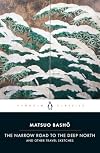
I’d heard about this book for a long while before locating a copy and actually reading it. Japan seems to have many stories of pilgrims, priests, Artists, Samurai, and just plain travellers who made journeys in Japan and documented their travels. Travelling from shrine to shrine, staying at temples, or wayside inns. And certainly, the country lends itself to this sort of travel: lots of water for travellers from rivers and streams; wonderful scenery, (though this comes with mountains to show more scale) and lots of villages along the way. Still, As is pointed out in this book, “travels in his day had to be made under very precarious conditions, and that few people, if any, thought of taking to the road merely for pleasure or pastime”. I found the book fascinating both as a travelogue and as a book of poetry.
I think the translator is well aware of the impossibility of really translating Haiku. The kanji used in Haiku create pictures in the minds of the readers even before their brain takes in the meaning. I see this many times with my own wife who is Japanese. She can grasp in an instant the basic subject of a passage; See a fish restaurant at 100m. Will use English for some conversations that are impossible to broach in Japanese. So the idea that the English translations capture the essence of the Haiku is probably far-fetched. Still....I feel that I can glimpse the Haiku through the translation. (It’s about a frog!). A bit like saying “War and Peace” is about Russia.
But I loved the combination of the travel text with the Haiku. And I’ve visited some of the places that Bashoo visited so long ago. I guess they have changed....the narrow road has been replaced with a Shinkansen. But the love of nature shines through in both the text and the poems. A few themes seem to recur: cuckoos, loneliness, silence, water, rain, forests. But some passages are mundane :
Behind, a woman tearing
The meat of a dried codfish.
It wasn’t all five star accommodation. He complains frequently of filthy surroundings and of fleas and lice. And in one point....almost casually describes an abandoned 3 year old child. He gave him some food but then pressed on his way ...leaving the child crying by the river bank. To me: a horrific scene. But, I guess these were tough times.
The veneration of poets survives in Japan. My mother in law was a “Disciple” of some poet who was, apparently, almost, but not quite, a “National Treasure”. And we have some of his hand-written poems framed around the house. Unfortunately I can’t read them.
Bit, I’m inspired enough to maybe try my own hand at some poetry writing on similar themes. Though without the Japanese characters they will never have the same impact and multiple meanings.
I’ve extracted some passages below, really to help me remember the book and some of the passages that impacted me. But also to try and capture some of the essence of the book; Basho himself
Introduction
Bashō seems to have gained an increasingly firm footing in the poetic circles of Edo, for in 1675 when Sōin came from Ōsaka, Bashō was among the poets who were invited to compose linked verse with him. The encounter with Sōin must have been an epoch-making event for Bashō, for upon this occasion he changed his pen name from Sōbō to Tōsei. Deep respect for Sōin, as well as his marked influence, can be felt in the linked verse he composed in the year after.....What Bashō learned from Sōin is the special value in poetry of the humble and unpretentious imagery of everyday life, as he himself testifies by saying: ‘If you describe a green willow in the spring rain it will be excellent as linked verse of a higher order. Linked verse of a lower order, however, must be used for more homely images, such as a crow picking mud snails in a rice paddy.”
In 1682, when Bashö's house was only two years old, it was destroyed by a fire that swept through a large part of Edo. So Basho sought a temporary abode in the house of Rokuso Gohei....In the summer of 1683, Bashö's mother died in his native place, and in the winter of the same year, a new house was built for him in Fukagawa by his friends and disciples.
What must be borne in mind in reading the travel sketches by Bashö is that travels in his day had to be made under very precarious conditions, and that few people, if any, thought of taking to the road merely for pleasure or pastime....he took to the road, “caring naught for his provisions”....This tragic sense is given beautiful expression in the opening passage of The Records of a Weather-Exposed Skeleton......It is written in haibun, prose mixed with haiku, but the two are not perfectly amalgamated.
Basho returned to his home in Edo in the summer of 1685 after about nine months of wandering......In 1686 two anthologies, Kawazu Awase (Frog Contest) and Haru no Hi (A Spring Day), were published. The former is a collection of poems on frogs by Basho and his disciples. The latter is traditionally counted as the second of the Major Anthologies, though there are only three poems of Basho in it......Let me quote it here [probably Basho’s most famous haiku]...once again with a comment by one of his disciples.
Breaking the silence
Of an ancient pond,
A frog jumped into water-
A deep resonance.
This poem was written by our master on a spring day. He was sitting in his riverside house in Edo, bending his ears to the soft cooing of a pigeon in the quiet rain. There was a mild wind in the air, and one or two petals of cherry blossom were falling gently to the ground.
Now and then in the garden was heard the sound of frogs jumping into the water.
One of the disciples sitting with him immediately suggested for the first half of the poem, Amidst the flowers
Of the yellow rose.
Our master thought for a while, but finally he decided on
Breaking the silence
Of an ancient pond.
The disciple's suggestion is admittedly picturesque and beautiful but our master's choice, being simpler, contains more truth in it. It is only he who has dug deep into the mystery of the universe that can choose a phrase like this.....The pond is, indeed, a mirror held up to reflect the author's mind.....Basho explains this himself in the following way. Go to the pine if you want to learn about the pine, or to the bamboo if you want to learn about the bamboo. And in doing so, you must leave your subjective preoccupation with yourself. Otherwise you impose yourself on the object and do not learn......Your poetry issues of its own accord when you and the object have become one.
It seems to me that there is an air of an 'étude' about The Records of a Travel-worn Satchel, and that it should be read as a kind of stepping-stone for the subsequent travel sketches.
A Visit to Sarashina Village is the shortest of all travel sketches by Bashö. It carries on, however, the wonderful tragi-comical effect of the concluding passages of The Records of a Travel-Worn Satchel. In its fine polish, in particular, it is unrivalled and shines forth like a gem.
Basho returned from his expedition to Suma and Sarashina in the autumn of 1688, and already in the spring of the following year he left on the third of his major journeys.....Basho's third major journey brought him The Narrow Road to the Deep North (Oku no Hosomichi), the last of the travel sketches translated in this book. Leaving Edo in the spring of 1689, he spent more than two and a half years on the road.....In the imagination of the people at least, the North was largely an unexplored territory, and it represented for Basho all the mystery there was in the universe......It seems to me that there are two things remarkable about The Narrow Road to the Deep North. One is variety. Each locality, including the little unknown places Bashö visited in passing, is portrayed with a distinctive character of its own,
The other remarkable thing about The Narrow Road to the Deep North is its unity. To use Bashö's own classification, variety, being the temporary, changeable element (ryükö), is in the substance (jitsu) of the work. Unity, on the other hand, is the permanent, unchangeable element existing in the essence (kyo) of the work......Scholars have pointed out that in his attempt to achieve unity Bashö took such liberty as to change the natural course of events, or even invent fictitious events. The result is a superb work of art where unity dominates without destroying variety.
In the present travel sketch, however, Basho has mastered the art of writing haibun so completely that prose and haiku illuminate each other like two mirrors held up facing each other......This is something no one before him was able to achieve,
The retreat of my disciple, Kyorai, is in the suburbs of Kyoto, among the bamboo thickets of Shimo Saga-not far from either Mount Arashiyama or the Oigawa River. It is an ideal place for meditation, for it is hushed in silence. Such is the laziness of my friend, Kyorai, that his windows are covered with tall grass growing rank in the garden, and his roofs are buried under the branches of overgrown persimmon trees.
During the two-year period we are now dealing with, two anthologies of great importance were published. They are Hisago (A Gourd) and Saru Mino (A Coat for a Monkey), the fourth and fifth of the Major Anthologies.....It is generally believed that those two anthologies demonstrate the mature style of Basho (shöfü) at its highest pitch. To quote some poems (hokku) from this period:
With a friend in Omi
I sat down, and bid farewell
To the departing spring,
Most reluctantly.
Hardly a hint
Of their early death,
Cicadas singing
In the trees.
Under the bright moon,
The children of the vicinity
All lined up
On the porch of a temple.
With your singing
Make me lonelier than ever,
You, solitary bird,
Cuckoo of the forest.
if one broods upon these poems long enough, one realizes that they also have a symbolic quality. This symbolic quality inherent in the poem is called by Basho sabi (loneliness), shiori (tenderness), and hosomi (slenderness), depending on the mode of its manifestation and the degree of its saturation......Sabi is in the colour of a poem......If a man goes to war wearing stout armour or to a party dressed up in gay clothes, and if this man happens to be an old man, there is something lonely about him. Sabi is something like that. It is in the poem regardless of the scene it describes-
Basho says that in his case the link is provided by what he calls the aroma (nio), echo (hibiki), countenance (omokage), colour (utsuri) and rank (kurai) of the preceding poem......When you hit something, the noise comes back to you in a matter of an instant. This is what I mean by hibiki. In the following pair, for example, the second poem is a perfect echo of the first.
Against the wooden floor
I threw a silver-glazed cup,
Breaking it to pieces.
Look, now, the slender curve
Of your sword, half-drawn.
It is indeed by virtue of this imaginative linking technique (nioi-zuke) that Basho was able to achieve an unprecedented degree of perfection in his linked verse.
Basho returned to Edo from his third major journey after two and a half years of wandering, in the winter of 1691, and in the spring of the following year a new house was built for him. Basho spent the next two and a half years in this house......My solitude shall be my company, and my poverty my wealth.....Already a man of fifty, I should be able to maintain this self-imposed discipline.
Only for morning glories
I open my door-
During the daytime I keep it
Tightly barred.
In the poems Basho wrote during this period, however, there was a strange sense of detachment from life.....For example:
The wild cries of a cat
Having been hushed,
The soft beams of the moon
Touched my bedroom.
The voice of a cuckoo
Dropped to the lake
Where it lay floating
On the surface.
In the sky
Of eight or nine yards
Above the willow-
Drizzling rain.
In the spring of 1694, Bashö left on the last of his major journeys.
This time he was determined to travel, if possible, to the southern end of Japan. He was already fifty......The poems he wrote on this journey suggest something almost like a shadow of death. For example:
Autumn drawing near,
My heart of itself
Inclines to a cosy room
Of four-and-a-half mats.
Ancient city of Nara,
Ancient images of Buddha,
Shrouded in the scent
Of Chrysanthemums.
Deep is autumn,
And in its deep air
I somehow wondered
Who my neighbour is.
While Basho was lingering in Ösaka and its vicinity, he fell victim to what seems to have been an attack of dysentery.
Seized with a disease
Halfway on the road,
My dreams keep revolving
Round the withered moor.
Later I [Donshuu] was summoned by our master, who told me that he had in mind another poem which ended like this:
Round, as yet round,
My dreams keep revolving.
Thus died on 12 October 1694 one of the greatest geniuses in Japanese literature, and five years after his death, the last of his Major Anthologies, Zoku Saru Mino (A Coat for a Monkey, Continued), was published,
His travel sketches, in particular, show him at his best or on his way to his best......I have used a four-line stanza in translating haiku.....I shall not, of course, try to defend my stanza, for it is an experiment, and just as any other experiment in literature, the result alone can justify or disqualify it.
The Records of a Weather-Exposed Skeleton
I left my broken house on the River Sumida in the August of the first year of Jyōkyō among the wails of the autumn wind.
After ten autumns
In Edo, my mind
Points back to it
As my native place.
I crossed the barrier-gate of Hakone on a rainy day. All the mountains were deeply buried behind the clouds.
In a way
It was fun
Not to see Mount Fuji
In foggy rain.
As I was plodding along the River Fuji, I saw a small child, hardly three years of age, crying pitifully on the bank, obviously abandoned by his parents. They must have thought this child was unable to ride through the stormy waters of life which run as wild as the rapid river itself,
I gave him what little food I had with me.
The ancient poet
Who pitied monkeys for their cries,
What would he say, if he saw
This child crying in the autumn wind?
The day I wanted to cross the River Oi, it rained from morning till night, and I was held up by the swollen river.
A long rainy day of autumn,
My friends in Edo
Are perhaps counting the days,
Thinking of us at the River Oi
I visited the outer shrine of Ise one evening just before dark.
In the utter darkness
Of a moonless night,
A powerful wind embraces
The ancient cedar trees.
I am indeed dressed like a priest, but priest I am not, for the dust of the world still clings to me. The keeper of the inner shrine prevented me from entering the holy seat of the god because my appearance was like a Buddhist priest.
I visited a poet at his hermitage.
An ivy spray
Trained up over the wall
And a few bamboos
Inviting a tempest.
At last I reached my native village in the beginning of September, but I could not find a single trace of the herbs my mother used to grow in front of her room. The herbs must have been completely bitten away by the frost.
[Passing through the mountainous villages of Imasu and Yamanaka] I went to see the tomb of Lady Tokiwa, the ill-fated mistress of the wicked Lord Yoshitomo
The autumn wind,
Resembling somewhat
The frozen heart
Of Lord Yoshitomo.
Tired of sleeping on a grass pillow, I went down to the seashore before break of day.
Early dawn,
Young white fish
Shining in ephemeral white,
Hardly an inch long.
The end of the year came, while I was thus travelling here and there.
With a hat on my head
And straw sandals on my feet,
I met on the road
The end of the year.
There was a plum orchard.
Blanket of white plum,
I wonder what happened to the cranes,
Stolen or hidden
Behind the plum blossoms?
I crossed a mountain on my way to Otsu.
I picked my way
Through a mountain road,
And I was greeted
By a smiling violet.
I stopped at a certain shop for lunch.
A branch of wild azalea
Thrown into a bucket,
Behind, a woman tearing
The meat of a dried codfish.
A roadside scene:
Wild sparrows
In a patch of yellow rape,
Pretending to admire
The flowers.
A Visit to the Kashima Shrine
Among the bush-clover were other wild flowers in bloom, such as bellflower, valerian, pampas large and small, all tangled in great confusion.....We reached the town of Fusa on the banks of the River Tone towards nightfall. The fishermen of this town catch salmon by spreading wickerwork traps in the river, and sell it in the markets in Edo.....Shortly before day break, however, the moon began to shine through the rifts made in the hanging clouds. I immediately wakened the priest, and other members of the household followed him out of bed. We sat for a long time in utter silence, watching the moonlight trying to penetrate the clouds and listening to the sound of the lingering rain.
The following are the poems we composed on this occasion:
Poems composed at a farm-house:
A solitary crane
In the half-reaped paddies,
The autumn deepens
In the village.
Written by Tōsei (Basho)
The Records of a Travel-Worn Satchel
In this mortal frame of mine....there is something called is called a wind-swept spirit for lack of a better name......This something in me took to writing poetry years ago, merely to amuse itself at first, but finally making it its lifelong business......Indeed, ever since it began to write poetry, it has never found peace with itself, always wavering between doubts of one kind and another.......The first lesson for the artist is, therefore, to learn how to overcome such barbarism and animality, to follow nature, to be one with nature......I could not help feeling vague misgivings about the future of my journey, as I watched the fallen leaves of autumn being carried away by the wind.
From this day forth
I shall be called a wanderer,
Leaving on a journey
Thus among the early showers.
As I was invited to parties on a boat, at my friends' houses, or even at my own hermitage, I became used to the pomp and splendour of feasting unawares and almost fell a victim to the illusion that a man of importance was leaving on a journey. From time immemorial the art of keeping diaries while on the road was popular among the people......It is easy enough to say, for example, that such and such a day was rainy in the morning but fine in the afternoon, that there was a pine tree at such and such a place......Although in fact they are not even worth mentioning unless there are fresh and arresting elements in them.....The readers will find in my diary a random collection of what I have seen on the road, views somehow remaining in my heart-an isolated house in the mountains, or a lonely inn surrounded by the moor, for example.....I must admit that my records are little more than the babble of the intoxicated and the rambling talk of the dreaming,
I stopped overnight at Narumi,
Only half the way I came
To the ancient capital,
And above my head
Clouds heavy with snow.
I was invited to a party.
Stretching by force
The wrinkles of my coat,
I started out on a walk
To a snow-viewing party.
Deep as the snow is,
Let me go as far as I can
Till I stumble and fall,
Viewing the white landscape.
I paid a visit to the shrine at Ise Yamada.
Not knowing
The name of the tree,
I stood in the flood
Of its sweet smell.
It is a bit too cold
To be naked
In this stormy wind
Of February.
After visits to Mount Miwa and Mount Tafu, I climbed the steep pass of Hoso.
Higher than the lark
I climbed into the air,
Taking breath
At the summit of a pass.
At Nijikkö:
One after another
In silent succession fall
The flowers of yellow rose-
The roar of tumbling water.
Indeed, one of the greatest pleasures of travelling was to find a genius hidden among weeds and bushes, a treasure lost in broken tiles, a mass of gold buried in clay, and when I did find such a person, I always kept a record
I was in Nara on Buddha's birthday, and saw the birth of a fawn. I was so struck by the coincidence that I wrote:
By what divine consideration
Is it, I wonder,
That this fawn is born
On Buddha's birthday?
At a certain man's home in Osaka:
To talk casually
About an iris flower
Is one of the pleasures
Of the wandering journey.
I thought of the bloody war that had taken place in the mountains at the back of the beach. I wanted to see the site of this old war. So I started to climb Mount Tetsukai.
It was, on the other hand, an incurable folly of mine to think that, had I come here in autumn, I would have had a greater poetic success, for that only proved the poverty of my mind.
From this village I followed a narrow ridge road leading to the province of Tamba through many a precipice having such fearful names as Hell's Window and Headlong Fall. When I came to Ichi-no-tani, the huge precipice where Yoshitsune had performed the feat of a downhill rush with great success,
A Visit to Sarashina Village
The autumn wind inspired my heart with a desire to see the rise of the full moon over Mount Obasute. That rugged mountain in the village of Sarashina is where the villagers in the remote past used to abandon their ageing mothers among the rocks.
I abandoned my horse and staggered on my own legs, for I was dizzy with the height and unable to maintain my mental balance from fear. The servant, on the other hand, mounted the horse, and seemed to give not even the slightest thought to the danger. He often nodded in a doze
It occurred to me that every one of us was like this servant, wading through the ever-changing reefs of this world in stormy weather, totally blind to the hidden dangers, and that the Buddha surveying us from on high, would surely feel the same misgivings about our fortune as I did about the servant.
Seeing in the country
A big moon in the sky,
I felt like decorating it
With gold-lacquer work.
On to a bridge
Suspended over a precipice
Clings an ivy vine,
Body and soul together.
Ancient imperial horses
Must have also crossed
This suspended bridge
On their way to Kyoto.
A yellow valerian
With its slender stalk
Stands bedecked
In droplets of dew.
Hot radish
Pierced my tongue,
While the autumn wind
Pierced my heart.
The Narrow Road to the Deep North
I myself have been tempted for a long time by the cloud-moving wind-filled with a strong desire to wander.......It was early on the morning of March the twenty-seventh that I took to the road. There was darkness lingering in the sky, and the moon was still visible, though gradually thinning away. The faint shadow of Mount Fuji and the cherry blossoms of Ueno and Yanaka were bidding me a last farewell......My friends stood in a line and waved good-bye as long as they could see my back......I lodged in an inn at the foot of Mount Nikko on the night of March the thirtieth. The host of the inn introduced himself as Honest Gozaemon, and told me to sleep in perfect peace upon his grass pillow, for his sole ambition was to be worthy of his name......I watched him rather carefully but found him almost stubbornly honest, utterly devoid of worldly cleverness......Indeed, such saintly honesty and purity as his must not be scorned, for it verges closely on the Perfection preached by Confucius.
One day we took a walk to the suburbs. We saw the ruins of an ancient dog-shooting ground, and pushed further out into the grass-moor to see the tomb of Lady Tamamo and the famous Hachiman Shrine, upon whose god the brave archer, Yoichi, is said to have called for aid when he was challenged to shoot a single fan suspended over a boat drifting offshore.
Amid mountains of high summer,
I bowed respectfully before
The tall clogs of a statue,
Asking a blessing on my journey.
Even the woodpeckers
Have left it untouched,
This tiny cottage
In a summer grove.
I went to see the willow tree which Saigyo celebrated in his poem, when he wrote, 'Spreading its shade over a crystal stream'. I found it near the village of Ashino on the bank of a rice-field. I
When the girls had planted
A square of paddy-field,
I stepped out of
The shade of a willow tree.
I came at last to the barrier-gate of Shirakawa, which marks the entrance to the
northern regions.....This gate was counted among the three largest checking stations, and many poets had passed through it, each leaving a poem of his own making. I myself walked between trees laden with thick foliage, with the distant sound of autumn wind in my ears and the vision of autumn tints before my eyes.
I called on the Poet Tokyu at the post town of Sukagawa,.....It was deplorable, however, to have passed the gate of Shirakawa without a single poem worth recording, so I wrote:
The first poetic venture
I camc across-
The rice-planting songs
Of the far north.
Using this poem as a starting piece, we made three books of linked verse.
There was a lonely temple in the vicinity, and tombs of the Sato family were still standing in the graveyard. I wept bitterly in front of the tombstones of the two young wives, remembering how they had dressed up their frail bodies in armour after the death of their husbands.
I had a bath in a hot spring before I took shelter at an inn. It was a filthy place with rough straw mats spread out on an earth floor.....A storm came upon us towards midnight, and between the noise of thunder and leaking rain and the raids of mosquitoes and fleas, I could not get a wink of sleep.
My heart leaped with joy when I saw the celebrated pine tree of Takekuma, its twin trunks shaped exactly as described by the ancient poets. I was immediately reminded of the Priest Nöin, who had grieved to find upon his second visit this same tree cut and thrown into the River Natori as bridge-piles by the newly appointed governor of the province. [They had been replanted]
Three months after we saw
Cherry blossoms together
I came to see the glorious
Twin trunks of the pine.
Relying solely on the drawings of Kaemon, which served as a guide, I pushed along the Narrow Road to the Deep North, and came to the place where tall sedges were growing in clusters. This was the home of the famous sedgemats of Tofu. Even now it is the custom of the people of this area to send carefully woven mats as a tribute to the governor each year.
I came to the pine woods called Sue-no-matsuyama, where I found a temple named Masshozan and a great number of tombstones scattered among the trees. It was a depressing sight indeed, for young or old, loved or loving, we must all go to such a place at the end of our lives.
Much praise has been lavished upon he wonders of the islands of Matsushima......The pines are of the freshest green, and their branches are curved in exquisite lines, bent by the wind constantly blowing through them......Indeed, the beauty of the entire scene can only be compared to the most divinely endowed of feminine countenances.......My pen strove in vain to equal this superb creation of divine artifice.
When a country is defeated, there remain only mountains and rivers, and on a ruined castle in spring only grasses thrive. I sat down on my hat and wept bitterly till I almost forgot time.
A thicket of summer grass
Is all that remains
Of the dreams and ambitions
Of ancient warriors.
Written by Sora
thanks to the outer frame and a covering of tiles added for protection, they had survived to be a monument of at least a thousand years.
I arrived by way of Naruko hot spring at the barrier-gate of Shitomae which blocked the entrance to the province of Dewa. The gate-keepers were extremely suspicious, for very few travellers dared to pass this difficult road under normal circumstances. I was admitted after long waiting, so that darkness overtook me while I was climbing a huge mountain.
Bitten by fleas and lice,
I slept in a bed,
A horse urinating all the time
Close to my pillow.
The mountains were so thickly covered with foliage and the air underneath was so hushed that I felt as if I were groping my way in the dead of night. There was not even the cry of a single bird to be heard, and the wind seemed to breathe out black soot through every rift in the hanging clouds........There was a temple called Ryushakuji in the province of Yamagata.
Founded by the great Priest Jikaku, this temple was known for the absolute tranquillity......
The stony ground itself bore the colour of eternity, paved with velvety moss. The doors of the shrines built on the rocks were firmly barred and there was not a sound to be heard.
In the utter silence
Of a temple,
A cicada's voice alone
Penetrates the rocks.
These rural poets were now merely struggling to find their way in the forest of error....for there was no one to guide them. At their request, therefore, I sat with them to compose a book of linked verse, and left it behind me as a gift. It was indeed a great pleasure for me to be of such help during my wandering journey.
I climbed Mount Haguro on the third of June. Through the effort of my friend, Zushi Sakichi, I was granted an audience with the high priest Egaku,
“Court Ceremonies and Rites during the Years of Engi,” mentions that there is a sacred shrine on Mount Sato in the province of Dewa. The scribe must have written Sato where he should have written Kuro, for the two sounds are represented by Chinese ideographs looking very much alike. The present name of the mountain, Haguro, is probably an abridged form of Mount Kuro in the province of Dewa.
This shrine on Mount Haguro is counted among the three most sacred shrines of the north,
There are hundreds of houses where the priests practise religious rites with absolute severity.
I climbed Mount Gassan on the eighth....and reached the summit, completely out of breath and nearly frozen to death. Presently the sun went down and the moon rose glistening in the sky. I spread some leaves on the ground and went to sleep.
My host, Egaku, asked me to put down in verse some impressions of my pilgrimage to the three mountains, so I wrote as follows on the narrow strips of writing paper he had given me.
How cool it is,
A pale crescent shining
Above the dark hollow
Of Mount Haguro.
How many columns of clouds
Had risen and crumbled, I wonder
Before the silent moon rose
Over Mount Gassan.
Forbidden to betray
The holy secrets of Mount Yudono,
I drenched my sleeves
In a flood of reticent tears.
Tears rushed to my eyes
As I stepped knowingly
Upon the coins on the sacred road
Of Mount Yudono.
Written by Sora
In the temple named Kanmanjuji....When the hanging screens were rolled up, an extraordinary view unfolded itself before my eyes--Mount Chökai supporting the sky like a pillar in the south with its shadowy reflection in the water, the barrier-gate of Muyamuya just visible in the west, an endless causeway leading as far as Akita in the east, and finally, in the north, Shiogoshi........The charm of Kisagata is in the beauty of its weeping countenance. It is not only lonely but also penitent, as it were,
I entered the province of Echigo through the barrier-gate of Nezu, and arrived at the barrier-gate of Ichiburi in the province of Ecchu.....During the nine days I needed for this trip, I could not write very much, what with the heat and moisture, and my old complaint that pestered me immeasurably.
The great Milky Way
Spans in a single arch
The billow-crested sea,
Falling on Sado beyond.
The voices of two young women whispering in the next room, however, came creeping into my ears.....I gathered that they were concubines from Niigata....I sympathized with them,
their life was such that they had to drift along even as the white froth of waters that beat on the shore, and having been forced to find a new companion each night, they had to renew their pledge of Love at every tum, thus proving each time the fatal sinfulness of their nature. I listened to their whispers till fatigue lulled me to sleep.
My companion, Sora, was seized with an incurable pain in his stomach. So he decided to hurry, all by himself, to his relatives in the village of Nagashima in the province of Ise. As he said good-bye, he wrote:
No matter where I fall
On the road,
Fall will I to be buried
Among flowering bush-clovers.
I stopped overnight at the Zenshöji Temple near the castle of Daishoji.......Sora, too, had stayed here the night before and left behind the following poem:
All night long
I listened to the autumn wind
Howling on the hill
At the back of the temple.
I went to see the famous pine of Shiogoshi. The entire beauty of this place, I thought, was best expressed in the following poem by Saigyo.
Inviting the wind to carry
Salt waves of the sea,
The pine tree of Shiogoshi
Trickles all night long
Shiny drops of moonlight.
Should anyone dare to write another poem on this pine tree, it would be like trying to add a sixth finger to his hand.......
I entered the port of Tsuruga on the night of the fourteenth. The sky was clear and the moon was unusually bright. I said to the host of my inn, 'I hope it will be like this again tomorrow night when the full moon rises.'.....In this little book of travel is included everything under the sky-not only that which is hoary and dry but also that which is young and colourful, not only that which is strong and imposing but also that which is feeble and ephemeral.
What’s my overall take on the book?
Well I really liked it. Enjoyed the travelogue text and enjoyed the interspersed Haiku poems. It evoked a beautiful, bygone Japan. Five stars from me. show less
I think the translator is well aware of the impossibility of really translating Haiku. The kanji used in Haiku create pictures in the minds of the readers even before their brain takes in the meaning. I see this many times with my own wife who is Japanese. She can grasp in an instant the basic subject of a passage; See a fish restaurant at 100m. Will use English for some conversations that are impossible to broach in Japanese. So the idea that the English translations capture the essence of the Haiku is probably far-fetched. Still....I feel that I can glimpse the Haiku through the translation. (It’s about a frog!). A bit like saying “War and Peace” is about Russia.
But I loved the combination of the travel text with the Haiku. And I’ve visited some of the places that Bashoo visited so long ago. I guess they have changed....the narrow road has been replaced with a Shinkansen. But the love of nature shines through in both the text and the poems. A few themes seem to recur: cuckoos, loneliness, silence, water, rain, forests. But some passages are mundane :
Behind, a woman tearing
The meat of a dried codfish.
It wasn’t all five star accommodation. He complains frequently of filthy surroundings and of fleas and lice. And in one point....almost casually describes an abandoned 3 year old child. He gave him some food but then pressed on his way ...leaving the child crying by the river bank. To me: a horrific scene. But, I guess these were tough times.
The veneration of poets survives in Japan. My mother in law was a “Disciple” of some poet who was, apparently, almost, but not quite, a “National Treasure”. And we have some of his hand-written poems framed around the house. Unfortunately I can’t read them.
Bit, I’m inspired enough to maybe try my own hand at some poetry writing on similar themes. Though without the Japanese characters they will never have the same impact and multiple meanings.
I’ve extracted some passages below, really to help me remember the book and some of the passages that impacted me. But also to try and capture some of the essence of the book; Basho himself
Introduction
Bashō seems to have gained an increasingly firm footing in the poetic circles of Edo, for in 1675 when Sōin came from Ōsaka, Bashō was among the poets who were invited to compose linked verse with him. The encounter with Sōin must have been an epoch-making event for Bashō, for upon this occasion he changed his pen name from Sōbō to Tōsei. Deep respect for Sōin, as well as his marked influence, can be felt in the linked verse he composed in the year after.....What Bashō learned from Sōin is the special value in poetry of the humble and unpretentious imagery of everyday life, as he himself testifies by saying: ‘If you describe a green willow in the spring rain it will be excellent as linked verse of a higher order. Linked verse of a lower order, however, must be used for more homely images, such as a crow picking mud snails in a rice paddy.”
In 1682, when Bashö's house was only two years old, it was destroyed by a fire that swept through a large part of Edo. So Basho sought a temporary abode in the house of Rokuso Gohei....In the summer of 1683, Bashö's mother died in his native place, and in the winter of the same year, a new house was built for him in Fukagawa by his friends and disciples.
What must be borne in mind in reading the travel sketches by Bashö is that travels in his day had to be made under very precarious conditions, and that few people, if any, thought of taking to the road merely for pleasure or pastime....he took to the road, “caring naught for his provisions”....This tragic sense is given beautiful expression in the opening passage of The Records of a Weather-Exposed Skeleton......It is written in haibun, prose mixed with haiku, but the two are not perfectly amalgamated.
Basho returned to his home in Edo in the summer of 1685 after about nine months of wandering......In 1686 two anthologies, Kawazu Awase (Frog Contest) and Haru no Hi (A Spring Day), were published. The former is a collection of poems on frogs by Basho and his disciples. The latter is traditionally counted as the second of the Major Anthologies, though there are only three poems of Basho in it......Let me quote it here [probably Basho’s most famous haiku]...once again with a comment by one of his disciples.
Breaking the silence
Of an ancient pond,
A frog jumped into water-
A deep resonance.
This poem was written by our master on a spring day. He was sitting in his riverside house in Edo, bending his ears to the soft cooing of a pigeon in the quiet rain. There was a mild wind in the air, and one or two petals of cherry blossom were falling gently to the ground.
Now and then in the garden was heard the sound of frogs jumping into the water.
One of the disciples sitting with him immediately suggested for the first half of the poem, Amidst the flowers
Of the yellow rose.
Our master thought for a while, but finally he decided on
Breaking the silence
Of an ancient pond.
The disciple's suggestion is admittedly picturesque and beautiful but our master's choice, being simpler, contains more truth in it. It is only he who has dug deep into the mystery of the universe that can choose a phrase like this.....The pond is, indeed, a mirror held up to reflect the author's mind.....Basho explains this himself in the following way. Go to the pine if you want to learn about the pine, or to the bamboo if you want to learn about the bamboo. And in doing so, you must leave your subjective preoccupation with yourself. Otherwise you impose yourself on the object and do not learn......Your poetry issues of its own accord when you and the object have become one.
It seems to me that there is an air of an 'étude' about The Records of a Travel-worn Satchel, and that it should be read as a kind of stepping-stone for the subsequent travel sketches.
A Visit to Sarashina Village is the shortest of all travel sketches by Bashö. It carries on, however, the wonderful tragi-comical effect of the concluding passages of The Records of a Travel-Worn Satchel. In its fine polish, in particular, it is unrivalled and shines forth like a gem.
Basho returned from his expedition to Suma and Sarashina in the autumn of 1688, and already in the spring of the following year he left on the third of his major journeys.....Basho's third major journey brought him The Narrow Road to the Deep North (Oku no Hosomichi), the last of the travel sketches translated in this book. Leaving Edo in the spring of 1689, he spent more than two and a half years on the road.....In the imagination of the people at least, the North was largely an unexplored territory, and it represented for Basho all the mystery there was in the universe......It seems to me that there are two things remarkable about The Narrow Road to the Deep North. One is variety. Each locality, including the little unknown places Bashö visited in passing, is portrayed with a distinctive character of its own,
The other remarkable thing about The Narrow Road to the Deep North is its unity. To use Bashö's own classification, variety, being the temporary, changeable element (ryükö), is in the substance (jitsu) of the work. Unity, on the other hand, is the permanent, unchangeable element existing in the essence (kyo) of the work......Scholars have pointed out that in his attempt to achieve unity Bashö took such liberty as to change the natural course of events, or even invent fictitious events. The result is a superb work of art where unity dominates without destroying variety.
In the present travel sketch, however, Basho has mastered the art of writing haibun so completely that prose and haiku illuminate each other like two mirrors held up facing each other......This is something no one before him was able to achieve,
The retreat of my disciple, Kyorai, is in the suburbs of Kyoto, among the bamboo thickets of Shimo Saga-not far from either Mount Arashiyama or the Oigawa River. It is an ideal place for meditation, for it is hushed in silence. Such is the laziness of my friend, Kyorai, that his windows are covered with tall grass growing rank in the garden, and his roofs are buried under the branches of overgrown persimmon trees.
During the two-year period we are now dealing with, two anthologies of great importance were published. They are Hisago (A Gourd) and Saru Mino (A Coat for a Monkey), the fourth and fifth of the Major Anthologies.....It is generally believed that those two anthologies demonstrate the mature style of Basho (shöfü) at its highest pitch. To quote some poems (hokku) from this period:
With a friend in Omi
I sat down, and bid farewell
To the departing spring,
Most reluctantly.
Hardly a hint
Of their early death,
Cicadas singing
In the trees.
Under the bright moon,
The children of the vicinity
All lined up
On the porch of a temple.
With your singing
Make me lonelier than ever,
You, solitary bird,
Cuckoo of the forest.
if one broods upon these poems long enough, one realizes that they also have a symbolic quality. This symbolic quality inherent in the poem is called by Basho sabi (loneliness), shiori (tenderness), and hosomi (slenderness), depending on the mode of its manifestation and the degree of its saturation......Sabi is in the colour of a poem......If a man goes to war wearing stout armour or to a party dressed up in gay clothes, and if this man happens to be an old man, there is something lonely about him. Sabi is something like that. It is in the poem regardless of the scene it describes-
Basho says that in his case the link is provided by what he calls the aroma (nio), echo (hibiki), countenance (omokage), colour (utsuri) and rank (kurai) of the preceding poem......When you hit something, the noise comes back to you in a matter of an instant. This is what I mean by hibiki. In the following pair, for example, the second poem is a perfect echo of the first.
Against the wooden floor
I threw a silver-glazed cup,
Breaking it to pieces.
Look, now, the slender curve
Of your sword, half-drawn.
It is indeed by virtue of this imaginative linking technique (nioi-zuke) that Basho was able to achieve an unprecedented degree of perfection in his linked verse.
Basho returned to Edo from his third major journey after two and a half years of wandering, in the winter of 1691, and in the spring of the following year a new house was built for him. Basho spent the next two and a half years in this house......My solitude shall be my company, and my poverty my wealth.....Already a man of fifty, I should be able to maintain this self-imposed discipline.
Only for morning glories
I open my door-
During the daytime I keep it
Tightly barred.
In the poems Basho wrote during this period, however, there was a strange sense of detachment from life.....For example:
The wild cries of a cat
Having been hushed,
The soft beams of the moon
Touched my bedroom.
The voice of a cuckoo
Dropped to the lake
Where it lay floating
On the surface.
In the sky
Of eight or nine yards
Above the willow-
Drizzling rain.
In the spring of 1694, Bashö left on the last of his major journeys.
This time he was determined to travel, if possible, to the southern end of Japan. He was already fifty......The poems he wrote on this journey suggest something almost like a shadow of death. For example:
Autumn drawing near,
My heart of itself
Inclines to a cosy room
Of four-and-a-half mats.
Ancient city of Nara,
Ancient images of Buddha,
Shrouded in the scent
Of Chrysanthemums.
Deep is autumn,
And in its deep air
I somehow wondered
Who my neighbour is.
While Basho was lingering in Ösaka and its vicinity, he fell victim to what seems to have been an attack of dysentery.
Seized with a disease
Halfway on the road,
My dreams keep revolving
Round the withered moor.
Later I [Donshuu] was summoned by our master, who told me that he had in mind another poem which ended like this:
Round, as yet round,
My dreams keep revolving.
Thus died on 12 October 1694 one of the greatest geniuses in Japanese literature, and five years after his death, the last of his Major Anthologies, Zoku Saru Mino (A Coat for a Monkey, Continued), was published,
His travel sketches, in particular, show him at his best or on his way to his best......I have used a four-line stanza in translating haiku.....I shall not, of course, try to defend my stanza, for it is an experiment, and just as any other experiment in literature, the result alone can justify or disqualify it.
The Records of a Weather-Exposed Skeleton
I left my broken house on the River Sumida in the August of the first year of Jyōkyō among the wails of the autumn wind.
After ten autumns
In Edo, my mind
Points back to it
As my native place.
I crossed the barrier-gate of Hakone on a rainy day. All the mountains were deeply buried behind the clouds.
In a way
It was fun
Not to see Mount Fuji
In foggy rain.
As I was plodding along the River Fuji, I saw a small child, hardly three years of age, crying pitifully on the bank, obviously abandoned by his parents. They must have thought this child was unable to ride through the stormy waters of life which run as wild as the rapid river itself,
I gave him what little food I had with me.
The ancient poet
Who pitied monkeys for their cries,
What would he say, if he saw
This child crying in the autumn wind?
The day I wanted to cross the River Oi, it rained from morning till night, and I was held up by the swollen river.
A long rainy day of autumn,
My friends in Edo
Are perhaps counting the days,
Thinking of us at the River Oi
I visited the outer shrine of Ise one evening just before dark.
In the utter darkness
Of a moonless night,
A powerful wind embraces
The ancient cedar trees.
I am indeed dressed like a priest, but priest I am not, for the dust of the world still clings to me. The keeper of the inner shrine prevented me from entering the holy seat of the god because my appearance was like a Buddhist priest.
I visited a poet at his hermitage.
An ivy spray
Trained up over the wall
And a few bamboos
Inviting a tempest.
At last I reached my native village in the beginning of September, but I could not find a single trace of the herbs my mother used to grow in front of her room. The herbs must have been completely bitten away by the frost.
[Passing through the mountainous villages of Imasu and Yamanaka] I went to see the tomb of Lady Tokiwa, the ill-fated mistress of the wicked Lord Yoshitomo
The autumn wind,
Resembling somewhat
The frozen heart
Of Lord Yoshitomo.
Tired of sleeping on a grass pillow, I went down to the seashore before break of day.
Early dawn,
Young white fish
Shining in ephemeral white,
Hardly an inch long.
The end of the year came, while I was thus travelling here and there.
With a hat on my head
And straw sandals on my feet,
I met on the road
The end of the year.
There was a plum orchard.
Blanket of white plum,
I wonder what happened to the cranes,
Stolen or hidden
Behind the plum blossoms?
I crossed a mountain on my way to Otsu.
I picked my way
Through a mountain road,
And I was greeted
By a smiling violet.
I stopped at a certain shop for lunch.
A branch of wild azalea
Thrown into a bucket,
Behind, a woman tearing
The meat of a dried codfish.
A roadside scene:
Wild sparrows
In a patch of yellow rape,
Pretending to admire
The flowers.
A Visit to the Kashima Shrine
Among the bush-clover were other wild flowers in bloom, such as bellflower, valerian, pampas large and small, all tangled in great confusion.....We reached the town of Fusa on the banks of the River Tone towards nightfall. The fishermen of this town catch salmon by spreading wickerwork traps in the river, and sell it in the markets in Edo.....Shortly before day break, however, the moon began to shine through the rifts made in the hanging clouds. I immediately wakened the priest, and other members of the household followed him out of bed. We sat for a long time in utter silence, watching the moonlight trying to penetrate the clouds and listening to the sound of the lingering rain.
The following are the poems we composed on this occasion:
Poems composed at a farm-house:
A solitary crane
In the half-reaped paddies,
The autumn deepens
In the village.
Written by Tōsei (Basho)
The Records of a Travel-Worn Satchel
In this mortal frame of mine....there is something called is called a wind-swept spirit for lack of a better name......This something in me took to writing poetry years ago, merely to amuse itself at first, but finally making it its lifelong business......Indeed, ever since it began to write poetry, it has never found peace with itself, always wavering between doubts of one kind and another.......The first lesson for the artist is, therefore, to learn how to overcome such barbarism and animality, to follow nature, to be one with nature......I could not help feeling vague misgivings about the future of my journey, as I watched the fallen leaves of autumn being carried away by the wind.
From this day forth
I shall be called a wanderer,
Leaving on a journey
Thus among the early showers.
As I was invited to parties on a boat, at my friends' houses, or even at my own hermitage, I became used to the pomp and splendour of feasting unawares and almost fell a victim to the illusion that a man of importance was leaving on a journey. From time immemorial the art of keeping diaries while on the road was popular among the people......It is easy enough to say, for example, that such and such a day was rainy in the morning but fine in the afternoon, that there was a pine tree at such and such a place......Although in fact they are not even worth mentioning unless there are fresh and arresting elements in them.....The readers will find in my diary a random collection of what I have seen on the road, views somehow remaining in my heart-an isolated house in the mountains, or a lonely inn surrounded by the moor, for example.....I must admit that my records are little more than the babble of the intoxicated and the rambling talk of the dreaming,
I stopped overnight at Narumi,
Only half the way I came
To the ancient capital,
And above my head
Clouds heavy with snow.
I was invited to a party.
Stretching by force
The wrinkles of my coat,
I started out on a walk
To a snow-viewing party.
Deep as the snow is,
Let me go as far as I can
Till I stumble and fall,
Viewing the white landscape.
I paid a visit to the shrine at Ise Yamada.
Not knowing
The name of the tree,
I stood in the flood
Of its sweet smell.
It is a bit too cold
To be naked
In this stormy wind
Of February.
After visits to Mount Miwa and Mount Tafu, I climbed the steep pass of Hoso.
Higher than the lark
I climbed into the air,
Taking breath
At the summit of a pass.
At Nijikkö:
One after another
In silent succession fall
The flowers of yellow rose-
The roar of tumbling water.
Indeed, one of the greatest pleasures of travelling was to find a genius hidden among weeds and bushes, a treasure lost in broken tiles, a mass of gold buried in clay, and when I did find such a person, I always kept a record
I was in Nara on Buddha's birthday, and saw the birth of a fawn. I was so struck by the coincidence that I wrote:
By what divine consideration
Is it, I wonder,
That this fawn is born
On Buddha's birthday?
At a certain man's home in Osaka:
To talk casually
About an iris flower
Is one of the pleasures
Of the wandering journey.
I thought of the bloody war that had taken place in the mountains at the back of the beach. I wanted to see the site of this old war. So I started to climb Mount Tetsukai.
It was, on the other hand, an incurable folly of mine to think that, had I come here in autumn, I would have had a greater poetic success, for that only proved the poverty of my mind.
From this village I followed a narrow ridge road leading to the province of Tamba through many a precipice having such fearful names as Hell's Window and Headlong Fall. When I came to Ichi-no-tani, the huge precipice where Yoshitsune had performed the feat of a downhill rush with great success,
A Visit to Sarashina Village
The autumn wind inspired my heart with a desire to see the rise of the full moon over Mount Obasute. That rugged mountain in the village of Sarashina is where the villagers in the remote past used to abandon their ageing mothers among the rocks.
I abandoned my horse and staggered on my own legs, for I was dizzy with the height and unable to maintain my mental balance from fear. The servant, on the other hand, mounted the horse, and seemed to give not even the slightest thought to the danger. He often nodded in a doze
It occurred to me that every one of us was like this servant, wading through the ever-changing reefs of this world in stormy weather, totally blind to the hidden dangers, and that the Buddha surveying us from on high, would surely feel the same misgivings about our fortune as I did about the servant.
Seeing in the country
A big moon in the sky,
I felt like decorating it
With gold-lacquer work.
On to a bridge
Suspended over a precipice
Clings an ivy vine,
Body and soul together.
Ancient imperial horses
Must have also crossed
This suspended bridge
On their way to Kyoto.
A yellow valerian
With its slender stalk
Stands bedecked
In droplets of dew.
Hot radish
Pierced my tongue,
While the autumn wind
Pierced my heart.
The Narrow Road to the Deep North
I myself have been tempted for a long time by the cloud-moving wind-filled with a strong desire to wander.......It was early on the morning of March the twenty-seventh that I took to the road. There was darkness lingering in the sky, and the moon was still visible, though gradually thinning away. The faint shadow of Mount Fuji and the cherry blossoms of Ueno and Yanaka were bidding me a last farewell......My friends stood in a line and waved good-bye as long as they could see my back......I lodged in an inn at the foot of Mount Nikko on the night of March the thirtieth. The host of the inn introduced himself as Honest Gozaemon, and told me to sleep in perfect peace upon his grass pillow, for his sole ambition was to be worthy of his name......I watched him rather carefully but found him almost stubbornly honest, utterly devoid of worldly cleverness......Indeed, such saintly honesty and purity as his must not be scorned, for it verges closely on the Perfection preached by Confucius.
One day we took a walk to the suburbs. We saw the ruins of an ancient dog-shooting ground, and pushed further out into the grass-moor to see the tomb of Lady Tamamo and the famous Hachiman Shrine, upon whose god the brave archer, Yoichi, is said to have called for aid when he was challenged to shoot a single fan suspended over a boat drifting offshore.
Amid mountains of high summer,
I bowed respectfully before
The tall clogs of a statue,
Asking a blessing on my journey.
Even the woodpeckers
Have left it untouched,
This tiny cottage
In a summer grove.
I went to see the willow tree which Saigyo celebrated in his poem, when he wrote, 'Spreading its shade over a crystal stream'. I found it near the village of Ashino on the bank of a rice-field. I
When the girls had planted
A square of paddy-field,
I stepped out of
The shade of a willow tree.
I came at last to the barrier-gate of Shirakawa, which marks the entrance to the
northern regions.....This gate was counted among the three largest checking stations, and many poets had passed through it, each leaving a poem of his own making. I myself walked between trees laden with thick foliage, with the distant sound of autumn wind in my ears and the vision of autumn tints before my eyes.
I called on the Poet Tokyu at the post town of Sukagawa,.....It was deplorable, however, to have passed the gate of Shirakawa without a single poem worth recording, so I wrote:
The first poetic venture
I camc across-
The rice-planting songs
Of the far north.
Using this poem as a starting piece, we made three books of linked verse.
There was a lonely temple in the vicinity, and tombs of the Sato family were still standing in the graveyard. I wept bitterly in front of the tombstones of the two young wives, remembering how they had dressed up their frail bodies in armour after the death of their husbands.
I had a bath in a hot spring before I took shelter at an inn. It was a filthy place with rough straw mats spread out on an earth floor.....A storm came upon us towards midnight, and between the noise of thunder and leaking rain and the raids of mosquitoes and fleas, I could not get a wink of sleep.
My heart leaped with joy when I saw the celebrated pine tree of Takekuma, its twin trunks shaped exactly as described by the ancient poets. I was immediately reminded of the Priest Nöin, who had grieved to find upon his second visit this same tree cut and thrown into the River Natori as bridge-piles by the newly appointed governor of the province. [They had been replanted]
Three months after we saw
Cherry blossoms together
I came to see the glorious
Twin trunks of the pine.
Relying solely on the drawings of Kaemon, which served as a guide, I pushed along the Narrow Road to the Deep North, and came to the place where tall sedges were growing in clusters. This was the home of the famous sedgemats of Tofu. Even now it is the custom of the people of this area to send carefully woven mats as a tribute to the governor each year.
I came to the pine woods called Sue-no-matsuyama, where I found a temple named Masshozan and a great number of tombstones scattered among the trees. It was a depressing sight indeed, for young or old, loved or loving, we must all go to such a place at the end of our lives.
Much praise has been lavished upon he wonders of the islands of Matsushima......The pines are of the freshest green, and their branches are curved in exquisite lines, bent by the wind constantly blowing through them......Indeed, the beauty of the entire scene can only be compared to the most divinely endowed of feminine countenances.......My pen strove in vain to equal this superb creation of divine artifice.
When a country is defeated, there remain only mountains and rivers, and on a ruined castle in spring only grasses thrive. I sat down on my hat and wept bitterly till I almost forgot time.
A thicket of summer grass
Is all that remains
Of the dreams and ambitions
Of ancient warriors.
Written by Sora
thanks to the outer frame and a covering of tiles added for protection, they had survived to be a monument of at least a thousand years.
I arrived by way of Naruko hot spring at the barrier-gate of Shitomae which blocked the entrance to the province of Dewa. The gate-keepers were extremely suspicious, for very few travellers dared to pass this difficult road under normal circumstances. I was admitted after long waiting, so that darkness overtook me while I was climbing a huge mountain.
Bitten by fleas and lice,
I slept in a bed,
A horse urinating all the time
Close to my pillow.
The mountains were so thickly covered with foliage and the air underneath was so hushed that I felt as if I were groping my way in the dead of night. There was not even the cry of a single bird to be heard, and the wind seemed to breathe out black soot through every rift in the hanging clouds........There was a temple called Ryushakuji in the province of Yamagata.
Founded by the great Priest Jikaku, this temple was known for the absolute tranquillity......
The stony ground itself bore the colour of eternity, paved with velvety moss. The doors of the shrines built on the rocks were firmly barred and there was not a sound to be heard.
In the utter silence
Of a temple,
A cicada's voice alone
Penetrates the rocks.
These rural poets were now merely struggling to find their way in the forest of error....for there was no one to guide them. At their request, therefore, I sat with them to compose a book of linked verse, and left it behind me as a gift. It was indeed a great pleasure for me to be of such help during my wandering journey.
I climbed Mount Haguro on the third of June. Through the effort of my friend, Zushi Sakichi, I was granted an audience with the high priest Egaku,
“Court Ceremonies and Rites during the Years of Engi,” mentions that there is a sacred shrine on Mount Sato in the province of Dewa. The scribe must have written Sato where he should have written Kuro, for the two sounds are represented by Chinese ideographs looking very much alike. The present name of the mountain, Haguro, is probably an abridged form of Mount Kuro in the province of Dewa.
This shrine on Mount Haguro is counted among the three most sacred shrines of the north,
There are hundreds of houses where the priests practise religious rites with absolute severity.
I climbed Mount Gassan on the eighth....and reached the summit, completely out of breath and nearly frozen to death. Presently the sun went down and the moon rose glistening in the sky. I spread some leaves on the ground and went to sleep.
My host, Egaku, asked me to put down in verse some impressions of my pilgrimage to the three mountains, so I wrote as follows on the narrow strips of writing paper he had given me.
How cool it is,
A pale crescent shining
Above the dark hollow
Of Mount Haguro.
How many columns of clouds
Had risen and crumbled, I wonder
Before the silent moon rose
Over Mount Gassan.
Forbidden to betray
The holy secrets of Mount Yudono,
I drenched my sleeves
In a flood of reticent tears.
Tears rushed to my eyes
As I stepped knowingly
Upon the coins on the sacred road
Of Mount Yudono.
Written by Sora
In the temple named Kanmanjuji....When the hanging screens were rolled up, an extraordinary view unfolded itself before my eyes--Mount Chökai supporting the sky like a pillar in the south with its shadowy reflection in the water, the barrier-gate of Muyamuya just visible in the west, an endless causeway leading as far as Akita in the east, and finally, in the north, Shiogoshi........The charm of Kisagata is in the beauty of its weeping countenance. It is not only lonely but also penitent, as it were,
I entered the province of Echigo through the barrier-gate of Nezu, and arrived at the barrier-gate of Ichiburi in the province of Ecchu.....During the nine days I needed for this trip, I could not write very much, what with the heat and moisture, and my old complaint that pestered me immeasurably.
The great Milky Way
Spans in a single arch
The billow-crested sea,
Falling on Sado beyond.
The voices of two young women whispering in the next room, however, came creeping into my ears.....I gathered that they were concubines from Niigata....I sympathized with them,
their life was such that they had to drift along even as the white froth of waters that beat on the shore, and having been forced to find a new companion each night, they had to renew their pledge of Love at every tum, thus proving each time the fatal sinfulness of their nature. I listened to their whispers till fatigue lulled me to sleep.
My companion, Sora, was seized with an incurable pain in his stomach. So he decided to hurry, all by himself, to his relatives in the village of Nagashima in the province of Ise. As he said good-bye, he wrote:
No matter where I fall
On the road,
Fall will I to be buried
Among flowering bush-clovers.
I stopped overnight at the Zenshöji Temple near the castle of Daishoji.......Sora, too, had stayed here the night before and left behind the following poem:
All night long
I listened to the autumn wind
Howling on the hill
At the back of the temple.
I went to see the famous pine of Shiogoshi. The entire beauty of this place, I thought, was best expressed in the following poem by Saigyo.
Inviting the wind to carry
Salt waves of the sea,
The pine tree of Shiogoshi
Trickles all night long
Shiny drops of moonlight.
Should anyone dare to write another poem on this pine tree, it would be like trying to add a sixth finger to his hand.......
I entered the port of Tsuruga on the night of the fourteenth. The sky was clear and the moon was unusually bright. I said to the host of my inn, 'I hope it will be like this again tomorrow night when the full moon rises.'.....In this little book of travel is included everything under the sky-not only that which is hoary and dry but also that which is young and colourful, not only that which is strong and imposing but also that which is feeble and ephemeral.
What’s my overall take on the book?
Well I really liked it. Enjoyed the travelogue text and enjoyed the interspersed Haiku poems. It evoked a beautiful, bygone Japan. Five stars from me. show less
Lists
Awards


You May Also Like


Associated Authors
Statistics
- Works
- 158
- Also by
- 23
- Members
- 5,185
- Popularity
- #4,797
- Rating
- 4.0
- Reviews
- 96
- ISBNs
- 208
- Languages
- 19
- Favorited
- 31

