
Harry Bates (1900–1981)
Author of Farewell to the Master [short fiction]
About the Author
Series
Works by Harry Bates
The Triggered Dimension 3 copies
Alas All Thinking! 3 copies
A Matter of Size 2 copies
A Scientist Rises [short story] 2 copies
Four Miles Within 1 copy
Death Of A Sensitive 1 copy
The Return Of Hawk Carse 1 copy
Short Fiction Collection 1 copy
Bd. 218. Rivalen im All 1 copy
Il falco degli spazi 1 copy
Klaatu 1 copy
The Slave Ship from Space 1 copy
Associated Works
Home Comforts: The Art and Science of Keeping House (1999) — Illustrator, some editions — 2,766 copies, 30 reviews
Isaac Asimov's Wonderful Worlds of Science Fiction, Volume 9: Robots (1989) — Contributor — 121 copies, 2 reviews
Ackermanthology: 65 Astonishing, Rediscovered Sci-Fi Shorts (1997) — Contributor — 98 copies, 1 review
They Came From Outer Space: 12 Classic Science Fiction Tales That Became Major Motion Pictures (1980) — Contributor — 91 copies, 1 review
Science-Fiction Classics: The Stories That Morphed Into Movies (1999) — Contributor — 24 copies, 1 review
Μεγάλη Ανθολογία Ε.Φ. 1. (1934 - 1950) — Contributor — 1 copy
Tagged
Common Knowledge
- Legal name
- Bates, Hiram Gilmore, III
- Other names
- Holmes, A. R.
¿Quien Sabe?
Gilmore, Anthony (with Desmond Winter Hall)
Winter, H. G. (with Desmond Winter Hall) - Birthdate
- 1900-10-09
- Date of death
- 1981-09
- Gender
- male
- Occupations
- science fiction writer
editor - Relationships
- Hall, Desmond Winter (collaborator)
- Nationality
- USA
- Birthplace
- Pittsburgh, Pennsylvania, USA
- Associated Place (for map)
- Pennsylvania, USA
Members
Reviews
NOTE: MAJOR SPOILERS.
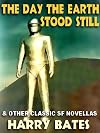
Rereading Arthur C. Clarke’s Childhood’s End (1953) inspired me to consider its connection with The Day the Earth Stood Still (1951). The film was directed by Robert Wise, the editor of Citizen Kane (1941), who would later direct West Side Story and The Sound of Music. He was not the usual B-Movie hack. He and his screenwriter had the good sense to change the name of the Bates robot from Gnut to Gort, thus avoiding all the silly jokes. Gort, Goliath-tall and show more all-silver-metal with only an eye-level slit for his death ray, is an imposing, sexless take on Dorothy’s Tin Woodsman. The humanoid emissary Klaatu is ultimately rescued by a kind-hearted woman. He leaves with Gort, telling us to be good, or else Gort will be back with his death ray. It is a symbolic warning about the Cold War nuclear arms race.
The point of the Bates novella Farewell to the Master (1940) is less political and more religious. Gnut looks nothing like he is portrayed in the movie: “For Gnut had almost exactly the shape of a man–a giant, but a man–with greenish metal for man's covering flesh, and greenish metal for man's bulging muscles. Except for a loincloth, he was nude. He stood like the powerful god of the machine of some undreamed-of scientific civilization, on his face a look of sullen, brooding thought.” Gort is a dangerous machine, while Gnut is a sleeping god. He can take Klaatu from the mausoleum and bring him back to life. When he tells us that he, not Klaatu, is “the master,” we are only a little surprised. The clear message is that when the gods show up, you won’t recognize them.
Childhood’s End borrows more from the story than the film. Clarke’s overlords look like the traditional images of Satan, and they bring not a warning but an apocalypse and a rapture. It is no surprise that Clarke has improved on his sources. show less
Rereading Arthur C. Clarke’s Childhood’s End (1953) inspired me to consider its connection with The Day the Earth Stood Still (1951). The film was directed by Robert Wise, the editor of Citizen Kane (1941), who would later direct West Side Story and The Sound of Music. He was not the usual B-Movie hack. He and his screenwriter had the good sense to change the name of the Bates robot from Gnut to Gort, thus avoiding all the silly jokes. Gort, Goliath-tall and show more all-silver-metal with only an eye-level slit for his death ray, is an imposing, sexless take on Dorothy’s Tin Woodsman. The humanoid emissary Klaatu is ultimately rescued by a kind-hearted woman. He leaves with Gort, telling us to be good, or else Gort will be back with his death ray. It is a symbolic warning about the Cold War nuclear arms race.
The point of the Bates novella Farewell to the Master (1940) is less political and more religious. Gnut looks nothing like he is portrayed in the movie: “For Gnut had almost exactly the shape of a man–a giant, but a man–with greenish metal for man's covering flesh, and greenish metal for man's bulging muscles. Except for a loincloth, he was nude. He stood like the powerful god of the machine of some undreamed-of scientific civilization, on his face a look of sullen, brooding thought.” Gort is a dangerous machine, while Gnut is a sleeping god. He can take Klaatu from the mausoleum and bring him back to life. When he tells us that he, not Klaatu, is “the master,” we are only a little surprised. The clear message is that when the gods show up, you won’t recognize them.
Childhood’s End borrows more from the story than the film. Clarke’s overlords look like the traditional images of Satan, and they bring not a warning but an apocalypse and a rapture. It is no surprise that Clarke has improved on his sources. show less
No doubt anyone looking at this book knows that this story by Harry Bates is the inspiration for the classic movie, “The Day the Earth Stood Still.” Dennis Herrick published the story here, in reprint, as a labor of love. He is a collector of “first contact” science fiction, providing here as an appendix a list of more than 200 other “first contact” stories and books.
“Farewell to the Master” was originally published in 1940, in Astounding magazine. The story itself is now show more overshadowed by the movie, but the story is entertaining in its own right. The movie departs significantly from the story, especially the story’s ending (which I won’t give away). The movie runs in the present tense, with Klaatu arriving, the unfortunate attack on him, his escape, and his return to deliver his message, all under the protection of the robot Gort.
The story is very different. It begins after Klaatu has been shot, killed, and buried in a mausoleum in Washington’s Tidal Basin. The robot Gnut (renamed for the movie) stands watch over Klaatu’s ship, housed in a museum that has been built around it. Researchers work to understand the ship, and Gnut. The ship itself is referred to as a “time-space” ship — its arrival was not, as in the movie, a landing but a sudden appearance, as if transported instantly through time and space rather than through spaceflight.
Cliff Sutherland is the central character of the story, a reporter who observes and studies Gnut. Gnut, as the story starts, stands a steady, unmoving, unreacting vigil over the ship. Sutherland hides in the museum overnight to watch Gnut, to see if there is any life or movement to him at all.
Many pieces of the movie — the escape of Klaatu, his brief life as “Mr. Carpenter”, the roles of Helen Benson and her son, her fiance Tom Stevens, Professor Barnhardt, even the demonstration by Klaatu — are not in the story itself. The story is more enigmatic, more surprising and mysterious.
To say more than I have about the plot would be to give away too much. It’s a fast, easy, fun read — bringing back from the past the flavor of science fiction well before we first reached space in the fifties and sixties. Mainly though, it’s worth reading out of curiosity — just to see what inspired the classic movie. show less
“Farewell to the Master” was originally published in 1940, in Astounding magazine. The story itself is now show more overshadowed by the movie, but the story is entertaining in its own right. The movie departs significantly from the story, especially the story’s ending (which I won’t give away). The movie runs in the present tense, with Klaatu arriving, the unfortunate attack on him, his escape, and his return to deliver his message, all under the protection of the robot Gort.
The story is very different. It begins after Klaatu has been shot, killed, and buried in a mausoleum in Washington’s Tidal Basin. The robot Gnut (renamed for the movie) stands watch over Klaatu’s ship, housed in a museum that has been built around it. Researchers work to understand the ship, and Gnut. The ship itself is referred to as a “time-space” ship — its arrival was not, as in the movie, a landing but a sudden appearance, as if transported instantly through time and space rather than through spaceflight.
Cliff Sutherland is the central character of the story, a reporter who observes and studies Gnut. Gnut, as the story starts, stands a steady, unmoving, unreacting vigil over the ship. Sutherland hides in the museum overnight to watch Gnut, to see if there is any life or movement to him at all.
Many pieces of the movie — the escape of Klaatu, his brief life as “Mr. Carpenter”, the roles of Helen Benson and her son, her fiance Tom Stevens, Professor Barnhardt, even the demonstration by Klaatu — are not in the story itself. The story is more enigmatic, more surprising and mysterious.
To say more than I have about the plot would be to give away too much. It’s a fast, easy, fun read — bringing back from the past the flavor of science fiction well before we first reached space in the fifties and sixties. Mainly though, it’s worth reading out of curiosity — just to see what inspired the classic movie. show less

Saw the trailer for the new movie and got curious. I love the short story, Farewell to the Master, which is what the movies were based on - VERY loosely, I must say. Like so many short stories that get turned into movies, a simple, elegant tale is turned into an action flick full of political strife and explosions. (Well, there was at least one explosion in the story too.) But the message of the short story is so entirely different from either movie. The moral figures in the movies are us, show more as the human race. The aliens say "clean up your act or you'll be destroyed." The moral figures in the story are the aliens themselves - earth's destruction is never in the picture at all. show less
The story that one of my favorite films, The Day the Earth Stood Still, is based on. The movie's better and much different from the story, but it's definitely worth a read, just to see the origin. It's a decent, page-turning read, but the ending doesn't make a lot of sense, and the tale doesn't really hold up to much analysis.
Read the story, but then watch the movie!
Read the story, but then watch the movie!
Lists
You May Also Like


Associated Authors
Statistics
- Works
- 63
- Also by
- 25
- Members
- 442
- Popularity
- #55,391
- Rating
- 4.0
- Reviews
- 6
- ISBNs
- 58
- Languages
- 1