
Harry Whittington (1915–1989)
Author of The Man from U.N.C.L.E.: The Doomsday Affair
About the Author
Series
Works by Harry Whittington
Die, Lover 3 copies
Strictly for the Boys 2 copies
Native Girl 1 copy
La caída del imperio romano 1 copy
HIS BROTHER'S WIFE 1 copy
Temptations of Valerie 1 copy
Dear Deadly Past 1 copy
Swamp Kill 1 copy
Black Lizard 1 copy
High Thunder / A Trap for Sam Dodge — Contributor — 1 copy
il morto chiamò la polizia 1 copy
mille bolle 1 copy
God's Back was Turned 1 copy
The Searching Rider 1 copy
Murhavekko 1 copy
Let’s Count Our Dead 1 copy
Satan's Widow 1 copy
Drygulch Town 1 copy
Vengeful Sinner 1 copy
The strange young wife 1 copy
Associated Works
Murder Plus: True Crime Stories from the Masters of Detective Fiction (1992) — Contributor — 46 copies
Tagged
Common Knowledge
- Legal name
- Whittington, Harry Benjamin
- Other names
- Harrison, Whit
Whitney, Hallam
Carter, Ashley
Evans, Tabor
Stevens, Blaine
White, Harry (show all 10)
Wells, Hondo
Holland, Kel
Stuart, Clay
Myers, Harriet Kathryn - Birthdate
- 1915-02-04
- Date of death
- 1989-06-11
- Gender
- male
- Nationality
- USA
- Birthplace
- Ocala, Florida, USA
- Associated Place (for map)
- Florida, USA
Members
Reviews

Harry Whittington was nicknamed the King of the Paperbacks, having penned over 170 of them in his lifetime. He was also one of the greatest of the pulp writers of the fifties and captured the essence of the pulpy feel almost effortlessly. “A Night For Screaming” is without question a five-star read.
It is filled with the sense of desperation, the sense of nowhere to turn to, down on your luck with the whole world turned against you. The backdrop is a hot, dusty, world where the show more protagonist drifts penniless and with the law after him for a murder he didn’t do, but how the hell is going to prove it. He is just running “like a conditioned mouse in a maze.” He can’t even bum a quarter from a lady on the main street without having her act like he’s crazy – even when “she looked like the busty, leggy brand of chick that got spoken to by any man with energy enough to open his mouth, which was just about what [he] had left.” “She had the arrogant look of the spoiled babe who has learned to take everything that isn’t freely rendered to her; laughter didn’t come easy to her unless there was a knife in it.” Ouch. This is without doubt a vicious little femme fatale. And that’s before he knows that Eve Cassell is the feudal lord’s wife, waving a whiskey bottle around and dressed in a blue nightgown and that “she’s a dame no ten men could ever satisfy.” And the men in this book. “Nothing organically wrong with them,” but what they “suffered was a virus of the soul.” This book is a gem. The plot may not be that complex, but Whittington fills it with descriptions of desperation, of meanness, of people struggling to get through each and every day. And, everyone is trapped inside a prison, some with bars, some without bars. show less
It is filled with the sense of desperation, the sense of nowhere to turn to, down on your luck with the whole world turned against you. The backdrop is a hot, dusty, world where the show more protagonist drifts penniless and with the law after him for a murder he didn’t do, but how the hell is going to prove it. He is just running “like a conditioned mouse in a maze.” He can’t even bum a quarter from a lady on the main street without having her act like he’s crazy – even when “she looked like the busty, leggy brand of chick that got spoken to by any man with energy enough to open his mouth, which was just about what [he] had left.” “She had the arrogant look of the spoiled babe who has learned to take everything that isn’t freely rendered to her; laughter didn’t come easy to her unless there was a knife in it.” Ouch. This is without doubt a vicious little femme fatale. And that’s before he knows that Eve Cassell is the feudal lord’s wife, waving a whiskey bottle around and dressed in a blue nightgown and that “she’s a dame no ten men could ever satisfy.” And the men in this book. “Nothing organically wrong with them,” but what they “suffered was a virus of the soul.” This book is a gem. The plot may not be that complex, but Whittington fills it with descriptions of desperation, of meanness, of people struggling to get through each and every day. And, everyone is trapped inside a prison, some with bars, some without bars. show less
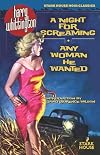
I recently read a comment somewhere -- and I can't remember where -- to the effect that anyone who hadn't read any Harrington was really a hardboiled/noir ignoramus, so I decided I'd better fill this egregious gap in my knowledge. That led me to this double volume . . . and to the urge to say a very loud thank you in absentia to whoever it was who made that comment. Really I'd prefer to give this 4.5 stars rather than just 4.
The first novel, A Night for Screaming (1960), sees younger cop show more Mitch Walker on the run from a false murder charge but more importantly from his own ex-partner Fred Palmer, a brutally sadistic cop whose torturous methods Mitch would rather die than experience first hand. Mitch finds refuge on the vast plantation/livestock farm run, using largely prison labour, by another brutal man, Barton M. Cassel. Cassel knows Mitch is on the run, and uses that fact to blackmail him into participating into an insurance scam, a plot that will also enable Cassel to frame Mitch for murdering the reluctant lover of Cassel's hot young wife Eve. Complicating matters is that Eve has now set her lustful sights on Mitch . . . After a relatively slow start in classic noir territory -- a small town diner, a pretty but faded waitress with a heart of gold, a pair of corrupt, bullying cops -- but then starts accelerating, until eventually the pages (of which there aren't all that many) are sort of sizzling past. I reached the tale's end gasping and much sooner than I'd anticipated.
Golly. Follow that!
The long, absorbing and erudite introduction to this volume by David Laurence Wilson gives the impression that the second novel, Any Woman He Wanted (1961, as by Whit Harrison), is a pretty insignificant piece by comparison, a novel in which Whittington's normally deft touch slipped a little. By contrast, I think I enjoyed even more than I did A Night for Screaming. Disillusioned, embittered, too-often brutal homicide cop Mike Ballard has little reason to like DA Tom Flynn, even though Flynn is a rare honest man trying to clean up a dirty town. Four years ago, Mike infiltrated the town's largest mob and brought it down; all Flynn could see was that Mike was in cahoots with mobsters, and he pursued him for it -- which is why Mike is currently on the lowest detective rung rather than in a senior position within the PD. Just to make matters worse, seven years ago Flynn married the love of Mike's life, Carolyn. But then Flynn is murdered and suddenly everyone's overeager to insist he committed suicide; and soon other honest cops who were involved in the investigation are being killed too, their cause of death likewise being covered up. When Mike's drinking friend The Greek is threatened and no one in the PD seems overly interested in giving him police protection, Mike at last decides to strike back against the crime overlords and their high-placed puppets. He finds the trail -- which soon becomes a trail of corpses -- leads far closer to the Flynn family and his own life than he could have imagined . . .
Mike isn't a character you're intended to like, with his tendency to default to violence at the drop of a hat, but he has the same kind of ethical integrity (and sexual moral code) as, say, Travis McGee in the John D. MacDonald novels. But he's a hero nevertheless . . . just not a hero you would yourself want to be.
Both novels have some great noirish lines ("They're all here. Not only his family, but everybody who ever hated Tom Flynn has shown up today [for the funeral]. I never saw so many black suits, and black ties -- and black dirty hearts" [p185]) as well as some lapses ("She still didn't see the hot eyes melting and running all over her" [p191]}, and Whittington has an irritating faux-characterization tic of describing people who're suffering spiritual malaise in terms of physical sickness ("The illness inside Ernie had turned his face a nice ash-gray" [p187]); further, the text has more typos than even a labour of love should have.
But these are minor carps. Go read. show less

Whittington was known as the “king of the paperbacks” and published in excess of 170 paperback novels in his lifetime. “Fires that Destroy” is a pulp crime novel, but it is not your classic action-packed crime
story. And, don’t read it expecting to be kept in suspense. There’s little
question from the first pages who is the killer or why or what the various characters will end up being. The novel is not about the action so much as the psychological motivations of the main show more character, Bernice Harper. In Joe Lansdale’s introduction to the novel, “Fires that Destroy” is compared to the great Cain novels, which pick apart
characters and show their descent into worlds of guilt and compromise.
Even though this novel is a character study rather than an wham-bam action story, it is somehow compelling and, once I started reading, it became very difficult to put down. The questions you are left with after
reading this are whether Bernice is to sympathized with or not. Is she simply a horrible person motivated by greed and lust or is she thrust into this situation by how society has treated her. She suffers from “ugly duckling syndrome” and thinks other women have always gotten
their way because of their looks and their figure and that she has suffered in comparison because she is somewhat lacking in the looks and appeal. Is this a justification for murder? Is it a justification for buying her way to happiness?
Is she somewhat out of her mind? Even when she is put in a good situation- being a companion to a rich, handsome blind man – she can’t trust that he would have picked her if he had sight and she
“hated herself because it was a joke to pawn her off as a looker on a man who couldn’t see her.”
In the end, is she just a sad case of someone to be pitied or has the
narrator fooled you into thinking this person who is motivated by uncontrollable lust and greed is someone decent if but for the way people look at her or if but for the men she picked or bought. “She grew up determined to have all the things she’d been denied,” Whittington explains. “To want was one thing – that was hell. To be
wanted – that was all that mattered. Her eyes filled with tears. Without that, you had nothing.”
It is, at base, a novel of obsession: “When finally you admit that you are going to kill a man, your obsession take over. You begin to plan how you can do it – and get away with it.” But, does the obsession go
away or are you forever haunted by guilt and shame for what you did.
Do you always think everyone suspects you or everyone is after you? How far can you run? How far can you hide from those nightmare eyes that keep haunting you?
This is a terrific novel and it makes you wonder why Whittington was not more widely recognized as one of the great American writers of the
mid-twentieth century. show less
story. And, don’t read it expecting to be kept in suspense. There’s little
question from the first pages who is the killer or why or what the various characters will end up being. The novel is not about the action so much as the psychological motivations of the main show more character, Bernice Harper. In Joe Lansdale’s introduction to the novel, “Fires that Destroy” is compared to the great Cain novels, which pick apart
characters and show their descent into worlds of guilt and compromise.
Even though this novel is a character study rather than an wham-bam action story, it is somehow compelling and, once I started reading, it became very difficult to put down. The questions you are left with after
reading this are whether Bernice is to sympathized with or not. Is she simply a horrible person motivated by greed and lust or is she thrust into this situation by how society has treated her. She suffers from “ugly duckling syndrome” and thinks other women have always gotten
their way because of their looks and their figure and that she has suffered in comparison because she is somewhat lacking in the looks and appeal. Is this a justification for murder? Is it a justification for buying her way to happiness?
Is she somewhat out of her mind? Even when she is put in a good situation- being a companion to a rich, handsome blind man – she can’t trust that he would have picked her if he had sight and she
“hated herself because it was a joke to pawn her off as a looker on a man who couldn’t see her.”
In the end, is she just a sad case of someone to be pitied or has the
narrator fooled you into thinking this person who is motivated by uncontrollable lust and greed is someone decent if but for the way people look at her or if but for the men she picked or bought. “She grew up determined to have all the things she’d been denied,” Whittington explains. “To want was one thing – that was hell. To be
wanted – that was all that mattered. Her eyes filled with tears. Without that, you had nothing.”
It is, at base, a novel of obsession: “When finally you admit that you are going to kill a man, your obsession take over. You begin to plan how you can do it – and get away with it.” But, does the obsession go
away or are you forever haunted by guilt and shame for what you did.
Do you always think everyone suspects you or everyone is after you? How far can you run? How far can you hide from those nightmare eyes that keep haunting you?
This is a terrific novel and it makes you wonder why Whittington was not more widely recognized as one of the great American writers of the
mid-twentieth century. show less

Harry Whittington was known as the "King of the Paperbacks." He published over 170 of them. He is best known for his fifties and sixties pulp novels. "Brute in Brass" is so good you'd think it would be more well known than it is. Every single page in this book is good. The writing is just fantastic.
What is the book about except the distance between Heaven and Hell? There's a man on death row and a crooked cop on the take. There's his mistress who has set up in an apartment and whose kid show more he's put through private school. There's the wife of the man on death row pleading with him to find evidence of actual innocence. There's the hoodlum who runs the town and everyone in it. And there's the commission looking for someone to take the fall.
Through every page you feel Mike Ballard struggle with a glimpse of heaven that seems just out of reach in the form of a woman who melts not just his heart but his soul. But it doesn't matter because the truth is he is just walking through hell.
Whittington wrote a powerful noir novel that isn't dark and gloomy. It's not filled with endless unnecessary descriptions. It's very easy to read and flows quickly. And when you finish, you just gotta find out what else the King has written. show less
What is the book about except the distance between Heaven and Hell? There's a man on death row and a crooked cop on the take. There's his mistress who has set up in an apartment and whose kid show more he's put through private school. There's the wife of the man on death row pleading with him to find evidence of actual innocence. There's the hoodlum who runs the town and everyone in it. And there's the commission looking for someone to take the fall.
Through every page you feel Mike Ballard struggle with a glimpse of heaven that seems just out of reach in the form of a woman who melts not just his heart but his soul. But it doesn't matter because the truth is he is just walking through hell.
Whittington wrote a powerful noir novel that isn't dark and gloomy. It's not filled with endless unnecessary descriptions. It's very easy to read and flows quickly. And when you finish, you just gotta find out what else the King has written. show less
You May Also Like


Associated Authors
Statistics
- Works
- 116
- Also by
- 2
- Members
- 918
- Popularity
- #27,945
- Rating
- 3.5
- Reviews
- 24
- ISBNs
- 84
- Languages
- 6