
Peter Schickele (1935–2024)
Author of The Definitive Biography of P. D. Q. Bach
About the Author
Disambiguation Notice:
(ger) P. D. Q. Bach ist eine Erfindung des amerikanischen Komponisten und Professors Peter Schickele als der letzte, unbekannte Sohn von Johann Sebastian Bach.
Birth: 1742-04-01, Baden-Baden, Germany
Death: 1807-05-05
P. D. Q. Bach is an invention of the US composer and professor Peter Schickele as the last unknown son of Johann Sebastian Bach. Fictional birth: 1742-04-01, Baden-Baden, Germany, and death: 1807-05-05.
Image credit: Prof. Peter Schickele at the Outer Banks Forum Saturday, 27 March 2010, photo by Peter Hummers
Works by Peter Schickele
Four folk song upsettings : for mezzanine-soprano, devious instruments, and piano (S. 4) (1996) 7 copies, 1 review
Toot Suite, S. 212 3 copies
The Intimate P.D.Q. Bach 3 copies
The Eminent Musicologist and Composer, Peter Schickele in a program of the recently discovered works of P.D.Q. Bach (1807 - 1742)? (1990) 2 copies
The emperor's new clothes : for narrator, oboe, violin, viola, violoncello, and piano (2008) 2 copies
The Wurst of P.D.Q. Bach 1 copy
liebeslieder polka 1 copy
The Seasonings, S. 1 1/2 tsp 1 copy
The wurst of P.D.Q. Bach 1 copy
Oedipus Tex (S.150) 1 copy
Sonata Piccola 1 copy
Noël. 1 copy
Guide my soul 1 copy
Little Suite for Susan 1 copy
Little Suite for Summer 1 copy
The Boston Wonder 1 copy
It was a lover and his lass : from Liebeslieder polkas (S. 2/4) : S.A.T.B. with piano, five hands 1 copy
P. D. Q. Bach Strikes Back 1 copy
Monochrome I 1 copy
Requiem for string orchestra 1 copy
The Wurst of P.D.Q. Bach 1 copy
Associated Works
Where the Wild Things Are...and 5 More Stories [1975 film] (1975) — Narrator / Music — 59 copies, 2 reviews
Where the Wild Things Are, Goldilocks and the Three Bears, Doctor De Soto, & Owl Moon (2006) — Narrator, some editions — 2 copies
Tagged
Common Knowledge
- Canonical name
- Schickele, Peter
- Legal name
- Schickele, Johann Peter
- Other names
- Bach, P. D. Q.
- Birthdate
- 1935-07-17
- Date of death
- 2024-01-16
- Gender
- male
- Education
- Swarthmore College
The Juilliard School - Occupations
- composer
bassoonist - Nationality
- USA
- Birthplace
- Ames, Iowa, USA
- Places of residence
- New York, New York, USA
Fargo, North Dakota, USA
Swarthmore, Pennsylvania, USA - Disambiguation notice
- P. D. Q. Bach is an invention of the US composer and professor Peter Schickele as the last unknown son of Johann Sebastian Bach.
Fictional birth: 1742-04-01, Baden-Baden, Germany, and death: 1807-05-05. - Associated Place (for map)
- USA
Members
Discussions
R.I.P. P.D.Q. 1807-1742? in Classical Music (February 2024)
Reviews

There seems to have been a kind of golden age of classical-music-based humour in the 1950s and 60s, with musically-literate audiences of our (grand-)parents’ generation filling concert halls to titter at the antics of people like Gerard Hoffnung and Victor Borge. Peter Schickele’s concerts of the music of PDQ Bach, which started out as a student prank at the Juilliard and went mainstream in New York in the mid-1960s, fitted squarely into this tradition.
Schickele managed to keep the joke show more going for longer than most, and eventually the fiction of J.S. Bach’s youngest son, the only completely untalented member of the dynasty, expanded from a silly name and a couple of parody pieces to a complete life-story, whilst Schickele built up a matching comic persona for himself as Very Full Professor of Musicolology and Musical Pathology at the University of Southern North Dakota at Hoople tracing fragments of PDQ’s music in the bottom of chamber pots and on the rubbish heaps of Central European inns.
In this biography, Schickele pokes fun at the conventions of musical literature in multiple ways, speculating at length about PDQ’s life-story for which, even in fiction, only the flimsiest bits of evidence survive. We know that he was apprenticed to a deranged carpenter and instrument maker, Zahnstocher (=Toothpick), that he was for a time Kapellmeister in the inebriated court of Prince Fred at Wein-am-Rhein, and that he ended up in the spa town of Baden Baden Baden after making a fortune from a travelling medicine show, but beyond that it is all speculation. And Schickele doesn’t hesitate to speculate.
The book is lavishly illustrated with crazy musical examples and wittily miscaptioned period engravings, and — as you would expect — the text is one long succession of bad jokes, perhaps the most flagrant of them being the passage where he embarks on a serious discussion of an abstruse bit of musical philosophy but the text runs off the bottom of the page into oblivion before he can get to the point.
At one point Schickele writes about his own research methods, illustrating his account with a photo-essay about the facilities of the USND at H (this location seems to be a dig at the agricultural college where his father used to teach). Each photo purporting to be a different faculty building actually shows the same isolated barn from a different angle.
The book ends with various useless appendices and a catalogue raisonné of PDQ Bach’s surviving works, including such old favourites as the Pervertimento and the cantata “Iphigenia in Brooklyn”.
Fun if you’re musically-minded and have a taste for slightly puerile humour! show less
Schickele managed to keep the joke show more going for longer than most, and eventually the fiction of J.S. Bach’s youngest son, the only completely untalented member of the dynasty, expanded from a silly name and a couple of parody pieces to a complete life-story, whilst Schickele built up a matching comic persona for himself as Very Full Professor of Musicolology and Musical Pathology at the University of Southern North Dakota at Hoople tracing fragments of PDQ’s music in the bottom of chamber pots and on the rubbish heaps of Central European inns.
In this biography, Schickele pokes fun at the conventions of musical literature in multiple ways, speculating at length about PDQ’s life-story for which, even in fiction, only the flimsiest bits of evidence survive. We know that he was apprenticed to a deranged carpenter and instrument maker, Zahnstocher (=Toothpick), that he was for a time Kapellmeister in the inebriated court of Prince Fred at Wein-am-Rhein, and that he ended up in the spa town of Baden Baden Baden after making a fortune from a travelling medicine show, but beyond that it is all speculation. And Schickele doesn’t hesitate to speculate.
The book is lavishly illustrated with crazy musical examples and wittily miscaptioned period engravings, and — as you would expect — the text is one long succession of bad jokes, perhaps the most flagrant of them being the passage where he embarks on a serious discussion of an abstruse bit of musical philosophy but the text runs off the bottom of the page into oblivion before he can get to the point.
At one point Schickele writes about his own research methods, illustrating his account with a photo-essay about the facilities of the USND at H (this location seems to be a dig at the agricultural college where his father used to teach). Each photo purporting to be a different faculty building actually shows the same isolated barn from a different angle.
The book ends with various useless appendices and a catalogue raisonné of PDQ Bach’s surviving works, including such old favourites as the Pervertimento and the cantata “Iphigenia in Brooklyn”.
Fun if you’re musically-minded and have a taste for slightly puerile humour! show less
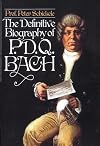
Peter Schickele died last week. I’ve seen him in person and was totally entertained. Since his death, I’ve watched some of his videos and read his book THE DEFINITIVE BIOGRAPHY OF PDQ BACH for the first time. My only complaint is that I wish I knew more about music.
The book is delightful and full of laughs that sneak up on you. For example, names of people and places and footnotes (do read them all). My husband, who is a musician, is sitting near me reading the book, cracking up at many show more of these passages. He’ll explain them to me when he finishes.
Some serious information explaining some of information does creep in but it is often an offshoot cloaked in humor such as defining terms like “What do you mean by form?”
Other examples of humor are found in chapter titles: Chapter 1 Early Infancy. 1742 to 1745. Chapter 2. Late Infancy 1745 to 1766.
“A man who triumphed over the most staggering obstacle ever place before a composer:: absolute and utter lack of talent.”
One sentence has 102 words and 27 commas.
There are descriptions and drawings of esoteric instruments as well as stories of his operas and compositions.
Schickele goes into detail analyzing the music. The more you know about the music, the funnier it will be.
At one point the author was trying to locate a person to get more information about P. D. Q. Bach. but the man was no longer at the monastery. “He had been exposed as a thief, and sent away with brand on his forehead signifying to all the world that he was a felonious monk.”
Unfortunately, I read an e-book version and the photography was blurry.
If you’re not familiar with PDQ Bach, go online and look at some of the videos. Here’s one: https://m.youtube.com/watch?v=WR4CdKSeD-E show less
The book is delightful and full of laughs that sneak up on you. For example, names of people and places and footnotes (do read them all). My husband, who is a musician, is sitting near me reading the book, cracking up at many show more of these passages. He’ll explain them to me when he finishes.
Some serious information explaining some of information does creep in but it is often an offshoot cloaked in humor such as defining terms like “What do you mean by form?”
Other examples of humor are found in chapter titles: Chapter 1 Early Infancy. 1742 to 1745. Chapter 2. Late Infancy 1745 to 1766.
“A man who triumphed over the most staggering obstacle ever place before a composer:: absolute and utter lack of talent.”
One sentence has 102 words and 27 commas.
There are descriptions and drawings of esoteric instruments as well as stories of his operas and compositions.
Schickele goes into detail analyzing the music. The more you know about the music, the funnier it will be.
At one point the author was trying to locate a person to get more information about P. D. Q. Bach. but the man was no longer at the monastery. “He had been exposed as a thief, and sent away with brand on his forehead signifying to all the world that he was a felonious monk.”
Unfortunately, I read an e-book version and the photography was blurry.
If you’re not familiar with PDQ Bach, go online and look at some of the videos. Here’s one: https://m.youtube.com/watch?v=WR4CdKSeD-E show less
From the table of contents to the index, this book is absolutely hilarious. P.D.Q. Bach is the worst composer in the history of music (or would be if he hadn't been made up by Peter Schickele). In this book Schickele summarizes the scholarship available thus far on the life and music of Johann Sebastian Bach's youngest son, P.D.Q. (apparently Bach was so unimpressed with his youngest child that he didn't even bother to give him a name, just initials that may or may not stand for anything). show more P.D.Q.'s legacy of "originality through incompentency" is obvious in the unconventional instruments he wrote for including bicycle, balloon, tromboon (a trombone with a bassoon's mouthpiece), pandemonium, steam calliope, kazoo, and oscar mayer weiner whistle, among many others. From his beginnings as a composer (The Initial Plunge period), to midlife when he found his niche (The Soused Period), to his later years (The Contrition Period), P.D.Q.'s music is so bad it's sure to make anyone laugh. Schickele was also able to blackmail a recording studio into producing albums of P.D.Q.'s discovered works, which I highly recommend to anyone who is willing to listen. This was a great book. show less
I have long enjoyed and found hilarious the Peter Schickele hoax/farce of P.D.Q. Bach. I first was introduced through the now defunct Detroit classical music FM station WQRS. After collecting records, I now have enjoyed this detailed and encompassing book-length treatment of the joke. I think it hits my funnybone the same way Monty Python does for being irreverent and smartly funny and I see in reading these old chestnuts that some of this stuff has crept into my own repertoire and become show more part of my own sense of humor... show less
Awards


You May Also Like


Associated Authors
Statistics
- Works
- 102
- Also by
- 4
- Members
- 763
- Popularity
- #33,345
- Rating
- 4.1
- Reviews
- 18
- ISBNs
- 24
- Languages
- 3
- Favorited
- 1