
Jaron Lanier
Author of You are not a gadget : a manifesto
About the Author
Image credit: photo by Flickr user vanz
Works by Jaron Lanier
Ten Arguments for Deleting Your Social Media Accounts Right Now (2018) — Author — 855 copies, 41 reviews
Dawn of the New Everything: Encounters with Reality and Virtual Reality (2017) 260 copies, 11 reviews
Haunted by Her Name 1 copy
Associated Works
This Will Make You Smarter: New Scientific Concepts to Improve Your Thinking (Edge Question Series) (2012) — Contributor — 899 copies, 17 reviews
The Next Fifty Years: Science in the First Half of the Twenty-first Century (2002) — Contributor — 410 copies, 10 reviews
Tagged
Common Knowledge
- Canonical name
- Lanier, Jaron
- Legal name
- Lanier, Jaron Zepel
- Birthdate
- 1960-05-03
- Gender
- male
- Education
- New Mexico State University
- Occupations
- writer
musician
computer scientist - Organizations
- VPL Research
Microsoft Research
Advanced Network and Services - Awards and honors
- Friedenspreis des Deutschen Buchhandels (2014)
- Agent
- Mandel, Jay
- Nationality
- USA
- Birthplace
- New York, New York, USA
- Associated Place (for map)
- New York, USA
Members
Reviews
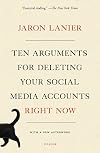
Un libro importante da leggere oggi, direi quasi “da far leggere a scuola”. Non ci si lasci ingannare dal titolo: non si tratta semplicemente di chiudere un account social per “protesta” contro le grandi corporation. Si tratta di ragionare con consapevolezza sull’effetto dei social media sulle nostre vite. Lanier a tratti assume toni fin troppo alti, paragonando la condotta di Facebook o Google a quella di sette religiose… ma non fanno forse lo stesso i loro portavoce, parlando show more di progetti pensati per rendere le persone immortali o le macchine più intelligenti di noi? Le 10 tesi di questo libro aiutano a capire perché siamo sempre più distanti, intolleranti e razzisti, con conseguenza politiche davanti agli occhi di tutti. Senza i social media e la non-etica che propongono, fatta di individualismo, popolarità e gare a chi fa la voce più grossa, in Italia probabilmente non avremmo al governo Lega e 5 stelle. A un livello forse meno radicale, questo libro aiuta a capire che cosa veramente abbiamo offerto in cambio di software che, gratis, sembrano semplificarci la vita. show less
To many people, Jaron Lanier is the father of virtual reality. He coined the term in its contemporary usage though points to an older, literary use. Lanier is a credit-sharer, not a credit-grabber, so this memoir of his childhood, early work and years at VPL Research, Inc. is full of sharing the credit with mentors and collaborators. Lanier, though, is not your typical Silicon Valley entrepreneur/coder/inventor.
First and foremost, Lanier is a humanist. Much of that may come from his show more unconventional childhood. He lost his mother in a car accident when he was young. He grew up in New Mexico in a house his father allowed him to design (geodesic, sort of). He was taking college classes before he graduated high school. In fact, he never graduated. Much of his life reads like Hunter S. Thompson without the drugs and misogyny. Wild, free, spontaneous, and on the edge, that was his life, but it was a life of learning, always thinking, always learning.
He talks about the development of virtual reality and computers. He also explains why he does not fear the singularity because he does not believe in artificial intelligence. He explains why VR is the anti-AI. In fact, he has fifty-two definitions of VR which is, of course, the “new everything.” He believes that as we develop technology, we also develop, that machines will not outpace us.
He is full of opinions that reflect his humanism. He thinks the “weightlessness” of the internet leads to the fakery, fraud, theft, and vile abusiveness that is so common. Folks do not have to invest themselves and that lets them be their worst selves. There, I am sure he is right.
What the heck did I just read? That’s kind of how I have felt all through reading Dawn of the New Everything. I enjoyed every minute of it, but it was a wild ride. I don’t have the background to make this an easy read. I don’t code. I know how to make bold and italic text, but that’s about it. Even simple things like hyperlinks, I have to look at a sample. So, this is a book that I expected to take me out of my comfort zone. It did more than that.
There’s a stream of consciousness kind of speed and spontaneity to the text. It feels like it was spoken, not written. Perhaps it was. More than anything, though, it was sort of hallucinogenic. I might not understand it all, but it’s all original. His major theme is that we need to center computing and technology on humanity, not on the technology for the sake of technology. Technology should be contoured to humanity and not seek to shape humanity to its contours.
Lanier sees risk in technology if it is produced without empathy, but also sees tremendous potential for technology, particularly virtual reality, to create empathy. I enjoyed this book very much even though it was a challenge and took me far too long to read it.
I received an e-galley of Dawn of the New Everything from the publisher through NetGalley. There were no photos or illustrations in the e-galley but I have paged through the released version and it’s full of pictures.
Dawn of the New Everything at Macmillan / Henry Holt & Co.
Jaron Lanier author site
Interview with Business Insider
https://tonstantweaderreviews.wordpress.com/2017/12/31/9781627794091/ show less
First and foremost, Lanier is a humanist. Much of that may come from his show more unconventional childhood. He lost his mother in a car accident when he was young. He grew up in New Mexico in a house his father allowed him to design (geodesic, sort of). He was taking college classes before he graduated high school. In fact, he never graduated. Much of his life reads like Hunter S. Thompson without the drugs and misogyny. Wild, free, spontaneous, and on the edge, that was his life, but it was a life of learning, always thinking, always learning.
He talks about the development of virtual reality and computers. He also explains why he does not fear the singularity because he does not believe in artificial intelligence. He explains why VR is the anti-AI. In fact, he has fifty-two definitions of VR which is, of course, the “new everything.” He believes that as we develop technology, we also develop, that machines will not outpace us.
He is full of opinions that reflect his humanism. He thinks the “weightlessness” of the internet leads to the fakery, fraud, theft, and vile abusiveness that is so common. Folks do not have to invest themselves and that lets them be their worst selves. There, I am sure he is right.
What the heck did I just read? That’s kind of how I have felt all through reading Dawn of the New Everything. I enjoyed every minute of it, but it was a wild ride. I don’t have the background to make this an easy read. I don’t code. I know how to make bold and italic text, but that’s about it. Even simple things like hyperlinks, I have to look at a sample. So, this is a book that I expected to take me out of my comfort zone. It did more than that.
There’s a stream of consciousness kind of speed and spontaneity to the text. It feels like it was spoken, not written. Perhaps it was. More than anything, though, it was sort of hallucinogenic. I might not understand it all, but it’s all original. His major theme is that we need to center computing and technology on humanity, not on the technology for the sake of technology. Technology should be contoured to humanity and not seek to shape humanity to its contours.
Lanier sees risk in technology if it is produced without empathy, but also sees tremendous potential for technology, particularly virtual reality, to create empathy. I enjoyed this book very much even though it was a challenge and took me far too long to read it.
I received an e-galley of Dawn of the New Everything from the publisher through NetGalley. There were no photos or illustrations in the e-galley but I have paged through the released version and it’s full of pictures.
Dawn of the New Everything at Macmillan / Henry Holt & Co.
Jaron Lanier author site
Interview with Business Insider
https://tonstantweaderreviews.wordpress.com/2017/12/31/9781627794091/ show less
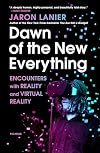
Lanier, Jaron. Dawn of the New Everything: Encounters with Reality and Virtual Reality. Holt, 2017.
In Dawn of the New Everything, Jaron Lanier combines a personal memoir with a history of the development of virtual reality programs and technologies. In theory, he separates the biographical and historical narratives into alternating chapters, but at times, the two become inseparable. His personal story is compelling. His mother was killed in a car wreck when he was nine, a loss he says show more affected his social development well into adulthood. He and his father lived in a tent for a while, and he built a geodesic dome while still a teenager. He skipped high school and went straight to college. He was intuitive, with an extraordinarily strong subjective reaction to sensory experience. He became a musician and composer and studied math and computer programming. He became a leading developer and advocate for virtual reality applications. He talks about virtual reality, a term he is said to have coined, with almost religious zeal. Nevertheless, he steers a middle course between naïve utopianism and equally naïve cynicism. The more experience we have with virtual reality, he says, the better able we will be to appreciate our nonvirtual sensory experience. He speaks nostalgically of his early days in Silicon Valley and laments the hucksterism he finds there now. Readers familiar with North Carolina’s Research Triangle will appreciate what he has to say about the virtual reality lab at the University of North Carolina in the 1980s. He explains how VR applications have grown beyond gaming and become an important part of medical training and practice. In the end, Lanier’s personality dominates the book—and that is a good thing. 5 stars. show less
In Dawn of the New Everything, Jaron Lanier combines a personal memoir with a history of the development of virtual reality programs and technologies. In theory, he separates the biographical and historical narratives into alternating chapters, but at times, the two become inseparable. His personal story is compelling. His mother was killed in a car wreck when he was nine, a loss he says show more affected his social development well into adulthood. He and his father lived in a tent for a while, and he built a geodesic dome while still a teenager. He skipped high school and went straight to college. He was intuitive, with an extraordinarily strong subjective reaction to sensory experience. He became a musician and composer and studied math and computer programming. He became a leading developer and advocate for virtual reality applications. He talks about virtual reality, a term he is said to have coined, with almost religious zeal. Nevertheless, he steers a middle course between naïve utopianism and equally naïve cynicism. The more experience we have with virtual reality, he says, the better able we will be to appreciate our nonvirtual sensory experience. He speaks nostalgically of his early days in Silicon Valley and laments the hucksterism he finds there now. Readers familiar with North Carolina’s Research Triangle will appreciate what he has to say about the virtual reality lab at the University of North Carolina in the 1980s. He explains how VR applications have grown beyond gaming and become an important part of medical training and practice. In the end, Lanier’s personality dominates the book—and that is a good thing. 5 stars. show less
I'm sympathetic to the author's complaints but the central idea of a utopian future that runs on microtransations paid to everyone based on the fact the they are alive and generate data is full of holes and self-contradictions. In the same book the author complains about how digitisable domains fall foul of a fat tail "superstar" distribution where only ones at the very top get any money at all but fails to see that this is what he proposes.
I think the most telling passage is when he show more mistakenly describes the Morlocks and the Eloi from the Time Machine by switching their ancestry around to conform to his views (claiming Morlocks descended from the rich and Eloi from the poor). What editor would let something like this slip through? The author might be a visionary but seeing what can be might be interfering with seeing what is. He genuinely believes the digital economy is the biggest obstacle and threat and traditional problems of resources, wars etc. don't come into it.
He also pre-emptively admits that he hasn't really worked out any details and then goes on to list random minutiae of his proposed system but at the same time admits no critique of the technical or logical feasibility because the details will work themselves out correctly naturally. How do you engage that kind of discussion?
There are also a lot of passive aggressive comments on the economy shutting down his industries of choice and this must be the first time I've seen someone use "open source/linux/wikipedia types" as an insult. Then again he does mention he works for Microsoft but I think that's a bit beyond towing the company line. show less
I think the most telling passage is when he show more mistakenly describes the Morlocks and the Eloi from the Time Machine by switching their ancestry around to conform to his views (claiming Morlocks descended from the rich and Eloi from the poor). What editor would let something like this slip through? The author might be a visionary but seeing what can be might be interfering with seeing what is. He genuinely believes the digital economy is the biggest obstacle and threat and traditional problems of resources, wars etc. don't come into it.
He also pre-emptively admits that he hasn't really worked out any details and then goes on to list random minutiae of his proposed system but at the same time admits no critique of the technical or logical feasibility because the details will work themselves out correctly naturally. How do you engage that kind of discussion?
There are also a lot of passive aggressive comments on the economy shutting down his industries of choice and this must be the first time I've seen someone use "open source/linux/wikipedia types" as an insult. Then again he does mention he works for Microsoft but I think that's a bit beyond towing the company line. show less
Lists
Awards


You May Also Like


Associated Authors
Statistics
- Works
- 10
- Also by
- 6
- Members
- 3,519
- Popularity
- #7,217
- Rating
- 3.5
- Reviews
- 129
- ISBNs
- 90
- Languages
- 11
- Favorited
- 5
