
Benjamin E. Sasse
Author of The Vanishing American Adult
About the Author
Image credit: US Senate Official Portrait
Works by Benjamin E. Sasse
Tagged
Common Knowledge
- Canonical name
- Sasse, Benjamin E.
- Legal name
- Sasse, Benjamin Eric
- Birthdate
- 1972-02-22
- Gender
- male
- Education
- Yale (PhD|History)
- Occupations
- politician
university professor
university adminstrator
government official - Organizations
- University of Texas
U.S. Department of Health and Human Services
Midland University
U.S. Senate
Republican Party
Westminster Seminary California (show all 7)
United Reformed Churches in North America - Nationality
- USA
- Birthplace
- Plainview, Nebraska, USA
- Places of residence
- Texas, USA
Washington, D.C., USA
Fremont, Nebraska, USA - Associated Place (for map)
- USA
Members
Reviews
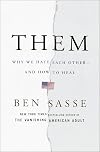
Rating: 4* of five
The Publisher Says: From the New York Times bestselling author of The Vanishing American Adult, an intimate and urgent assessment of the existential crisis facing our nation.
Something is wrong. We all know it.
American life expectancy is declining for a third straight year. Birth rates are dropping. Nearly half of us think the other political party isn’t just wrong; they’re evil. We’re the richest country in history, but we’ve never been more pessimistic. What’s show more causing the despair?
In Them, bestselling author and U.S. Senator Ben Sasse argues that, contrary to conventional wisdom, our crisis isn’t really about politics. It’s that we’re so lonely we can’t see straight—and it bubbles out as anger.
Local communities are collapsing. Across the nation, little leagues are disappearing, Rotary clubs are dwindling, and in all likelihood, we don’t know the neighbor two doors down. Work isn’t what we’d hoped: less certainty, few lifelong coworkers, shallow purpose. Stable families and enduring friendships—life’s fundamental pillars—are in statistical freefall.
As traditional tribes of place evaporate, we rally against common enemies so we can feel part of on a team. No institutions command widespread public trust, enabling foreign intelligence agencies to use technology to pick the scabs on our toxic divisions. We’re in danger of half of us believing different facts than the other half, and the digital revolution throws gas on the fire.
There’s a path forward—but reversing our decline requires something radical: a rediscovery of real places and real human-to-human relationships. Even as technology nudges us to become rootless, Sasse shows how only a recovery of rootedness can heal our lonely souls.
America wants you to be happy, but more urgently, America needs you to love your neighbor. Fixing what’s wrong with the country depends on you rebuilding right where you’re planted.
I CHECKED THIS BOOK OUT FROM THE PRIME LENDING SERVICE. USE THEM OFTEN, THEY PAY AUTHORS FOR OUR USE.
My Review: I'm allergic to old-fasihoned neighborliness, community-building exercises, the idea that living in the same zip code says something fundamental about my connection to people.
In days of yore, that would've marked me out as weird. Now that makes me...for the first time in my adult life...mainstream. And what did Mark Twain say about about agreeing with the majority? "Whenever you find yourself on the side of the majority, it is time to reform (or pause and reflect)."
I doubt I can change much, but others? There's hope for them and by extension all of us.
That Author Sasse is a Republican should tell anyone who knows me everything I need to convey by reporting positive agreement with his prescription for what ails the US body politic. (Also, per Wikipedia, Senator Sasse: "{o}n February 13, 2021, ...was one of seven Republican senators to vote to convict Donald Trump of incitement of insurrection in his second impeachment trial."} Go former Senator Sasse!)
The anomie and isolation of seemingly the majority of young people is absolutely terrifying. What Author Sasse posits as solutions earn all my four stars. His framing of the problems we face is resolutely inside the educated elite PoV one would expect from a lifelong academic and former Senator. Only in the funhouse mirror of US politics is this man in any way a centrist. He is also not wrong.
Many of the rights and norms Author Sasse identified as under threat in this 2018 book, eg the inalienable rights of all individuals including habeas corpus, and the freedom of conscience and the right to exercise it in private life (the Dobbs decision rises before my appalled eyes),have been explicitly targeted by the current administration. It's been a long, slow process to dumb down and distract people away from the assault on our institutions of trust and collective action. Look at Project 2025's digital ghosts.
A big part of that process has been the demonization and politicization of Others. When someone is Other, they're not protected like you should be, or protected from you like they should be. A long and successful campaign to convince people "They" are a threat to decency and rightness has been waged by the real "Them" the actual political operators of the Heritage Foundation, the Federalist Society, and so on.
Destroying the people's willingness to see each other as real, decent people who might disagree on things but who nonetheless have a lot in common, or divide and conquer, has been the colonizer's, the fascist's, the authoritarian's cornerstone strategy for millennia. It hasn't stopped working yet.
You, as an individual, have to stop falling for it in order to defeat it.
Read some of Sasse's ideas and try them out. show less
The Publisher Says: From the New York Times bestselling author of The Vanishing American Adult, an intimate and urgent assessment of the existential crisis facing our nation.
Something is wrong. We all know it.
American life expectancy is declining for a third straight year. Birth rates are dropping. Nearly half of us think the other political party isn’t just wrong; they’re evil. We’re the richest country in history, but we’ve never been more pessimistic. What’s show more causing the despair?
In Them, bestselling author and U.S. Senator Ben Sasse argues that, contrary to conventional wisdom, our crisis isn’t really about politics. It’s that we’re so lonely we can’t see straight—and it bubbles out as anger.
Local communities are collapsing. Across the nation, little leagues are disappearing, Rotary clubs are dwindling, and in all likelihood, we don’t know the neighbor two doors down. Work isn’t what we’d hoped: less certainty, few lifelong coworkers, shallow purpose. Stable families and enduring friendships—life’s fundamental pillars—are in statistical freefall.
As traditional tribes of place evaporate, we rally against common enemies so we can feel part of on a team. No institutions command widespread public trust, enabling foreign intelligence agencies to use technology to pick the scabs on our toxic divisions. We’re in danger of half of us believing different facts than the other half, and the digital revolution throws gas on the fire.
There’s a path forward—but reversing our decline requires something radical: a rediscovery of real places and real human-to-human relationships. Even as technology nudges us to become rootless, Sasse shows how only a recovery of rootedness can heal our lonely souls.
America wants you to be happy, but more urgently, America needs you to love your neighbor. Fixing what’s wrong with the country depends on you rebuilding right where you’re planted.
I CHECKED THIS BOOK OUT FROM THE PRIME LENDING SERVICE. USE THEM OFTEN, THEY PAY AUTHORS FOR OUR USE.
My Review: I'm allergic to old-fasihoned neighborliness, community-building exercises, the idea that living in the same zip code says something fundamental about my connection to people.
In days of yore, that would've marked me out as weird. Now that makes me...for the first time in my adult life...mainstream. And what did Mark Twain say about about agreeing with the majority? "Whenever you find yourself on the side of the majority, it is time to reform (or pause and reflect)."
I doubt I can change much, but others? There's hope for them and by extension all of us.
That Author Sasse is a Republican should tell anyone who knows me everything I need to convey by reporting positive agreement with his prescription for what ails the US body politic. (Also, per Wikipedia, Senator Sasse: "{o}n February 13, 2021, ...was one of seven Republican senators to vote to convict Donald Trump of incitement of insurrection in his second impeachment trial."} Go former Senator Sasse!)
The anomie and isolation of seemingly the majority of young people is absolutely terrifying. What Author Sasse posits as solutions earn all my four stars. His framing of the problems we face is resolutely inside the educated elite PoV one would expect from a lifelong academic and former Senator. Only in the funhouse mirror of US politics is this man in any way a centrist. He is also not wrong.
Many of the rights and norms Author Sasse identified as under threat in this 2018 book, eg the inalienable rights of all individuals including habeas corpus, and the freedom of conscience and the right to exercise it in private life (the Dobbs decision rises before my appalled eyes),have been explicitly targeted by the current administration. It's been a long, slow process to dumb down and distract people away from the assault on our institutions of trust and collective action. Look at Project 2025's digital ghosts.
A big part of that process has been the demonization and politicization of Others. When someone is Other, they're not protected like you should be, or protected from you like they should be. A long and successful campaign to convince people "They" are a threat to decency and rightness has been waged by the real "Them" the actual political operators of the Heritage Foundation, the Federalist Society, and so on.
Destroying the people's willingness to see each other as real, decent people who might disagree on things but who nonetheless have a lot in common, or divide and conquer, has been the colonizer's, the fascist's, the authoritarian's cornerstone strategy for millennia. It hasn't stopped working yet.
You, as an individual, have to stop falling for it in order to defeat it.
Read some of Sasse's ideas and try them out. show less
My oldest Facebook posts are from May 2008, which means a third of my life has been spent in the blue light of social media. I remember the time before, but it feels like a different world — and that’s a big part of what concerns former Nebraska Senator Ben Sasse.
Anyone who’s spent years in the social media space has seen the discourse degenerate to the point that it feels as if the only thing we have in common is mutual loathing. It’s difficult to imagine a bright future for people show more this wracked by distrust, dislike, and hate.
Sasse’s diagnosis is that America is in the throes of a loneliness crisis. Technological revolutions have disrupted age-old patterns of work, migration, and family. We're losing our sense of place, leaving us more isolated from tangible flesh-and-blood people than ever before. Seeking the society we crave, we’re more vulnerable than ever to the malevolent anti-tribes: loose collections of online strangers with no organizing principle other than the fact that we dislike the same things.
This ability to huddle in front of our phones, cocooning ourselves in negative echo chambers, has proven corrosive to national unity. When you exist in a real-life local tribe, the need to solve local problems incentivizes debate, compromise, consensus, and community. When you exist in a digital anti-tribe, the incentives are toward hating your enemies as extravagantly as possible.
The result is not a continent unified on the American dream, but an archipelago of islands at war in a sea of mutual incomprehension. The way back won’t start with government or business or thought leaders: it will come only as individuals, families, and communities choose to unplug from the industries of online hate, reconnect with real neighbors, and build real relationships with real people.
I like this book, which neatly straddles the space between Charles Murray’s “Coming Apart” and Yuval Harari’s “Homo Deus.” Sasse recognizes that technology is only accelerating the fracturing that Murray documented in great detail, and with Harari recognizes that technology is driving us toward a biomechanical future so fast that we haven’t even begun to count the cost.
Where Sasse shines is how he zeroes in on loneliness as a key driver of our disintegrating society. Tech is not the problem, nor is partisan politics, nor are economics. The problem is that we’ve taken the infinite potential of our tools and used them to silo ourselves. We create alliances on Internet battlefields as a sickly and harmful substitute for difficult but rewarding friendships over the back fence.
Sasse writes in an easy conversational style that’s pleasant and engaging. Despite being one of the most conservative Republican senators at the time of writing, he’s even-handed in his handling of the culture of spite. If anything, he’s harder on his own team than he is on progressives. And you’d expect nothing less: after all, according to him, healing comes when you turn off your smart phone and start pulling weeds in your own backyard. show less
Anyone who’s spent years in the social media space has seen the discourse degenerate to the point that it feels as if the only thing we have in common is mutual loathing. It’s difficult to imagine a bright future for people show more this wracked by distrust, dislike, and hate.
Sasse’s diagnosis is that America is in the throes of a loneliness crisis. Technological revolutions have disrupted age-old patterns of work, migration, and family. We're losing our sense of place, leaving us more isolated from tangible flesh-and-blood people than ever before. Seeking the society we crave, we’re more vulnerable than ever to the malevolent anti-tribes: loose collections of online strangers with no organizing principle other than the fact that we dislike the same things.
This ability to huddle in front of our phones, cocooning ourselves in negative echo chambers, has proven corrosive to national unity. When you exist in a real-life local tribe, the need to solve local problems incentivizes debate, compromise, consensus, and community. When you exist in a digital anti-tribe, the incentives are toward hating your enemies as extravagantly as possible.
The result is not a continent unified on the American dream, but an archipelago of islands at war in a sea of mutual incomprehension. The way back won’t start with government or business or thought leaders: it will come only as individuals, families, and communities choose to unplug from the industries of online hate, reconnect with real neighbors, and build real relationships with real people.
I like this book, which neatly straddles the space between Charles Murray’s “Coming Apart” and Yuval Harari’s “Homo Deus.” Sasse recognizes that technology is only accelerating the fracturing that Murray documented in great detail, and with Harari recognizes that technology is driving us toward a biomechanical future so fast that we haven’t even begun to count the cost.
Where Sasse shines is how he zeroes in on loneliness as a key driver of our disintegrating society. Tech is not the problem, nor is partisan politics, nor are economics. The problem is that we’ve taken the infinite potential of our tools and used them to silo ourselves. We create alliances on Internet battlefields as a sickly and harmful substitute for difficult but rewarding friendships over the back fence.
Sasse writes in an easy conversational style that’s pleasant and engaging. Despite being one of the most conservative Republican senators at the time of writing, he’s even-handed in his handling of the culture of spite. If anything, he’s harder on his own team than he is on progressives. And you’d expect nothing less: after all, according to him, healing comes when you turn off your smart phone and start pulling weeds in your own backyard. show less
The Vanishing American Adult: Our Coming-of-Age Crisis--and How to Rebuild a Culture of Self-Reliance by Benjamin E. Sasse
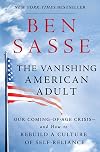
Summary: Concerned about the passivity he observes among many emerging adults, the author proposes five character building habits to foster resilient, responsible adults and wisely engaged citizens.
As a college president, Ben Sasse quickly became acquainted with the passivity, fragility and a sense of entitlement in his student body. As a U.S. Senator from Nebraska, he is deeply disturbed at the implications this has for our republic. As a parent, he writes about the steps he thinks he (and show more we) need to take, beginning in our own families to reverse this trend.
His first three chapters chronicle the problem of endless adolescence, using the story of Peter Pan in Neverland as a metaphor. He describes a generation on more medications, addicted to screens, and for many pornography, as well as living at home longer and marrying later if at all, and intellectually fragile, wanting "safe zones" instead of fighting for free speech. He is not at all convinced that the answer lies with our schools and writes critically of the role John Dewey played in a public school movement that relegated parents and other mediating structures to inferior and subsidiary role in the development of children. He contends most crucially that schools are failing to teach children how to learn, harking back to Dorothy Sayers' Lost Tools of Learning, and particularly the lost focus on the trivium of grammar, logic, and rhetoric.
Sasse then proposes five habits that he believes may begin to address the deficits he observes:
1. Fleeing Age Segregation. He believes our society has become highly age segregated, isolating generations from each other, giving emerging adults no contact with life in its different stages, the changes that occur in body and mind, and the realities of death and birth, which he believes it important to witness.
2. Embrace Work Pain. He observes that many youth never have experiences where they have to persist through pain or struggle to complete a hard task and encourages various volunteer and work experiences from childhood on.
3. Consume Less. He observes the paradox of material affluence and the stress and lack of happiness that walk hand in hand and proposes steps to defer material gratification to focus on more significant life priorities.
4. Travel To See. He argues that traveling early and often and learning to travel light exposes one to the world beyond one's own enclave that helps one define more deeply the values one wants to embrace.
5. Build a Bookshelf. He argues that America is fundamentally an idea, and that the stock of ideas we accrue from our reading is critical not only to the richness of our own lives but to our citizenship. He describes his process of developing both his own and his children's "bookshelves" and gives us some interesting reading suggestions.
Sasse makes it clear that this is not a book about policy. But neither is it simply about parenting our children. It is about the polis. He believes what makes America exceptional is its ideas, and that developing a rising generation of people who assume personal responsibility, who can face challenges with resilience, and know how to think rigorously and to engage others ideas with both civility and tenacity. He then concludes the book with imagining what Teddy Roosevelt would say to a high school graduating class.
This is both an engaging and demanding book. Sasse tells stories about his own upbringing, some of the crazy things he did with his friends that shaped him, and about how he and his wife Melissa are raising their children (including experiences one daughter had castrating bulls on a ranch where she worked). With each of his five "habits" he concludes the chapter with practical "stepping stones." He is also a person who believes ideas have consequences and devotes significant space in each chapter to the intellectual history of the things he is talking about. This could be off-putting for some, and yet it illustrates his conviction that the ideas we embrace, and that in turn, shape us both individually and collectively, matter. Reading Sasse, you will encounter Augustine, Rousseau, Dewey and Tocqueville, among others.
Sasse is a conservative and has the third most conservative voting record in the Senate. He clearly is one who believes in limited federal government and the importance of local "mediating institutions" and the critical importance of a virtuous, informed citizenry. He shares the Republican Party's suspicion of public education (but advocates for public education may want to listen to his concerns that the role of parents is often usurped by education "experts," and that more money and more technology often is not translating into better education). But he addresses a phenomenon that has to be of concern to every public official--the character of the rising generation, and how they are being prepared for responsible adulthood.
I don't think Ben Sasse would mind if you disagree with him. He strikes me as someone who values a good argument. His internal argument, weighing Augustine and Rousseau against each other, suggests that all he would ask is that you give him a good argument in return. That, he would think, is what adults do. show less
As a college president, Ben Sasse quickly became acquainted with the passivity, fragility and a sense of entitlement in his student body. As a U.S. Senator from Nebraska, he is deeply disturbed at the implications this has for our republic. As a parent, he writes about the steps he thinks he (and show more we) need to take, beginning in our own families to reverse this trend.
His first three chapters chronicle the problem of endless adolescence, using the story of Peter Pan in Neverland as a metaphor. He describes a generation on more medications, addicted to screens, and for many pornography, as well as living at home longer and marrying later if at all, and intellectually fragile, wanting "safe zones" instead of fighting for free speech. He is not at all convinced that the answer lies with our schools and writes critically of the role John Dewey played in a public school movement that relegated parents and other mediating structures to inferior and subsidiary role in the development of children. He contends most crucially that schools are failing to teach children how to learn, harking back to Dorothy Sayers' Lost Tools of Learning, and particularly the lost focus on the trivium of grammar, logic, and rhetoric.
Sasse then proposes five habits that he believes may begin to address the deficits he observes:
1. Fleeing Age Segregation. He believes our society has become highly age segregated, isolating generations from each other, giving emerging adults no contact with life in its different stages, the changes that occur in body and mind, and the realities of death and birth, which he believes it important to witness.
2. Embrace Work Pain. He observes that many youth never have experiences where they have to persist through pain or struggle to complete a hard task and encourages various volunteer and work experiences from childhood on.
3. Consume Less. He observes the paradox of material affluence and the stress and lack of happiness that walk hand in hand and proposes steps to defer material gratification to focus on more significant life priorities.
4. Travel To See. He argues that traveling early and often and learning to travel light exposes one to the world beyond one's own enclave that helps one define more deeply the values one wants to embrace.
5. Build a Bookshelf. He argues that America is fundamentally an idea, and that the stock of ideas we accrue from our reading is critical not only to the richness of our own lives but to our citizenship. He describes his process of developing both his own and his children's "bookshelves" and gives us some interesting reading suggestions.
Sasse makes it clear that this is not a book about policy. But neither is it simply about parenting our children. It is about the polis. He believes what makes America exceptional is its ideas, and that developing a rising generation of people who assume personal responsibility, who can face challenges with resilience, and know how to think rigorously and to engage others ideas with both civility and tenacity. He then concludes the book with imagining what Teddy Roosevelt would say to a high school graduating class.
This is both an engaging and demanding book. Sasse tells stories about his own upbringing, some of the crazy things he did with his friends that shaped him, and about how he and his wife Melissa are raising their children (including experiences one daughter had castrating bulls on a ranch where she worked). With each of his five "habits" he concludes the chapter with practical "stepping stones." He is also a person who believes ideas have consequences and devotes significant space in each chapter to the intellectual history of the things he is talking about. This could be off-putting for some, and yet it illustrates his conviction that the ideas we embrace, and that in turn, shape us both individually and collectively, matter. Reading Sasse, you will encounter Augustine, Rousseau, Dewey and Tocqueville, among others.
Sasse is a conservative and has the third most conservative voting record in the Senate. He clearly is one who believes in limited federal government and the importance of local "mediating institutions" and the critical importance of a virtuous, informed citizenry. He shares the Republican Party's suspicion of public education (but advocates for public education may want to listen to his concerns that the role of parents is often usurped by education "experts," and that more money and more technology often is not translating into better education). But he addresses a phenomenon that has to be of concern to every public official--the character of the rising generation, and how they are being prepared for responsible adulthood.
I don't think Ben Sasse would mind if you disagree with him. He strikes me as someone who values a good argument. His internal argument, weighing Augustine and Rousseau against each other, suggests that all he would ask is that you give him a good argument in return. That, he would think, is what adults do. show less
The Vanishing American Adult: Our Coming-of-Age Crisis--and How to Rebuild a Culture of Self-Reliance by Benjamin E. Sasse
Senator Ben Sasse laments the loss of grit, resilience, and initiative in the emerging generation of today's young people. Perpetual adolescence is now commonplace. Entitled, coddled, soft, and intellectually fragile seem like more accurate terms to describe today's rising youth. But Sasse is no outdated, finger wagging codger. While some find it easy to pick on younger generations for various foibles, Sasse notes that some of the fault lies with the older generations for failing to show more intentionally approach the shaping and training of younger generations.
Drawing from experience as a university president and current U.S. senator, Sasse outlines a handful of macro themes which have contributed to the current state of affairs. These include the indulgence of more material goods than ever before, an increase in age segregated environments, collapsing households, the moral hallowing of schooling, and a fraying of a national consensus on goals and ideals (ch. 1). His insights are historical and insightful. While part 1 highlights the passivity problem, part 2 looks at a prospective way forward. Sasse's script calls it an active program, contrasting with the passivity problem from chs. 1-3. His approach includes habits to cultivate in order to train up more rugged, hard-working, persevering young people. He churns out the next 170 pages delving into ideas such as fleeing age segregation, embracing work pain, consuming less, traveling, building a bookshelf, and making America an idea again.
Regardless of where one aligns along partisan lines, children are important, Sasse says. Once the goal of fully formed, vivacious, capable adults is agreed upon, solutions can be debated over. There is a far bigger divide in America between an engaged vs. unengaged citizenry than mere right vs. left. For a democracy to work, an engaged and informed citizenry is required. Sasse brings these points to light in his helpful postscript.
I really like a lot of things about this book and hope to champion some of the same ideals working as an educator. show less
Drawing from experience as a university president and current U.S. senator, Sasse outlines a handful of macro themes which have contributed to the current state of affairs. These include the indulgence of more material goods than ever before, an increase in age segregated environments, collapsing households, the moral hallowing of schooling, and a fraying of a national consensus on goals and ideals (ch. 1). His insights are historical and insightful. While part 1 highlights the passivity problem, part 2 looks at a prospective way forward. Sasse's script calls it an active program, contrasting with the passivity problem from chs. 1-3. His approach includes habits to cultivate in order to train up more rugged, hard-working, persevering young people. He churns out the next 170 pages delving into ideas such as fleeing age segregation, embracing work pain, consuming less, traveling, building a bookshelf, and making America an idea again.
Regardless of where one aligns along partisan lines, children are important, Sasse says. Once the goal of fully formed, vivacious, capable adults is agreed upon, solutions can be debated over. There is a far bigger divide in America between an engaged vs. unengaged citizenry than mere right vs. left. For a democracy to work, an engaged and informed citizenry is required. Sasse brings these points to light in his helpful postscript.
I really like a lot of things about this book and hope to champion some of the same ideals working as an educator. show less
You May Also Like


Associated Authors
Statistics
- Works
- 4
- Members
- 1,163
- Popularity
- #22,093
- Rating
- 3.8
- Reviews
- 33
- ISBNs
- 17
- Languages
- 1