
Yuval Levin
Author of The Great Debate: Edmund Burke, Thomas Paine, and the Birth of Right and Left
About the Author
Yuval Levin is the Hertog Fellow at the Ethics and Public Policy Center and the founder and editor of National Affairs. A former White House advisor and congressional staffer, and a current contributing editor to National Review and the Weekly Standard, Levin lives in Maryland.
Works by Yuval Levin
The Great Debate: Edmund Burke, Thomas Paine, and the Birth of Right and Left (2013) 365 copies, 7 reviews
The Fractured Republic: Renewing America's Social Contract in the Age of Individualism (2016) 223 copies, 6 reviews
A Time to Build: From Family and Community to Congress and the Campus, How Recommitting to Our Institutions Can Revive the American Dream (2020) 122 copies, 1 review
American Covenant: How the Constitution Unified Our Nation―and Could Again (2024) 54 copies, 2 reviews
Tagged
Common Knowledge
- Birthdate
- 1977-04-06
- Gender
- male
- Birthplace
- Haifa, Israel
- Map Location
- Israel
Members
Reviews
The Fractured Republic: Renewing Americas Social Contract in the Age of Individualism by Yuval Levin
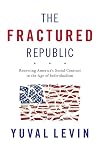
I was super impressed with this book as a whole, as it coalesces a lot of things I've been thinking about lately. It starts off slowly, and I'm sure critiques can be made of the necessarily generalized narrative he gives in the earlier part of the book, but it gets steadily better as one goes on. If you find the "setting the table" chapters a bit dry, don't give up.
In short, Levin argues that partisan politics is hobbled by "competing nostalgias" that get in the way of productive policy show more debates. Most attempts to fix problems on a national scale prove unworkable because they look backward at an exceptionally consolidated period of U.S. history (mid-20th century), rather than reckoning with the diffuse, fractious society we inhabit today. To get around this roadblock, Levin believes we need to "empower a multiplicity of problem-solvers throughout our society, rather than hoping that one problem-solver in Washington gets it right" (5). In turn, this will demand renewal of the "middle layers," or mediating institutions, of society (neighborhoods, community and religious organizations, workplace and family) to halt the drift toward statism on one hand or excessive individualism on the other. I liked Levin's acknowledgment of the need for "epistemic humility" and experimentation, because we frankly don't know what solutions will be effective for dealing with, e.g., poverty, but we're more likely to find things that work on the face-to-face level (through a "modernized ethic of subsidiarity") than through programs that were designed for very different historical circumstances. He also suggests that the diversity and diffusion of contemporary America may be uniquely well suited to this kind of community-based search for solutions.
There is obviously a lot of work to be done before even getting to that point, and this rather sweeping, densely argued book isn't long on specifics; but I guess that's what National Affairs is for. This is one of the more refreshing, perceptive, and hopeful things I've read on politics this year, and I think it contains a lot that could be profitably discussed by people across the spectrum, not just those who'd identify as "reform conservatives." show less
In short, Levin argues that partisan politics is hobbled by "competing nostalgias" that get in the way of productive policy show more debates. Most attempts to fix problems on a national scale prove unworkable because they look backward at an exceptionally consolidated period of U.S. history (mid-20th century), rather than reckoning with the diffuse, fractious society we inhabit today. To get around this roadblock, Levin believes we need to "empower a multiplicity of problem-solvers throughout our society, rather than hoping that one problem-solver in Washington gets it right" (5). In turn, this will demand renewal of the "middle layers," or mediating institutions, of society (neighborhoods, community and religious organizations, workplace and family) to halt the drift toward statism on one hand or excessive individualism on the other. I liked Levin's acknowledgment of the need for "epistemic humility" and experimentation, because we frankly don't know what solutions will be effective for dealing with, e.g., poverty, but we're more likely to find things that work on the face-to-face level (through a "modernized ethic of subsidiarity") than through programs that were designed for very different historical circumstances. He also suggests that the diversity and diffusion of contemporary America may be uniquely well suited to this kind of community-based search for solutions.
There is obviously a lot of work to be done before even getting to that point, and this rather sweeping, densely argued book isn't long on specifics; but I guess that's what National Affairs is for. This is one of the more refreshing, perceptive, and hopeful things I've read on politics this year, and I think it contains a lot that could be profitably discussed by people across the spectrum, not just those who'd identify as "reform conservatives." show less
The Fractured Republic: Renewing America's Social Contract in the Age of Individualism by Yuval Levin
Well done book by a thoughtful conservative about what is wrong with America and what would help. He's very fair about leftist motivations and accomplishments and also gets into right-wing shortcomings and mistakes. He leaves no doubt that he's a conservative, but there's a strong feeling of fairness and even-handedness that I really respect. His basic diagnosis is that both left and right are too nostalgic about mid-twentieth century golden eras, (FDR and LBJ for the left and Ike and Reagan show more on the right). He feels that too much emphasis has gone to extreme ends of society, both the federal government on one hand and atomized individuals on the other hand. He advocates more power to state & local government and stuff like churches and labor unions and of course families. (Imagine, a conservative seeing something good about unions.)
What I didn't like about the book: humorless! Also, while I think he's remarkably generous to his political opponents' general theories, sometimes he gets a bit snarky to individual leftists (like Obama). Also, there seems to be an undercurrent of American exceptionalism - he never says "rah rah America" but there's a wisp of it in the background that I'm sensitive to and don't like.
That said, I'm super impressed with the way this book is done and I wish there were more like it coming from both sides. (All sides) show less
What I didn't like about the book: humorless! Also, while I think he's remarkably generous to his political opponents' general theories, sometimes he gets a bit snarky to individual leftists (like Obama). Also, there seems to be an undercurrent of American exceptionalism - he never says "rah rah America" but there's a wisp of it in the background that I'm sensitive to and don't like.
That said, I'm super impressed with the way this book is done and I wish there were more like it coming from both sides. (All sides) show less
The Fractured Republic: Renewing America's Social Contract in the Age of Individualism by Yuval Levin
The basic thesis of the book is that "diffusion" of society has resulted in a shift from conformity to individuality since mid-century, resulting in "moral chaos" that created today's "bifurcation" into a prosperous upper class and a languishing lower class with a hollowed out middle class (what progressives call "inequality", a label that he rejects as irrelevantly focusing on the ultra-rich), which can only be fixed by "subsidiarity" (aka communitarian conservatism) - weakening the federal show more government (particularly the executive branch, and the "overreach" of the Obama administration) and instead strengthening private communities, especially churches and synagogues (but weirdly no mention of mosques, go figure).
Some interesting ideas presented in the context of "traditional social conservatism" as to why the fixation by both the left and right for the "good old days" is misguided and not realistic, but marred by his outright rejection of social democracy as a valid approach without really providing any actual evidence as to why he thinks this is the case. Likewise, he rejects the notion that poverty causes weak communities and societal ills such as "children out of wedlock" (a quaint euphemism for single-parent homes), crime, drug use, etc., and instead sees "culture" the cause of the poverty, although again little evidence presented to support this backwards assertion.
While he criticizes the right-wing almost as much as the left, especially the hyper-individualist libertarians, ultimately it's just window dressing for a defense of the traditional Reagan-era small-government conservative tropes of "family values", lower taxes, looser regulations, privatization of social programs and government services, and dismantling the welfare state.
Ultimately the argument falls flat, however. At the same time he defends the "traditional social mediating institutions" (especially religious ones) because they have "stood the test of time", but also rejects the role of a powerful central authority and instead advocates experimentation with a variety of smaller local solutions to see which are most effective. The arguments are dressed up in fancy language, but ultimately it's clear that he already knows the answer and is reasoning his way towards justifying it, rather than working towards a solution to the problems at hand.
He does get bonus points for clearly differentiating between education and skills training, and makes a strong case that the latter isn't a good substitute for the former, and that a liberal education is still an important foundation for a healthy society. show less
Some interesting ideas presented in the context of "traditional social conservatism" as to why the fixation by both the left and right for the "good old days" is misguided and not realistic, but marred by his outright rejection of social democracy as a valid approach without really providing any actual evidence as to why he thinks this is the case. Likewise, he rejects the notion that poverty causes weak communities and societal ills such as "children out of wedlock" (a quaint euphemism for single-parent homes), crime, drug use, etc., and instead sees "culture" the cause of the poverty, although again little evidence presented to support this backwards assertion.
While he criticizes the right-wing almost as much as the left, especially the hyper-individualist libertarians, ultimately it's just window dressing for a defense of the traditional Reagan-era small-government conservative tropes of "family values", lower taxes, looser regulations, privatization of social programs and government services, and dismantling the welfare state.
Ultimately the argument falls flat, however. At the same time he defends the "traditional social mediating institutions" (especially religious ones) because they have "stood the test of time", but also rejects the role of a powerful central authority and instead advocates experimentation with a variety of smaller local solutions to see which are most effective. The arguments are dressed up in fancy language, but ultimately it's clear that he already knows the answer and is reasoning his way towards justifying it, rather than working towards a solution to the problems at hand.
He does get bonus points for clearly differentiating between education and skills training, and makes a strong case that the latter isn't a good substitute for the former, and that a liberal education is still an important foundation for a healthy society. show less
A phenomenal analysis of America's current political/social landscape. It was written and published before Trump was elected--yet in its way predicted the election and its aftermath. The other fantastic thing about this book is that the author both exposes his own biases and goes out of his way to make both sides are represented throughout. Sometimes the verbiage is dense, but it always is precise. Well worth the read, but it can be a slog at times.
Lists
You May Also Like


Associated Authors
Statistics
- Works
- 19
- Members
- 839
- Popularity
- #30,460
- Rating
- 3.8
- Reviews
- 16
- ISBNs
- 45
- Languages
- 3