
Marguerite Yourcenar (1903–1987)
Author of Memoirs of Hadrian
About the Author
A French novelist, playwright, and essayist born in Belgium, Marguerite Yourcenar was a resident of the United States for many years, living in isolation on a small island off the coast of Maine. Educated at home by wealthy and cultured parents, she had a strong humanistic background, translating show more the ancient Greek poet Pindar and the poems of the modern Greek Constantine Cavafy. She has translated American Negro spirituals and works of Virginia Woolf (see Vol. 1) and Henry James (see Vol. 1). Her novels include Alexis (1929) and Coup de Grace (1939). A collection of poems, Fires, was published in 1936. Yourcenar is particularly known for Hadrian's Memoirs (1951), a philosophical meditation in the form of a fictional autobiography of the second-century Roman emperor. In Germaine Bree's judgment, "With great erudition and great psychological insight, Marguerite Yourcenar constructed a body of work that is a meditation on the destiny of mankind." In 1981, she became the first woman ever elected to the French Academy. (Bowker Author Biography) show less
Series
Works by Marguerite Yourcenar
Memoirs of Hadrian ; and, Reflections on the composition of Memoirs of Hadrian (1951) 2,999 copies, 68 reviews
I trentatré nomi di Dio. Tentativo di un diario senza data e senza pronome personale. Testo francese a fronte (1988) 16 copies, 1 review
Théâtre, tome 2 : Electre ou la chute des masques - Le Mystère d'Alceste - Qui n'a pas son Minotaure (1932) — Author — 11 copies
Alexis o el tratado del inútil combate / El denario del sueño / El tiro de gracia (Contemporánea) (2017) 10 copies
Discours de réception de Madame Marguerite Yourcenar à l'Académie Française (1981) — Author — 7 copies
En 1939, l'Amérique commence à Bordeaux: Lettres à Emmanuel Boudot-Lamotte (1938-1980) (2016) 3 copies
OPERE Romanzi e racconti 2 copies
«Le pendant des "Mémoires d'Hadrien" et leur entier contraire»: Correspondance 1964-1967 (2019) 2 copies
/1!: Romanzi e racconti 1 copy
Hadrianoren oroitzapenak eta eranskin gisa Hadrianoren oroitzapene buruzko ohar-bilduma (1985) 1 copy
Алексис 1 copy
KUJTIMET E ADRIANIT 1 copy
Sous bénéfice d'inventaire 1 copy
Alexis, Le Coup De Grâce 1 copy
Los ojos azules pelo negro — Author — 1 copy
La nouvelle Eurydice 1 copy
El Alquimista 1 copy
Osmeh kraljevića Marka 1 copy
Emléklapok 1 copy
Izabrani ogledi 1 copy
Austurlenskar sögur 1 copy
Notas à margem do tempo 1 copy
Associated Works
The Smiles of Rome: A Literary Companion for Readers and Travelers (2005) — Contributor — 67 copies, 2 reviews
Tagged
Common Knowledge
- Canonical name
- Yourcenar, Marguerite
- Legal name
- de Crayencour, Marguerite Antoinette Jeanne Marie Ghislaine Cleenewerck
- Birthdate
- 1903-06-08
- Date of death
- 1987-12-17
- Gender
- female
- Education
- Lycée de Nice (Baccalauréat)
Education paternelle et précepteurs - Occupations
- novelist
essayist
poet
short story writer
playwright - Organizations
- Académie française (1980)
American Academy of Arts and Letters (Literature, 1982)
Erasmus Prize (1983) - Awards and honors
- Grand Prix de Littérature de l'Académie française (1977)
- Relationships
- Frick, Grace (lover)
- Short biography
- Marguerite Yourcenar nacque a Bruxelles nel 1903 e morì negli Stati Uniti nel 1987. Cresciuta nel nord della Francia e a Parigi, trascorse poi la maggior parte della sua vita all’estero, in Italia, Svizzera, Grecia e Stati Uniti. Eletta all’Académie Française nel 1981 (prima e unica donna), è stata autrice di raccolte di versi, poemi in prosa, racconti, lavori teatrali, saggi, traduzioni.
- Cause of death
- Naturelle (Vieillesse)
- Nationality
- France
Belgium - Birthplace
- Brussels, Belgium
- Places of residence
- Brussels, Belgium (birth)
Mount Desert Island, Maine, USA
Northeast Harbor, Maine, USA (death)
Hartford, Connecticut, USA - Place of death
- Bangor, Maine, USA
- Burial location
- Somesville, Maine, USA
- Associated Place (for map)
- Maine, USA
Members
Discussions
May 2026: Marguerite Yourcenar in Monthly Author Reads (May 26)
Group Read, June 2017: Memoirs of Hadrian in 1001 Books to read before you die (June 2017)
Reviews

Americans are largely unaware that war continued in Europe between the World Wars so the scenario of Coup de Grace was new to me. A mercenary, who was too young for the First World War, finds himself fighting in several conflicts particularly in the Baltic region. There he is billeted at the estate of an old friend and fellow soldier. The friend’s sister becomes enamored of him. He has no feelings for her, is devoid of empathy, and is persistently cruel in his rejection. He in fact show more doesn’t like women, though he occasionally indulges himself with prostitutes. A Freudian might suggest that he was a latent homosexual who can not accept that he’s really in love with her brother who is also his best friend. The girl responds to his rebuffs by falling into depravity with the other soldiers. She eventually disguises herself as a boy and runs off to join the Bolsheviks. This short novel doesn’t end well for anyone but it is so well written that it’s worth the sadness. show less

"...there was a unique moment in history, between Cicero and Marcus Aurelius, when man stood alone....A great part of my life was going to be spent in trying to define, and then to portray, that man existing alone and yet closely bound with all being."
--Marguerite Yourcenar
Memoirs of Hadrian is a fictional exploration into the mind of the real and remarkable Roman emperor, Hadrian (117-138CE), considered one of the five good emperors.
It is masterfully done.
I can heartily recommend it to a show more wide variety of readers: those interested in the Roman Empire as history, those interested in philosophical ideas and their application, those interested in astute human observations, and those interested in divine writing with sublime insights. Some might even be interested in it for its tragic romance between Hadrian and Antinous, Antinous later the god object of cult worship.
Lots of props to Yourcenar for sticking with known facts, and while interpreting some, never contradicting or being wildly creative with the fainter ones. She gave herself admirable strict boundaries. And props to the English translator and love of Yourcenar's life, Grace Frick.
Reading it can be a little like herding cats, though, with so much going on at once. When we speak of the Hadrian in this novel, we often are talking about a fuzzy combination of
1 The historic Hadrian
2. The political and philosophic Hadrian personality by Yourcenar
3. The Hadrian that is a dying man looking back on his life, defending it with 20/20 hindsight and some remaining blind spots
4. And never forget, in all cases, this is Hadrian the Roman Emperor of the second century, complete with the ego of an emperor and living the acceptable sexual mores that we in our twenty first century find highly objectionable.
it is written as a letter to young Marcus Aurelius, adopted grandson of Hadrian, another future emperor, last of the "five good" ones. But the sooner you let go of that idea, the better. It is hardly ever a realistic letter. In fact, it is hardly a memoir, truth be told. It is the organized but private thoughts of man remembering his life, often dipping into a defensive mode as an emperor would even when only thinking to himself, and with himself always as the superior being. (That might be said of all of us to varying degrees.)
Definitely Hadrian alone is the protagonist, others are bit players. Thus, there is no dialogue, just Hadrian.
Now that you know some of the peculiarities, don't doubt for a minute that is not worth your time to read, especially to read slowly, taking breaks to ponder the man, his experiences, his stunning insights accessible even to plebs.
I bet you will come away thinking about Yourcenar quite a bit too, with admiration. She walked such a fascinating tightrope here. So much so that the included final chapter "Reflections on the Composition of Memoirs of Hdrian" is so edifying, so integral, I could recommend you read it first, and again last to further enjoy the rewards of this marvelous novel.
Thank you to Antiquity Buddy Readers: Mark, Lisa, and Dave, three readers who faithfully bring joy and intelligence to a joint read. When they write their reviews of this novel, I will add those links because their thoughts are sure to be uniquely insightful and illustrate other possible take-aways
this novel can have on a reader.
Lisa's review https://www.goodreads.com/review/show/7213943931
Mark's review https://www.goodreads.com/review/show/3411581580
Dave's review https://www.goodreads.com/review/show/7215613467
"I fell to making, and then re-making, this portrait of a man who was almost wise." show less
--Marguerite Yourcenar
Memoirs of Hadrian is a fictional exploration into the mind of the real and remarkable Roman emperor, Hadrian (117-138CE), considered one of the five good emperors.
It is masterfully done.
I can heartily recommend it to a show more wide variety of readers: those interested in the Roman Empire as history, those interested in philosophical ideas and their application, those interested in astute human observations, and those interested in divine writing with sublime insights. Some might even be interested in it for its tragic romance between Hadrian and Antinous, Antinous later the god object of cult worship.
Lots of props to Yourcenar for sticking with known facts, and while interpreting some, never contradicting or being wildly creative with the fainter ones. She gave herself admirable strict boundaries. And props to the English translator and love of Yourcenar's life, Grace Frick.
Reading it can be a little like herding cats, though, with so much going on at once. When we speak of the Hadrian in this novel, we often are talking about a fuzzy combination of
1 The historic Hadrian
2. The political and philosophic Hadrian personality by Yourcenar
3. The Hadrian that is a dying man looking back on his life, defending it with 20/20 hindsight and some remaining blind spots
4. And never forget, in all cases, this is Hadrian the Roman Emperor of the second century, complete with the ego of an emperor and living the acceptable sexual mores that we in our twenty first century find highly objectionable.
it is written as a letter to young Marcus Aurelius, adopted grandson of Hadrian, another future emperor, last of the "five good" ones. But the sooner you let go of that idea, the better. It is hardly ever a realistic letter. In fact, it is hardly a memoir, truth be told. It is the organized but private thoughts of man remembering his life, often dipping into a defensive mode as an emperor would even when only thinking to himself, and with himself always as the superior being. (That might be said of all of us to varying degrees.)
Definitely Hadrian alone is the protagonist, others are bit players. Thus, there is no dialogue, just Hadrian.
Now that you know some of the peculiarities, don't doubt for a minute that is not worth your time to read, especially to read slowly, taking breaks to ponder the man, his experiences, his stunning insights accessible even to plebs.
I bet you will come away thinking about Yourcenar quite a bit too, with admiration. She walked such a fascinating tightrope here. So much so that the included final chapter "Reflections on the Composition of Memoirs of Hdrian" is so edifying, so integral, I could recommend you read it first, and again last to further enjoy the rewards of this marvelous novel.
Thank you to Antiquity Buddy Readers: Mark, Lisa, and Dave, three readers who faithfully bring joy and intelligence to a joint read. When they write their reviews of this novel, I will add those links because their thoughts are sure to be uniquely insightful and illustrate other possible take-aways
this novel can have on a reader.
Lisa's review https://www.goodreads.com/review/show/7213943931
Mark's review https://www.goodreads.com/review/show/3411581580
Dave's review https://www.goodreads.com/review/show/7215613467
"I fell to making, and then re-making, this portrait of a man who was almost wise." show less
Memoirs of Hadrian: And Reflections on the Composition of Memoirs of Hadrian (Penguin Modern Classics) by Marguerite Yourcenar
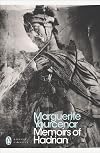
As a historical memoir, this book has to contend with the perennial pitfalls of both historical fiction and memoir — respectively, overdosing on ostentatious period detail, and self-satisfied retrospective airbrushing. I think it overcomes the first of these quite well, especially given the paucity of biographical material Yourcenar has to work with. You do feel transported to that "happy period of more than fourscore years", as Gibbon called it, without getting tangled up in togas. show more Tromping around the Empire with its peripatetic head honcho, leaving a trail of new towns, monuments and public works in our wake, is fun. But Yourcenar's Hadrian strikes me as more French than Spanish in his disposition; he doesn't have much of a sense of humour and sometimes I found myself wishing he'd loosen up a little. Like many a memoirist, self-deprecation isn't his strong suit. His grief for Antinous is very moving, though (even if Antinous himself remains a cypher), and Hadrian's (and Yourcenar's) affection for this Halcyon era with its air of optimism, general religious tolerance, and comparative lack of senseless mass slaughter is palpable. I realize it isn't cool these days to blame, pace Gibbon, the Christians for the decline and fall, but fuck it, I still do. show less
Alexis Ou o Tratado Do Vao Combate [Colecao Grandes Romances]. Traducao De Martha Calderaro by Marguerite Yourcenar

A chave de leitura desse texto está no subtítulo. O romance é uma carta escrita por Alexis para explicar para a esposa porque a está abandonando. Entre divagações e devaneios, momentos poéticos e dramáticos a carta vai encurralando o autor e o leitor até seu desfecho. Pensar que foi escrito pela jovem Marguerite com apenas 24 anos também vai surpreender o leitor.
Lists
le donne raccontano (10)
1960s (1)
Europe (1)
Nifty Fifties (1)
1930s (1)
Five star books (1)
Awards


You May Also Like


Associated Authors
Statistics
- Works
- 110
- Also by
- 12
- Members
- 14,612
- Popularity
- #1,574
- Rating
- 4.0
- Reviews
- 293
- ISBNs
- 816
- Languages
- 33
- Favorited
- 59


