
Josyane Savigneau
Author of Marguerite Yourcenar: Inventing a Life
About the Author
Josyane Savigneau edits "Le Monde's" book review & is the author of "Marquerite Yourcenar: Inventing a Life" (translated by Joan E. Howard), which Edmund White called, in a front-page review in the "New York Times Book Review," "surely the best biography to be written in French in several decades." show more She lives in France. (Bowker Author Biography) show less
Image credit: Josyane Savigneau in Paris, 30 août 2015
Works by Josyane Savigneau
Tagged
Common Knowledge
- Canonical name
- Savigneau, Josyane
- Legal name
- Savigneau, Josyane
- Birthdate
- 1951
- Gender
- female
- Occupations
- biographer
- Nationality
- France
- Birthplace
- Châtellerault, France
- Map Location
- France
Members
Reviews
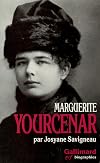
In my twenties I was completely taken with the books of Marguerite Yourcenar (1903-1987): Mémoires d’Hadrien and L’Oeuvre au Noir were among the best I had read up to that point. I also couldn’t devour her family histories (the three volumes of Labyrinthe du Monde) fast enough.
It was especially the book of interviews with her by French critic Mathieu Galley (Les yeux ouverts, 1980) that charmed me: Yourcenar emerged from it as a very idiosyncratic, thoughtful observer and commentator show more on the phenomenon of ‘man’, on life, and on literature in general. I was particularly intrigued by her vision of the immutability of man throughout history, a vision that stood and stands in stark contrast to the still prevailing paradigm that man is constantly advancing, not only in his circumstances but also in his essence.
Josyanne Savigneau's biography was published in 1990, a few years after Yourcenar's death. The voluminous book (700 pages) had been waiting on my bookshelf for more than 2 decades, but due to family and professional concerns I didn't get around to reading it. Also, the fear that my idol would be dethroned from her pedestal undoubtedly played a part in that. And now that I've read it: that fear was justified! Not that Savigneau has made a distasteful portrait of her that testifies to a love of spectacle and a lack of respect. No, not at all: the gigantic personality that Yourcenar was, and her great literary merit, are portrayed accurately. But Savigneau has made a sincere attempt to portray the whole person Marguerite Yourcenar, with her good and her less good sides.
At the time, after the publication of the biography, there was immediately a scandal that she had focused so much on Yourcenar's relationship with Grace Frick, and then with Jerry Wilson. And it is true: both receive a lot of attention, and in my opinion rightly so, because they highlight aspects of Yourcenar’s personality that are relevant, also for her work.
What struck me most in this biography are Yourcenar’s little quirks: she was headstrong, stubborn, haughty, hypochondriac, could treat people very disparagingly and even seemed to come close to what you might call a narcissistic personality. That doesn’t sound nice, I know. But Savigneau constantly emphasizes how much Yourcenar took control of her own memory and manipulated it, to the point of blatant lies and distortions. It is that overall character trait, the obsession with bending the things and people around her to her will that is also relevant to her work, I think. It was not the objective biography of Hadrian that interested her in Mémoires d’Hadrien, nor the correct representation of Europe ravaged by religious wars in Oeuvre au Noir. But it is an idiosyncratic reconstruction of what for her is the ever-searching, struggling, clinging person in a world full of permanent uncertainties. It is also what makes her one of the greatest writers of the twentieth century.
This is a great biography (only a pity about the lack of the numerous photos that are regularly referred to). Savigneau has made an honest attempt to reconstruct the person Marguerite Yourcenar, with the sources that she had at her disposal at the time. It is typical that Yourcenar forbade access to her personal archive until 50 years after her death. I hope that I may live to see it released in 2037 and possibly shed new light on this giant of French literature. show less
It was especially the book of interviews with her by French critic Mathieu Galley (Les yeux ouverts, 1980) that charmed me: Yourcenar emerged from it as a very idiosyncratic, thoughtful observer and commentator show more on the phenomenon of ‘man’, on life, and on literature in general. I was particularly intrigued by her vision of the immutability of man throughout history, a vision that stood and stands in stark contrast to the still prevailing paradigm that man is constantly advancing, not only in his circumstances but also in his essence.
Josyanne Savigneau's biography was published in 1990, a few years after Yourcenar's death. The voluminous book (700 pages) had been waiting on my bookshelf for more than 2 decades, but due to family and professional concerns I didn't get around to reading it. Also, the fear that my idol would be dethroned from her pedestal undoubtedly played a part in that. And now that I've read it: that fear was justified! Not that Savigneau has made a distasteful portrait of her that testifies to a love of spectacle and a lack of respect. No, not at all: the gigantic personality that Yourcenar was, and her great literary merit, are portrayed accurately. But Savigneau has made a sincere attempt to portray the whole person Marguerite Yourcenar, with her good and her less good sides.
At the time, after the publication of the biography, there was immediately a scandal that she had focused so much on Yourcenar's relationship with Grace Frick, and then with Jerry Wilson. And it is true: both receive a lot of attention, and in my opinion rightly so, because they highlight aspects of Yourcenar’s personality that are relevant, also for her work.
What struck me most in this biography are Yourcenar’s little quirks: she was headstrong, stubborn, haughty, hypochondriac, could treat people very disparagingly and even seemed to come close to what you might call a narcissistic personality. That doesn’t sound nice, I know. But Savigneau constantly emphasizes how much Yourcenar took control of her own memory and manipulated it, to the point of blatant lies and distortions. It is that overall character trait, the obsession with bending the things and people around her to her will that is also relevant to her work, I think. It was not the objective biography of Hadrian that interested her in Mémoires d’Hadrien, nor the correct representation of Europe ravaged by religious wars in Oeuvre au Noir. But it is an idiosyncratic reconstruction of what for her is the ever-searching, struggling, clinging person in a world full of permanent uncertainties. It is also what makes her one of the greatest writers of the twentieth century.
This is a great biography (only a pity about the lack of the numerous photos that are regularly referred to). Savigneau has made an honest attempt to reconstruct the person Marguerite Yourcenar, with the sources that she had at her disposal at the time. It is typical that Yourcenar forbade access to her personal archive until 50 years after her death. I hope that I may live to see it released in 2037 and possibly shed new light on this giant of French literature. show less
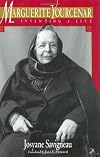
Marguerite Yourcenar is one of my favorite authors and has been so ever since I first read Memoirs of Hadrian. I went on to read several of her other novels and literary essays. Included with Memoirs of Hadrian in my list of favorites are both Alexis and Fires, short, beautiful and uncommon novels. Her prose always demonstrated exquisite precision, often with a poetic quality, and her interest in the classical world was of particular interest. She became the first and only woman to be show more admitted to the Académie Fançaise in 1980.
Josyane Savigneau's biography is a worthy companion to these works. The subtitle, "Inventing a Life", is appropriate on many levels beginning with her reincarnation as Marguerite Yourcenar in her teens (a nome de plume created as an acronym of her given name of Crayencour) to her years in France followed by decades spent in America. She lived in Maine for 42 years with her lover, the American academian Grace Frick, whom she met in 1937, and with whom she was to live until Frick's death from breast cancer in 1979. That this relationship was bookended by relationships with young men is just one of the many contradictions present in the long life of Marguerite Yourcenar. She was living in the US in June 1940, when the Germans invaded France, and there she was to remain for most of her life. All of this and more is shared in this biography that details the life of learning and love that produced some of the most beautiful prose works of the twentieth century. show less
Josyane Savigneau's biography is a worthy companion to these works. The subtitle, "Inventing a Life", is appropriate on many levels beginning with her reincarnation as Marguerite Yourcenar in her teens (a nome de plume created as an acronym of her given name of Crayencour) to her years in France followed by decades spent in America. She lived in Maine for 42 years with her lover, the American academian Grace Frick, whom she met in 1937, and with whom she was to live until Frick's death from breast cancer in 1979. That this relationship was bookended by relationships with young men is just one of the many contradictions present in the long life of Marguerite Yourcenar. She was living in the US in June 1940, when the Germans invaded France, and there she was to remain for most of her life. All of this and more is shared in this biography that details the life of learning and love that produced some of the most beautiful prose works of the twentieth century. show less
Marguerite Yourcenar: L'invention d'une vie (N.R.F. biographies) (French Edition) by Josyane Savigneau
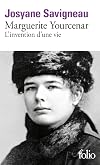
Tout simplement passionnant, car ce livre révèle la véritable Yourcenar, au-delà de l'image qu'elle a voulu donner d'elle-même. Elle apparaît beaucoup plus fragile et donc beaucoup plus humaine et attachante que dans ses propres livres. Evidemment, cette biographie permet de lire autrement son oeuvre, de mieux découvrir ce que cachent et ce que révèlent les personnages de ses romans.
> BAnQ (Laniel C.-A., La presse, 21 juil. 1996, B-7) : https://diffusion.banq.qc.ca/pdfjs-1.6.210-dist_banq/web/pdf.php/K80TjcOGRADjS9p...
> BAnQ (Archambault G., Le devoir, 17 mai 1997, D-9) : https://diffusion.banq.qc.ca/pdfjs-1.6.210-dist_banq/web/pdf.php/3iakpQbZDPce-7g...
> Babelio : https://www.babelio.com/livres/Savigneau-Carson-McCullers--Un-coeur-de-jeune-fil...
> BAnQ (Archambault G., Le devoir, 17 mai 1997, D-9) : https://diffusion.banq.qc.ca/pdfjs-1.6.210-dist_banq/web/pdf.php/3iakpQbZDPce-7g...
> Babelio : https://www.babelio.com/livres/Savigneau-Carson-McCullers--Un-coeur-de-jeune-fil...
Apr 13, 2021 (Edited)French
Awards


You May Also Like


Statistics
- Works
- 11
- Members
- 248
- Popularity
- #92,013
- Rating
- 4.3
- Reviews
- 5
- ISBNs
- 29
- Languages
- 6
