
Janice Law (1) (1941–)
Author of Fires of London
For other authors named Janice Law, see the disambiguation page.
Series
Works by Janice Law
Associated Works
ParaSpheres: Extending Beyond the Spheres of Literary and Genre Fiction: Fabulist and New Wave Fabulist Stories (2006) — Contributor — 65 copies
The Lady Sleuths MEGAPACK ®: 20 Modern and Classic Tales of Female Detectives (2014) — Contributor — 16 copies
Tagged
Common Knowledge
- Legal name
- Trecker, Janice Law
- Birthdate
- 1941
- Gender
- female
- Occupations
- artist
journalist
adjunct professor - Organizations
- University of Connecticut
Members
Reviews
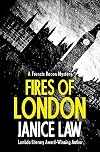
Francis Bacon (the 20th century artist, not the 17th century philosopher) is a surprising choice for a mystery protagonist. He was booted out of his home by his domineering father for being flamboyantly effeminate, and lived on his wits, mostly in London, seeking out wealthy older men to keep him. More often, he lived with his old nanny, Jessie Lightfoot, who had always been more of a mother to him. But don't be fooled by the seeming domesticity of a grown man living with his old nan. She show more didn't put any sort of a crimp in his style. She even vetted his lovers.
Janice Law sets Fires of London in 1940, shortly after the wartime blackout made nighttime London a place of misty, impenetrable blackness. She has Bacon acting as an ARP (air raid precautions) warden, walking a beat at night. One night, he learns that one of his acquaintances in London's gay demimonde has been brutally murdered in a nearby park. Not long afterward, Bacon literally stumbles on another victim. Feeling under threat himself, Bacon uses his patrols and contacts to try to find the murderer.
Law skillfully mixes wry humor with heart-thumping suspense. Bacon's scenes with his nan are a little like a comedy double act; full of charm and chuckles. The mood changes completely when Bacon stumbles through nighttime streets and alleys with only falling bombs and incendiaries as illumination to help him avoid threats from a host of attackers. I've read a lot of World War II-era mysteries, and several novels that take place during the London Blitz. I don't remember another that did such a good job at conveying the chaos, fear and exhilaration of being on the streets during a raid.
During the Golden Age of mystery, a typical novel would clock in right around 200 pages. For a skilled writer, that was plenty of time to limn the characters, bump off the victim, and collect enough clues to solve the crime. Janice Law may not be a high-profile mystery writer, but she's a longtime author with an Edgar nomination under her belt (in 1977, for Best First Novel), and she knows how to write a good, tight story in that Golden Age manner. At 196 pages, this is a quick but satisfying read. I should note that the book includes sexual content, but there are no detailed or graphic descriptions. Recommended.
Disclosure: I received a free review text of the ebook version of this title from the publisher, via Netgalley. show less
Janice Law sets Fires of London in 1940, shortly after the wartime blackout made nighttime London a place of misty, impenetrable blackness. She has Bacon acting as an ARP (air raid precautions) warden, walking a beat at night. One night, he learns that one of his acquaintances in London's gay demimonde has been brutally murdered in a nearby park. Not long afterward, Bacon literally stumbles on another victim. Feeling under threat himself, Bacon uses his patrols and contacts to try to find the murderer.
Law skillfully mixes wry humor with heart-thumping suspense. Bacon's scenes with his nan are a little like a comedy double act; full of charm and chuckles. The mood changes completely when Bacon stumbles through nighttime streets and alleys with only falling bombs and incendiaries as illumination to help him avoid threats from a host of attackers. I've read a lot of World War II-era mysteries, and several novels that take place during the London Blitz. I don't remember another that did such a good job at conveying the chaos, fear and exhilaration of being on the streets during a raid.
During the Golden Age of mystery, a typical novel would clock in right around 200 pages. For a skilled writer, that was plenty of time to limn the characters, bump off the victim, and collect enough clues to solve the crime. Janice Law may not be a high-profile mystery writer, but she's a longtime author with an Edgar nomination under her belt (in 1977, for Best First Novel), and she knows how to write a good, tight story in that Golden Age manner. At 196 pages, this is a quick but satisfying read. I should note that the book includes sexual content, but there are no detailed or graphic descriptions. Recommended.
Disclosure: I received a free review text of the ebook version of this title from the publisher, via Netgalley. show less
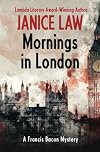
I’m not a big reader of mysteries and I’ve literally never read a tale of espionage. Well, that’s if you don’t count Janice Law’s charming (and oh so very British) Francis Bacon mysteries. Previously, I read the first of this particular “trilogy,” Nights in Berlin and loved the wicked and witty protagonist (who is based on the well-known 20th Century Irish painter). Somehow I missed Afternoons in Paris but that did not take away from my enjoyment of the charming final show more installment, Mornings in London.
Like Berlin, this takes place in Europe between the wars and focuses on the British fascination with Il Duce (Benito Mussolini) and the rise of Italian fascism. I’ll admit to almost complete ignorance of the finer points of modern European history so a lot of this was lost on me. (Mosely? Wasn’t he the under butler on Downtown Abbey?) But that didn’t take away my enjoyment of the mystery itself or Law’s incredible characters. I was particularly fond of Bacon’s spirited cousin Poppy (do I smell a spin-off in the works?) and his thoroughly capable Nan, eager to take on the bad guys and always up to the task. She calls to mind Mrs. Hudson in the BBC Sherlock series, a feisty older woman whose nurturing nature hides the steely cunning beneath the surface. There’s also a reappearance of Bacon’s foppish wheeler-dealer of an uncle who works for the British government and so, naturally, cannot be completely trusted.
In many ways, this is a classic “cozy” style whodunit with a body turning up at a country estate during a weekend gathering of the British upper crust. What makes it unique is the element of espionage and the rather mordant LGBT protagonist at the center of it all. This is a brisk, fun read. It has mystery, suspense, humor and political intrigue. Perfect with a warm cup of tea on a chilly winter’s evening. I'll surely be seeking out Law's other work in future. show less
Like Berlin, this takes place in Europe between the wars and focuses on the British fascination with Il Duce (Benito Mussolini) and the rise of Italian fascism. I’ll admit to almost complete ignorance of the finer points of modern European history so a lot of this was lost on me. (Mosely? Wasn’t he the under butler on Downtown Abbey?) But that didn’t take away my enjoyment of the mystery itself or Law’s incredible characters. I was particularly fond of Bacon’s spirited cousin Poppy (do I smell a spin-off in the works?) and his thoroughly capable Nan, eager to take on the bad guys and always up to the task. She calls to mind Mrs. Hudson in the BBC Sherlock series, a feisty older woman whose nurturing nature hides the steely cunning beneath the surface. There’s also a reappearance of Bacon’s foppish wheeler-dealer of an uncle who works for the British government and so, naturally, cannot be completely trusted.
In many ways, this is a classic “cozy” style whodunit with a body turning up at a country estate during a weekend gathering of the British upper crust. What makes it unique is the element of espionage and the rather mordant LGBT protagonist at the center of it all. This is a brisk, fun read. It has mystery, suspense, humor and political intrigue. Perfect with a warm cup of tea on a chilly winter’s evening. I'll surely be seeking out Law's other work in future. show less
Thankfully, I don't mind when historical figures are wrangled into improbable fictions, and in this case, I loved watching Francis Bacon slum it and fight crime in World War II London.
Bacon, a crazy surrealist modernist painter who totally creepies me out (warning: painting is wicked disturbing!), is the narrator of this quick, dirty, exciting murder mystery set in the 1940s. An asthmatic, Bacon was unfit for service and instead worked for the Air Raid Precautions (ARP), doing rounds in show more London during the Blitz, ensuring blackout conditions were observed. Those dark nights, when his duties were completed, he would indulge in a quick pickup at a local park with an anonymous man. Living with his beloved nanny -- near blind, but sharp as a tack -- Bacon was kept in painting supplies thanks to his married lover, a local alderman, with whom he ran an illegal roulette parlor now and then for extra cash.
Naturally inclined toward trouble with a strong disinterest in police, Bacon nonetheless finds himself forced to work with a local cop when he continues to stumble upon murdered men in his neighborhood. With the Blitz killing many indiscriminately, the pointed murders provoke additional fear in Bacon and his circle of acquaintances.
I don't know much about Bacon other than having a passing awareness of his art, so I can't say whether Law's articulation of him is accurate or irreverent. I loved him -- he was wry and self-deprecating, quick and clever and kind of sketchy, bold and dirty and observant -- and he was a fascinating narrator for a World War II/London Blitz murder mystery. Through Bacon, Law's writing is pretty and poignant, artistic without feeling contrived. I had something like ten pages of bookmarks for a 179-page story -- I couldn't stop noting lines I loved, like this one, from about midway, when Bacon helps a crew of men dig rubble off someone after one of the nightly bombings.
For those who care, there's lots of implied gay sex but nothing overt; still, I felt deliciously seedy while reading. I raced through this one and would have loved it if it were twice or three times the length; hell, I'd love it if this became a series. I so liked Bacon, that rascal, dapper and damaged. Whether 'accurate' to the historical figure or not, Law's Bacon is a character I already miss. show less
Bacon, a crazy surrealist modernist painter who totally creepies me out (warning: painting is wicked disturbing!), is the narrator of this quick, dirty, exciting murder mystery set in the 1940s. An asthmatic, Bacon was unfit for service and instead worked for the Air Raid Precautions (ARP), doing rounds in show more London during the Blitz, ensuring blackout conditions were observed. Those dark nights, when his duties were completed, he would indulge in a quick pickup at a local park with an anonymous man. Living with his beloved nanny -- near blind, but sharp as a tack -- Bacon was kept in painting supplies thanks to his married lover, a local alderman, with whom he ran an illegal roulette parlor now and then for extra cash.
Naturally inclined toward trouble with a strong disinterest in police, Bacon nonetheless finds himself forced to work with a local cop when he continues to stumble upon murdered men in his neighborhood. With the Blitz killing many indiscriminately, the pointed murders provoke additional fear in Bacon and his circle of acquaintances.
I don't know much about Bacon other than having a passing awareness of his art, so I can't say whether Law's articulation of him is accurate or irreverent. I loved him -- he was wry and self-deprecating, quick and clever and kind of sketchy, bold and dirty and observant -- and he was a fascinating narrator for a World War II/London Blitz murder mystery. Through Bacon, Law's writing is pretty and poignant, artistic without feeling contrived. I had something like ten pages of bookmarks for a 179-page story -- I couldn't stop noting lines I loved, like this one, from about midway, when Bacon helps a crew of men dig rubble off someone after one of the nightly bombings.
The dog dived toward the cavity newly opened in the mess of brick and timber before raising an eerie howl. Strange how effortlessly expressive animals are, while we hairless beasts must struggle over canvass and paints and the English language. (p73-74)
For those who care, there's lots of implied gay sex but nothing overt; still, I felt deliciously seedy while reading. I raced through this one and would have loved it if it were twice or three times the length; hell, I'd love it if this became a series. I so liked Bacon, that rascal, dapper and damaged. Whether 'accurate' to the historical figure or not, Law's Bacon is a character I already miss. show less
Set in London in 1939 just before the Blitz, artist Frances Bacon spends his nights as an air raid precaution (ARP) warden. It is his task to patrol a section of the city to ensure that all windows are blacked out so that no light shows and all street lamps are extinguished. On quiet nights, however, he is not averse to a little 'rough trade' in the park with willing older gents.
But someone is taking advantage of the blackout to kill young gay men and Bacon has the misfortune to stumble (in show more one case, literally) over the bodies. Soon, he is the major... scratch that, the only suspect since the inspector in charge of the case may have reasons of his own not to investigate any further. In desperation to clear his name, Bacon goes on the run determined to solve the crimes himself.
I have to admit that I knew very little about the real Bacon outside of having seen a couple of his paintings which I found more than a little macabre. I have no idea how true to life the Frances Bacon of the story is but he makes an extremely likable protagonist with a wry sense of humour and just a touch of mischief about him. He lives with his old, blind, but always sharp, nanny while running an illegal roulette wheel with his married lover.
However, the real star of the book has to be the Blitz. Author Janice law does a marvelous job of describing the first bombings of London: the complete impenetrable dark of the blackout so intense you couldn't see your hand in front of your face, the chaos, the noise of the planes, the explosions, the thunder of falling buildings and the screams of those who weren't able to make it to the shelters, and, of course, the all-consuming fear.
Fires of London is relatively short but packs quite a wallop in its less than 200 pages. Frances Bacon makes a unique and fascinating hero; the murderer, although fairly obvious, is interesting; but, more than anything, Ms Law's description of the Blitz makes Fires of London one very fine historical mystery. show less
But someone is taking advantage of the blackout to kill young gay men and Bacon has the misfortune to stumble (in show more one case, literally) over the bodies. Soon, he is the major... scratch that, the only suspect since the inspector in charge of the case may have reasons of his own not to investigate any further. In desperation to clear his name, Bacon goes on the run determined to solve the crimes himself.
I have to admit that I knew very little about the real Bacon outside of having seen a couple of his paintings which I found more than a little macabre. I have no idea how true to life the Frances Bacon of the story is but he makes an extremely likable protagonist with a wry sense of humour and just a touch of mischief about him. He lives with his old, blind, but always sharp, nanny while running an illegal roulette wheel with his married lover.
However, the real star of the book has to be the Blitz. Author Janice law does a marvelous job of describing the first bombings of London: the complete impenetrable dark of the blackout so intense you couldn't see your hand in front of your face, the chaos, the noise of the planes, the explosions, the thunder of falling buildings and the screams of those who weren't able to make it to the shelters, and, of course, the all-consuming fear.
Fires of London is relatively short but packs quite a wallop in its less than 200 pages. Frances Bacon makes a unique and fascinating hero; the murderer, although fairly obvious, is interesting; but, more than anything, Ms Law's description of the Blitz makes Fires of London one very fine historical mystery. show less
Lists
Awards


You May Also Like


Associated Authors
Statistics
- Works
- 26
- Also by
- 6
- Members
- 335
- Popularity
- #71,018
- Rating
- 3.6
- Reviews
- 17
- ISBNs
- 104
- Languages
- 2