
About the Author
Works by Ichiro Kishimi
The Courage to Be Disliked: The Japanese Phenomenon That Shows You How to Change Your Life and Achieve Real Happiness (2013) 1,963 copies, 40 reviews
The Courage to Be Happy: Discover the Power of Positive Psychology and Choose Happiness Every Day (2016) 209 copies, 1 review
The Courage to be Happy: True Contentment Is Within Your Power (Courage To series) (2020) 54 copies, 1 review
The Complete Courage to Be Disliked Duology Boxed Set: The Courage to be Disliked and The Courage to Be Happy (2024) 5 copies
The Courage to be Happy [Hardcover], The Courage To Be Disliked 2 Books Collection Set (2019) 3 copies
The Courage to be happy 1 copy
Tagged
Common Knowledge
- Birthdate
- 1956
- Gender
- male
- Nationality
- Japan
- Birthplace
- Kyoto, Japan
- Associated Place (for map)
- Japan
Members
Reviews

I first encountered this book several years ago as an audiobook and gave it five stars at the time. Revisiting it now in print, I’m not sure it quite reaches that same level for me—but I still found it thoughtful, engaging, and ultimately worthwhile.
The book is structured as a dialogue between a philosopher and a skeptical young man, unpacking the ideas of Adlerian psychology through extended conversation. In audio form this structure works particularly well; on the page it can show more occasionally feel a bit repetitive or drawn out, and the younger interlocutor is not always the most likable conversational partner. That said, the format clearly echoes the style of classical philosophical dialogues—very much in the tradition of Socrates—where the friction between participants is part of how the ideas unfold.
I also have a soft spot for the niche genre of philosophy taught through narrative or conversation (Sophie's World remains one of my favourites), so this approach worked for me even when the discussion circled the same concepts more than once.
Even on a reread, the core ideas about responsibility, interpersonal relationships, and the freedom to define one’s own life remain compelling. It may not resonate with every reader—and some will likely find the philosophical framing or tone frustrating—but for those open to it, there’s a lot here to sit with. show less
The book is structured as a dialogue between a philosopher and a skeptical young man, unpacking the ideas of Adlerian psychology through extended conversation. In audio form this structure works particularly well; on the page it can show more occasionally feel a bit repetitive or drawn out, and the younger interlocutor is not always the most likable conversational partner. That said, the format clearly echoes the style of classical philosophical dialogues—very much in the tradition of Socrates—where the friction between participants is part of how the ideas unfold.
I also have a soft spot for the niche genre of philosophy taught through narrative or conversation (Sophie's World remains one of my favourites), so this approach worked for me even when the discussion circled the same concepts more than once.
Even on a reread, the core ideas about responsibility, interpersonal relationships, and the freedom to define one’s own life remain compelling. It may not resonate with every reader—and some will likely find the philosophical framing or tone frustrating—but for those open to it, there’s a lot here to sit with. show less
The Courage to Be Disliked: The Japanese Phenomenon That Shows You How to Change Your Life and Achieve Real Happiness by Ichiro Kishimi
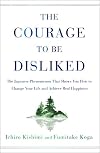
I almost put this book down after the first few chapters. The author's didactic presentation style was difficult to adapt to but that alone wasn't enough to turn me away. The almost-final straw was what I perceived to be the incessant victim blaming. For example, if the hypothetical student has a problem, the answer almost always is "you're choosing to have this problem."
But now that I've read the entirety of The Courage to Be Disliked, and consider it one of the most important books I've show more read this year, I can look back at my original objection and see the author was trying to make a difficult point as quickly as possible, like ripping off a band-aid, to condition the reader for some tough-love to come. The point of the early chapters is to realize that *most* problems are problems of choice and once you internalize that, then you can get to really good stuff.
Adlerian Psychology—this is the 'Japanese Phenomenon' from the title—feels like a religion. Honestly, I think that's more of a Japanese/American translation issue than anything else, but ultimately, it's beside the point. There are arguments and scientific backing for this branch of psychology which separates it from religion, but if this book is your main or only exposure to it, then it's going to come down to your gut feeling (aka belief/religion). My take is that's okay. Use the ideas or reject them. Let the results of how one manages the near-impossible task of changing one's life speak for themselves. show less
But now that I've read the entirety of The Courage to Be Disliked, and consider it one of the most important books I've show more read this year, I can look back at my original objection and see the author was trying to make a difficult point as quickly as possible, like ripping off a band-aid, to condition the reader for some tough-love to come. The point of the early chapters is to realize that *most* problems are problems of choice and once you internalize that, then you can get to really good stuff.
Adlerian Psychology—this is the 'Japanese Phenomenon' from the title—feels like a religion. Honestly, I think that's more of a Japanese/American translation issue than anything else, but ultimately, it's beside the point. There are arguments and scientific backing for this branch of psychology which separates it from religion, but if this book is your main or only exposure to it, then it's going to come down to your gut feeling (aka belief/religion). My take is that's okay. Use the ideas or reject them. Let the results of how one manages the near-impossible task of changing one's life speak for themselves. show less
The Courage to Be Disliked: The Japanese Phenomenon That Shows You How to Change Your Life and Achieve Real Happiness by Ichiro Kishimi
First, an admission: I bought this book as a joke, not seriously intending to read it. 'The Courage to be Disliked'? Crazy. But then I actually started reading it, and within pages I was hooked.
Like almost everyone I can think of, I am familiar with the name Sigmund Freud, and of his impact on the world of psychiatry and psychology. His theory that all present problems can be traced back to a root cause is compelling and clearly understandable.
But most importantly, it might very well be show more wrong.
In this fascinating book, Kishimi introduces the reader to the work and philosophy of Freud's contemporary, Alfred Adler. He turned Freud's logic on its head, suggesting instead that we use our current state as an excuse not to change. For example, somebody who is depressed might say that they are depressed as a result of a failed marriage, or that they were never loved as children. But this way of looking at things will simply prevent positive change from happening: you cannot change the past, and therefore the future is already written for you. Adler instead said that a depressed person is using their depression as an excuse not to be depressed - or in other words, there are benefits to the depression that outweigh fighting against it.
At first, this sounds quite ridiculous, not to mention downright insensitive. But as you probe the argument, you find that it is rather more sensible than it first seemed: a depressed person does not have to take risks, such as trying to go out and find somebody to date. If you try asking somebody out, you can easily be rejected, and that causes pain; but if you say you are too depressed to even attempt change, you are protected against the risk.
The courage spoken of in the title of this book then is not so much that you go out of your way to be disliked, but that you come to an understanding of who's task it is to do the disliking. You cannot make people like you - you can only live in such a way that being liked or disliked matters little to you and your sense of self.
This was the first time I read the name Adler; I doubt it will be the last. My curiosity has been piqued, and I want to know more, for here I seem to have found an approach to living my life that I can really get onboard with. show less
Like almost everyone I can think of, I am familiar with the name Sigmund Freud, and of his impact on the world of psychiatry and psychology. His theory that all present problems can be traced back to a root cause is compelling and clearly understandable.
But most importantly, it might very well be show more wrong.
In this fascinating book, Kishimi introduces the reader to the work and philosophy of Freud's contemporary, Alfred Adler. He turned Freud's logic on its head, suggesting instead that we use our current state as an excuse not to change. For example, somebody who is depressed might say that they are depressed as a result of a failed marriage, or that they were never loved as children. But this way of looking at things will simply prevent positive change from happening: you cannot change the past, and therefore the future is already written for you. Adler instead said that a depressed person is using their depression as an excuse not to be depressed - or in other words, there are benefits to the depression that outweigh fighting against it.
At first, this sounds quite ridiculous, not to mention downright insensitive. But as you probe the argument, you find that it is rather more sensible than it first seemed: a depressed person does not have to take risks, such as trying to go out and find somebody to date. If you try asking somebody out, you can easily be rejected, and that causes pain; but if you say you are too depressed to even attempt change, you are protected against the risk.
The courage spoken of in the title of this book then is not so much that you go out of your way to be disliked, but that you come to an understanding of who's task it is to do the disliking. You cannot make people like you - you can only live in such a way that being liked or disliked matters little to you and your sense of self.
This was the first time I read the name Adler; I doubt it will be the last. My curiosity has been piqued, and I want to know more, for here I seem to have found an approach to living my life that I can really get onboard with. show less
The Courage To Be Disliked: How to free yourself, change your life and achieve real happiness (Courage To series) by Ichiro Kishimi
I couldn't finish it. Bless me, i tried to, i really did, but i really couldn't take any more of this tedious mediocrity.
I had to keep on putting it down and going off and reading other things, and each time i came back i came back with good intentions, but each time i just put it down and went and read something else. Eventually, after 4 months of this, i got to 80% read and i just had to give up: it really wasn't doing my happiness any good whatsoever.
To sum it up: there's someone who show more claims to be a philosopher who is having a discussion with a young man, but the young man is asking all the wrong questions and failing miserably to point out the flaws in the supposed philosopher's babble: the ridiculousness of this conversation just makes one feel like banging ones head against the wall.
Seriously people, you could just keep picking random books off library bookshelves for the rest of your life and not read anything as tedious and pointless as this book.
As such, this book has received my website's great honour of being placed on "The Bookshelf of Infamy", i've also deleted it from my Kindle and Amazon account: yes, it really is that bad.
I certainly won't be bothering to read the sequel. show less
I had to keep on putting it down and going off and reading other things, and each time i came back i came back with good intentions, but each time i just put it down and went and read something else. Eventually, after 4 months of this, i got to 80% read and i just had to give up: it really wasn't doing my happiness any good whatsoever.
To sum it up: there's someone who show more claims to be a philosopher who is having a discussion with a young man, but the young man is asking all the wrong questions and failing miserably to point out the flaws in the supposed philosopher's babble: the ridiculousness of this conversation just makes one feel like banging ones head against the wall.
Seriously people, you could just keep picking random books off library bookshelves for the rest of your life and not read anything as tedious and pointless as this book.
As such, this book has received my website's great honour of being placed on "The Bookshelf of Infamy", i've also deleted it from my Kindle and Amazon account: yes, it really is that bad.
I certainly won't be bothering to read the sequel. show less
Lists
Awards

You May Also Like


Associated Authors
Statistics
- Works
- 23
- Members
- 2,264
- Popularity
- #11,338
- Rating
- 3.8
- Reviews
- 45
- ISBNs
- 73
- Languages
- 16