
Eula Biss
Author of On Immunity: An Inoculation
About the Author
Image credit: By Slowking4 - Own work, GFDL 1.2, https://commons.wikimedia.org/w/index.php?curid=35034131
Works by Eula Biss
The Pain Scale 1 copy
Associated Works
Tales of Two Americas: Stories of Inequality in a Divided Nation (2017) — Contributor — 228 copies, 7 reviews
Touchstone Anthology of Contemporary Creative Nonfiction: Work from 1970 to the Present (2007) — Contributor — 219 copies, 3 reviews
Read Hard: Five Years of Great Writing from the Believer (2009) — Contributor — 87 copies, 2 reviews
Tagged
Common Knowledge
- Birthdate
- 1977
- Gender
- female
- Education
- University of Iowa (MFA)
Hampshire College - Organizations
- Northwestern University
- Relationships
- Graf, Ellen (mother)
- Nationality
- USA
- Places of residence
- Chicago, Illinois, USA
- Associated Place (for map)
- Illinois, USA
Members
Reviews
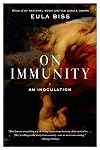
I'd like to start by saying I do not have kids. I think the topic of immunity and vaccination is an incredibly personal one and if you are a mother who is even thinking deeply about these things you are already doing your best you can to care for your kids.
Biss' book is a nonfiction look into the history of vaccination and a discussion of some of the current issues. She presents the information without berating people. I love the details she gives about milkmaids, cowpox, the development of show more the polio vaccination and so much more. She brings the topic to life by giving it a background and talking about real examples throughout history. She also makes a fascinating connection between disease and Bram Stoker's Dracula. He stands as he example of the plague and sickness we fear, sucking our life away
She brings the AIDS crisis into the book to show an example of how the views of disease have become driven by fear and sometimes even a belief that if we do things "right" we can protect ourselves and our children. She talks about her own experiences and the decisions she's made with her child. She presents current CDC or WHO statistics about disease and outbreaks around the world.
One of the most interesting aspects to me was the explanation of herd immunity and the important part it plays in protecting people with compromised immune systems. She pulls no punches when talking about scare tactics that are sometimes used based on no fax or incorrect or false studies that have already been disproved. It really made me think about where we get our information and the tendency that all people have to believe things without fact checking them.
BOTTOM LINE: I wanted to learn more about this issue from a well-researched source and so this book worked well for me. Everyone will approach this issue with their own belief system, so that will obviously affect your view of the material, but I thought she did an excellent job. I especially appreciated how she drew a clear line between what was packed and what was her opinion.
“Wealthier countries have the luxury of entertaining fears the rest of the world cannot afford.” show less
Biss' book is a nonfiction look into the history of vaccination and a discussion of some of the current issues. She presents the information without berating people. I love the details she gives about milkmaids, cowpox, the development of show more the polio vaccination and so much more. She brings the topic to life by giving it a background and talking about real examples throughout history. She also makes a fascinating connection between disease and Bram Stoker's Dracula. He stands as he example of the plague and sickness we fear, sucking our life away
She brings the AIDS crisis into the book to show an example of how the views of disease have become driven by fear and sometimes even a belief that if we do things "right" we can protect ourselves and our children. She talks about her own experiences and the decisions she's made with her child. She presents current CDC or WHO statistics about disease and outbreaks around the world.
One of the most interesting aspects to me was the explanation of herd immunity and the important part it plays in protecting people with compromised immune systems. She pulls no punches when talking about scare tactics that are sometimes used based on no fax or incorrect or false studies that have already been disproved. It really made me think about where we get our information and the tendency that all people have to believe things without fact checking them.
BOTTOM LINE: I wanted to learn more about this issue from a well-researched source and so this book worked well for me. Everyone will approach this issue with their own belief system, so that will obviously affect your view of the material, but I thought she did an excellent job. I especially appreciated how she drew a clear line between what was packed and what was her opinion.
“Wealthier countries have the luxury of entertaining fears the rest of the world cannot afford.” show less
I have a big book crush on Eula Biss now. This book is deep without being difficult. I found it super thought-provoking, especially her thoughts on sympathizing with anti-vax feelings. I admit to harshly judging anti-vaxxers, but it is not totally irrational to fear/distrust the establishment. There is a lot to chew on in terms of who we trust and why.
She is less sympathetic to individualism/exceptionalism. One of my favorite sections from the book is: "I do not need to consult an ethicist show more to determine that there is something wrong [with making a special exemption just for yourself]." She points out that when we give blood, we are doing it for others, not for ourselves. Getting vaccinated should be seen in this same light.
This was published in 2014 and it's still very relevant in 2021 in the midst of COVID vaccinations.
This is also a book that felt deeply relevant to me as the parent of a young child. The fear/anxiety of parenting in the 21st century is almost unbearable to me sometimes. It felt good to read someone as smart as Biss struggle with the same issues and parse their origins. There's a great section on how many parents value "purity" and cleanliness and things that are "natural" in parenting. Our fears are often out of whack with the actual risks.
This is also a book about the "us versus them" mentality both in terms of how we related to germs/viruses (are they foreign invaders or are they part of us?) and how we relate to other humans (do we blame disease on those perceived as other or different?). Metaphors and analogies matter. show less
She is less sympathetic to individualism/exceptionalism. One of my favorite sections from the book is: "I do not need to consult an ethicist show more to determine that there is something wrong [with making a special exemption just for yourself]." She points out that when we give blood, we are doing it for others, not for ourselves. Getting vaccinated should be seen in this same light.
This was published in 2014 and it's still very relevant in 2021 in the midst of COVID vaccinations.
This is also a book that felt deeply relevant to me as the parent of a young child. The fear/anxiety of parenting in the 21st century is almost unbearable to me sometimes. It felt good to read someone as smart as Biss struggle with the same issues and parse their origins. There's a great section on how many parents value "purity" and cleanliness and things that are "natural" in parenting. Our fears are often out of whack with the actual risks.
This is also a book about the "us versus them" mentality both in terms of how we related to germs/viruses (are they foreign invaders or are they part of us?) and how we relate to other humans (do we blame disease on those perceived as other or different?). Metaphors and analogies matter. show less
I spent the week reading this on the subway, which I thought would be a scarier proposition than it was, given the whole Ebola thing… people are wearing breather masks for their commute, for goodness sake. But I found it to be a very smart and measured contemplation of the ways in which we view our bodies, health and illness, our immune systems—the term is recent, a 1970s construct—and particularly the subject of vaccinations. Within that, she brings in a lot of interesting cultural show more touchpoints: Bram Stoker’s Dracula, Rachel Carson’s Silent Spring, the history of inoculation, and the etymology of the metaphors we use for disease and the body—it’s a little surprising to note how many of the terms come from warfare. Or maybe it’s not. As someone who has a very uneasy relationship to doctors and medicine and illness, I found the book surprisingly reassuring. show less
In this brief and beautifully written book Eula Biss explores the meaning and significance of the concepts of inoculation and immunity in the individual and society. Each chapter is written as an essay on various aspects of the topic. It is not presented as technical/scientific information, though there is no paucity of facts in the text. Ten pages of sources and citations at the back of the book are interesting reading by themselves.
Through facts, myths, and metaphor the author points out show more the importance of a larger understanding of important concepts. She explores how we integrate information into our systems of thought, hence the subtitle: "an inoculation". The result is an attempt to inoculate the reader against quick assumptions based on poorly researched facts and an awareness of the impact of metaphorical language on our impressions, opinions, and ultimately our world view.
Through this book, Ms. Biss effectively demonstrates the value of the study of humanities in a world that is currently dominated by technology and sound bites. Kudos to her.
One of my favorite quotes in the book is on p. 128 citing George Orwell's observation that thought can corrupt language and language can corrupt thought:
"Stale metaphors reproduce stale thinking. Mixed metaphors confuse. And metaphors flow in two directions - thinking about one thing in terms of another can illuminate or obscure both. If our sense of bodily vulnerability can pollute our politics, then our sense of political powerlessness must inform how we treat our bodies." show less
Through facts, myths, and metaphor the author points out show more the importance of a larger understanding of important concepts. She explores how we integrate information into our systems of thought, hence the subtitle: "an inoculation". The result is an attempt to inoculate the reader against quick assumptions based on poorly researched facts and an awareness of the impact of metaphorical language on our impressions, opinions, and ultimately our world view.
Through this book, Ms. Biss effectively demonstrates the value of the study of humanities in a world that is currently dominated by technology and sound bites. Kudos to her.
One of my favorite quotes in the book is on p. 128 citing George Orwell's observation that thought can corrupt language and language can corrupt thought:
"Stale metaphors reproduce stale thinking. Mixed metaphors confuse. And metaphors flow in two directions - thinking about one thing in terms of another can illuminate or obscure both. If our sense of bodily vulnerability can pollute our politics, then our sense of political powerlessness must inform how we treat our bodies." show less
Lists
Awards


You May Also Like


Associated Authors
Statistics
- Works
- 7
- Also by
- 6
- Members
- 1,911
- Popularity
- #13,465
- Rating
- 3.9
- Reviews
- 75
- ISBNs
- 41
- Languages
- 6
- Favorited
- 3