
Kathleen Belew
Author of Bring the War Home: The White Power Movement and Paramilitary America
About the Author
Image credit: By Christopher Michel from San Francisco
Works by Kathleen Belew
Associated Works
Myth America: Historians Take On the Biggest Legends and Lies About Our Past (2022) — Contributor — 281 copies, 5 reviews
Tagged
Common Knowledge
- Birthdate
- 1981-11-11
- Gender
- female
- Occupations
- Associate Professor of US History
- Organizations
- University of Chicago
- Nationality
- USA
- Associated Place (for map)
- USA
Members
Reviews
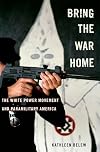
Forget Stephen King. This is the scariest book I've ever read.
The book mostly covers the white power movement in the 80s and 90s, ending with the Oklahoma City bombing, which I remember well. But, unbeknownst to me, that bombing launched a "widespread wave of violence as the militia movement, and the broader white power movement, took action around the country."
Guess I wasn't paying attention back then. I'm paying attention now. We all know there's a resurgence of late. They are emboldened. show more And they're coming to your town. They've already arrived in my liberal town (The Proud Boys) appearing en masse at a school board meeting, flashing their white power hand signs. It's enough to give you nightmares.
This is essential reading for anyone who's paying attention! show less
The book mostly covers the white power movement in the 80s and 90s, ending with the Oklahoma City bombing, which I remember well. But, unbeknownst to me, that bombing launched a "widespread wave of violence as the militia movement, and the broader white power movement, took action around the country."
Guess I wasn't paying attention back then. I'm paying attention now. We all know there's a resurgence of late. They are emboldened. show more And they're coming to your town. They've already arrived in my liberal town (The Proud Boys) appearing en masse at a school board meeting, flashing their white power hand signs. It's enough to give you nightmares.
This is essential reading for anyone who's paying attention! show less
Important, deeply researched for the timeframe she chooses to cover. Not a boffo dramatic read, but the people and the story are eye-opening, appalling, and very frightening. The scariest part is just how long these folks have been at this, the technology they have amassed, and the fact that the current iteration - as only the last of many over decades - is emerging as a public force, no longer just hunkered down in the woods of Idaho playing with their guns (and armored vehicles, and show more grenades, and C-4 plastic explosive, and in one case, enough cyanide to kill more people than have died of Covid in the US), but now marching down our streets with Congresscreatures in their pockets. I found the description of how these groups set up a communication system via "Liberty Net" before the internet was even a thing fascinating - they were decades ahead of Facebook, Parler and Gab. She plays fair by also tracing the intense militarization of the police and how it contributed to the atrocity of Ruby Ridge and the Waco debacle. For those of us waking up to the terrors and new prominence of the white power movement (her chosen term to encompass the Klan, Aryan Nations and other white supremacists, which eventually folded in the modern militias), this is a useful and cautionary work of history and background with an urgent currency. show less
When American paranoia spilled out into the open on January 7, 2021, I thought it a good time to re-educate myself about the players on the field.
To an outsider, the attack on the US Capitol looked like a cross between the storming of the Bastille and the burning of the Reichstag with some crazy costumes. It was tragic that four Capitol policemen lost their lives defending the seat of American democracy, and it could have been much worse had the legislators not gotten out of the building show more ahead of the mob.
What is equally crazy is the stonewalling by the Republican Party over efforts to get the bottom of such pressing questions as:
1) Why was there insufficient policing of the Capitol even though the FBI and the Capitol police knew something was underfoot?
2) Who were the organizers and what were their ultimate objectives?
3) Was Donald Trump actively engaged in an attempted coup-d’état?
4) Is another event brewing and if so how can it be stopped?
This brought me to Kathleen Belew’s excellent sociological study “Bring the War Home: The White Power Movement and Paramilitary America.”
As Belew sees it there are distinct contributors to domestic terrorism in America:
- there are the garden variety racists, amply represented by the Klu Klux Klan and their derivatives,
- there are the more generalized racists, alt-right, skinheads and easily identifiable neo-Nazis, anti-semites, and groups like the Proud Boys
- there is the stream of anti-communists stretching back to the Red Scare originating at the turn of the 20th century reaching its summit in the McCarthy Hearings of the 1950’s. Belew tracks a new variant of this epidemic in soldiers returning from Vietnam, and crazies who want us to believe they defended America even though they never did.
- there are groups of unmoored religious cults who variously believe in the Second Coming of Christ and where the men hate Arabs but conveniently believe in the Arab custom of polygamy.
- there are the contemporary and un-sanctioned militia groups who believe the right to bear arms means carrying around semi-automatic rifles to the neighbourhood grocery store. America is unique in having about 300 million licensed firearms in the hands of ordinary citizens.
- there are the anti-taxers, anti-abortionists, anti-unionists, anti-vaxers, and anti-maskers.
You could easily confuse these groups but they represent unique challenges to law enforcement.
In the 1990’s law enforcement took far too extreme measures to disarm a white separatist family in the hills of Idaho. Google Ruby Ridge and you’ll see what I mean. Then there was David Koresh and the Waco Texas standoff.
The ultimate expression of the paranoia was undoubtedly Timothy McVeigh’s bombing of a government building in Oklahoma. McVeigh conspired with militarists, white power, and anti-taxers.
McVeigh did not act alone. There were plenty of weapons and bomb-making expertise in the hands of white power groups. A lot of weapons had been stolen from US military bases. They were used to terrorize minorities, commit murder, and rob banks.
I was less familiar with the Greensboro massacre in 1979 where white power factions attacked and killed members of the Communist Workers Party who had organized a “Death to the Klan” march. The white-power attackers were exonerated by an all-white jury.
We can all see how the current partisan political environment played into the events on Capitol Hill. Donald Trump tried everything to reverse the results of the election with the help of Republican legislators, FOX News, and Vladimir Putin’s troll farm.
The question remains what are the sources of these extremist views? Many are not solely American-made behaviours. Colour-based prejudice, anti-semitism, nativism, and separatism go way back before the founding of the American Republic.
Of course, America was founded to some degree by religious separatists, anti-taxers, and grew up on a dangerous frontier. The historical frontier is long gone, but the frontier as a paranoid fantasy lives on.
And there is plenty of venom and envy to go around. show less
To an outsider, the attack on the US Capitol looked like a cross between the storming of the Bastille and the burning of the Reichstag with some crazy costumes. It was tragic that four Capitol policemen lost their lives defending the seat of American democracy, and it could have been much worse had the legislators not gotten out of the building show more ahead of the mob.
What is equally crazy is the stonewalling by the Republican Party over efforts to get the bottom of such pressing questions as:
1) Why was there insufficient policing of the Capitol even though the FBI and the Capitol police knew something was underfoot?
2) Who were the organizers and what were their ultimate objectives?
3) Was Donald Trump actively engaged in an attempted coup-d’état?
4) Is another event brewing and if so how can it be stopped?
This brought me to Kathleen Belew’s excellent sociological study “Bring the War Home: The White Power Movement and Paramilitary America.”
As Belew sees it there are distinct contributors to domestic terrorism in America:
- there are the garden variety racists, amply represented by the Klu Klux Klan and their derivatives,
- there are the more generalized racists, alt-right, skinheads and easily identifiable neo-Nazis, anti-semites, and groups like the Proud Boys
- there is the stream of anti-communists stretching back to the Red Scare originating at the turn of the 20th century reaching its summit in the McCarthy Hearings of the 1950’s. Belew tracks a new variant of this epidemic in soldiers returning from Vietnam, and crazies who want us to believe they defended America even though they never did.
- there are groups of unmoored religious cults who variously believe in the Second Coming of Christ and where the men hate Arabs but conveniently believe in the Arab custom of polygamy.
- there are the contemporary and un-sanctioned militia groups who believe the right to bear arms means carrying around semi-automatic rifles to the neighbourhood grocery store. America is unique in having about 300 million licensed firearms in the hands of ordinary citizens.
- there are the anti-taxers, anti-abortionists, anti-unionists, anti-vaxers, and anti-maskers.
You could easily confuse these groups but they represent unique challenges to law enforcement.
In the 1990’s law enforcement took far too extreme measures to disarm a white separatist family in the hills of Idaho. Google Ruby Ridge and you’ll see what I mean. Then there was David Koresh and the Waco Texas standoff.
The ultimate expression of the paranoia was undoubtedly Timothy McVeigh’s bombing of a government building in Oklahoma. McVeigh conspired with militarists, white power, and anti-taxers.
McVeigh did not act alone. There were plenty of weapons and bomb-making expertise in the hands of white power groups. A lot of weapons had been stolen from US military bases. They were used to terrorize minorities, commit murder, and rob banks.
I was less familiar with the Greensboro massacre in 1979 where white power factions attacked and killed members of the Communist Workers Party who had organized a “Death to the Klan” march. The white-power attackers were exonerated by an all-white jury.
We can all see how the current partisan political environment played into the events on Capitol Hill. Donald Trump tried everything to reverse the results of the election with the help of Republican legislators, FOX News, and Vladimir Putin’s troll farm.
The question remains what are the sources of these extremist views? Many are not solely American-made behaviours. Colour-based prejudice, anti-semitism, nativism, and separatism go way back before the founding of the American Republic.
Of course, America was founded to some degree by religious separatists, anti-taxers, and grew up on a dangerous frontier. The historical frontier is long gone, but the frontier as a paranoid fantasy lives on.
And there is plenty of venom and envy to go around. show less
Terrifying book, well researched but sometimes repetitive and badly written, about white power activism and organizing from post-Vietnam until now. The “leaderless” strategy that spurred acts like the Oklahoma City bombing has paid off in significant part by convincing journalists and most law enforcement officers that people like Dylann Roof and Timothy McVeigh were “lone wolves” rather than embedded in a larger network that trained and encouraged them. Belew’s thesis that the show more Vietnam War fundamentally reshaped the white power movement would have been strengthened by more contrast with the pre-Vietnam configurations, and it’s not clear that “Vietnam” structures the current movement’s understanding of its relationship with America and America’s government as it did twenty years ago. Her argument that post-Vietnam white power movements understood themselves as fundamentally in opposition to the federal government, as opposed to enforcing a racial hierarchy with which the government agreed, also needs some revisiting post-Trump. (I also wonder how much this is really a change—the KKK members and other racists who terrorized people in the first half of the twentieth century, in North and South, probably also thought that their local governments were really on their side, and they were almost certainly right. Hmm, this makes me think about Arendt’s argument about anti-Semitism’s inherent link to opposition to the modern state, and whether it could be extended to African-Americans’ relationship to the federal versus local governments.) show less
Lists
Awards


You May Also Like


Associated Authors
Statistics
- Works
- 3
- Also by
- 2
- Members
- 493
- Popularity
- #50,126
- Rating
- 4.1
- Reviews
- 11
- ISBNs
- 11