
David Rabe
Author of The Firm [1993 film]
About the Author
Born in Dubuque, Iowa, Rabe was educated at Loras College and Villanova. His service in Vietnam has had a major influence on his work, particularly in his early plays. In 1971 both The Basic Training of Pavlo Hummel, which traces a soldier's life from basic training to an ugly and ironic death in show more Vietnam, and Sticks and Bones, a slightly absurdist play that combines broad satire of U.S. family life with a realistic portrayal of the suffering of a blind veteran, were produced at Joseph Papp's New York Shakespeare Festival. Rabe's other plays of the 1970s were also produced there. Streamers (1976), which won the New York Drama Critics Circle Award, is the most notable of his Vietnam plays. Set in an army barracks, it is a powerful presentation of the destruction that can result from blind, uncontrolled rage. Hurlyburly (1985), which concerns the hollow lifestyle of a group of hip southern California men, began a long run on Broadway in 1984. As with many of Rabe's other plays, it explores the horrors that can result from distorted ideas of masculinity. Another recent play, Goose and Tomtom (1987), is a forceful drama about two small-time jewel thieves. In it, Rabe explores the theme of the illusory nature of reality. (Bowker Author Biography) show less
Image credit: photo:davidabrown
Series
Works by David Rabe
The Vietnam Plays, Volume I: The Basic Training of Pavlo Hummel and Sticks and Bones (1973) 97 copies
Plays, Volume 1: Basic Training of Pavlo Hummel; Sticks and Bones; Streamers; The Orphan (2002) 3 copies
In the Boom Boom Room 2 copies
Acerto final 1 copy
Ραβδιά και κόκκαλα 1 copy
Associated Works
The Actor's Book of Contemporary Stage Monologues: More Than 150 Monologues from More Than 70 Playwrights (1987) — Contributor — 193 copies
The Actor's Book of Scenes from New Plays: 70 Scenes for Two Actors, from Today's Hottest Playwrights (1988) — Contributor — 87 copies, 1 review
The Tony winners: A collection of ten exceptional plays, winners of the Tony Award for the most distinguished play of the year (1977) — Contributor — 6 copies
Tagged
Common Knowledge
- Canonical name
- Rabe, David
- Legal name
- Rabe, David William
- Birthdate
- 1940-03-10
- Gender
- male
- Education
- Loras College
Villanova University - Occupations
- playwright
- Awards and honors
- American Academy of Arts and Letters Academy Award (Literature, 1974)
- Relationships
- Clayburgh, Jill (wife)
- Nationality
- USA
- Birthplace
- Dubuque, Iowa, USA
- Associated Place (for map)
- Iowa, USA
Members
Reviews

David returns home after he is wounded in the Vietnam War. He is blind, yet he sees better than anyone. He comes back to a family that couldn’t have been more typical of its era. Denial, racism, a deep desire to hide everything under the carpet. A father that is an absolute brute, a mother whose weakness prevents her from keeping the family together, a younger brother whose only ‘’ideals’’ are pretending to play his guitar, eating chocolate cake and fucking girls in the back seat. show more How can David not fall into despair?
David Rabe’s play is a constant punch in the stomach. It throws you on the ground, and receive blow after blow, unable to move. You are frozen, witnessing the struggle of a young, broken man whose life and love have been destroyed, whose family home becomes Hell on Earth, worse than the worst battlefield. We could refer to PSTD, racism, middle-class narrow-mindedness, rednecks living in their own distorted microcosm. For me, these are just words. What horrifies me is the absolute lack of any kind of tenderness, not to mention love, from the parents to their child, the cruelty inflicted on the son who fought for an empty cause. When your home becomes a snake pit, what can you do?
From the beginning to its shocking closure, Sticks and Bones is one of the most terrifying, complex, demanding plays in American Drama, a treasure that we need to bring out of its present oblivion. If anyone is listening…
My reviews can also be found on https://theopinionatedreaderblog.wordpress.com/ show less
David Rabe’s play is a constant punch in the stomach. It throws you on the ground, and receive blow after blow, unable to move. You are frozen, witnessing the struggle of a young, broken man whose life and love have been destroyed, whose family home becomes Hell on Earth, worse than the worst battlefield. We could refer to PSTD, racism, middle-class narrow-mindedness, rednecks living in their own distorted microcosm. For me, these are just words. What horrifies me is the absolute lack of any kind of tenderness, not to mention love, from the parents to their child, the cruelty inflicted on the son who fought for an empty cause. When your home becomes a snake pit, what can you do?
From the beginning to its shocking closure, Sticks and Bones is one of the most terrifying, complex, demanding plays in American Drama, a treasure that we need to bring out of its present oblivion. If anyone is listening…
My reviews can also be found on https://theopinionatedreaderblog.wordpress.com/ show less
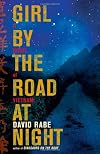
The Girl by the Road at Night by David Rabe is not a war novel. Instead, Rabe subtitles it "a novel about Vietnam”. This is true, since there are no scenes of combat described anywhere, at least not directly. It is a story about two individuals whose lives are directly impacted by the Vietnam War, trying to find refuge in human companionship. In principle, this is another casualties of war scenario, but Rabe creates something dark and beautiful through his use of prose and the rendering of show more his characters. His protagonists find each other really without looking for anything beyond a quick buck and a cheap lay, yet somehow immediately identify in each other the apparent loneliness which follows loss--of family, love, and innocence.The novel begins almost comically, with Private Joe Whitaker wandering aimlessly around an anti-war demonstration in Washington, DC drunk and in search of meaningless sex as a last hurrah. Recently drafted, he doesn’t quite see the devastation of the war just yet. The opening chapter serves as a characterization of Private Whitaker, and the reader won’t see anything exceptional about this would-be soldier. We know that he feels strongly about a failed relationship and therefore, is capable of feeling something beyond lust. But he is introduced to the reader as young and superficial with regard to satisfying his own base needs. With this, however, his subtle transformation becomes all the more apparent as the novel moves along, particularly once he arrives in Vietnam and begins his days as a jeep mechanic, and eventually, when he meets Quach Ngoc Lan.Lan is a young, slight-figured Vietnamese woman whose father is dead and whose other family members are dispersed throughout the country. She works as a prostitute cutting deals with American GIs who get "boucoup" sex and their jeeps washed at the local car wash owned by the village brothel--a kind of full-service whorehouse. The tone shifts from the surreally comic to the more melancholy when the reader is introduced to Lan, who still dreams of a childhood lost and who goes about her life with quiet, even tragic resignation. What Rabe does brilliantly at the beginning and throughout the novel is evoke emotion and sympathy in the reader without being sentimental. He does this through prose that is both lyrical and matter-of-fact, describing serene landscapes and squalid interiors, allowing setting to reflect the interactions between, and the quiet despair within, his lonely characters: “She prowls the room, the dirt-stained tile of the floor. A gecko starts and stops. Her feet are small in her worn-out slippers, and reaching the front doorway, her eyes seek into the night, the road before her thudding with a huge green truck caked with wrinkled dust, loaded with crates. The sink and surge of the pavement comes through the earth to her feet.”Whitaker is surprised by the youth and prettiness of Lan, and even more so when she expresses interest in having him as one of her customers. Never forgetting that she is only a prostitute and nothing more, he will still feel something completely unexpected in her presence, which Rabe describes perfectly in the scene of their first encounter: “Whitaker, with Lan, who has come to stand beside him wearing white cotton pajamas, her long thick hair hanging loose, feels his prick stir and lust mixes with a funny fear and loneliness he does not understand. The silence, comprehensive as sleep, is strange, as if he has never heard a rural night before.” Not quite love but more than lust, Whitaker can hardly make sense of his thoughts and feelings, and it is precisely through this confusion that the reader sees that he has moved beyond what he was at the beginning. His “funny fear and loneliness” makes him more human, more soul than body, even though it is his search for carnal pleasures which brings him to this momentary realization of the senselessness of war and the contingency of loss: “Maybe now...he will be able to find himself, he thinks, somehow locating the lost part of himself that he knows is in there.”But to hope for Whitaker’s transformation to be genuine would be asking too much in the context of war, which tears away at human decency and human dignity. When Whitaker seeks Lan a second time, he finds her getting punched in the face by another GI--yet stands there and does nothing. Later feeling guilty for not having interceded, he perform a heroic act by saving her from two hostile Vietnamese soldiers. The scene is hardly described as a grand, benevolent gesture, though the reader is appeased to know that sympathy still exists. In the end, however, heroism, love, and friendship--what was once familiar seems tenuous, senseless and haphazard. These things have their moments, but the war pollutes them and robs them of their familiar goodness and meaning.The end of the novel, like the chance encounter between Lan and Whitaker, illustrates this randomness of life painfully and succinctly. It will disappoint readers who will perhaps wish to forget that life and death and love are all really a matter of chance. The language of The Girl by the Road at Night is poetic and moving, but the intent is not to romanticize war nor to obscure the brute ugliness it. Words are infused with the weight of tragedy and despair from page to page. The characters do what they can in a universe which is cruelly indifferent to the fate of all, an indifference only worsened by the ignorance and chaos which characterized this war for so many. show less

Very mixed feelings about this work. First, the thing rambles on for more than half without establishing any sort of plot line and seemingly just a written down version of basic training, complete with humiliation of the recruits and extreme misogyny. When the plot finally does establish, in Act II, it becomes much more of a play, but the problems still remain. It could be that this is simply a poor read, and it might do better staged, since the real impact of this play would appear to be in show more the action, not the words, but I just couldn't get past the rambling incoherence of so much of the work (acknowledging that rambling incoherence was actually a "style" at the time this was written, and plot was considered bourgeoisie). It does do a good job of capturing the total dehumanization of soldiers, and the fate that awaits them should they ever try to act as humans and peers to people only slightly higher on the hierarchy. I would also say that Rabe made a courageous move making his hero so extremely anti-heroic, and essentially a total jerk. show less

A self-absorbed bizarre love triangle. More like triangular prism. Obtuse, scalene but certainly not equilateral. A scathing satire on out-of-work actors in LA with relationship problems and a penchant to make the mundane spectacular. Super 80's. Everything I want in a play.
Lists
Awards


You May Also Like


Associated Authors
Statistics
- Works
- 37
- Also by
- 11
- Members
- 1,179
- Popularity
- #21,802
- Rating
- 3.5
- Reviews
- 21
- ISBNs
- 92
- Languages
- 2