
Rodney Hall (1) (1935–)
Author of Just Relations
For other authors named Rodney Hall, see the disambiguation page.
About the Author
Rodney Hall was born in England on November 18, 1935. After World War II, he migrated to Australia with his family. At the age of 16, he left school in Brisbane, but eventually graduated from the University of Queensland in 1971. He has written collections of poetry, biographies, novels, and show more scripts for both television and radio. His works include Penniless till Doomsday, Popeye Never Told You: Childhood Memories of the War, and The Day We Had Hitler Home. He has won numerous awards including the Grace Leven Poetry Prize for A Soapbox Omnibus, the Victorian Premier's Literary Award and the Vance Palmer Prize for Fiction for Captivity Captive, the Miles Franklin Award for Just Relations and for The Grisly Wife, and the Australian Literature Society Gold Medal for The Second Bridegroom and Love without Hope. In 1990, he was made a Member of the Order of Australia for services to literature. (Bowker Author Biography) show less
Series
Works by Rodney Hall
Eyewitness: poems 1 copy
Associated Works
Tagged
Common Knowledge
- Birthdate
- 1935-11-18
- Gender
- male
- Education
- University of Queensland
- Occupations
- poet
novelist
short story writer
editor
biographer - Nationality
- England (birth)
UK (birth)
Australia
Members
Reviews

"Here in New South Wales...the real and the fabulous have not yet gone their separate ways. There is nothing to prevent our fables taking root here. And we have brought plenty of them with us."
What a revelation! Rodney Hall, a two-time Miles Franklin Winner (and seven-time nominee) has always been on my to-read list for that reason, but (in retrospect disappointingly) no-one has ever taken the time to recommend him to me. Indeed, his collective oeuvre has fewer than 400 ratings on Goodreads show more and around 60 reviews. Mr Hall, how the world has wronged you.
The Second Bridegroom is a sublime piece of literature, set in the 1830s as a convict escapes his dire conditions along the coast of Australia somewhere south of Sydney. In the bush, he finds himself part of a ceremony among local Indigenous people, whom he can barely comprehend even as people, let alone as practitioners of another culture. To say much more would be to spoil an exhilarating read, buoyed by Hall's delicate, exquisite prose and his ability to conjure a world lost to us (arguably two worlds). His narrator, apologetic for upsetting his reader with the mere idea that this other beings might be "men", is an authentic and engaging viewpoint into a mindset. Hall's work fuses the 1830s with the present day, raising questions about our shared past while exploring beyond individuals into the very essence of humanity, power, dignity, grief, and faith.
"Do you hear that as you read my words? Do you know the grief we know? Does life mean what you thought?"
Hall is clearly a writer's writer, but I believe that he could be engaging to all readers of quality Australian literature. I hope his reputation remains. show less
What a revelation! Rodney Hall, a two-time Miles Franklin Winner (and seven-time nominee) has always been on my to-read list for that reason, but (in retrospect disappointingly) no-one has ever taken the time to recommend him to me. Indeed, his collective oeuvre has fewer than 400 ratings on Goodreads show more and around 60 reviews. Mr Hall, how the world has wronged you.
The Second Bridegroom is a sublime piece of literature, set in the 1830s as a convict escapes his dire conditions along the coast of Australia somewhere south of Sydney. In the bush, he finds himself part of a ceremony among local Indigenous people, whom he can barely comprehend even as people, let alone as practitioners of another culture. To say much more would be to spoil an exhilarating read, buoyed by Hall's delicate, exquisite prose and his ability to conjure a world lost to us (arguably two worlds). His narrator, apologetic for upsetting his reader with the mere idea that this other beings might be "men", is an authentic and engaging viewpoint into a mindset. Hall's work fuses the 1830s with the present day, raising questions about our shared past while exploring beyond individuals into the very essence of humanity, power, dignity, grief, and faith.
"Do you hear that as you read my words? Do you know the grief we know? Does life mean what you thought?"
Hall is clearly a writer's writer, but I believe that he could be engaging to all readers of quality Australian literature. I hope his reputation remains. show less

"The truth is that if we are to be any use tomorrow we have to accept what happened yesterday - so you may be sure there's something amiss when one hears so much about what we will do in the future while there's never a peep about what we have already done."
Rodney Hall is an utterly absorbing writer, and The Grisly Wife is another great success, haunting, atmospheric, darkly funny, and painful in its profundity. In the late 1860s, a radical preacher sails from England to Australia to set up show more a mission in a remote part of the east coast, with his posse of female followers and his virgin wife, Catherine Byrne, the narrator of the novel. The emigrants set up their new home in the (fictional) settlement of Yandilli, the site of Hall's previous novel The Second Bridegroom which was set around 1838, making this novel a thematic sequel.
Catherine - narrating her tale years later to an initially unnamed listener - is, like many of Hall's protagonists, a figure on the outskirts of her own culture. Like The Second Bridegroom's convict, who experienced the painful dawning of recognition when forced to interact with a society different to his own, Catherine is asking herself questions about social expectations, cultural norms, a figure of suppressed doubt amongst those who would see the choice between belief and savagery as a binary one.
"Ambition is a curious urge, don't you agree? being as much as to say if I do not surrender my place in life to struggle for a different place (some other person's place) then I will not quite fully live."
The novel falls squarely into the long tradition of tales about starchy British colonialists facing off against the Australian bush, attempting valiantly to replicate their culture in a location so very hostile to it. But it is also a novel about belief and doubt, about human connection, and the ways we attempt to navigate our lives as individuals while also existing in tandem with others. It is perhaps a slightly tougher read than Bridegroom on the grounds that Catherine's memory flits from idea to idea, year to year, seemingly haphazardly and with a more idiosyncratic speech pattern (she is rather like Emily Dickinson, with her love of dashes above all other punctuation).
The goal of literature is to discover. The goal of Australian literature is usually to discover what defines our country, our people. Hall suggests that we may not like what we find, but we have little choice, bound on a wheel of fire that must, someday, come full circle. show less
Rodney Hall is an utterly absorbing writer, and The Grisly Wife is another great success, haunting, atmospheric, darkly funny, and painful in its profundity. In the late 1860s, a radical preacher sails from England to Australia to set up show more a mission in a remote part of the east coast, with his posse of female followers and his virgin wife, Catherine Byrne, the narrator of the novel. The emigrants set up their new home in the (fictional) settlement of Yandilli, the site of Hall's previous novel The Second Bridegroom which was set around 1838, making this novel a thematic sequel.
Catherine - narrating her tale years later to an initially unnamed listener - is, like many of Hall's protagonists, a figure on the outskirts of her own culture. Like The Second Bridegroom's convict, who experienced the painful dawning of recognition when forced to interact with a society different to his own, Catherine is asking herself questions about social expectations, cultural norms, a figure of suppressed doubt amongst those who would see the choice between belief and savagery as a binary one.
"Ambition is a curious urge, don't you agree? being as much as to say if I do not surrender my place in life to struggle for a different place (some other person's place) then I will not quite fully live."
The novel falls squarely into the long tradition of tales about starchy British colonialists facing off against the Australian bush, attempting valiantly to replicate their culture in a location so very hostile to it. But it is also a novel about belief and doubt, about human connection, and the ways we attempt to navigate our lives as individuals while also existing in tandem with others. It is perhaps a slightly tougher read than Bridegroom on the grounds that Catherine's memory flits from idea to idea, year to year, seemingly haphazardly and with a more idiosyncratic speech pattern (she is rather like Emily Dickinson, with her love of dashes above all other punctuation).
The goal of literature is to discover. The goal of Australian literature is usually to discover what defines our country, our people. Hall suggests that we may not like what we find, but we have little choice, bound on a wheel of fire that must, someday, come full circle. show less
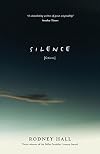
Silence by Rodney Hall has been on the TBR for far too long, and I owe its 'rediscovery' to my recent reading of Vortex, which included a reworking of one of the twenty-nine short fictions. So I had it on my desk for a while, reading one or two of its pieces from time to time, and then I set it aside for #ShortStorySeptember.
The book has a Table of Contents with a most unusual design by Tania Gomes. What might at first glance look like a gimmick takes on a new resonance after reading show more Vortex...
The ultimate irony of this collection is that Hall uses words to suggest silence and its absence. Sometimes he evokes the silent indifference of the natural world covering man's savagery with snow; sometimes it is the busy work of history which silences some voices while also casting discomfiting events into the void. Though his style shows his versatility both in taut prose and discursive ambiguities, the tone is melancholy.
This is an excerpt from 'James Cook' showing Hall's mastery of 19th century style and mindset:
Today, much of what we read is directed at the effects of colonialism, and the dispossession of Indigenous people. But here, in these two paragraphs, Hall makes us reckon with the ordinary people tasked with the colonial project. He shows us the anxiety of men who have lost their leader in some new peril which they do not understand.
To read the rest of my review please visit https://anzlitlovers.com/2025/09/21/silence-2011-by-rodney-hall/ show less
The book has a Table of Contents with a most unusual design by Tania Gomes. What might at first glance look like a gimmick takes on a new resonance after reading show more Vortex...
The ultimate irony of this collection is that Hall uses words to suggest silence and its absence. Sometimes he evokes the silent indifference of the natural world covering man's savagery with snow; sometimes it is the busy work of history which silences some voices while also casting discomfiting events into the void. Though his style shows his versatility both in taut prose and discursive ambiguities, the tone is melancholy.
This is an excerpt from 'James Cook' showing Hall's mastery of 19th century style and mindset:
The wind off the land has dropped alltogether, Resolution's rigging steady as compass-bearings rules upon the sky. The stillness is intense, tho' for myself, memories of yesterday's shots spoil all peace of mind. We can guess who fired them—but at whom? Why did they stop? Why has Mr Cook not yet returned? In our hearts we suspect he has met his death, This is our tremendous reason for idleness, unable to decide what might be done. Moreover, any false action could be construed by the natives as incivility, if, in fact, he is still alive. Having taken a powder-horn from my pouch to be ready, prudently I slip it back out of sight of the crew.
Captn Clerke objects that Mr Cook could surely have come to no harm, it being barely two weeks since he was ceremoniously welcomd here. Indeed, the islanders robed him then in a cape of feathers plucked from rare parrots—little orange and yellow chaps—to receive him off our ship like a god. Notwithstanding which, something is unquestionably gone wrong, something which we fear to speak of. Neither I, nor any man aboard, can doubt it & a sullen silence locks down, the cosmos fixd around us on this glassy lagoon. (p.21)
Today, much of what we read is directed at the effects of colonialism, and the dispossession of Indigenous people. But here, in these two paragraphs, Hall makes us reckon with the ordinary people tasked with the colonial project. He shows us the anxiety of men who have lost their leader in some new peril which they do not understand.
To read the rest of my review please visit https://anzlitlovers.com/2025/09/21/silence-2011-by-rodney-hall/ show less

Rodney Hall as poet emerges from this novel, well worth reading in its complex, twisted prose, although perhaps best placed at the end of the loose trilogy of novels. Although it is not connected to them plot-wise (aside from a couple of subtle references), this story of lust, fear, and captivity on the harsh Australian coast at the end of the 19th century builds much of its strength from Hall's other explorations of such a world.
I am just going to post one of the many powerful passages show more from the novel, rather than attempt to come to terms with the experience of reading Hall. He deserves to have a much stronger presence on Australian bookshelves.
"Sitting round the oil-lamps of a winter's night, Pa read Lives of the Saints at the rate of about one sentence an hour. Mum read even more dreadful things in the darkness beyond her own familiar dark. And we played a card game called Happy Families.
When the wind blew from the north-east, which it often did, we could hear a distant crash of waves down at the cliffs below the twenty. And when we had gone to bed - as we preyed on each other, breathing each other's snores, turning together in our separate sleep so our bed-springs made harmony or screamed in someone else's nightmare - the cracks between the planks of the rough walls gaped wider and hair-fine glints of a silver sheet turned its wave to our drowning eyes; our bodyheat went sleepwalking till the dogs grew restless and put up their pointed noses and the horses, musing as they stood round in mockery of sleep, bent to stir the fog with caressing tongues and shook magnificent necks in the moonlight of a mare's eye.. While the ocean, that relentless heart, beat beat beat away at the rocks." show less
I am just going to post one of the many powerful passages show more from the novel, rather than attempt to come to terms with the experience of reading Hall. He deserves to have a much stronger presence on Australian bookshelves.
"Sitting round the oil-lamps of a winter's night, Pa read Lives of the Saints at the rate of about one sentence an hour. Mum read even more dreadful things in the darkness beyond her own familiar dark. And we played a card game called Happy Families.
When the wind blew from the north-east, which it often did, we could hear a distant crash of waves down at the cliffs below the twenty. And when we had gone to bed - as we preyed on each other, breathing each other's snores, turning together in our separate sleep so our bed-springs made harmony or screamed in someone else's nightmare - the cracks between the planks of the rough walls gaped wider and hair-fine glints of a silver sheet turned its wave to our drowning eyes; our bodyheat went sleepwalking till the dogs grew restless and put up their pointed noses and the horses, musing as they stood round in mockery of sleep, bent to stir the fog with caressing tongues and shook magnificent necks in the moonlight of a mare's eye.. While the ocean, that relentless heart, beat beat beat away at the rocks." show less
Awards


You May Also Like


Associated Authors
Statistics
- Works
- 35
- Also by
- 1
- Members
- 717
- Popularity
- #35,385
- Rating
- 3.8
- Reviews
- 15
- ISBNs
- 99
- Languages
- 3
- Favorited
- 1