
Patrick White (1) (1912–1990)
Author of Voss
For other authors named Patrick White, see the disambiguation page.
About the Author
Patrick White was born on May 28, 1912 in Knightsbridge, London, to Australian parents. He studied modern languages at King's College, Cambridge. During World War II, he served in the Royal Air Force. His first novel, Happy Valley, was published in 1939. His other works include The Tree of Man, show more Voss, Riders in the Chariot, The Solid Mandala, The Twyborn Affair, and The Hanging Garden. He also wrote several plays including The Season at Sarsaparilla, Night on Bald Mountain, and Signal Driver. They never met with the success his fiction had and have not been produced outside Australia. He won the Nobel Prize for Literature in 1973. He died on September 30, 1990. (Bowker Author Biography) show less
Works by Patrick White
Associated Works
The Art of the Tale: An International Anthology of Short Stories (1986) — Contributor — 381 copies, 3 reviews
Australian Literature: An Anthology of Writing from the Land Down Under (1993) — Contributor — 29 copies, 1 review
Tagged
Common Knowledge
- Canonical name
- White, Patrick
- Legal name
- White, Patrick Victor Martindale
- Other names
- Gray, Alex Xenophon Demirjan
White, Patrick
패트릭 화이트
パトリック・ホワイト
帕特里克·怀特 - Birthdate
- 1912-05-28
- Date of death
- 1990-09-30
- Gender
- male
- Education
- Cheltenham College
University of Cambridge (King's College ∙ BA ∙ 1935)
Tudor House School - Occupations
- essayist
novelist
playwright
poet
short story writer
stockman - Organizations
- Patrick White Award (established)
- Awards and honors
- Nobel Prize (Literature, 1973)
Australian of the Year Award (1973) - Relationships
- Lascaris, Manoly (life partner)
- Nationality
- Australia
UK - Birthplace
- Knightsbridge, London, England, UK
- Places of residence
- London, England, UK
Sydney, New South Wales, Australia
Massachusetts, USA
New York, New York, USA
Castle Hill, New South Wales, Australia - Place of death
- Sydney, New South Wales, Australia
- Disambiguation notice
- VIAF:41847966
Members
Discussions
Message Board in Patrick White 100th Anniversary Challenge (April 2013)
The Twyborn Affair - discussion in Patrick White 100th Anniversary Challenge (December 2012)
The Eye of the Storm - discussion in Patrick White 100th Anniversary Challenge (November 2012)
Riders in the Chariot in Patrick White 100th Anniversary Challenge (August 2012)
The Vivisector in Patrick White 100th Anniversary Challenge (June 2012)
Voss - discussion in Patrick White 100th Anniversary Challenge (June 2012)
The Solid Mandala in Patrick White 100th Anniversary Challenge (May 2012)
Riders in the Chariot in Book talk (May 2012)
The Tree of Man - discussion in Patrick White 100th Anniversary Challenge (April 2012)
The Aunt's Story - discussion in Patrick White 100th Anniversary Challenge (April 2012)
A Fringe of Leaves - discussion in Patrick White 100th Anniversary Challenge (March 2012)
The Living and the Dead - discussion in Patrick White 100th Anniversary Challenge (February 2012)
The Novels in Patrick White 100th Anniversary Challenge (January 2012)
Reviews

One of the most wondrous books I have ever read, and one I return to whenever I need a reminder of the joys of literature.
This will be too dense for some, too languid for others, but it fits neatly into my Venn diagram of literary interests. Broadly well-intentioned characters slowly moving toward personal relevation? Check. An epic scope grafted on to ordinary lives? Check. A sense of tightly-spun character profiles in which each person is seen through multiple eyes, until a fully honed show more person emerges? Check. Other things I could list just to annoy you with this repetitive rhetoric? Check check check.
Although The Tree of Man is quintessentially Australian (so much so that it feels like a Tom Roberts has sprung to life) it has an abstract, intimate quality that suggests to me it could be read by anyone. As long as your culture has gone from rustic to urban, as long as you yourself have felt the quiet pull of loneliness, unexpected intimacy, doubt, and thwarted ambition. As long as you have at some point wondered if there was more to the universe than your tiny role in it, but perhaps put those thoughts away rather than face what they may mean.
This is a book that might be classified as "tough going" (like so much of White, whom I adore) but it's not intended to be read in one sitting. This really is a novel to be savoured. Let the language and the gradual expanse wash over you. You'll be okay in the end. If there is an end. show less
This will be too dense for some, too languid for others, but it fits neatly into my Venn diagram of literary interests. Broadly well-intentioned characters slowly moving toward personal relevation? Check. An epic scope grafted on to ordinary lives? Check. A sense of tightly-spun character profiles in which each person is seen through multiple eyes, until a fully honed show more person emerges? Check. Other things I could list just to annoy you with this repetitive rhetoric? Check check check.
Although The Tree of Man is quintessentially Australian (so much so that it feels like a Tom Roberts has sprung to life) it has an abstract, intimate quality that suggests to me it could be read by anyone. As long as your culture has gone from rustic to urban, as long as you yourself have felt the quiet pull of loneliness, unexpected intimacy, doubt, and thwarted ambition. As long as you have at some point wondered if there was more to the universe than your tiny role in it, but perhaps put those thoughts away rather than face what they may mean.
This is a book that might be classified as "tough going" (like so much of White, whom I adore) but it's not intended to be read in one sitting. This really is a novel to be savoured. Let the language and the gradual expanse wash over you. You'll be okay in the end. If there is an end. show less

10/10
10/10
It's been a week since I finished this book, and I still feel somewhat bloated: my mind, and not my innards, still distended by almost countless images that haunt me. I imagine my mind looks something like this right now:
I wonder if this particular (mental) cobra will ever be able to digest all that Patrick White packs in this novel. (I started by giving him a mere 8.5 -- but who am I kidding?)
It's an historical novel, on the surface of it, about a 19th century shipwreck (fact) show more and what happens to the crew and passengers after the ship runs aground on a coral reef of what is now Fraser Island, off the coast of Queensland. Based on the experiences of Eliza Fraser, who is the real-life model for the protagonist, Patrick White spins a tale of such overwhelming complexity that it will ever be impossible to separate fact from fiction after this.
After running aground on the isle that now bears her name, Eliza Fraser was "kidnapped" by an aboriginal tribe who, according to her narrative, tortured her, savaged her, almost beyond human endurance. She (again according to her testimony) only escaped with her life by the grace of an escaped convict who had been living on the island for some years, took pity on her, and led her to a white settlement. Her testimony led to the near-extermination of the tribe which had "captured" her, despite ample documentation by other wayfarers that this was a peaceable tribe which welcomed all who crossed their paths. The historical facts are so convoluted, and so sullied by multiple layers of liars that it will forever be impossible to know for certain what happened on the island. Still, what remains with a haunting vengeance is that Eliza Fraser knew how to land on her feet every step of the way, so it is more than likely that history will eventually speak against her.
While White takes us around and around the facts of Fraser's life, sometimes dancing very near to the facts, sometimes straying into wildest fiction, the story reveals itself to be even more complex than the historical figure upon whom the novel is based -- for this is not an exploration of Fraser's temporal existence, but an examination of her soul. Or, at least "a" soul of a gentlewoman -- any gentlewoman -- of the 19th century, who is asked to leave all her trappings at the shore, as it were, and step naked into her other self.
Stripped to her (literal) naked self, Ellen Roxburgh, the protagonist gentlewoman, reaches immediately for cover -- the proverbial fig leaf, as she stands, for the first time in her life, truly naked, in thought and in deed. She will be (re)shaped and (re)formed as she steps face-to-face with her primal self.
While she fashions a covering for her body, it is interesting and noteworthy that she hides her wedding ring among the fringe of leaves around her waist, the one element of civilization that she still retains. Holding it as a talisman, perhaps, but still holding it hidden.
On one level, it is a fine re-imagining of Genesis; on another, it is an equally provocative journey into a heart of darkness. Is the woman merely hiding, and ashamed of her nakedness -- of the self that is stripped of all accoutrement and pretension? Or is she afraid of her more repellent self -- the self that will stoop to any level, to survive? Is she simply mimicking primal behaviour in order to "get along" and survive -- or is she succumbing fully to her worst instincts and in so doing, becoming more savage than the "savages"?
White offers a provocative premise: it is exactly the cloak of civilization which elicits her worst possible instincts: those whose pretensions are well polished fall far lower, and degrade themselves more than those who have lived in rhythm with nature all their lives.
Painting by Sidney Nolan, "Mrs. Fraser"
Ellen Roxburgh is eventually "rescued" by a convict and returned to a white settlement, much in the manner that Eliza Fraser was; but unlike Fraser, Ellen seems to have grown spiritually -- for the official records show that Fraser's insistent complaints eventually led to the massacre of the aboriginal tribe. (She also returned to England, remarried and proceeded to extort funds from the government for her suffering, despite questionable proof whether she had indeed suffered at all.)
And that's what makes this novel especially difficult to digest properly: while encountering Ellen's transformative experiences on every page, it was difficult to forget Eliza Fraser, who was juxtaposed at an oblique angle, as a constant arbiter between truth and fiction, for Fraser's own story is as much fiction as is White's -- which leads to the ultimate circular argument that perhaps White got it right after all, and was somehow channelling Fraser's real story. What a conundrum!
This is a story that must be read a few times to bleed out all the nuances.
I leave this review half finished for now.
A Warning Buoy To All Gardeners
[In a rather sardonic tone, I note with some revulsion that there is an immense similarity between an opossum's tail and a dandelion root. I may never be able to look at a dandelion root again without feeling the urge to retch.] show less
10/10
It's been a week since I finished this book, and I still feel somewhat bloated: my mind, and not my innards, still distended by almost countless images that haunt me. I imagine my mind looks something like this right now:
I wonder if this particular (mental) cobra will ever be able to digest all that Patrick White packs in this novel. (I started by giving him a mere 8.5 -- but who am I kidding?)
It's an historical novel, on the surface of it, about a 19th century shipwreck (fact) show more and what happens to the crew and passengers after the ship runs aground on a coral reef of what is now Fraser Island, off the coast of Queensland. Based on the experiences of Eliza Fraser, who is the real-life model for the protagonist, Patrick White spins a tale of such overwhelming complexity that it will ever be impossible to separate fact from fiction after this.
After running aground on the isle that now bears her name, Eliza Fraser was "kidnapped" by an aboriginal tribe who, according to her narrative, tortured her, savaged her, almost beyond human endurance. She (again according to her testimony) only escaped with her life by the grace of an escaped convict who had been living on the island for some years, took pity on her, and led her to a white settlement. Her testimony led to the near-extermination of the tribe which had "captured" her, despite ample documentation by other wayfarers that this was a peaceable tribe which welcomed all who crossed their paths. The historical facts are so convoluted, and so sullied by multiple layers of liars that it will forever be impossible to know for certain what happened on the island. Still, what remains with a haunting vengeance is that Eliza Fraser knew how to land on her feet every step of the way, so it is more than likely that history will eventually speak against her.
While White takes us around and around the facts of Fraser's life, sometimes dancing very near to the facts, sometimes straying into wildest fiction, the story reveals itself to be even more complex than the historical figure upon whom the novel is based -- for this is not an exploration of Fraser's temporal existence, but an examination of her soul. Or, at least "a" soul of a gentlewoman -- any gentlewoman -- of the 19th century, who is asked to leave all her trappings at the shore, as it were, and step naked into her other self.
Stripped to her (literal) naked self, Ellen Roxburgh, the protagonist gentlewoman, reaches immediately for cover -- the proverbial fig leaf, as she stands, for the first time in her life, truly naked, in thought and in deed. She will be (re)shaped and (re)formed as she steps face-to-face with her primal self.
While she fashions a covering for her body, it is interesting and noteworthy that she hides her wedding ring among the fringe of leaves around her waist, the one element of civilization that she still retains. Holding it as a talisman, perhaps, but still holding it hidden.
On one level, it is a fine re-imagining of Genesis; on another, it is an equally provocative journey into a heart of darkness. Is the woman merely hiding, and ashamed of her nakedness -- of the self that is stripped of all accoutrement and pretension? Or is she afraid of her more repellent self -- the self that will stoop to any level, to survive? Is she simply mimicking primal behaviour in order to "get along" and survive -- or is she succumbing fully to her worst instincts and in so doing, becoming more savage than the "savages"?
White offers a provocative premise: it is exactly the cloak of civilization which elicits her worst possible instincts: those whose pretensions are well polished fall far lower, and degrade themselves more than those who have lived in rhythm with nature all their lives.
Painting by Sidney Nolan, "Mrs. Fraser"
Ellen Roxburgh is eventually "rescued" by a convict and returned to a white settlement, much in the manner that Eliza Fraser was; but unlike Fraser, Ellen seems to have grown spiritually -- for the official records show that Fraser's insistent complaints eventually led to the massacre of the aboriginal tribe. (She also returned to England, remarried and proceeded to extort funds from the government for her suffering, despite questionable proof whether she had indeed suffered at all.)
And that's what makes this novel especially difficult to digest properly: while encountering Ellen's transformative experiences on every page, it was difficult to forget Eliza Fraser, who was juxtaposed at an oblique angle, as a constant arbiter between truth and fiction, for Fraser's own story is as much fiction as is White's -- which leads to the ultimate circular argument that perhaps White got it right after all, and was somehow channelling Fraser's real story. What a conundrum!
This is a story that must be read a few times to bleed out all the nuances.
I leave this review half finished for now.
A Warning Buoy To All Gardeners
[In a rather sardonic tone, I note with some revulsion that there is an immense similarity between an opossum's tail and a dandelion root. I may never be able to look at a dandelion root again without feeling the urge to retch.] show less

White's second novel, The Living and the Dead is set in a grim, mournful, expectant London, waiting for WWII to properly commence. Its three central characters are a mother and her two adult children, each of whom faces disappointment, self-reflection, and more disappointment.
White was around 27 when he started the novel, and he spent the first two years of WWII working on the project, zipping between London (where he was struggling to find success) and New York (where he was critically show more acclaimed early on, and where he was closer to the man he had fallen in love with during this youthful period). Ultimately, surely to his surprise, White would end up - after the war - back in Australia, and in a relationship with a man very different to those he had met thus far. Perhaps then it seems fair to say that this novel is a different path to those with which White would have his great successes. I don't think it entirely works, but I think it may be a necessary step in his growth.
Funnily enough, this is less successful than his first - Happy Valley - even though that felt like a student writer aping his idols. However that may not be surprising. There, White could emulate much of what made his idols great. Here, he is still clearly inspired by Eliot and Joyce and others, but he is trying to find his own voice. It is more of an ambitious project in a sense, and that is the sense in which it fails. London never fully comes into view; White feels at something of a remove from most of his characters; and even his closest stand-in - the sensitive and clearly homosexual Elyot - is hazy, in no small part because White isn't able to confirm or expand upon the character's sexuality at all, even as he fails in his numerous heterosexual relationships. It all feels rather opaque, and not entirely deliberately. As critics have remarked frequently, it's a joy that his next novel was The Aunt's Story, beginning a run of masterpieces that would lead to White being named the first (and thus far, only) Australian Nobel Laureate for Literature.
So, in conclusion: this is a bit of an oddball member of the White canon, but an interesting portrait into his young literary mindset, if nothing else. show less
White was around 27 when he started the novel, and he spent the first two years of WWII working on the project, zipping between London (where he was struggling to find success) and New York (where he was critically show more acclaimed early on, and where he was closer to the man he had fallen in love with during this youthful period). Ultimately, surely to his surprise, White would end up - after the war - back in Australia, and in a relationship with a man very different to those he had met thus far. Perhaps then it seems fair to say that this novel is a different path to those with which White would have his great successes. I don't think it entirely works, but I think it may be a necessary step in his growth.
Funnily enough, this is less successful than his first - Happy Valley - even though that felt like a student writer aping his idols. However that may not be surprising. There, White could emulate much of what made his idols great. Here, he is still clearly inspired by Eliot and Joyce and others, but he is trying to find his own voice. It is more of an ambitious project in a sense, and that is the sense in which it fails. London never fully comes into view; White feels at something of a remove from most of his characters; and even his closest stand-in - the sensitive and clearly homosexual Elyot - is hazy, in no small part because White isn't able to confirm or expand upon the character's sexuality at all, even as he fails in his numerous heterosexual relationships. It all feels rather opaque, and not entirely deliberately. As critics have remarked frequently, it's a joy that his next novel was The Aunt's Story, beginning a run of masterpieces that would lead to White being named the first (and thus far, only) Australian Nobel Laureate for Literature.
So, in conclusion: this is a bit of an oddball member of the White canon, but an interesting portrait into his young literary mindset, if nothing else. show less
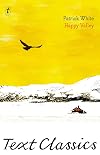
[review from my website, The Patrick White Catalogue]
"Australia. The land of plagues.
Happy Valley is, as many contemporary reviewers noted in 1939, a fascinating first novel. To look back after eighty years at the birth of a luminary novelist is to witness something messy yet styliah, imitative yet innovative, awkward yet accomplished. PW’s influences shine through one every page: Faulkner, Stein, Lawrence, Woolf and, overwhelmingly, James Joyce. Running throughout the book are elaborate show more streams of consciousness as the author attempts to capture the distracted, often illogical flow of human thought. Sentences omit words or finish abruptly; affected young Sidney Furlow occasionally lapses into French as her mind recites the Mallarmé poems of her schooling; at other times characters reject their own knowledge, suppressing thoughts and convincing themselves of fantasies, even as we witness the truth welling up in their mind. Vic Moriarty convinces herself she really is fond of her husband; Oliver Halliday asserts that he will leave his wife; all the while, their subconscious intrudes dangerously into the prose, suggesting a very different reality. PW paints subjectivity, leaving us to wonder at exactly what drives these characters. Does Moriarty snap in the schoolroom because he knows, on some level, that he is being cuckolded in his own home? Does Rodney know about his father’s betrayal unconsciously, even as he remains an innocent on a conscious level?
At the same time, there are numerous moments when PW’s pen gets away from him. The novel’s modernist peak takes place midway through, when Sidney angrily rides her horse home:
Is this Sidney’s mind collecting only the speediest parts of images as she rides, her emotions racing like her body? Is it the horse? It is perhaps the most impenetrable sequence.
The debt to Stein is profound in the repetition of words (“A wilderness of hours lay between lunch and tea. The yard was a wilderness of silence”). But the debt to Joyce is at the heart of the novel, especially its more imitative first half. The first ten chapters take place over a single day, from morning to night, chronicling the interconnecting lives in a single town, ending with a monologue of a person’s consciousness as they fall asleep. It is unashamedly an Australian mini-Ulysses. PW, too, is at pains to link the early chapters through the hawk flying overhead, and his discursive, sometimes didactic, narrator. As the narrator tells us we have to move on, spatially, further down the valley, we are given the sense of an authorial voice less than detached. Mark Williams has likened this voice to “the narrator of a Victorian novel”, someone arch but impartial, helping to direct us toward morals and symbols throughout.
At times, the young PW (who, after all, wrote the first sketchings of this novel when he was just 20), is not always able to convince in his narrator’s tone. The moment where we are told that women who wear mauve are silly is cute, and may conceivably be the thoughts of the characters, Alys Browne, but suggest more a writer trying to be wry or clever and not quite hitting the mark. Chapter 21 is especially notable as an attempt at philosophy which overwhelms the still immature writer; a sequence that cannot be blamed on the biases of a particular character but rather on a narrator letting his story get the better of him. On page 75 of the Text edition, PW begins a chapter with a lovely sentence recalling a feeling we may well have had. The next sentence commences: “Well, Alys Browne was feeling something like that”. Without the “well”, it may have been great, but instead it feels too chatty, too teenage; an inept attempt at lending a gossipy tone to the novel which is inconsistent with the overall nature of the work. (Contrast this with the exquisite opening to chapter 15, in which the narrator describes the rain and then writes a simple sentence: “Oliver Halliday and Alys Browne.” In context, we know already where they are, what they are doing, and how they feel about it. One of the most artful declarative sentences of PW’s career.)
Yet this is to short-change a writer who shows countless signs of a magnificent talent. His characters here resonate, fascinate, occasionally delight with their moments of lived reality. Many of them clearly come from PW’s own life. Rodney Halliday, the young would-be writer, different to the other boys and needing protection from them (perhaps recalling the asthmatic, intellectual young PW). He is there too perhaps in Rodney’s father, Oliver, a would-be poet who could never “find a theme”, and who is torn between Europe and Australia. The young Alys, determined to be different, and the young Oliver “cultivating an expression of intensity in the glass before going in to tea”, are both realistic conceptions of how PW may have felt during his formative years at Cambridge. Mrs Moriarty has big plans to become one of those ladies who reads while having breakfast in bed, and appears often in the “Ladies” page of the Sydney Morning Herald; this seems like a thinly-veiled reference to his own mother, and one wonders indeed how the stuffy-but-aspirational Mrs. Victor White must have felt about her son’s success in print with such an obscene, modernist text! Yet the nuanced character portrayals are not limited to figures from PW’s own existence. He captures in the opening pages the ordinary lives of Australian figures, most notably in Halliday’s frustration with the common folk such as the publican who utter stock phrases or small talk “just another minute, as if they were afraid that this was the last human contact they would make”. Margaret Quong, too, is a gorgeous character, with a neat shading of the impact of long-term emotional abuse and exclusion. (Chapter 31, in which Rodney and Margaret say their last goodbyes, is exceptionally beautifully written.)
The novel also accurately conveys the feelings that many white Australians felt toward Chinese-Australians. A relatively small group by the 1930s, Chinese-Australians had nevertheless been around for a century, coming south during the first Gold Rushes. The “Chows” are figures of fascination for some; disdain for others; yet viewed by PW as simply others aiming for an Australian dream ever out of reach, except for those willing to forgo their ideals in favour of something more limited, more coldly realistic. (This is a recurring theme of PW’s work.)
Another stylistic debt I suspect is Émile Zola. There are several sequences that reflect the mingling of symbolism and naturalism so indicative of that French grand master (whose entire Rougon-Macquart cycle, a work of genius, is now available in fresh translations from Oxford World’s Classics that remove the stale, heavily censored, 20th century English translations that rendered him an underwhelming figure in our language). The sumptuous sequences of the dance at the School of Arts and the race meeting, which bundle the characters together around one core activity. The brief but compelling moment in which PW personifies the building of the School of Arts itself. And the recurring symbol of the cyclamen flower in its lustre bowl, sprawling open in bloom and then gradually wilting, which reflect so powerfully Vic’s awakening, her desire, perhaps the pudendum itself.
As with any first novel, of course, there are intriguing insights into PW’s longer term career. Is Rodney gay? Or simply delicate? Either way he is the first of numerous young men who will not live up to the masculine demands of their society. Dr. Halliday’s despair at being merely “fond” of his wife reflects PW’s early dissatisfaction with the standard, committed, monogamous lives of unassuming heterosexuals. No legitimate couple in the novel (aside from perhaps the Belpers) has any intimacy or sexual connection; meanwhile, desire is sated in illicit love affairs that in themselves can never last. Twice in the novel, PW anticipates his next work, The Living and the Dead. Margaret is likened to a Gothic figure in a niche embodying pleasure and pain (seeming to connect directly to the Helvetius quote which opens the later novel). Later, Halliday realises: “I have been asleep… And I must remain awake, or at least conscious, conscious in one person of the whole”; the very symbol at the heart of the second work.
Is Happy Valley a success? It certainly pales in comparison to any of PW’s nine “mature” novels, simply by virtue of its occasional moments of oversimplification or broadness. Peter Craven, in his 2012 introduction to the novel, notes that although PW desires to write like a modernist, “the narrative impulse wins out” when he ultimately needs to focus things on a meaty murder plot in the final reels. Perhaps we can argue that Sidney Furlow doesn’t entirely convince, or that Clem Hagan’s motivations are driven more often by other characters than himself. Although PW is clearly on the side of the Asian-Australian characters, some of the descriptive passages nevertheless read as problematic to a 21st century mind. These are all minor flaws, however. Happy Valley is an engaging and enlightening read, worthy not just as a part of Australian literary history but as an intelligent novel in its own right. By 1939, there were still very few outright successes at a high-culture level in Australian letters – the peaks of Henry Handel Richardson and Barbara Baynton perhaps; the works of M. Barnard Eldershaw, Eleanor Dark, and Christina Stead – but here was a confident voice with a defiant signature style. Even the reviewers who did not like the novel seem to have acknowledged that PW was one to watch. This prediction would prove a fruitful one. show less
"Australia. The land of plagues.
Happy Valley is, as many contemporary reviewers noted in 1939, a fascinating first novel. To look back after eighty years at the birth of a luminary novelist is to witness something messy yet styliah, imitative yet innovative, awkward yet accomplished. PW’s influences shine through one every page: Faulkner, Stein, Lawrence, Woolf and, overwhelmingly, James Joyce. Running throughout the book are elaborate show more streams of consciousness as the author attempts to capture the distracted, often illogical flow of human thought. Sentences omit words or finish abruptly; affected young Sidney Furlow occasionally lapses into French as her mind recites the Mallarmé poems of her schooling; at other times characters reject their own knowledge, suppressing thoughts and convincing themselves of fantasies, even as we witness the truth welling up in their mind. Vic Moriarty convinces herself she really is fond of her husband; Oliver Halliday asserts that he will leave his wife; all the while, their subconscious intrudes dangerously into the prose, suggesting a very different reality. PW paints subjectivity, leaving us to wonder at exactly what drives these characters. Does Moriarty snap in the schoolroom because he knows, on some level, that he is being cuckolded in his own home? Does Rodney know about his father’s betrayal unconsciously, even as he remains an innocent on a conscious level?
At the same time, there are numerous moments when PW’s pen gets away from him. The novel’s modernist peak takes place midway through, when Sidney angrily rides her horse home:
“The wind is wind is water wind or water white in pockets of the eyes was once a sheep before time froze the plover call alew aloo atingle is the wire that white voice across the plain on thistle thorn the wind pricks face the licked fire the wind flame tossing out distance on a reel."
Is this Sidney’s mind collecting only the speediest parts of images as she rides, her emotions racing like her body? Is it the horse? It is perhaps the most impenetrable sequence.
The debt to Stein is profound in the repetition of words (“A wilderness of hours lay between lunch and tea. The yard was a wilderness of silence”). But the debt to Joyce is at the heart of the novel, especially its more imitative first half. The first ten chapters take place over a single day, from morning to night, chronicling the interconnecting lives in a single town, ending with a monologue of a person’s consciousness as they fall asleep. It is unashamedly an Australian mini-Ulysses. PW, too, is at pains to link the early chapters through the hawk flying overhead, and his discursive, sometimes didactic, narrator. As the narrator tells us we have to move on, spatially, further down the valley, we are given the sense of an authorial voice less than detached. Mark Williams has likened this voice to “the narrator of a Victorian novel”, someone arch but impartial, helping to direct us toward morals and symbols throughout.
At times, the young PW (who, after all, wrote the first sketchings of this novel when he was just 20), is not always able to convince in his narrator’s tone. The moment where we are told that women who wear mauve are silly is cute, and may conceivably be the thoughts of the characters, Alys Browne, but suggest more a writer trying to be wry or clever and not quite hitting the mark. Chapter 21 is especially notable as an attempt at philosophy which overwhelms the still immature writer; a sequence that cannot be blamed on the biases of a particular character but rather on a narrator letting his story get the better of him. On page 75 of the Text edition, PW begins a chapter with a lovely sentence recalling a feeling we may well have had. The next sentence commences: “Well, Alys Browne was feeling something like that”. Without the “well”, it may have been great, but instead it feels too chatty, too teenage; an inept attempt at lending a gossipy tone to the novel which is inconsistent with the overall nature of the work. (Contrast this with the exquisite opening to chapter 15, in which the narrator describes the rain and then writes a simple sentence: “Oliver Halliday and Alys Browne.” In context, we know already where they are, what they are doing, and how they feel about it. One of the most artful declarative sentences of PW’s career.)
Yet this is to short-change a writer who shows countless signs of a magnificent talent. His characters here resonate, fascinate, occasionally delight with their moments of lived reality. Many of them clearly come from PW’s own life. Rodney Halliday, the young would-be writer, different to the other boys and needing protection from them (perhaps recalling the asthmatic, intellectual young PW). He is there too perhaps in Rodney’s father, Oliver, a would-be poet who could never “find a theme”, and who is torn between Europe and Australia. The young Alys, determined to be different, and the young Oliver “cultivating an expression of intensity in the glass before going in to tea”, are both realistic conceptions of how PW may have felt during his formative years at Cambridge. Mrs Moriarty has big plans to become one of those ladies who reads while having breakfast in bed, and appears often in the “Ladies” page of the Sydney Morning Herald; this seems like a thinly-veiled reference to his own mother, and one wonders indeed how the stuffy-but-aspirational Mrs. Victor White must have felt about her son’s success in print with such an obscene, modernist text! Yet the nuanced character portrayals are not limited to figures from PW’s own existence. He captures in the opening pages the ordinary lives of Australian figures, most notably in Halliday’s frustration with the common folk such as the publican who utter stock phrases or small talk “just another minute, as if they were afraid that this was the last human contact they would make”. Margaret Quong, too, is a gorgeous character, with a neat shading of the impact of long-term emotional abuse and exclusion. (Chapter 31, in which Rodney and Margaret say their last goodbyes, is exceptionally beautifully written.)
The novel also accurately conveys the feelings that many white Australians felt toward Chinese-Australians. A relatively small group by the 1930s, Chinese-Australians had nevertheless been around for a century, coming south during the first Gold Rushes. The “Chows” are figures of fascination for some; disdain for others; yet viewed by PW as simply others aiming for an Australian dream ever out of reach, except for those willing to forgo their ideals in favour of something more limited, more coldly realistic. (This is a recurring theme of PW’s work.)
Another stylistic debt I suspect is Émile Zola. There are several sequences that reflect the mingling of symbolism and naturalism so indicative of that French grand master (whose entire Rougon-Macquart cycle, a work of genius, is now available in fresh translations from Oxford World’s Classics that remove the stale, heavily censored, 20th century English translations that rendered him an underwhelming figure in our language). The sumptuous sequences of the dance at the School of Arts and the race meeting, which bundle the characters together around one core activity. The brief but compelling moment in which PW personifies the building of the School of Arts itself. And the recurring symbol of the cyclamen flower in its lustre bowl, sprawling open in bloom and then gradually wilting, which reflect so powerfully Vic’s awakening, her desire, perhaps the pudendum itself.
As with any first novel, of course, there are intriguing insights into PW’s longer term career. Is Rodney gay? Or simply delicate? Either way he is the first of numerous young men who will not live up to the masculine demands of their society. Dr. Halliday’s despair at being merely “fond” of his wife reflects PW’s early dissatisfaction with the standard, committed, monogamous lives of unassuming heterosexuals. No legitimate couple in the novel (aside from perhaps the Belpers) has any intimacy or sexual connection; meanwhile, desire is sated in illicit love affairs that in themselves can never last. Twice in the novel, PW anticipates his next work, The Living and the Dead. Margaret is likened to a Gothic figure in a niche embodying pleasure and pain (seeming to connect directly to the Helvetius quote which opens the later novel). Later, Halliday realises: “I have been asleep… And I must remain awake, or at least conscious, conscious in one person of the whole”; the very symbol at the heart of the second work.
Is Happy Valley a success? It certainly pales in comparison to any of PW’s nine “mature” novels, simply by virtue of its occasional moments of oversimplification or broadness. Peter Craven, in his 2012 introduction to the novel, notes that although PW desires to write like a modernist, “the narrative impulse wins out” when he ultimately needs to focus things on a meaty murder plot in the final reels. Perhaps we can argue that Sidney Furlow doesn’t entirely convince, or that Clem Hagan’s motivations are driven more often by other characters than himself. Although PW is clearly on the side of the Asian-Australian characters, some of the descriptive passages nevertheless read as problematic to a 21st century mind. These are all minor flaws, however. Happy Valley is an engaging and enlightening read, worthy not just as a part of Australian literary history but as an intelligent novel in its own right. By 1939, there were still very few outright successes at a high-culture level in Australian letters – the peaks of Henry Handel Richardson and Barbara Baynton perhaps; the works of M. Barnard Eldershaw, Eleanor Dark, and Christina Stead – but here was a confident voice with a defiant signature style. Even the reviewers who did not like the novel seem to have acknowledged that PW was one to watch. This prediction would prove a fruitful one. show less
Lists
5 Best 5 Years (1)
A Novel Cure (1)
Nifty Fifties (1)
Take Four Books (1)
Women's Stories (1)
Five star books (2)
1950s (2)
Favourite Books (2)
Classics (2)
Allie's Wishlist (1)
Booker Prize (1)
Reading Globally (1)
1970 Club (1)
Awards


You May Also Like


Associated Authors
Statistics
- Works
- 42
- Also by
- 10
- Members
- 7,816
- Popularity
- #3,114
- Rating
- 3.9
- Reviews
- 172
- ISBNs
- 368
- Languages
- 19
- Favorited
- 30
