
Antonio Muñoz Molina
Author of Sepharad
About the Author
Antonio Munoz Molina was director of the Cervantes Institute from 2004 to 2006.
Disambiguation Notice:
(spa) No confundir con Antonio Muñoz Molina, nacido en Granada en 1945 y autor de "Las mañanas lucían" http://www.ideal.es/granada/v/20100610/cultura/munoz-molina-publica-mananas-20100610.html
Image credit: Antonio Muñoz Molina at the Madrid Book Fair 2025 on May 31, 2025 in Madrid, Spain
Series
Works by Antonio Muñoz Molina
Munoz Molina Antonio 1 copy
Lugares míticos de Jaén 2 : un paseo por deciséis lugares imprescindibles para conocer la provincia 1 copy
Jaén Monumental 1 copy
Extraños en la noche 1 copy
Un libro imposible 2002 1 copy
El ladrón de libros 1 copy
Relatos 1 copy
Beatus Ille. Novela. 1 copy
Associated Works
A Thousand Forests in One Acorn: An Anthology of Spanish-Language Fiction (2014) — Contributor — 53 copies
The Origins of Desire: Modern Spanish Short Stories (Modern European Short Stories) (1993) — Contributor — 14 copies
Tagged
Common Knowledge
- Legal name
- Muñoz Molina, Antonio
- Birthdate
- 1956-01-10
- Gender
- male
- Education
- University of Granada
- Occupations
- novelist
- Organizations
- Real Academia Española
- Relationships
- Lindo, Elvira (wife)
- Nationality
- Spain
- Birthplace
- Úbeda, Jaén, Spain
- Places of residence
- Úbeda, Jaén, Spain
New York, New York, USA - Map Location
- Spain
- Disambiguation notice
- No confundir con Antonio Muñoz Molina, nacido en Granada en 1945 y autor de "Las mañanas lucían"
http://www.ideal.es/granada/v/2010061...
Members
Reviews
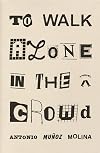
One Sentence Summary: A nameless man wanders Madrid and New York City, collecting experiences and telling stories of writers and artists from bygone eras.
Overall
To Walk Alone in the Crowd drops the reader into the mind of a nameless man wandering Madrid and New York City. We’re caught up in his thoughts, ruminations, and all the things he hears and sees. But he’s on a mission to record everything around him, to drink in all life has to offer when people these days are so focused on show more screens and their own lives. The wanderer rambles on about other, late wanderers within the literary world while also rambling around large cities. It’s a nice literary fiction read, but made me a bit angry as a female reader. Still, it’s a unique story, kind of feeling like a one-of-a-kind sort of thing, though I don’t read literary fiction often, so I couldn’t really say for sure.
Extended Thoughts
Follow a nameless man around the large cities of Madrid and New York City. From the beginning, he sets out to pay attention to everything happening around him, from the signs he reads to the sound of his recorded footsteps. It almost feels like he’s trying to rediscover himself or the city he finds himself in, or both. Every paragraph is headed by something that made me think it was pulled from the headlines or from a magazine, bits and pieces that make no sense on their own and don’t have any real relation to the content of the paragraph it heads. It’s an almost dizzying mass of a man trying to take in the world, seeing everything and reading everything, and then having it all be spit back at us.
To Walk Alone in the Crowd presents an interesting clash of new and old. Clearly written in the modern age as the wanderer uses smartphones and references other modern inventions, includes a few mentions of Trump seemingly running for president, and definitely mentions it’s 2016, there’s a huge focus on artists and writers from decades and centuries previous. He often feels a little obsessed with them and their own wanderings, telling their stories, particularly that of Walter Benjamin, with a great deal of what seems like reverence, though I still have no clue what Benjamin wrote. There’s such a focus on these other writers and artists that it seems he’s trying to emulate them, but the reader never really knows who he is or what he does. The whole story comes off more as a commentary of modern life than about the nameless person whose head we are in.
I did like the focus on opening one’s eyes and seeing and hearing everything going on around one, of being fully present in the here and now, of taking in life as it happens. It seems, more and more, people are so tied up in devices and staring at screens that it’s refreshing to see someone experiencing what life is really about. The noise and cacophony of daily, modern life is documented in lists and each paragraph is headed by what appears to be a newspaper headline or bits and pieces pulled from a magazine. There are mentions of current news stories woven throughout, stories that might make the front page or be glossed over and forgotten by the end of the day. The wanderer feels fully present in life, taking note of everything people often miss these days due to more interest in what devices have to offer. It was refreshing and fascinating to read about all the life happening every moment around everyone.
Yet To Walk Alone in the Crowd also feels incredibly misogynistic. The lives of men are detailed over and over. The wanderer returns to their stories repeatedly. Their careers and their own itinerant behavior are documented over and over. Their personal stories are told with a great deal of care and detail and what feels like genuine understanding and reverence from the wanderer. I now know more about men like Edgar Allen Poe and others I’ve never heard of before. Yet the women are sexualized. The man has a wife, but I don’t know anything about her other than she’s beautiful, has lots of sex with him, and seems to absolutely adore him even though they don’t spend much time out of bed together and he travels away from her frequently. Often, she felt forgotten or more like a lover. Even when he was going home at the end of the day, there was no mention of her at all. Then there are whole paragraphs devoted to prostitutes. The wanderer goes to great lengths to describe their sensual and sexual natures, the way they look, the way they position themselves invitingly, the things they have to offer to patrons. Most disturbing of all is how they are usually described as exotic, youthful, as though their only pursuit in life is to make their patrons very happy.
I must admit there is a lovely lyrical quality to the writing, though. It’s beautiful to read, as long as you don’t pay too much attention to some of the words. I loved that it drops the reader into daily life and opens their eyes to what they’re missing, but the smaller subject matters bothered me and I seriously debated on abandoning this book. On one hand, I appreciated what this book is trying to do. On the other, as a female reader, it made me angry. Or maybe literary fiction is just not for me.
To Walk Alone in the Crowd can be applauded for the invitation it offers to readers to step away from a screen and into actual, real life. It shows the cacophony that thrives around us every day and offers insights and ruminations on some great (male) artists. But it definitely wasn’t my cup of tea as a female reader, so it missed the mark a bit for me.
Thank you to NetGalley and the publisher for a review copy. All opinions expressed are my own. show less
Overall
To Walk Alone in the Crowd drops the reader into the mind of a nameless man wandering Madrid and New York City. We’re caught up in his thoughts, ruminations, and all the things he hears and sees. But he’s on a mission to record everything around him, to drink in all life has to offer when people these days are so focused on show more screens and their own lives. The wanderer rambles on about other, late wanderers within the literary world while also rambling around large cities. It’s a nice literary fiction read, but made me a bit angry as a female reader. Still, it’s a unique story, kind of feeling like a one-of-a-kind sort of thing, though I don’t read literary fiction often, so I couldn’t really say for sure.
Extended Thoughts
Follow a nameless man around the large cities of Madrid and New York City. From the beginning, he sets out to pay attention to everything happening around him, from the signs he reads to the sound of his recorded footsteps. It almost feels like he’s trying to rediscover himself or the city he finds himself in, or both. Every paragraph is headed by something that made me think it was pulled from the headlines or from a magazine, bits and pieces that make no sense on their own and don’t have any real relation to the content of the paragraph it heads. It’s an almost dizzying mass of a man trying to take in the world, seeing everything and reading everything, and then having it all be spit back at us.
To Walk Alone in the Crowd presents an interesting clash of new and old. Clearly written in the modern age as the wanderer uses smartphones and references other modern inventions, includes a few mentions of Trump seemingly running for president, and definitely mentions it’s 2016, there’s a huge focus on artists and writers from decades and centuries previous. He often feels a little obsessed with them and their own wanderings, telling their stories, particularly that of Walter Benjamin, with a great deal of what seems like reverence, though I still have no clue what Benjamin wrote. There’s such a focus on these other writers and artists that it seems he’s trying to emulate them, but the reader never really knows who he is or what he does. The whole story comes off more as a commentary of modern life than about the nameless person whose head we are in.
I did like the focus on opening one’s eyes and seeing and hearing everything going on around one, of being fully present in the here and now, of taking in life as it happens. It seems, more and more, people are so tied up in devices and staring at screens that it’s refreshing to see someone experiencing what life is really about. The noise and cacophony of daily, modern life is documented in lists and each paragraph is headed by what appears to be a newspaper headline or bits and pieces pulled from a magazine. There are mentions of current news stories woven throughout, stories that might make the front page or be glossed over and forgotten by the end of the day. The wanderer feels fully present in life, taking note of everything people often miss these days due to more interest in what devices have to offer. It was refreshing and fascinating to read about all the life happening every moment around everyone.
Yet To Walk Alone in the Crowd also feels incredibly misogynistic. The lives of men are detailed over and over. The wanderer returns to their stories repeatedly. Their careers and their own itinerant behavior are documented over and over. Their personal stories are told with a great deal of care and detail and what feels like genuine understanding and reverence from the wanderer. I now know more about men like Edgar Allen Poe and others I’ve never heard of before. Yet the women are sexualized. The man has a wife, but I don’t know anything about her other than she’s beautiful, has lots of sex with him, and seems to absolutely adore him even though they don’t spend much time out of bed together and he travels away from her frequently. Often, she felt forgotten or more like a lover. Even when he was going home at the end of the day, there was no mention of her at all. Then there are whole paragraphs devoted to prostitutes. The wanderer goes to great lengths to describe their sensual and sexual natures, the way they look, the way they position themselves invitingly, the things they have to offer to patrons. Most disturbing of all is how they are usually described as exotic, youthful, as though their only pursuit in life is to make their patrons very happy.
I must admit there is a lovely lyrical quality to the writing, though. It’s beautiful to read, as long as you don’t pay too much attention to some of the words. I loved that it drops the reader into daily life and opens their eyes to what they’re missing, but the smaller subject matters bothered me and I seriously debated on abandoning this book. On one hand, I appreciated what this book is trying to do. On the other, as a female reader, it made me angry. Or maybe literary fiction is just not for me.
To Walk Alone in the Crowd can be applauded for the invitation it offers to readers to step away from a screen and into actual, real life. It shows the cacophony that thrives around us every day and offers insights and ruminations on some great (male) artists. But it definitely wasn’t my cup of tea as a female reader, so it missed the mark a bit for me.
Thank you to NetGalley and the publisher for a review copy. All opinions expressed are my own. show less

In the dour Madrid of the 1950s, students Adriana and Gabriel become close friends and lovers. But when Gabriel goes off to California in 1967 to embark on a demanding new career in international finance, they lose touch and both marry other people. It’s not until forty-seven years later that they meet again, in the same room where they said goodbye.
Muñoz Molina turns this reunion of old lovers into the literary equivalent of a Bach cello suite, full of virtuoso formal structures (not show more least an opening sentence that goes on for over seventy pages), circling repetitions and complicated counterpoint. Gabriel, Adriana and the hapless narrator, Professor Máiquez, all have their own conflicting versions of what has gone on in the relationship over those forty-seven years. Through them we dig into the way a “lost love” can turn into an exercise in selfishness and self-indulgence, but also into the subtle ways our lives can be marked by history and geography, specifically by the nature of Spain during and after the Franco era and by the contrast between Europe and North America.
Although it’s a surprisingly short book, this feels like something intended as a major piece of literature. Thomas Bernhard’s name is dropped noisily in the jacket blurb, but it also feels a little bit as though Muñoz Molina is bagsying the place left vacant by Javier Marías. Irrespective of that, it is an enjoyable read and an intriguing twist on an old theme. show less
Muñoz Molina turns this reunion of old lovers into the literary equivalent of a Bach cello suite, full of virtuoso formal structures (not show more least an opening sentence that goes on for over seventy pages), circling repetitions and complicated counterpoint. Gabriel, Adriana and the hapless narrator, Professor Máiquez, all have their own conflicting versions of what has gone on in the relationship over those forty-seven years. Through them we dig into the way a “lost love” can turn into an exercise in selfishness and self-indulgence, but also into the subtle ways our lives can be marked by history and geography, specifically by the nature of Spain during and after the Franco era and by the contrast between Europe and North America.
Although it’s a surprisingly short book, this feels like something intended as a major piece of literature. Thomas Bernhard’s name is dropped noisily in the jacket blurb, but it also feels a little bit as though Muñoz Molina is bagsying the place left vacant by Javier Marías. Irrespective of that, it is an enjoyable read and an intriguing twist on an old theme. show less

It's the hot summer of 1969, and our 12-year-old narrator is following the progress of the Apollo XI moon mission from his home in the small town of Mágina in southern Spain (this fictional version of the author's birthplace, Úbeda, appears in several of his other books). He puts himself imaginatively into the minds of the astronauts — their isolation and the unknown dangers they face reflect in unexpected ways on his situation as an adolescent. But the high-tech world of spaceflight show more also seems bizarrely out of step with the backward semi-rural life he knows, where the family still gets its water in buckets from the well and uses a mule and a donkey for transport.
Big changes are happening for the narrator. He feels like a stranger in his own body, struggling to cope with the mental and physical changes of adolescence (and the constant masturbation-guilt). But he's also the first person in his family of peasants and market-gardeners to go to secondary school, and no-one at home can quite make sense of his passion for books; he no longer sees anything of his primary-school friends, who are all now doing apprenticeships or working in the fields, but at the Salesian school he's with bourgeois boys who can't relate to his peasant background and the way he has to work in the holidays.
The world in 1969 is in an exciting state of flux too: spaceflight above all, but there are also things like television, running water, tourists in short skirts and sunglasses, gas cookers, telephones, Faye Dunaway in Bonnie and Clyde, refrigerators, aeroplanes towing advertisements for products no-one he knows would have any idea what to do with... His reading is racing ahead of his Catholic teachers, too: he is aware of the narrow-mindedness of the maths-teaching headmaster, who likes to use Darwin, Nietzsche and Galileo as examples of thinkers punished by God for their presumptuousness, and is beginning to see through the charismatic young Father Peter — keen on the dignity of physical labour, although he's never actually done any — who sees the narrator as vocation material and keeps trying to persuade him to read Teilhard de Chardin.
Underlying all this, there's another, largely suppressed layer, with the people of Mágina still working through the consequences of things that happened thirty years ago in the Civil War. A prosperous neighbour is dying of cancer, which the narrator's grandfather (who had been a policeman under the Republic) sees as a very inadequate punishment for the way he cheated them of their savings at the end of the war; another neighbour is found hanged in his house — it's treated officially as suicide, but everyone in the street thinks it must have been delayed revenge.
Obviously, either the young Muñoz Molina was very precocious, or his adult self has been guilty of a little time-compression for dramatic purposes, but it's easy to suspend disbelief and engage with his vivid descriptions of the world of his childhood. A lot of it felt very like what I remember from that time, the excitement of all those acronym-filled technical diagrams of the Saturn V and the Apollo capsule to cut out and keep from magazines, the conviction that the world would never be the same as it was for our parents (different war, same principle), the realisation that our dim teachers had been fobbing us off with religious nonsense, the knowledge that space was quite different and actually much more interesting in reality than it was in H.G. Wells and Jules Verne, and so on. All those things you see so clearly in your early teens, which have a way of becoming nuanced and difficult later on... show less
Big changes are happening for the narrator. He feels like a stranger in his own body, struggling to cope with the mental and physical changes of adolescence (and the constant masturbation-guilt). But he's also the first person in his family of peasants and market-gardeners to go to secondary school, and no-one at home can quite make sense of his passion for books; he no longer sees anything of his primary-school friends, who are all now doing apprenticeships or working in the fields, but at the Salesian school he's with bourgeois boys who can't relate to his peasant background and the way he has to work in the holidays.
The world in 1969 is in an exciting state of flux too: spaceflight above all, but there are also things like television, running water, tourists in short skirts and sunglasses, gas cookers, telephones, Faye Dunaway in Bonnie and Clyde, refrigerators, aeroplanes towing advertisements for products no-one he knows would have any idea what to do with... His reading is racing ahead of his Catholic teachers, too: he is aware of the narrow-mindedness of the maths-teaching headmaster, who likes to use Darwin, Nietzsche and Galileo as examples of thinkers punished by God for their presumptuousness, and is beginning to see through the charismatic young Father Peter — keen on the dignity of physical labour, although he's never actually done any — who sees the narrator as vocation material and keeps trying to persuade him to read Teilhard de Chardin.
Underlying all this, there's another, largely suppressed layer, with the people of Mágina still working through the consequences of things that happened thirty years ago in the Civil War. A prosperous neighbour is dying of cancer, which the narrator's grandfather (who had been a policeman under the Republic) sees as a very inadequate punishment for the way he cheated them of their savings at the end of the war; another neighbour is found hanged in his house — it's treated officially as suicide, but everyone in the street thinks it must have been delayed revenge.
Obviously, either the young Muñoz Molina was very precocious, or his adult self has been guilty of a little time-compression for dramatic purposes, but it's easy to suspend disbelief and engage with his vivid descriptions of the world of his childhood. A lot of it felt very like what I remember from that time, the excitement of all those acronym-filled technical diagrams of the Saturn V and the Apollo capsule to cut out and keep from magazines, the conviction that the world would never be the same as it was for our parents (different war, same principle), the realisation that our dim teachers had been fobbing us off with religious nonsense, the knowledge that space was quite different and actually much more interesting in reality than it was in H.G. Wells and Jules Verne, and so on. All those things you see so clearly in your early teens, which have a way of becoming nuanced and difficult later on... show less

This is an unusual book in form: not only is it a novel that mixes non-fiction with fiction (something that a lot of books I've read recently do), but it also muddies the distinction between the novel and short fiction, in that its seventeen chapters can all be read as individual stories, testimonies or essays, and it is only when you read them all together that you start to see that there is also an underlying deep structure that links them together into a single work. And as if that wasn't show more enough, Muñoz Molina uses the disconcerting narrative trick of jumping unpredictably backwards and forwards within each chapter between a third person omniscient narrator, the first-person view of the "writer" character, the first-person view of someone who is telling him a story, and sometimes a second-person view of the person who is telling that person a story. But it all seems to work very well, once you get inside the book.
The many different stories Muñoz Molina brings together the book all dig into different aspects of exile or alienation - Spanish and German communists in Russia during the second world war, the narrator and his compatriots who are economic migrants from southern Spain to Madrid, Jews who found themselves suddenly declared undesirable aliens in their own countries under the Nazis, Kafka going secretly to the frontier to meet his lover Milena Jesenska, and Milena's death in the Ravensbrück concentration camp 25 years later. And much more, all tied in together by the underlying image of the expulsion of the Jews from Spain in 1492.
The subject-matter is often difficult and painful, but it's a pleasure to follow the rhythms of Muñoz Molina's writing and the understated way he navigates through it all without hitting us over the head with unnecessary explanations. But be warned: it's a book that comes with a heavy reading list you will almost certainly want to follow up yourself. Quite apart from the cunning way he ends the book with a huge advertisement for the museum of the Hispanic Society of America in New York (but it turns out that they are currently closed for renovations, so check before booking your flight...). show less
The many different stories Muñoz Molina brings together the book all dig into different aspects of exile or alienation - Spanish and German communists in Russia during the second world war, the narrator and his compatriots who are economic migrants from southern Spain to Madrid, Jews who found themselves suddenly declared undesirable aliens in their own countries under the Nazis, Kafka going secretly to the frontier to meet his lover Milena Jesenska, and Milena's death in the Ravensbrück concentration camp 25 years later. And much more, all tied in together by the underlying image of the expulsion of the Jews from Spain in 1492.
The subject-matter is often difficult and painful, but it's a pleasure to follow the rhythms of Muñoz Molina's writing and the understated way he navigates through it all without hitting us over the head with unnecessary explanations. But be warned: it's a book that comes with a heavy reading list you will almost certainly want to follow up yourself. Quite apart from the cunning way he ends the book with a huge advertisement for the museum of the Hispanic Society of America in New York (but it turns out that they are currently closed for renovations, so check before booking your flight...). show less
Lists
To Read (1)
Awards


You May Also Like


Associated Authors
Statistics
- Works
- 59
- Also by
- 5
- Members
- 5,157
- Popularity
- #4,824
- Rating
- 3.7
- Reviews
- 169
- ISBNs
- 446
- Languages
- 17
- Favorited
- 10
