
Félix Guattari (1930–1992)
Author of Anti-Oedipus: Capitalism and Schizophrenia
About the Author
Image credit: Semiotext(e)
Works by Félix Guattari
La philosophie est essentielle à l'existence humaine. : Entretien avec Antoine Spire (2003) 6 copies
Psychotherapie, Politik und die Aufgaben der institutionellen Analyse (edition suhrkamp, 768) (1976) 3 copies
Yayoi Kusama 1 copy
Escritos para el anti-edipo 1 copy
Trzy ekologie 1 copy
Kapitalizm ve şizofreni 2 1 copy
Gli arabi e noi 1 copy
Kapitalizm ve şizofreni 1 1 copy
La repressione in Italia 1 copy
Kafka Machine 1 copy
Associated Works
Tagged
Common Knowledge
- Canonical name
- Guattari, Félix
- Legal name
- Guattari, Pierre-Félix
- Birthdate
- 1930-04-30
- Date of death
- 1992-08-29
- Gender
- male
- Education
- University of Paris
- Occupations
- psychoanalyst
semiotician - Organizations
- La Borde
University of Paris VIII - Cause of death
- heart attack
- Nationality
- France
- Birthplace
- Villeneuve-les-Sablons, France
- Place of death
- Cour-Cheverny, France
- Associated Place (for map)
- France
Members
Reviews
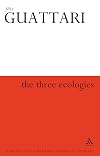
Life is an ‘aesthetico-existential process’. Among the many arguments stringed to the thread of human ecology, it is perhaps this that Guattari would kindly nod to the most. In ‘The Three Ecologies’, it is the artists who are considered to provide the most profound insights into the human condition:
“ … that poetic utterances can anticipate scientific advances by decades”.
As a conceptual construct our life is a work in progress … to learn to develop or respond to the chance show more events and the singularized points that take us in a new direction; or let us recognize a situation as a potential ‘new’ direction.
Ecosophy as an idea is illuminating in the sense that 'involves', it allows to dissolve the various forms of mental attitudes we develop. The philosophy of ecology, of human environment within the natural world, which we are mainly a 'part' of and not owners or bearers.
In light of the model of ‘Ecosophy’, Guattari stresses the generation of these singular events that mark one’s ‘mental ecosophy’, as well as their regeneration for subsequent resingularization of such moments, most importantly, to combat what is depicted as “fatalistic passivity”.
This sort of ‘idle’ passivity which results from the mass media’s “infantilization of opinion” is what freezes whatever discourse our ‘social ecosophy’ is engaged in, and thus emanates an atmosphere of a mass-passivity which endangers our already fragile ‘environmental ecosophy’.
As a document of cultural theory, ‘The Three Ecologies’ is an interestingly relevant read for our times. Guattari proposes what he terms as a ‘heterogenesis’ -- a ‘process of continuous singularization’ of subjectivity.
The poetic utterance and a simultaneous discursivity attached to its innumerable ambiguous chain of signification allows us to reject reductionist dominant interpretations of the individual, the society and the natural ecosystem. And the relevance of individual as well as collective participation of human beings in questioning the homogenization of a mass-discourse is restored. show less
“ … that poetic utterances can anticipate scientific advances by decades”.
As a conceptual construct our life is a work in progress … to learn to develop or respond to the chance show more events and the singularized points that take us in a new direction; or let us recognize a situation as a potential ‘new’ direction.
Ecosophy as an idea is illuminating in the sense that 'involves', it allows to dissolve the various forms of mental attitudes we develop. The philosophy of ecology, of human environment within the natural world, which we are mainly a 'part' of and not owners or bearers.
In light of the model of ‘Ecosophy’, Guattari stresses the generation of these singular events that mark one’s ‘mental ecosophy’, as well as their regeneration for subsequent resingularization of such moments, most importantly, to combat what is depicted as “fatalistic passivity”.
This sort of ‘idle’ passivity which results from the mass media’s “infantilization of opinion” is what freezes whatever discourse our ‘social ecosophy’ is engaged in, and thus emanates an atmosphere of a mass-passivity which endangers our already fragile ‘environmental ecosophy’.
As a document of cultural theory, ‘The Three Ecologies’ is an interestingly relevant read for our times. Guattari proposes what he terms as a ‘heterogenesis’ -- a ‘process of continuous singularization’ of subjectivity.
The poetic utterance and a simultaneous discursivity attached to its innumerable ambiguous chain of signification allows us to reject reductionist dominant interpretations of the individual, the society and the natural ecosystem. And the relevance of individual as well as collective participation of human beings in questioning the homogenization of a mass-discourse is restored. show less
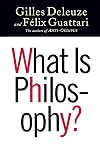
An acid trip that has you straddling thought through its junctions of philosophy, art, and science. Even though I read the English translation, Deleuze's prose shines through and profoundly carries you through the chaos of being and existence.
One small pointer: this is not an intro to philosophy. I definitely recommend reading widely on philosophy, preferably even wider than philosophy as Deleuze constantly refers to significant figures from the above three disciplines.
Easily one of the show more most thought-provoking and creative pieces of philosophy I've ever read. I particularly enjoyed Deleuze's vivid use of artists', philosophers', and scientists' works to drive home his points. One minute you're looking at the deeply theoretical through Hume and Einstein, the next you're looking at the art of sensation through Kafka and Joyce. I'll certainly be returning to this work throughout my life. show less
One small pointer: this is not an intro to philosophy. I definitely recommend reading widely on philosophy, preferably even wider than philosophy as Deleuze constantly refers to significant figures from the above three disciplines.
Easily one of the show more most thought-provoking and creative pieces of philosophy I've ever read. I particularly enjoyed Deleuze's vivid use of artists', philosophers', and scientists' works to drive home his points. One minute you're looking at the deeply theoretical through Hume and Einstein, the next you're looking at the art of sensation through Kafka and Joyce. I'll certainly be returning to this work throughout my life. show less
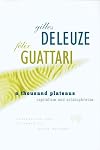
How does one read this book, and why? Hopefully not from beginning to end, and hopefully not expecting to find many easily digestible passages, let alone meaty, neatly wrapped takeaways.
This book is very much post 1968 (for Deleuze, the great Paris student revolt). It's politics are anti-authoritarian, acting itself out with irony, irreverence, and a heightened continental-styled intellectual obfuscation. Straight language and discourse were to be tossed out with a corrupt old guard that show more deliciously, for Deleuze, included many of his own professors. The style combines the exuberance of revolt and the vindictiveness of rebellion, exuberance in the energy of the language and vindictiveness in its opacity. It's rare to find a sentence that makes immediate sense or a pair of sentences with easy logical continuity between them.
Guattari, the team's other half, was a psychoanalyst, and you see that vector in the quirky obscure images and symbols that appear to have popped out of dreams to ride the monotonous rhythm of these sentences, one after the other for what feels like forever, soothed in the cozy confidence that the analyst in the corner, one of the good guys, never censures or censors. There will be a solidarity and classless parity in the parading of these repeating words, images, and ideas, each little one a citoyen of a new in-world that has pushed the old one decisively out.
So why give five stars to something whose language I mostly couldn't understand? Probably to honor its uniqueness; there's nothing quite like it. But more likely, for its musicality. It offers music of a kind I'll come back to; in small doses, one little plateau at a time. It will be a kind of music I can get nowhere else. It will refresh me. My fellow-traveling psychiatrist in the corner will look on avuncularly as I declaim (or Deleuze does for me) anything that suddenly and urgently demands to break free. It will be spring. I will be young. Masses will cheer as budding trees fall to the buzz of buzz saws to become our barricades. I will let my world die, knowing that it has already been reborn.
Then I'll wake up, smile, and say what a good little nap that was -- and be so, so glad the trees weren't really sawn down. show less
This book is very much post 1968 (for Deleuze, the great Paris student revolt). It's politics are anti-authoritarian, acting itself out with irony, irreverence, and a heightened continental-styled intellectual obfuscation. Straight language and discourse were to be tossed out with a corrupt old guard that show more deliciously, for Deleuze, included many of his own professors. The style combines the exuberance of revolt and the vindictiveness of rebellion, exuberance in the energy of the language and vindictiveness in its opacity. It's rare to find a sentence that makes immediate sense or a pair of sentences with easy logical continuity between them.
Guattari, the team's other half, was a psychoanalyst, and you see that vector in the quirky obscure images and symbols that appear to have popped out of dreams to ride the monotonous rhythm of these sentences, one after the other for what feels like forever, soothed in the cozy confidence that the analyst in the corner, one of the good guys, never censures or censors. There will be a solidarity and classless parity in the parading of these repeating words, images, and ideas, each little one a citoyen of a new in-world that has pushed the old one decisively out.
So why give five stars to something whose language I mostly couldn't understand? Probably to honor its uniqueness; there's nothing quite like it. But more likely, for its musicality. It offers music of a kind I'll come back to; in small doses, one little plateau at a time. It will be a kind of music I can get nowhere else. It will refresh me. My fellow-traveling psychiatrist in the corner will look on avuncularly as I declaim (or Deleuze does for me) anything that suddenly and urgently demands to break free. It will be spring. I will be young. Masses will cheer as budding trees fall to the buzz of buzz saws to become our barricades. I will let my world die, knowing that it has already been reborn.
Then I'll wake up, smile, and say what a good little nap that was -- and be so, so glad the trees weren't really sawn down. show less
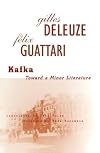
D&G say, hey you creeps, HERE is what kafka is good for. chuck out your hack interpretations of the man and get beyond the psycho-babble. From out of the laughter of the abyss Kafka's work is a rejection of complacency and failure; he was making way for a new way to see the world...
i like these guys
A LOT.
i like these guys
A LOT.
Lists
You May Also Like


Associated Authors
Statistics
- Works
- 83
- Also by
- 4
- Members
- 8,267
- Popularity
- #2,923
- Rating
- 4.0
- Reviews
- 62
- ISBNs
- 259
- Languages
- 22
- Favorited
- 3